
A battlecard filled from a rival’s website looks the same in every industry. It carries the rival’s tagline, its pricing tiers, a feature it lacks and a complaint borrowed from a review site. Every line is true, and a buyer could have read all of them before the first call.
The lines that win a competitive deal come from a place no buyer can browse. They are the price the rival’s rep quoted, what its product did when someone asked to see it work, and what its rep said about you. All three come out only in the rival’s own sales process: said on its calls, or written into the proposal that follows.
Mystery Demo brings those lines back. It books your competitors’ sales demos as a genuine buyer, records every call, and hands you a board where each finding carries the minute it was said.
A good battlecard is cut from that board. Here are three example cards cut that way, each for a different moment in a deal and a different industry:
Each card is marked for which lines desk research could fill and which needed the rival’s sales process. That split starts with the sources themselves.
Where Each Source of Battlecard Lines Runs Out
Most of a card can be filled from a desk, and it should be. Each desk source is good at one kind of line, and each one stops before the lines a rival only says to buyers.
Here is what each source can give a card, compared by the kind of evidence it holds:
| Source | What it gives a card | What it can’t see | Cost and time |
|---|---|---|---|
| The rival’s website and pricing page | The pitch it wants believed, its list prices, the features it documents | The price a rep quotes, and what works on screen | Free; an afternoon |
| Review sites | How customers felt after buying | What the rep said before the contract | Free; an afternoon |
| Win-loss interviews | Why your buyer chose, in the buyer’s words | The rival’s own words, which reach you secondhand | Your team’s time; weeks |
| Your own call recordings | What buyers repeat to your reps about a rival | What the rival said to that buyer | Already paid for; ongoing |
| CI software | Every public change, caught the day it happens | Anything said only on a call | A yearly subscription; always on |
| Taking the rival’s demo yourself | A real call, if the rep doesn’t know you | Whatever the rep holds back once your email domain gives you away | A working week per rival |
| Mystery Demo | What the rival’s rep says, shows and quotes to a buyer, recorded to the minute | How customers feel a year after buying, and public changes between projects | €499 per competitor; one to two weeks |
Every desk row earns its place. The website and review sites are the right source for anything the rival publishes, as long as each line carries the date it was read, because a rival can change a page overnight.
Win-loss interviews tell you why your buyer chose, and nothing beats them for that question. They hear the rival only through the buyer’s memory. The rival’s own pitch has to come from somewhere else, which is why a win-loss record needs a separate field for it.
CI software keeps the public half of a card current, and a finished card can live inside it. It can’t fill a row nobody heard, and that row is where battlecard platforms and mystery shopping part ways.
Taking the rival’s demo yourself is as close as a desk gets. Yes, your team could book it, but the rep sees your company’s email domain, looks you up in a minute, and gives you the generic tour.
Every desk source in the table stops short of the rival’s own sales call, and taking the demo yourself reaches it as a buyer the rep can look up. The call needs a buyer the rep has no reason to doubt, and your own team can’t be that buyer.
How Mystery Demo Gets a Credible Buyer Onto a Rival’s Calls
A project starts from the blank rows on your card. At kickoff, each one becomes a question the calls have to answer, such as what a rival quotes a buyer your size, or what its rep says once your name comes up.
Then Mystery Demo writes the fábula, the buying scenario each rival’s sales team will meet. It is fitted to that rival’s ideal customer, down to the team size, the current stack and the deadline, so the rep runs the call they run for real prospects.
The evaluation is genuine: the team does evaluate software on your behalf, and nobody real is impersonated. The invented part is the client in the scenario, the company the team says it is buying for.
Here is the fábula page from Mystery Demo’s public example board, where the client and every competitor are invented. A real project’s board is built from its own client’s calls.
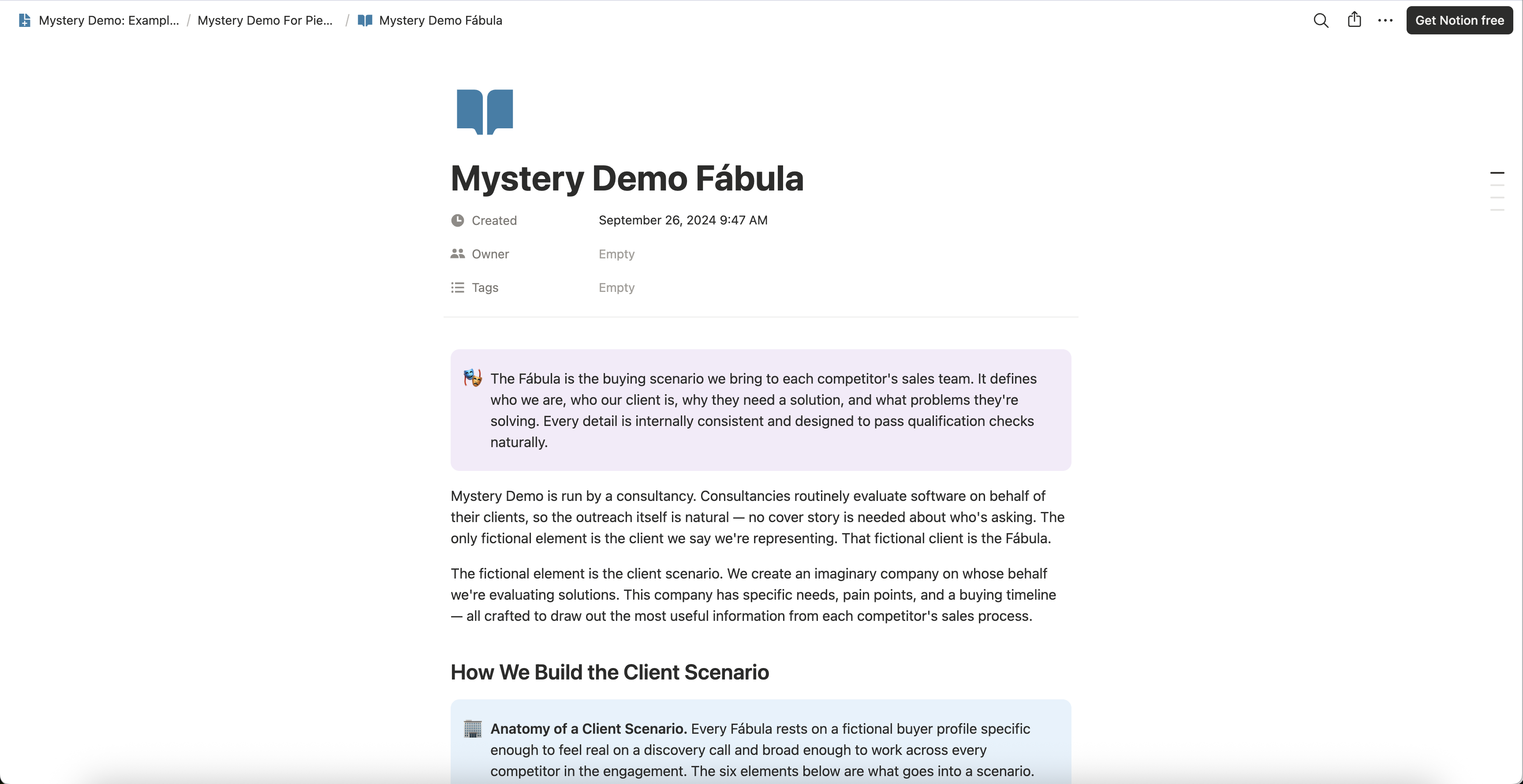
Read the purple callout first: every detail of the scenario is built to hold up under a rep’s qualifying questions. The paragraphs under it name the one invented element: the client being represented. Below them, the page starts laying out how that client scenario is built.
The calls then run the way a serious evaluation does:
Each rival then gets its own page on the board. Its expert analysis opens by naming what it rests on: the meetings, the minutes of recording and the documents behind the insights.
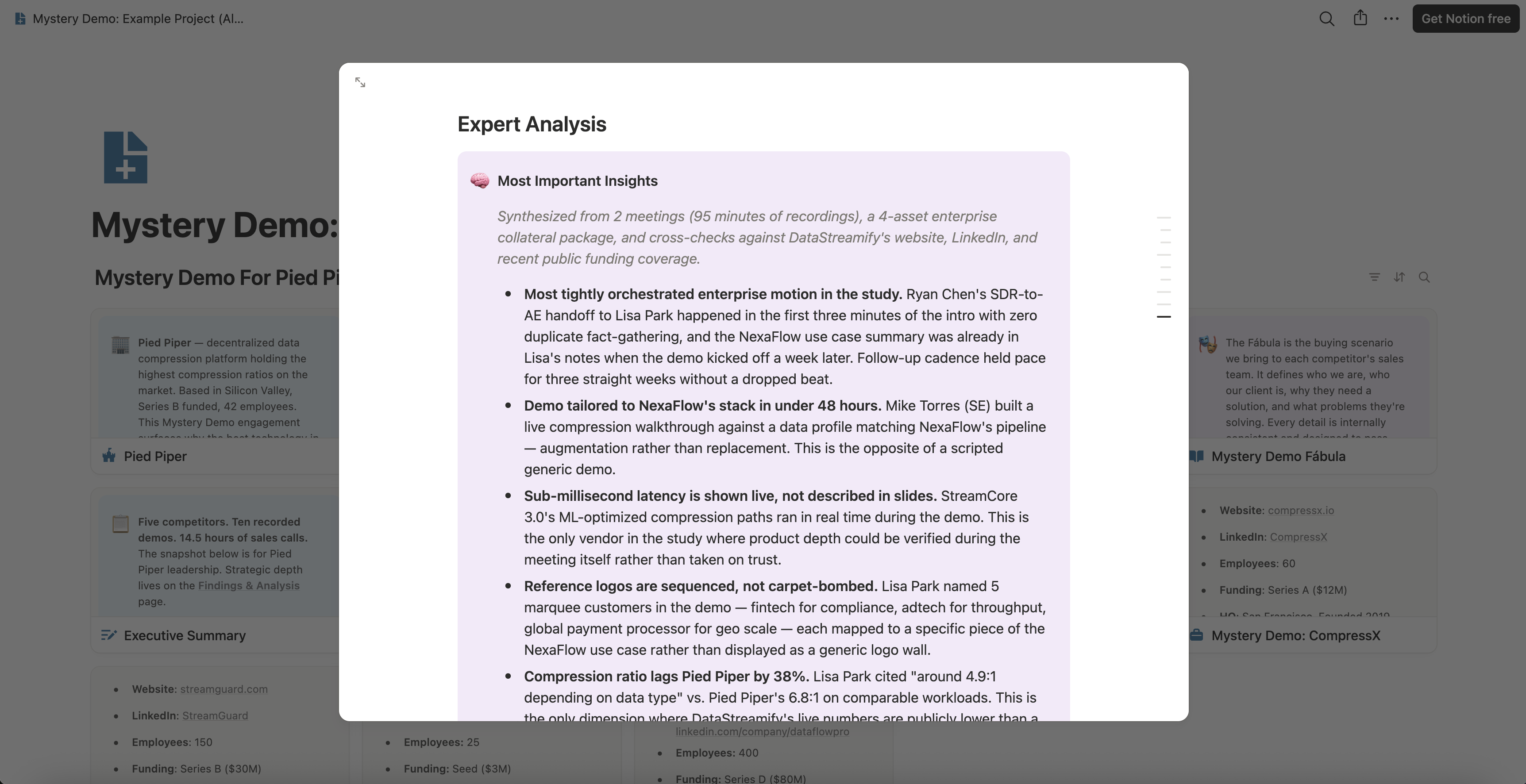
This page is what a battlecard is cut from. Each insight is tied to what a named rep said or showed on a specific call, so every line on the card can point at a minute your team can play back.
The cards themselves are part of the delivery. Each rival’s finished card goes on the board with every line linked to the recording it came from, which is what competitor battlecard research delivers. It costs a flat €499 per competitor, with nothing added, and one rival takes one to two weeks.
If one rival keeps turning up in your final rounds, tell us which one on a short intro call, and we will build the buyer it meets.
A board full of recordings still isn’t a card. A rep in a live deal needs a handful of lines they can say, and choosing them takes a few rules.
What Makes a Battlecard Worth Opening in a Live Deal
A good card is a cut of the research, never a copy of it. Whatever fields your battlecard template carries, these rules decide what survives the cut:
The lines you leave off matter as much as the ones you keep. The founding year, the headcount and the latest funding round go first, because a buyer finds them in ten seconds and a rep who reads them out sounds like a search result.
Next goes any line that claims more than its source shows, like a rep’s promise written up as a shipped feature. A line written only as big as its source is the one a rep can defend when a buyer asks where it came from.
.png)

The rules hold in every market. The lines themselves change with the market and the moment, so here are three cards, one moment each.
Example 1: A Head-to-Head Card for a Property Management Bake-Off
Say your team sells property management software to companies that run a few hundred rental units. Rival A turns up in most of your final rounds, and your account executive has the last demo against it on Thursday.
This is the card they read on Wednesday night. Rival A and every quote, minute and mark on it are invented, but each line is the kind a recorded call puts on a board.
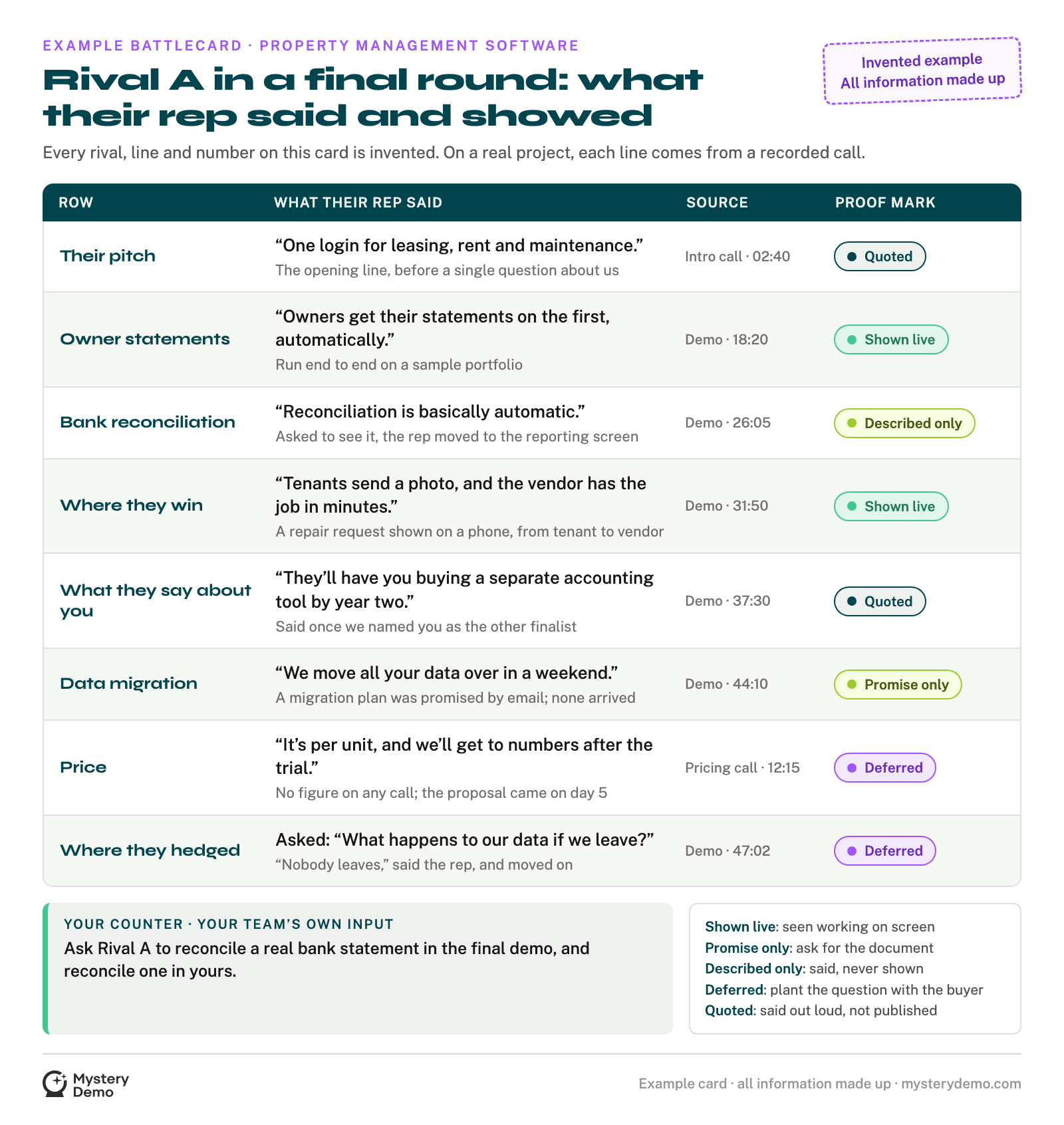
A desk could have filled three of its rows. The pitch is close to what Rival A’s homepage says, the tenant app is in its documentation, and per-unit pricing is on its pricing page.
Everything else needed the call. No page would tell you that owner statements ran live at 18:20 while reconciliation stayed a description at 26:05. No page would show you a migration plan that was promised and never sent.
The most useful row is the one no desk could reach. 37 minutes in, once your product came up, Rival A’s rep predicted a separate accounting tool by year two. Your account executive should expect that line on Thursday and answer it before the buyer raises it.
A weaker card would say “Rival A’s reconciliation is weak.” The call never showed that. It showed a rep who changed screens when asked, so the card says exactly that, and the counter asks Rival A to reconcile a real bank statement in front of the buyer.
Look at the price row, though. The rep pushed numbers to after the trial, and the talk about price is a deal moment with a card of its own.
Example 2: A Pricing Card for a Self-Storage Software Negotiation
Now a different market and a later moment. Your team sells management software to self-storage operators, and a buyer with twelve facilities is in the last two weeks of choosing between you and Rival B.
Rival B’s pricing page says $149 per facility a month, and your rep has priced against that number all month. The card below shows why it is the wrong number to price against, one move at a time.
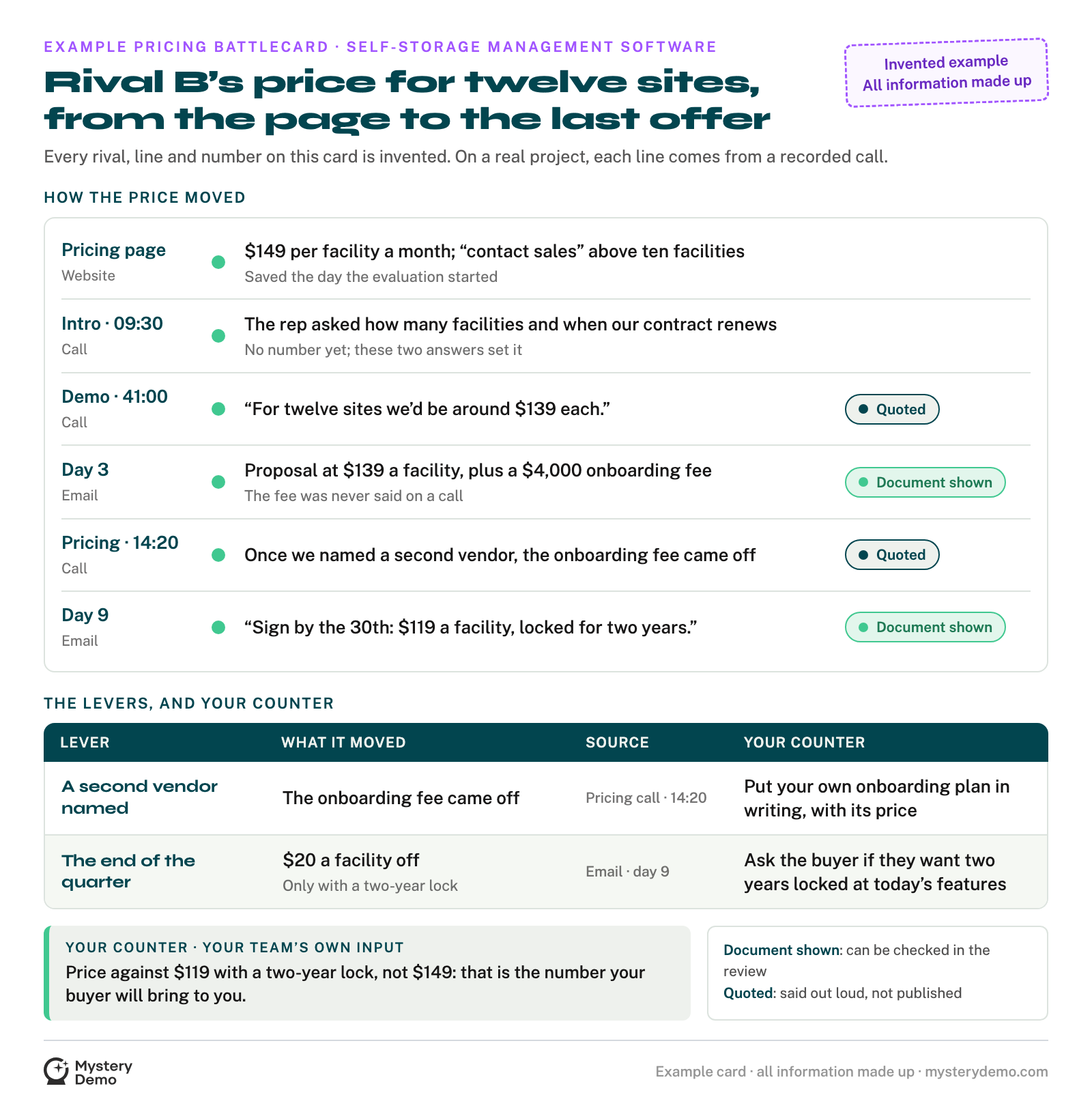
Rival B and every price on the card are invented, so copy the shape, not the numbers. The card follows the price from the page, through the two discovery questions that set it, to the fee in the written proposal and the offer at the end of the quarter.
Only the first line came from a desk. The quote came at 41:00 of the demo, and the $4,000 onboarding fee appeared only in the written proposal. The fee came off once a second vendor was named, and the $119 offer arrived with a two-year lock.
The levers table is the part a rep uses mid-negotiation. Each move Rival B made sits beside a counter, and the counters are your team’s own, because only your team knows whether to match a lock or sell against it.
On a Mystery Demo board, the pricing comparison gives each rival one row. A pricing card takes one of those rows and lays out every move behind it.
Here is that comparison on the invented example board. Read the transparency column: it says which competitors published a price and which only shared one on a call.
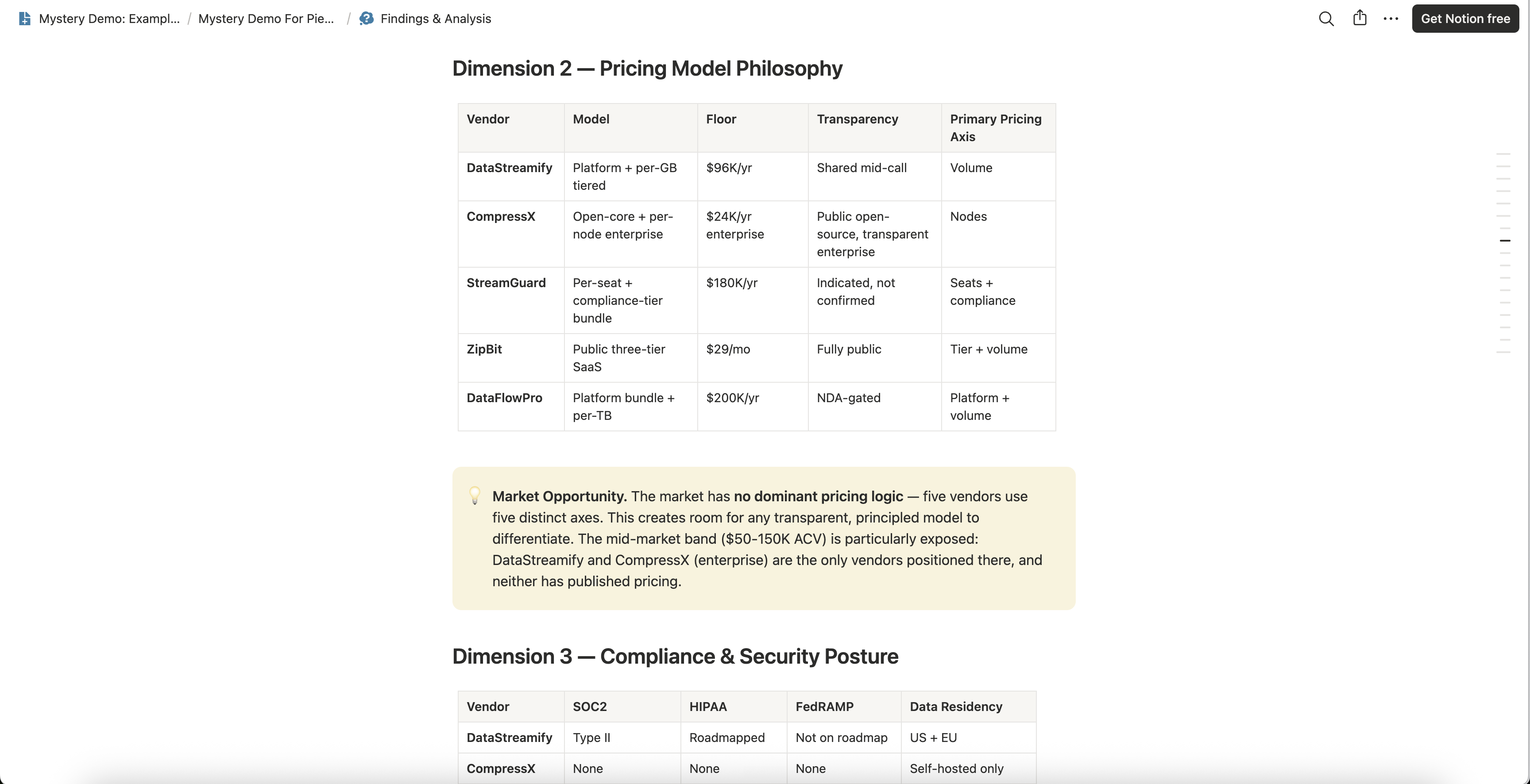
The comparison shows your pricing team where every rival sits. The card tells one rep what to say this week, and competitor pricing research fills both from the same recorded calls.
Even the right price can lose, though. A buyer can reach your discovery call already repeating what a rival told them about you.
Example 3: An Objection Card for Nonprofit Fundraising Software
Your team sells fundraising software to nonprofits, and buyers have started arriving at discovery with doubts about you that sound rehearsed. In this example, Rival C’s reps planted them on their own demos.
An objection card answers those lines one at a time. Like the other two, it is invented, down to every quote and minute.
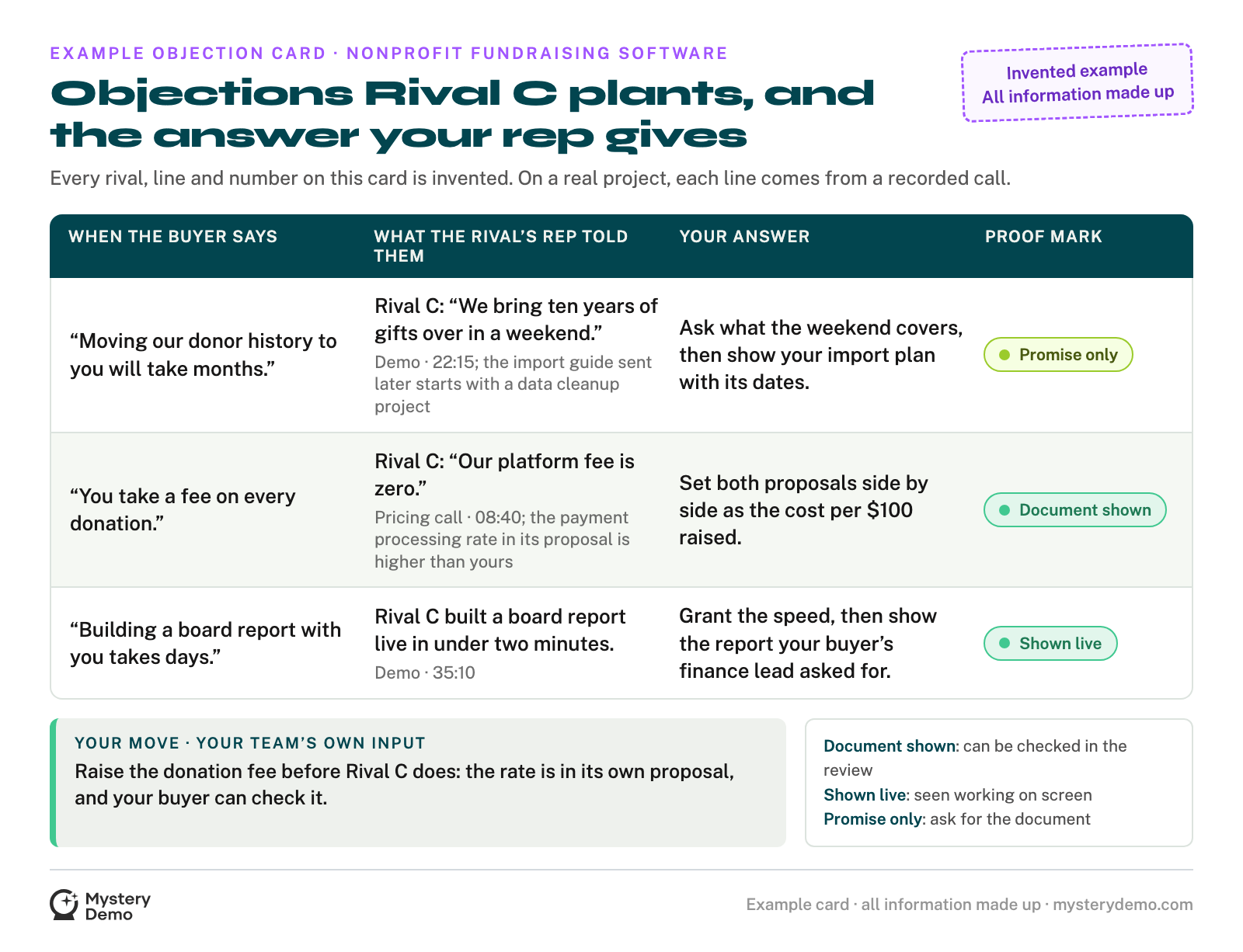
None of its three rows appears anywhere public. The weekend import, the zero platform fee and the two-minute board report were all said on Rival C’s own calls, and the first two came apart in the documents it sent afterwards.
The third row concedes, and it should. Rival C built a board report live, in under two minutes. A rep who denies what the buyer watched loses the buyer, so your answer moves to the report the buyer’s finance lead asked for.

The three cards cover three markets and three moments. Set them side by side, and the lines that decide each deal came from the same place.
Build the Card for the Moment You Lose In
A desk filled the background on all three cards: the pitch, the published price, the features each rival documents. Every line a rep would be pushed on came from a rival’s own sales process, on its calls or in the documents it sent after them.
So build first for the moment your deals die in: the head-to-head card if you lose final rounds, the pricing card if you lose on price, the objection card if buyers arrive already doubting you. Fill everything a desk can reach this week, and date every line.
Then get the call lines, because those are the lines a buyer brings back from the rival and tests your rep on. Mystery Demo gets them for a flat €499 per competitor, each one linked to the minute it was said.
Name the rival your reps least want to meet and the moment you keep losing to it. Start with a short intro call, and the card comes back with every line traced to the call it came from.
.png)


