
The card your battlecard platform refreshed this morning knows your rival’s new pricing page, its latest funding round and last week’s reviews. It does not know the number that rival’s rep quoted your buyer on their last call. Nobody who works for you was on that call.
A battlecard platform and mystery shopping both put lines on a card. They differ in the kind of evidence behind each line. A platform gathers what rivals publish and what your own people hear, and mystery shopping goes and hears what a rival says to a buyer.
Mystery Demo runs mystery shopping for B2B SaaS. Its team books your competitors’ sales demos as a credible buyer, sits every call, and hands back the recordings along with the card rows they fill.
What follows gives each approach its due, adds the three fixes teams try in between, and ends on which rows of your card need which kind of evidence.
A Battlecard Platform Keeps the Public Record Current
Start with what the platform does well, which is plenty. It watches everything a rival puts in public and everything your own people bring back, then turns it into cards inside the tools your reps already use.
Its sources fall into two groups:
The second group is bigger than it looks. In the Competitive Intelligence Alliance’s 2023 trends survey, sales was the top source of competitive intel, named by 83.33% of respondents. Updating battlecards was one of the two most common ways teams shared it, at 62.12%.
The public half is also cheap to watch. In Market Intelligence Tools’ September 2026 pricing report, a self-serve alert on a rival’s pricing changes, press releases and launches costs $0 to $99 a month. A platform that turns those signals into battlecards for a sales team costs five figures a year, starting around $10,000 to $30,000 before services.
Some rows on a card are public claims that drift, like a new tier on the pricing page or a feature the rival just shipped. For those rows, the platform is the right tool, and mystery shopping does not replace it.
Look at the two groups again, though. Everything in the first was written by the rival for strangers, and everything in the second is your own side’s view, heard after the fact.
The Rows That Decide a Deal Are Said on the Rival’s Call
Neither group reaches the rival’s own sales call, where its rep talks to a buyer it wants to win. The rows that decide a competitive deal get filled in on that call.
Field intel catches some of these secondhand, as whatever a buyer chose to repeat, in their own words, to a vendor they might not pick. One product marketer, asking peers on Reddit how they keep battlecards fresh, described how their team learns a rival changed something: “somehow we always find out because a rep mentions it after a call.”
A platform can get that mention to every rep the same day. It cannot make the mention more accurate than the buyer’s memory, and it cannot fill a row nobody heard.
So teams reach for ways to get closer to the call. Each one gets part of the way there.
Your Reps, Win-Loss Interviews and Your Own Calendar Each Stop Short
Three fixes are the usual next step, and each one earns its place for the question it answers.
Your reps and your call recordings. Call-analytics software flags every mention of a rival in your own calls and emails, the best record you have of what buyers repeat. It is still a paraphrase, heard on your call after the rival’s call has ended.
Win-loss interviews. The Competitive Intelligence Alliance calls them “the competitive intelligence professional’s single most effective source of actionable CI.” For the question they answer, why a buyer chose, they are hard to beat.
Win-loss interviews do not record what the rival quoted or said before the choice. The two work best together. The interview tells you which line hurt, and the recording gives you the exact words.
Sitting the demo yourself. Yes, your team could book the rival’s demo. By our estimate it costs about a working week per rival, from the booking to the last follow-up.
Booking it yourself also costs an email domain their rep can look up in a minute. A rep who recognizes your company tends to give you the generic tour.
None of the three fixes puts a credible buyer in the rival’s room for the whole sales process, from the first call to the written quote. That seat is the one mystery shopping exists to fill.
Mystery Shopping Puts a Buyer in the Rival’s Sales Process
Everything above reads what a rival publishes or what buyers remember of it. The sales call is where the rival quotes, shows, promises and attacks, and Mystery Demo exists to be on that call as the buyer.
Before any booking, Mystery Demo writes the fábula, the buying scenario each competitor’s sales team will meet. It sets six things to fit that competitor’s ideal customer: the industry, the headquarters, the team size, the funding stage, the current stack and growth driver, and the decision timeline.
Then the team requests the demo through the rival’s normal front door and runs the evaluation a real buyer would. That means discovery, the demo, the technical deep dive, the pricing conversation and every follow-up email, all of it recorded. Afterwards, every claim a rep made is checked against the rival’s website, LinkedIn and public news.
The evaluation is genuine. The team does assess software on a client’s behalf, and the only invented element is which client. Nobody real is ever impersonated.
Mystery shopping a competitor’s sales demo is legal, and retail, hospitality and financial services have measured their own service the same way for decades. Two lines keep it that way. Mystery Demo never signs an NDA, so no confidentiality agreement covers the call, and never pays for the product, so no license terms apply.
Recording those calls is lawful for the same reasons: a real operator evaluating real software, with no NDA signed and nothing bought. Your team can then check a quoted price weeks later against the recording, instead of trusting someone’s notes.
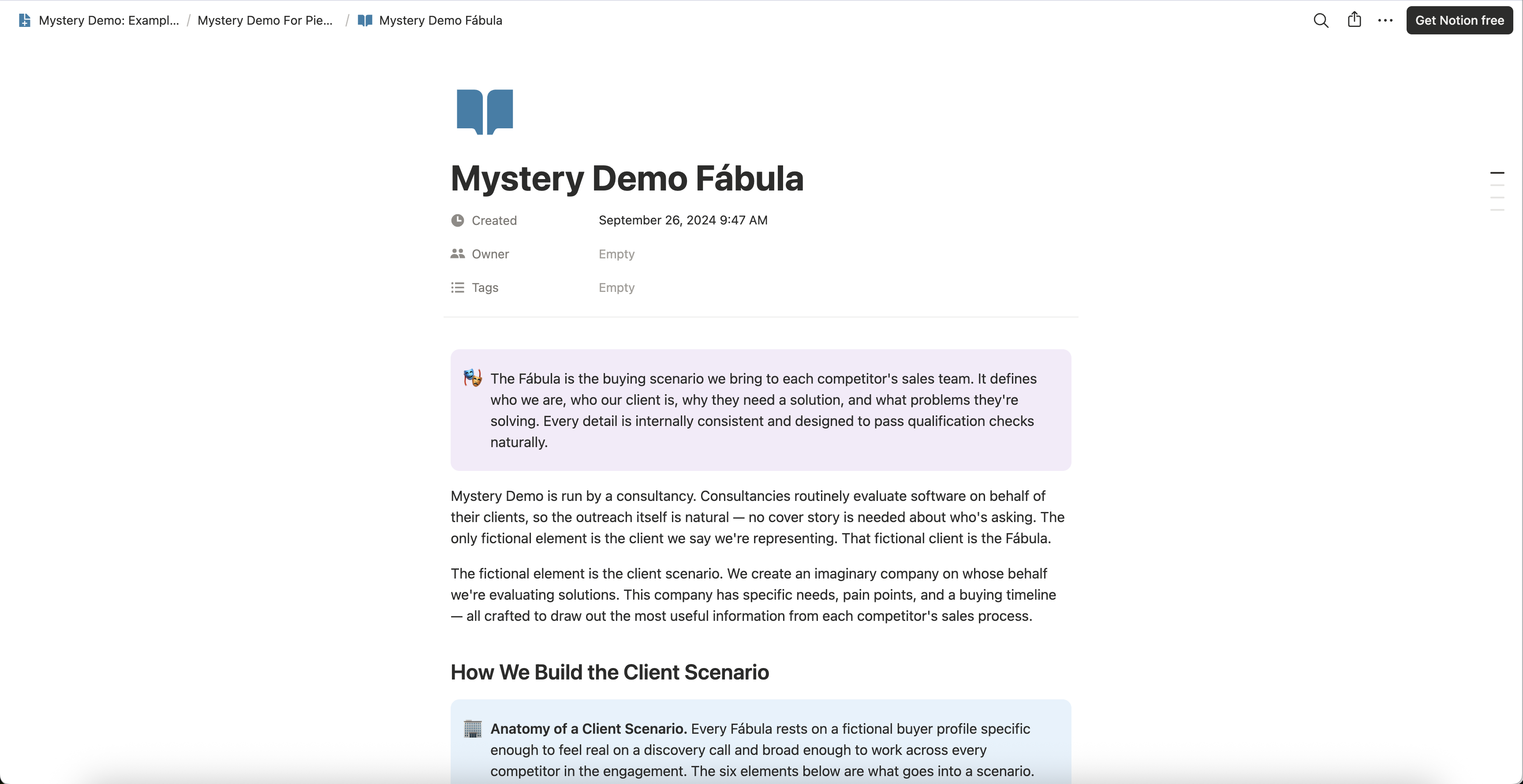
Below is the fábula page from Mystery Demo’s public example board, where the client and every competitor are invented. A real project’s board is built from that client’s own calls.
The purple callout at the top defines the fábula as the buying scenario brought to every competitor’s sales team, consistent enough to pass their qualification questions.
The scenario gets the team into the room. What the team brings back depends on the questions asked there, so the calls are sat by operators who have sold B2B software and know where a rep’s script runs out.
.png)

One call is one rep talking to one buyer on one day. When a second rep on a second call repeats the line, it becomes a claim about the company. Only that version belongs on a card your whole team says out loud.
Say one row on your card is always blank, like the rival’s quoted price or what its rep says about you. Bring us that card and the rival it is about. Walk us through the blank rows on a call, and Mystery Demo will sit that rival’s sales process as the buyer until each row has an answer and a recording behind it.
The team does not come back with a summary of how the calls felt. It comes back with the row, and the minute it was said.
What Comes Back Is a Card Row With a Timestamp
Every project ends in one shared Notion board. Each competitor gets a page holding its recordings, transcripts, emails and collateral, with the analysis written on top.
Say the security row on your card was written from the rival’s website. Here is the same row before and after the calls:
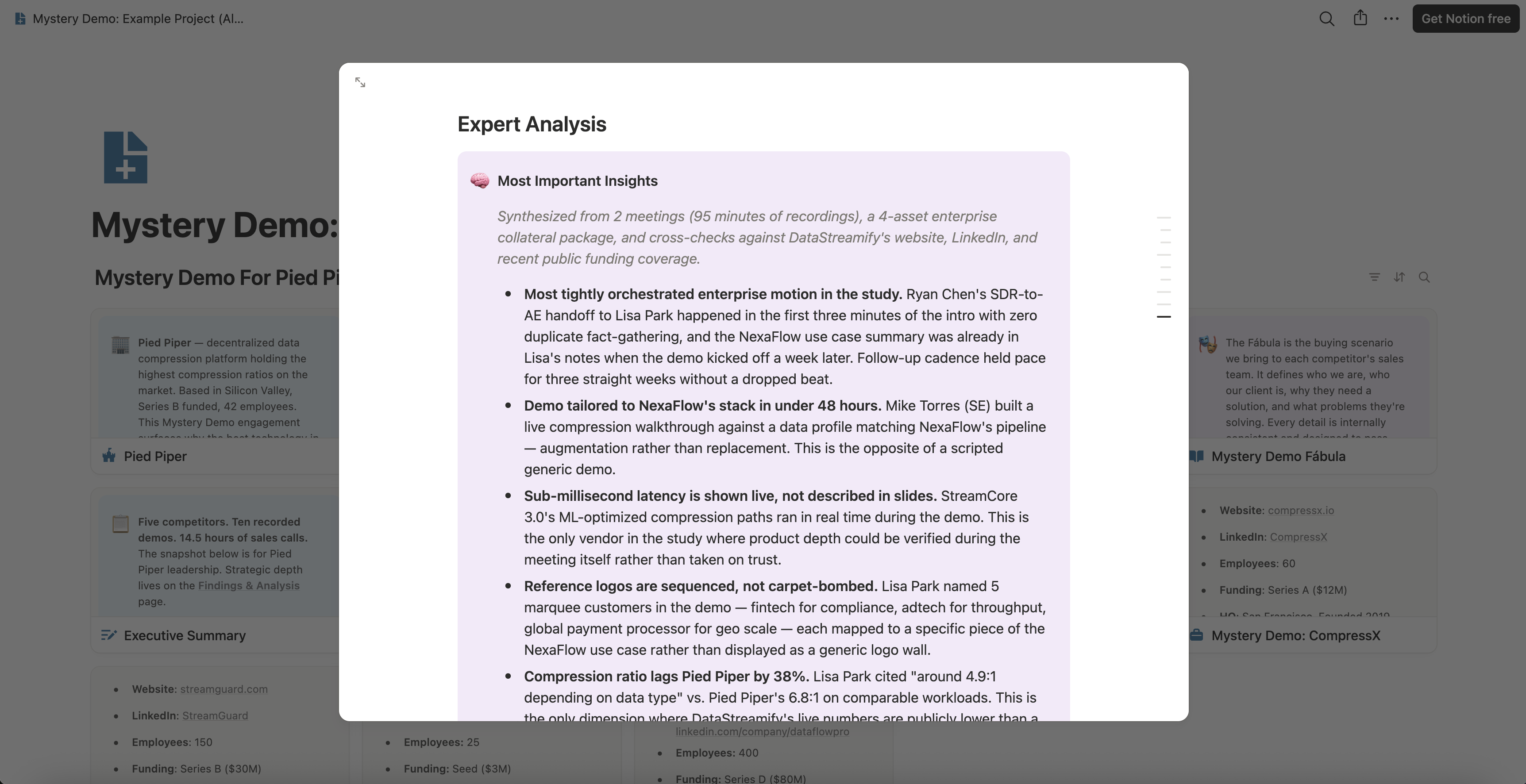
On the example board, this is what a competitor’s page looks like once the calls are in. The line at the top of its Expert Analysis names what it was built from: the meetings, the minutes of recording, the collateral the rep sent, and checks against the vendor’s website, LinkedIn and press. Each insight rests on that evidence, so a card line taken from it can cite its source.
Across competitors, the Findings & Analysis page lines up the same row for every rival. This is its pricing dimension: each competitor’s pricing model, its floor, how openly the price was shared, and the axis it charges on.
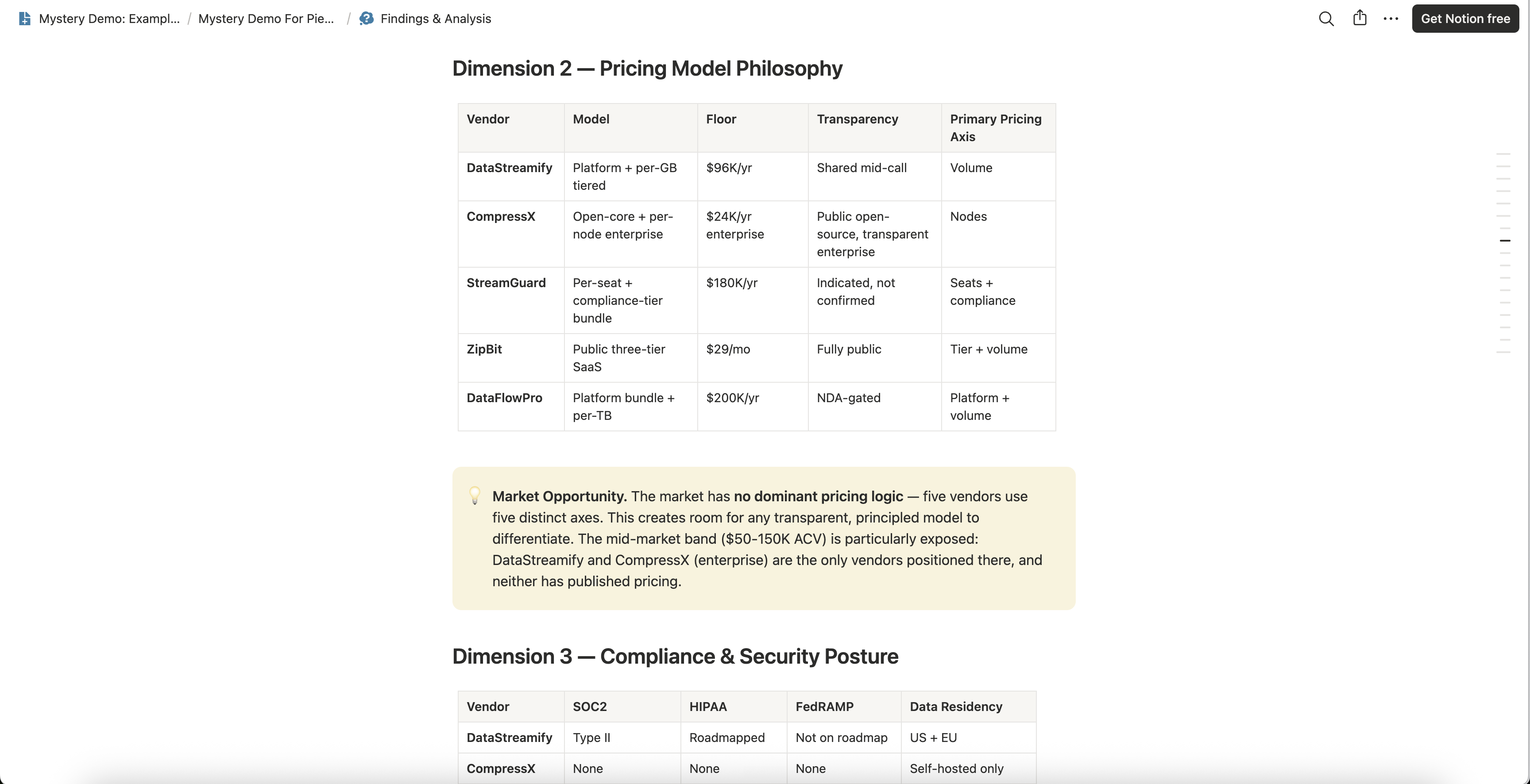
The transparency column is the one no feed can fill. It records whether a rival shared its price on the call, only hinted at it, or kept it behind an NDA. A rep wants to know that before quoting against them.
None of this replaces the platform you already pay for. The rows move into it, each with its recording and timestamp attached, and the platform does what it is good at: putting them in front of every rep before the next call.
A battlecard template built from real competitor demos shows how those rows turn into a card a rep can open mid-call. Our competitor battlecard research produces the rows themselves, on your own rivals.
Your card now carries two kinds of evidence, lines from the feed and lines from the call. Set every approach on the same terms, and the difference is easy to read.
Each Approach Answers a Different Question
Here is every approach above in one table, judged on what it can verify, what it cannot see, and what it costs in money and time.
| Approach | What it verifies | What it cannot see | Cost and time to an answer |
|---|---|---|---|
| Battlecard platform | What rivals publish and what your own people log, kept current in your reps’ tools | What a rival says to a buyer on its own sales call | Five figures a year for a full platform; monitoring alone from $0 to $99 a month. Continuous |
| Your reps’ notes and call recordings | What buyers repeat about a rival on your calls | The rival’s call itself | Already paid for. During and after your own deals |
| Win-loss interviews | Why buyers chose | What the rival said and quoted before they chose | Interviewer time per buyer. After the decision, one buyer at a time |
| Sitting the demo yourself | The tour a rival gives whoever you appear to be | The real sales motion, once your company is recognized | About a working week per rival, by our estimate, plus the exposure |
| Mystery Demo | What each rival quotes, shows, promises and attacks with a credible buyer, on the record | Anything not said on the calls, such as the rival’s internal roadmap | €499 per competitor, everything included. One to two weeks per competitor; four to eight for a landscape |
Read down the second column and the platform wins on breadth and freshness, which is what it is built for. Read down the third and the rival’s sales call is missing from every row but the last.
The table does not pick a winner. It tells you which question each approach answers, and leaves you to decide which questions your reps are losing on.
Sort Your Card by the Evidence Each Row Needs
So go back to your own cards and sort the rows. If your reps lose on public claims that drift, a pricing page that changed or a feature that shipped, buy freshness, and the platform will earn its fee.
If they lose on the quoted price, the discount and what the rival’s rep says about your product, those rows need the call. Once recorded, they belong in the platform you already run. They stay true until the rival changes how it sells, which is why teams re-run a project one to three years later to see what moved.
Each competitor costs a flat €499 and includes the scenario, every call, the recordings, the transcripts, the analysis and the board. One competitor takes one to two weeks.
Your platform will keep the rest of the card fresh on its own. For the rows it cannot reach, pick the rival and we will take the buyer’s seat in its sales process, and the first timestamped rows will be on your board in one to two weeks.
.png)


