
In B2B software, the things that decide a deal get said after somebody fills in a demo form. None of it is published. The pricing page shows three tiers and a button, and everything else sits behind that form: the price a rep quotes a real buyer, the workflow they run live, the questions they ask first, and what they say about you.
Almost everything worth knowing about a competitor sits behind the Request a Demo button, and none of it ever has to be written down.
Mystery Demo fills in that form for you. We book your competitors’ demos as a real buyer, sit in on the calls, ask the questions an experienced buyer asks, and record everything. Then we hand you a Notion board with the recordings inside it.
That is mystery shopping, built only for B2B SaaS.
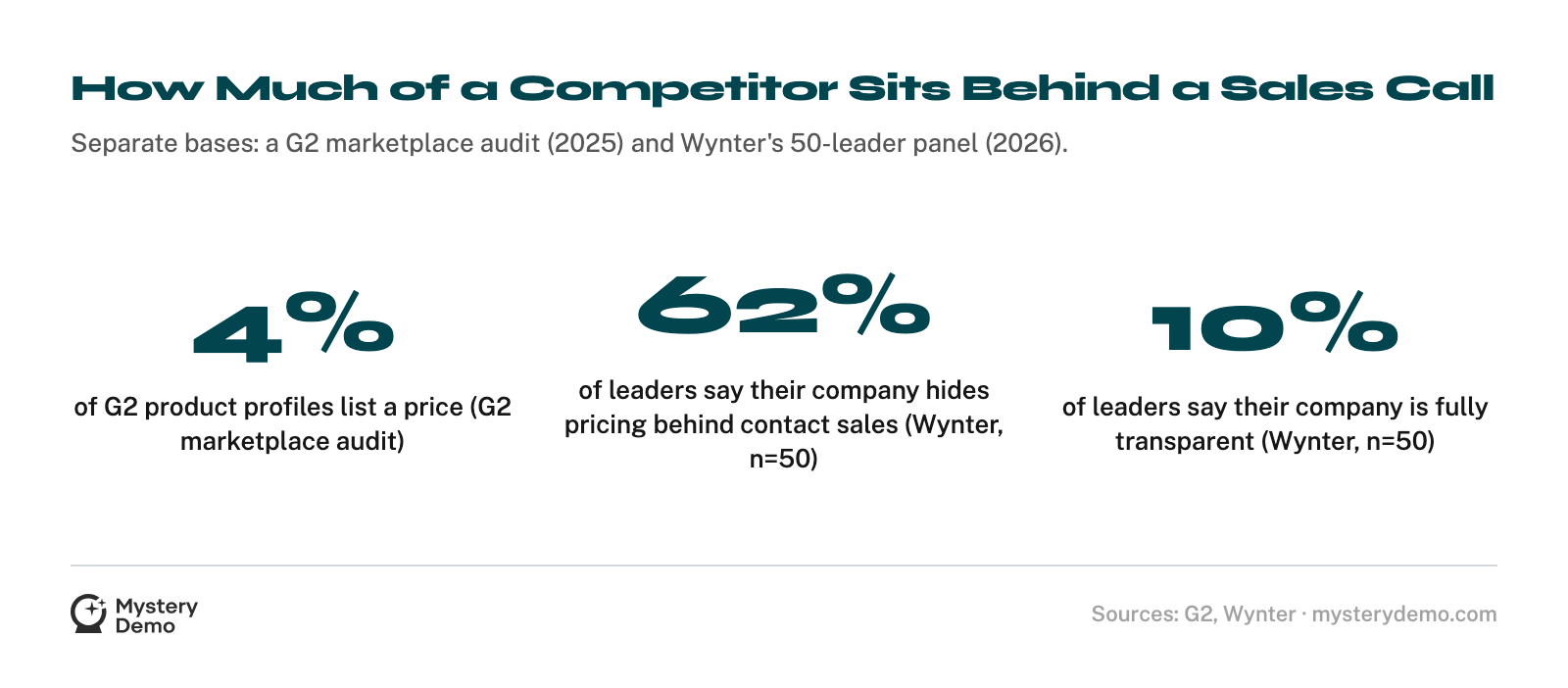
Fifty leaders is a small panel. It still points the same way as G2’s audit of its whole marketplace.
Mystery Shopping Is Older Than Software, and the Shop Floor Moved
Mystery shopping was not invented for SaaS. Retailers, hotels, and banks have used it for decades to see what happens when a customer walks in. The method always has the same three parts: a real prospective customer, a set of agreed tasks, and a write-up against questions agreed before the visit.
Somebody walks in as a buyer, does what a buyer does, and writes down what happened. In B2B software, the store is a calendar link and the shop floor is a forty-five minute call with a screen share. The write-up asks one question: does the product on the screen match the product on the website?
The buyer still has to be a buyer, and that changes who can do this work. A retail shopper needs a shopping list. A SaaS shopper has to get through qualification, which means a believable company, a budget, a timeline, a current stack, and a reason to be looking right now.
So the person on the call is someone who has bought and sold SaaS for a living, working from what we call a fábula. A fábula is a cover story that is true in every part except one: the client we say we represent. Nobody pretends to be another person, and the only thing the vendor does not know is who asked us to look.
The legal case is short. Attending a sales demo as a genuine evaluator is market research, the same kind retailers have run on shop floors for decades. There are two rules we never break:
No contract gets broken and nothing is obtained by fraud. That is the whole legal case. The longer version has its own page: the legal case for mystery shopping in B2B SaaS.
Why It Matters More in B2B Sales Than Anywhere Else
A retailer that mystery shops a rival learns how the rival greets customers. A SaaS company that mystery shops a rival learns why it is losing deals, and nothing else shows that. Here is what only comes out on the call:
Each of those is a row on a battlecard, a line in a pricing decision, or a sentence in a positioning brief. A pricing committee that only has the public tiers is pricing against the competitor’s opening offer. Competitor pricing research brings back the number after the objection.
A battlecard built from marketing pages prepares your reps for a pitch nobody on your team has heard. Battlecards built from recordings fix that.
None of those answers is on a website. Most teams build their battlecards and pricing decisions from the website anyway, because the website is all they have.
Nothing Else Gets You Into the Room
Every other source of competitive intelligence answers a real question. None of them tells you what happens on the call.
| Where you look | What it shows you | What it misses |
|---|---|---|
| Public monitoring | Site changes, launches, reviews, hiring, filings | The live product, the quoted price, the pitch |
| Your own pipeline | What your prospects and your reps say inside your deals | What the rival says when you are not in the room |
| Win-loss interviews | How a buyer remembers and explains a decision | What was demonstrated, in what order, with what caveats |
| A recorded demo | Qualification, demonstration, pricing, objections, follow-up | Anything internal: their win rate, retention, or pipeline |
Monitoring software does one job well: it watches what becomes public. Site changes, launches, and hiring are useful clues, but a rival has had time to prepare every one of them. A win-loss interview gives you a buyer’s memory of a decision, three weeks after the demo, filtered through what they want you to think of them.
The obvious move is to book the demo yourself, and it does not work. Your domain is already in their CRM, your team has met their reps at three conferences, and a founder asking a direct rival for a walkthrough tends to be memorable. Even where nobody recognizes you, the call goes differently: reps qualify hard, and a buyer with no budget, no timeline, and no real use case gets the short version.
So most teams end up confidently wrong about what a rival says on a call. The recorded demo is the one source that hears the pitch. Mystery Demo exists to take that call: as a buyer with a real evaluation to run, a story that holds up, and enough experience to know which answer came off a slide.
Who Is on the Call
Mystery Demo was founded by experienced SaaS entrepreneurs who advise software companies for a living, and we only run mystery demos for software companies. The person on the call has priced this kind of product, sold it, and bought it. They have sat on the buyer’s side of the demo table more times than the rep has.
A demo rep can tell within two minutes whether the buyer knows the category, and a tourist gets a different call than a buyer. The questions that open a call up are never clever. They are the plain questions an experienced buyer asks: which integrations are native, what the price does at the next tier, how long the last three implementations took, and which logos on the customer slide are still customers.
We have sat in hundreds of live competitor demos, across dozens of projects: hospitality tech, fintech, dev tools, HR and employer-of-record software, AI support, and more. The cover has never been blown, because a real evaluator with a true story is not acting.
Someone senior is on every call. None of this gets handed to a junior, and none of it runs off a script. The companies that hire us (we call them partners) come back for a second round because the same person runs the project.
.png)
That is who runs the project. The project itself runs the same way every time.
How a Mystery Demo Project Runs, From Kickoff to Handoff
There are five stages, and each one leaves a page on the board you receive at the end:
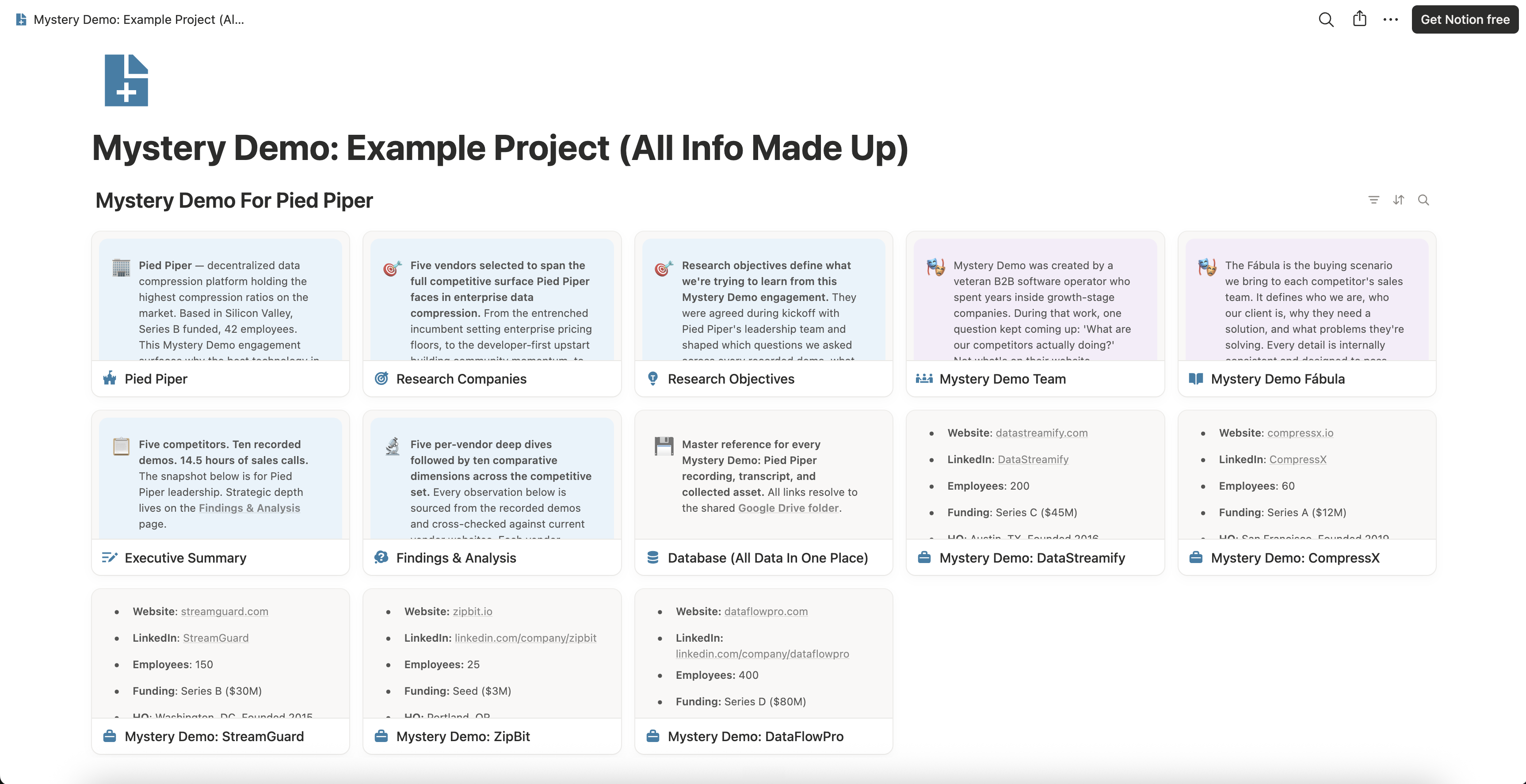
Then the handoff: a fully linked Notion board. The screenshots come from our public example project, and every company, person, and number in it is invented. The structure is real, and your board is built from your own competitors’ calls.
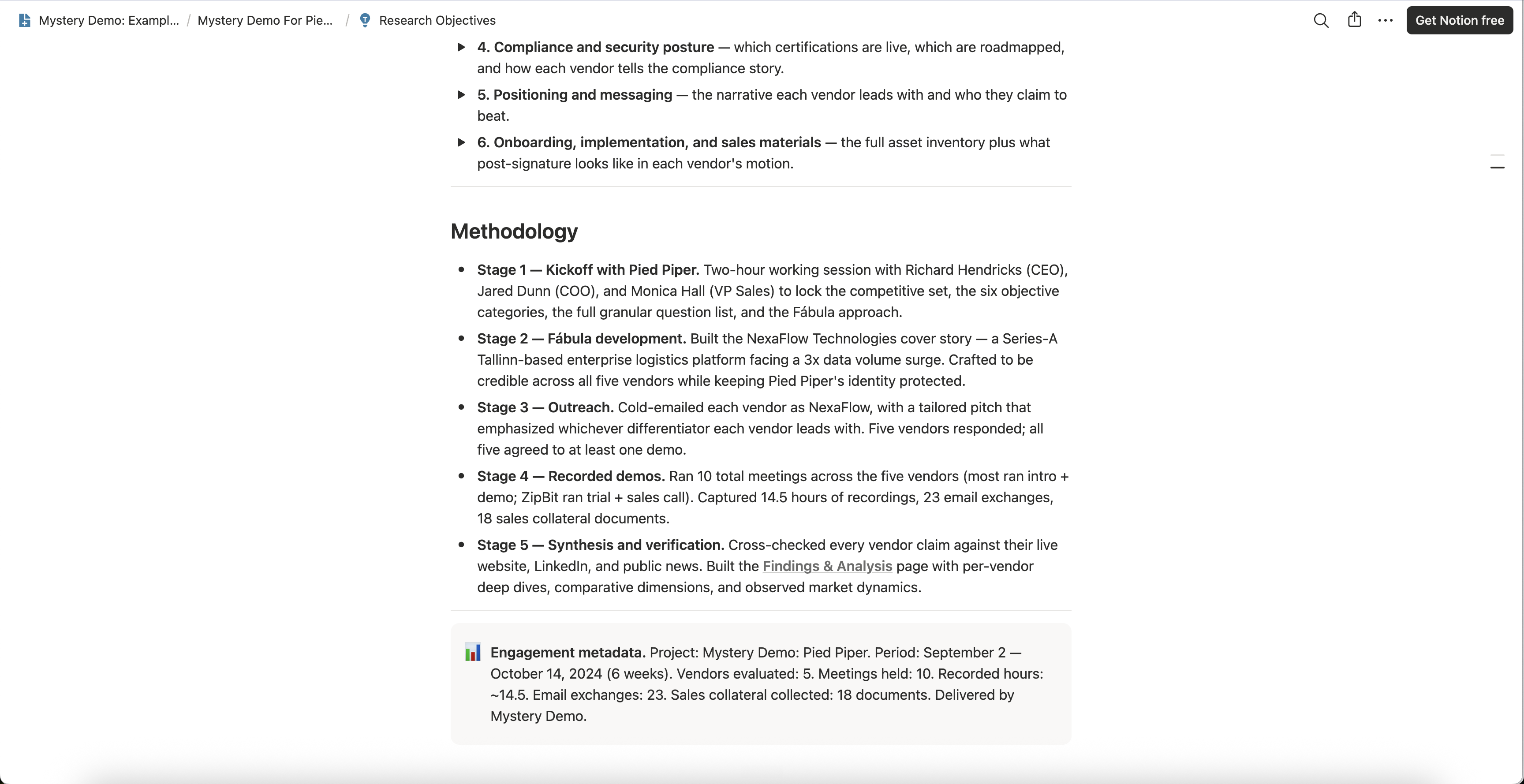
The board also records how it was built. Six months later, anyone can open the methodology page and see how the evidence was gathered.
Kickoff: The Objectives and the Questions
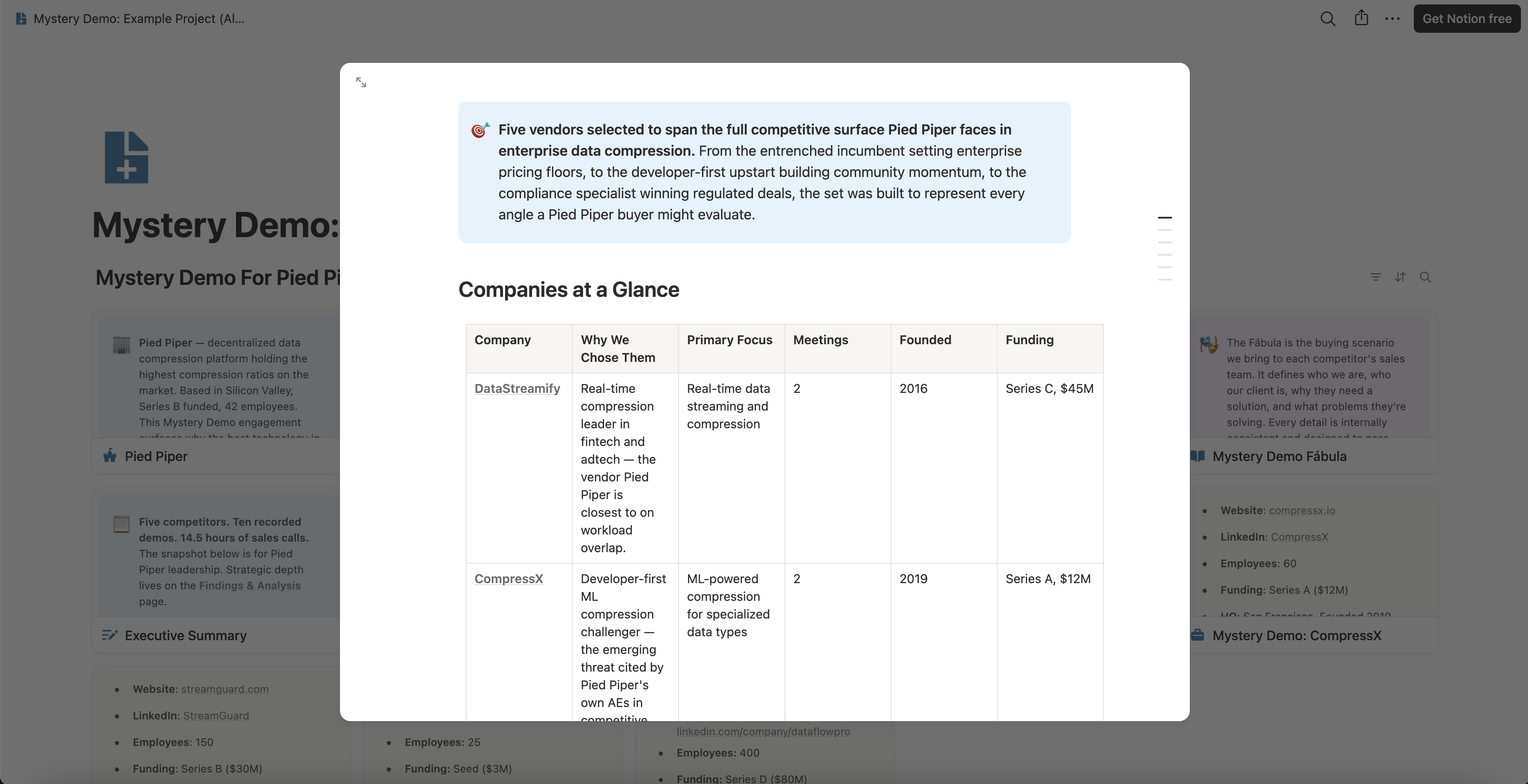
A project starts with a working session. The first thing it produces is the list of competitors: typically three to nine vendors, chosen to cover the whole field you meet in deals, from the budget option to the enterprise incumbent. Each name gets a line explaining why it is on the list.
The second thing the session produces is the brief. We agree on one core question, the one the whole project exists to answer. Under it sit a handful of objectives: pricing and packaging, how good the sales process is, what the product can do live, compliance, positioning, onboarding.
Under each objective sits the exact list of questions we will ask every vendor, so the answers line up in one table later.
You also demo your own product to us. We need to see what good looks like before the calls, or we cannot ask the one comparison question that pulls a rep off the script. That question is where most of the intelligence comes from.
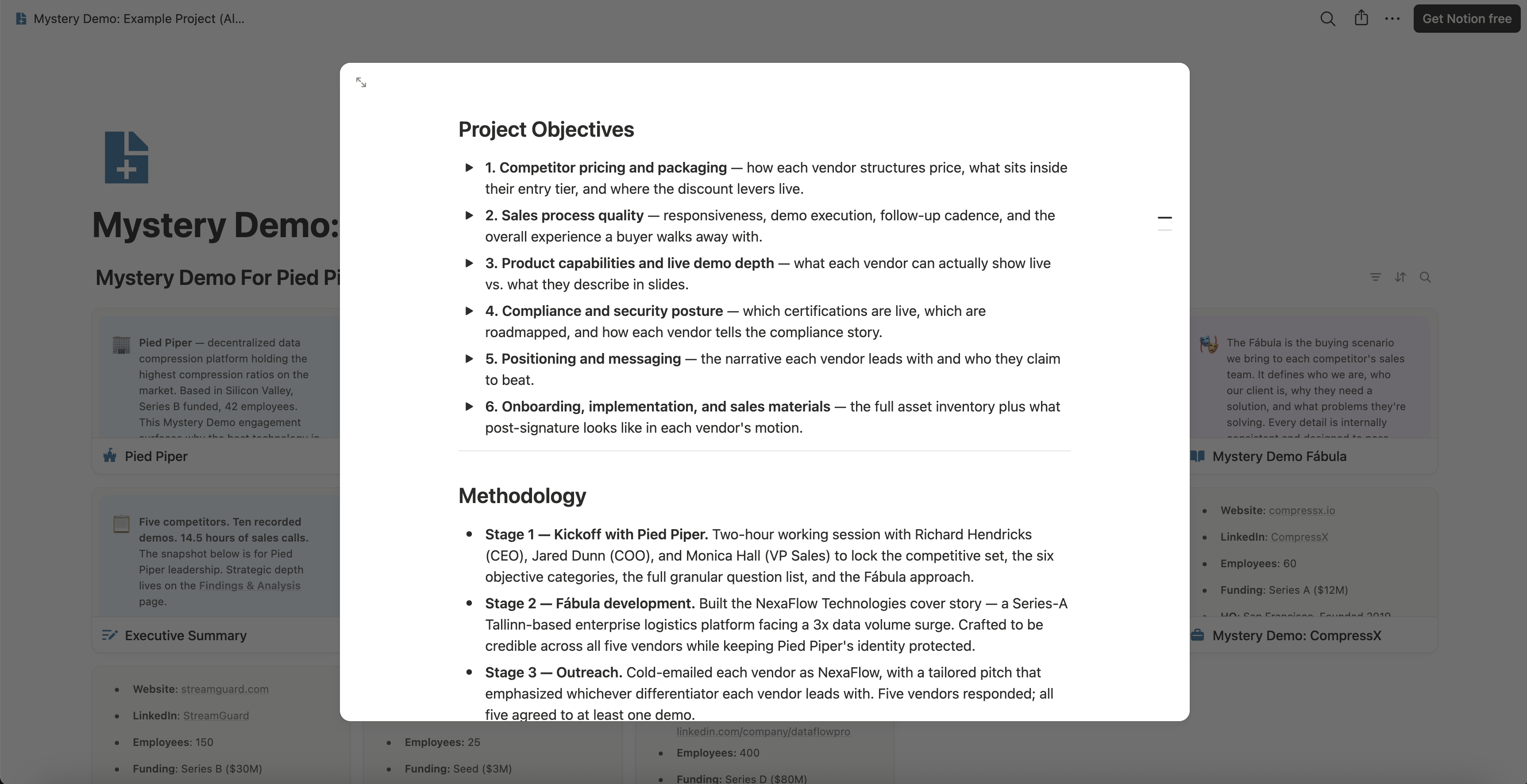
Every later page on the board answers the questions on this page. A finding that does not trace back to one of these questions does not belong on the board. The same session settles one more thing: who we will be when we email each vendor.
Building the Fábula
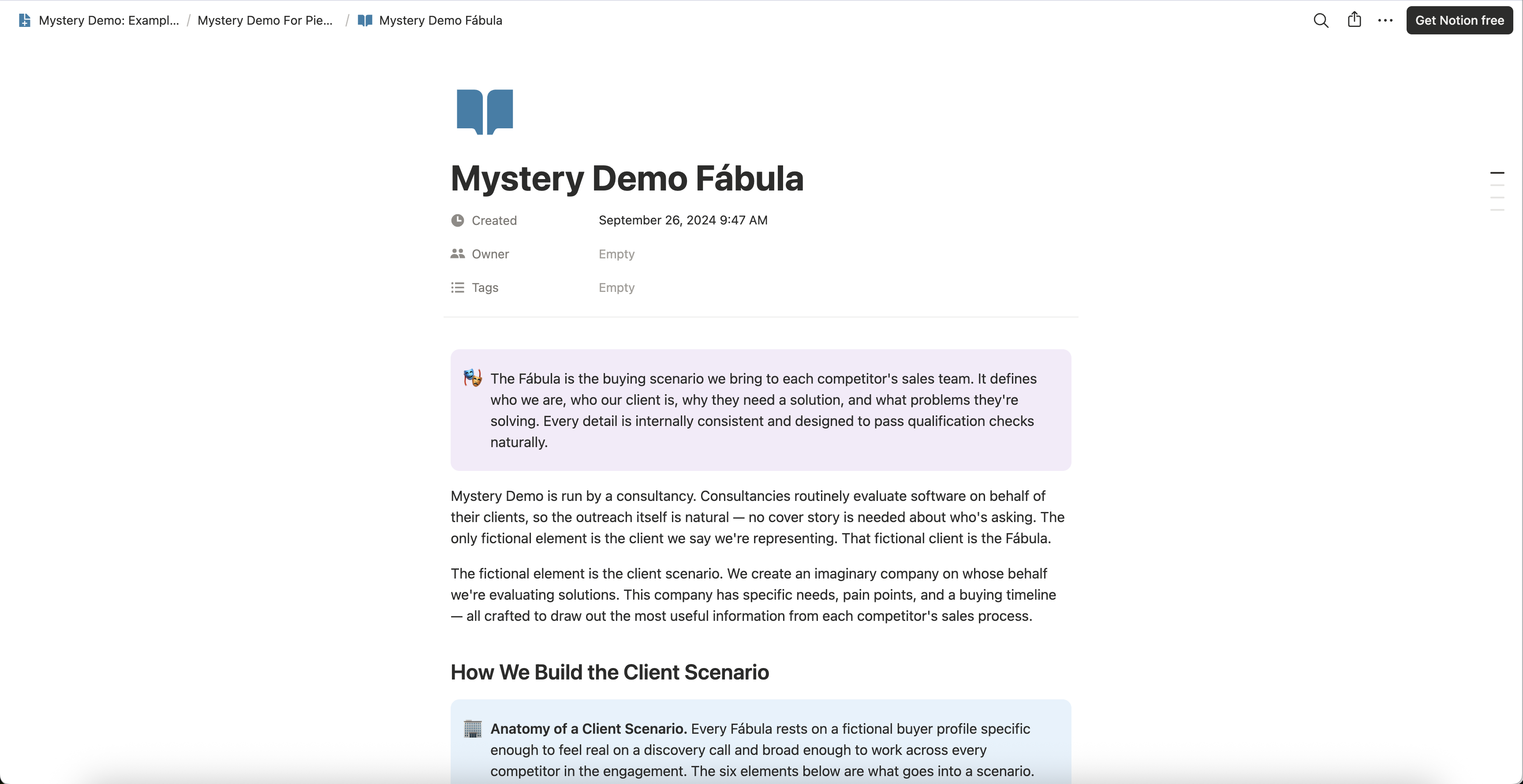
The fábula is the buying scenario we bring to every sales team: who is evaluating, for whom, why now, and what problem they are solving. Nearly all of it is true. We really do evaluate software for companies, so when we email a vendor and ask for a demo, the request is genuine.
The only fictional part is the client we name. A fábula has six elements, and each one is tuned to the vendor in front of us:
The core story stays the same for the whole project, and what we emphasize changes from vendor to vendor. A speed-first vendor hears about real-time workloads, and a developer-first vendor meets an engineering-led buyer with specific SDK needs. A compliance-first vendor gets the regulatory requirements up front, and if the product is self-serve, we sign up for the trial instead of booking a call.
Outreach and Booking
Outreach is a cold email, and it reads like every other evaluation request a vendor gets that week, because it is one. The first email says who is evaluating and introduces the client, and it sets a decision window. It also gives a reason for looking, and that reason is matched to whatever the vendor puts at the front of its pitch.
That is what gets a reply from the right person: a solutions engineer for a technical pitch, an account executive for a platform pitch, a founder for a founder-led company.
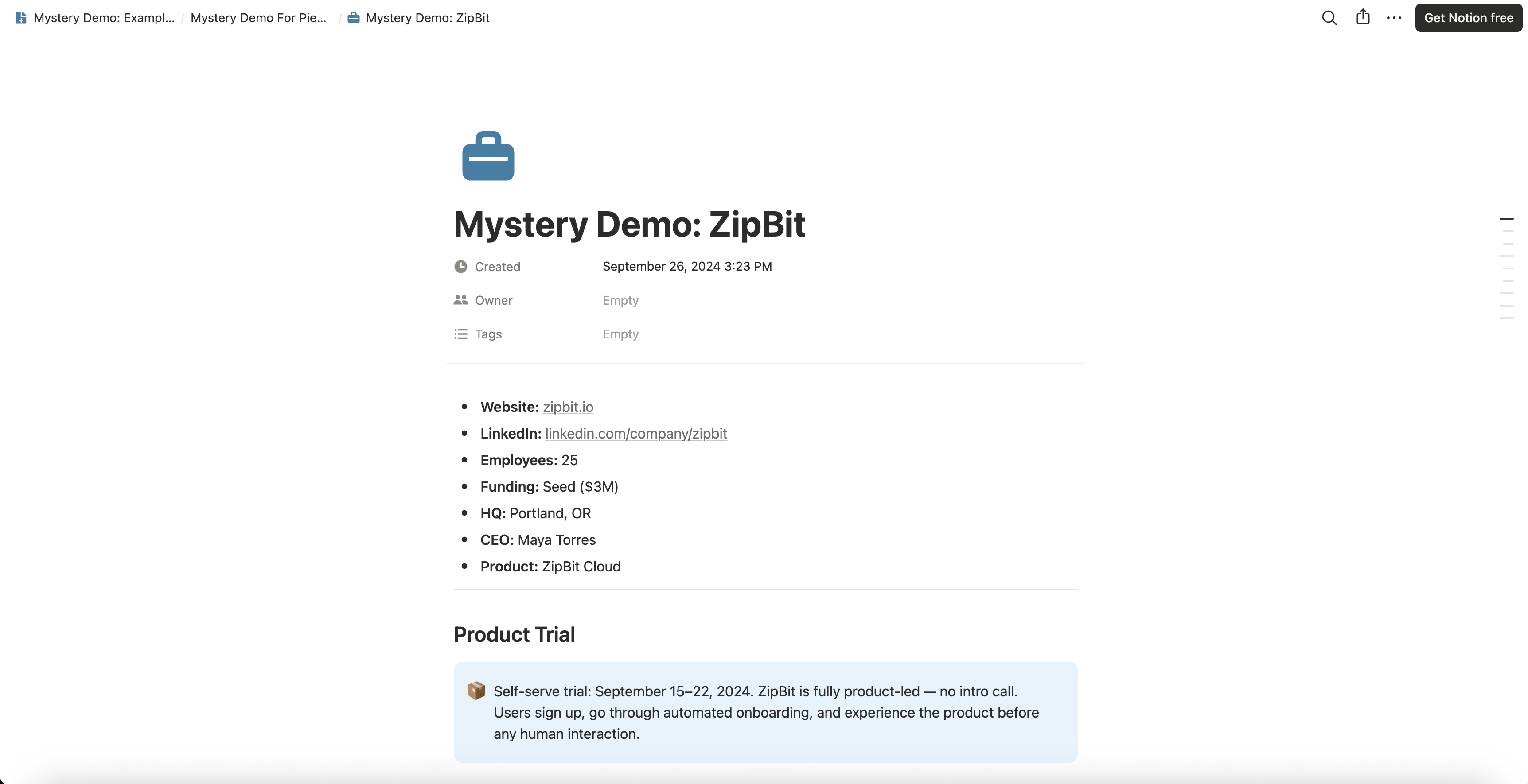
Not every vendor has a sales team to shop. A product that sells through a free trial gets shopped the way its buyers buy it: we sign up, use it, and wait for the onboarding emails and the sales call to come to us. A vendor that never puts a human on the call is a finding in itself, and it gets its own page.
The fábula does not end when the demo ends. We follow up the way a real buyer would: we read the collateral, answer the emails, and close every loop, so the people on the other end never learn it was a mystery demo. We also end up on their marketing email lists, which keeps the door open for a second round later.
Sitting Through the Demos, and Recording Everything
Then the calls start, and we go through each vendor’s full sales process, not just one demo: discovery, the demo, a technical deep dive, pricing, and the follow-up. When the question list needs more, we ask for extra meetings with product, engineering, or an executive. Every one of those meetings is inside the fee.
Every vendor gets the same question list, in roughly the same order, so their answers can sit side by side in one row later. Each rep does something different with the same question. One runs the workflow, one opens a slide, one says the next release covers it, and the recording shows the date they said so.
The most useful question in any demo is a boring one: can you show me that with my own data in it? A workflow shown live and a workflow described from a slide are two different facts. A feature grid flattens them into the same checkmark.
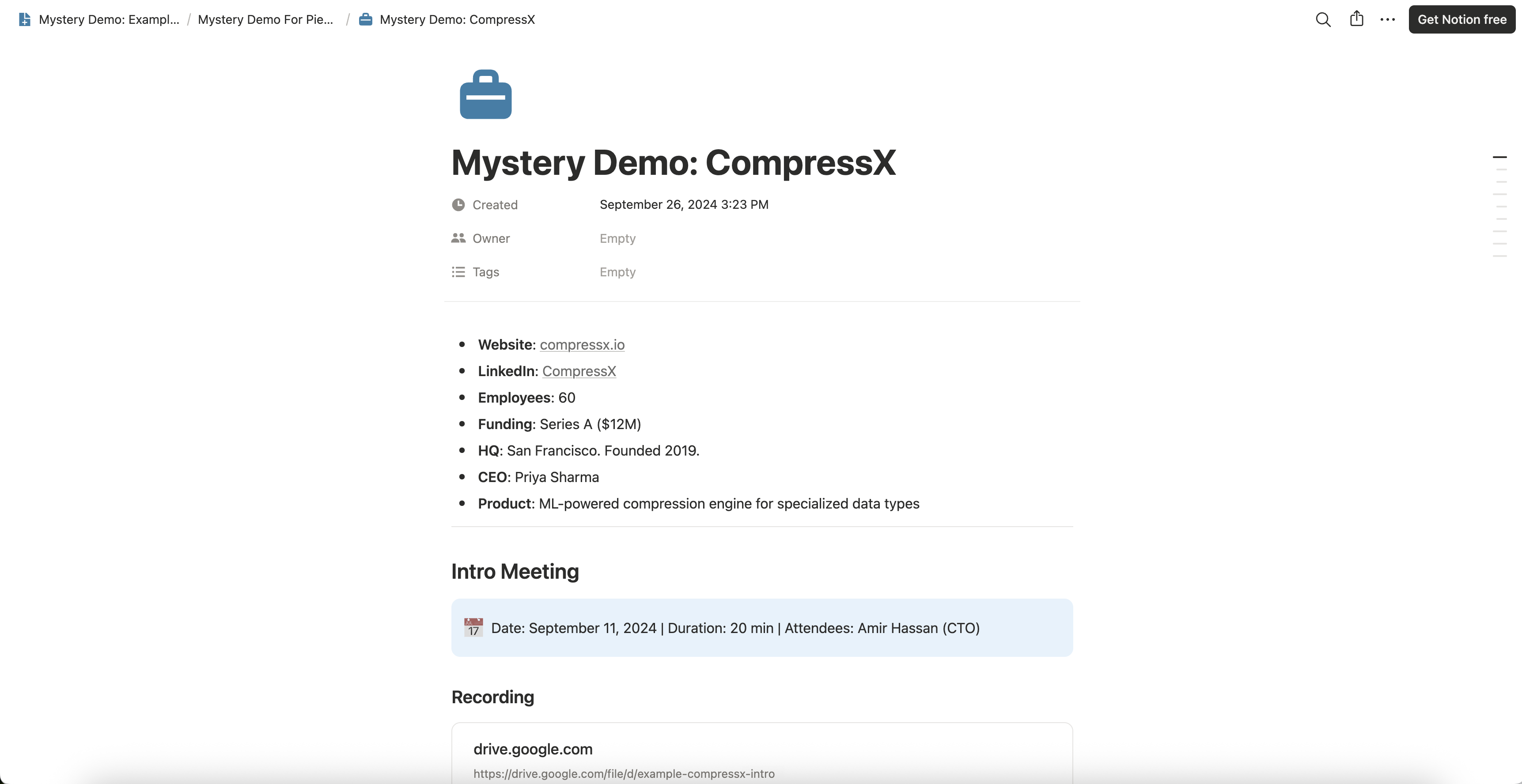
Every call is recorded and transcribed. The transcript is cleaned and timestamped, so a claim can be found in ten seconds and argued with in eleven. We file every email thread and every piece of collateral a vendor sends: the deck, the security questionnaire, the ROI calculator, the case study they attached without being asked.
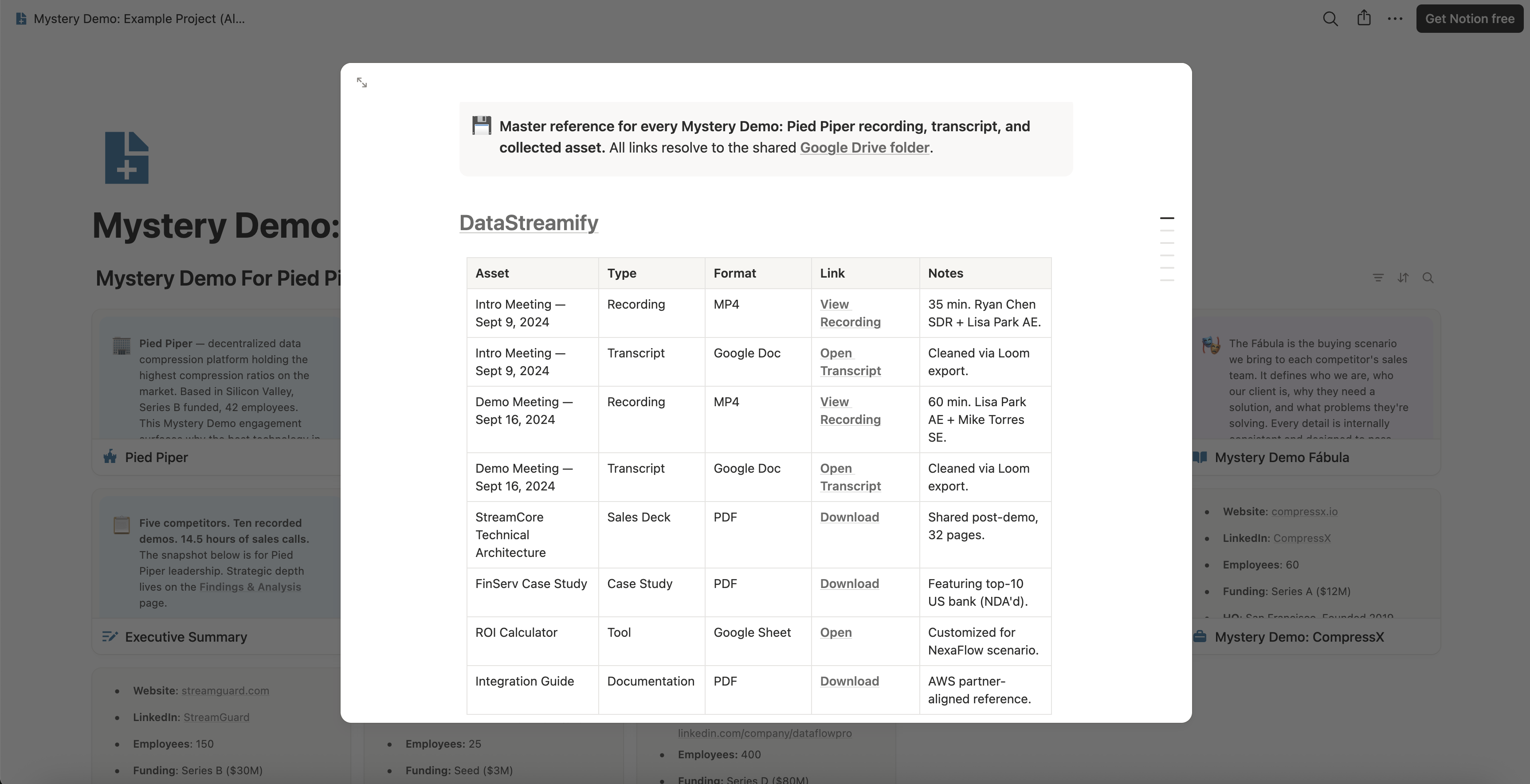
The recordings are the source. Everything else on the board is our reading of them, and the board is built so that is obvious. A Database page lists every recording, transcript, and file, with a working link, so anyone who doubts a sentence can go and watch the minute it came from.
Synthesis and Verification
The last stage turns the recordings into intelligence: we check every claim a rep made against the vendor’s website, its LinkedIn, and public news. The number the rep claimed goes on the board next to what the demo showed. A rep who quotes one number and demos another has told you two things, and both belong on the page.
Then we write the analysis in three layers. First, a deep dive on each vendor, which says what happened before it says what it means. Second, comparison tables that put every vendor side by side, including the product comparison, feature by feature and screen by screen, with each capability rated shipped, partial, or only claimed.
Third, a short summary for the leadership team.
What You Get: The Board, Page by Page
What you get is a Notion board with eight page types, and each page has one job. The screenshots are still the invented example. Your board will have your own competitors on it.
| Page | What it holds | Who opens it first |
|---|---|---|
| Client Profile | Who the partner is, what they sell, and what they want from the research | Everyone, once |
| Research Objectives | The core question, the objectives, the exact questions, the methodology | Whoever briefs the next project |
| Research Companies | Every vendor’s profile: size, funding, HQ, positioning, recent news, and why it was chosen | Product and marketing |
| Mystery Demo Fábula | The scenario used, and how it was adapted per vendor | Whoever briefs the next round |
| One page per competitor | Recordings, transcripts, emails, collateral, and an Expert Analysis on top | Whoever lost the last deal to them |
| Database | Every asset, every link, one place | Whoever doubts a sentence |
| Findings and Analysis | Per-vendor deep dives, the comparison tables (pricing, features, compliance, the sales scorecard), the strategic observations | Product, pricing, and sales leadership |
| Executive Summary | The five-minute version: landscape, key findings, where each competitor wins, the sales scorecard | The CEO, on a Sunday |
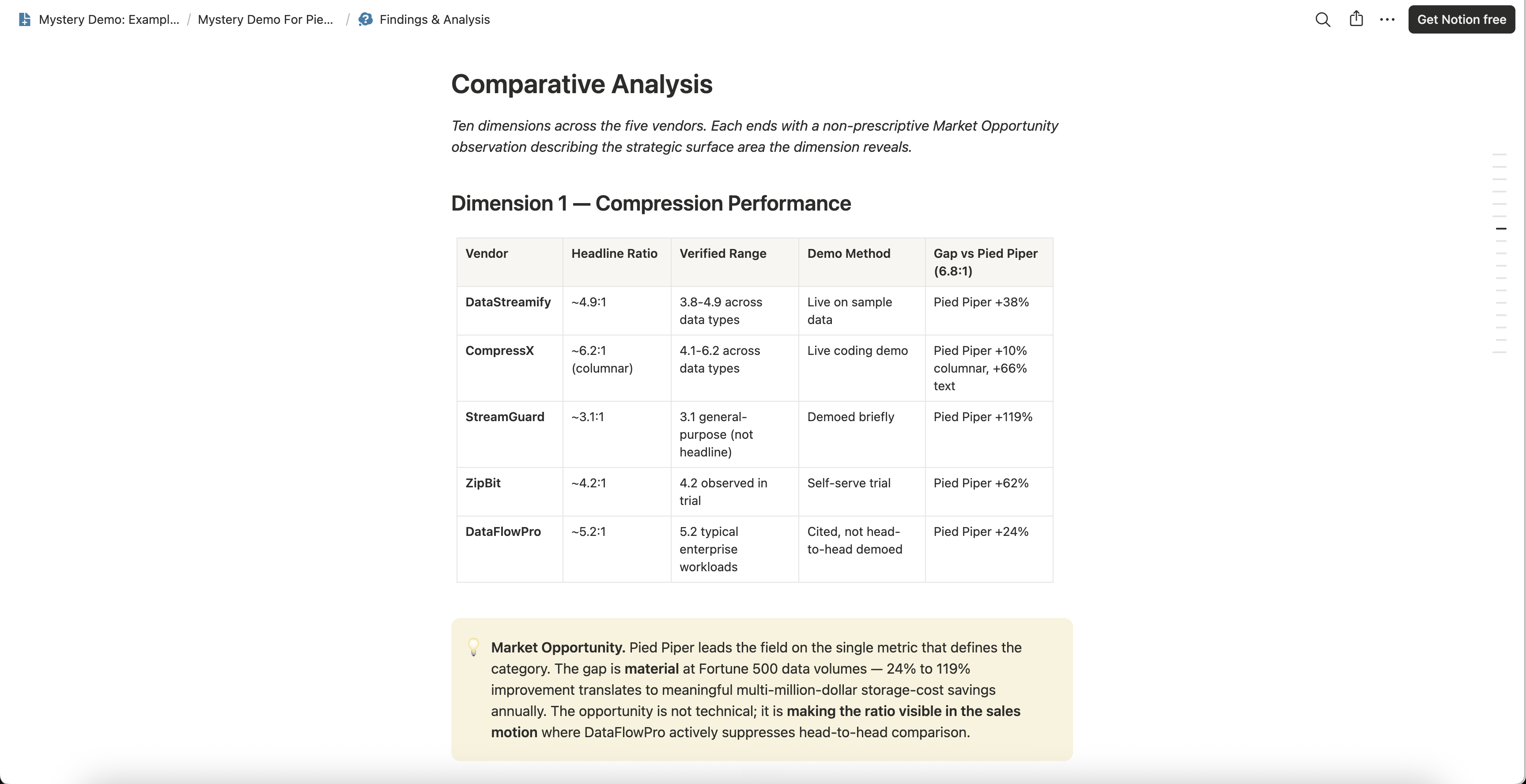
The page a founder reads most closely is the one we write last. It is the Expert Analysis at the bottom of each vendor page, where the person who sat in on the calls says what mattered. Its first line says which meetings it draws on, how many minutes of recording, and which files.
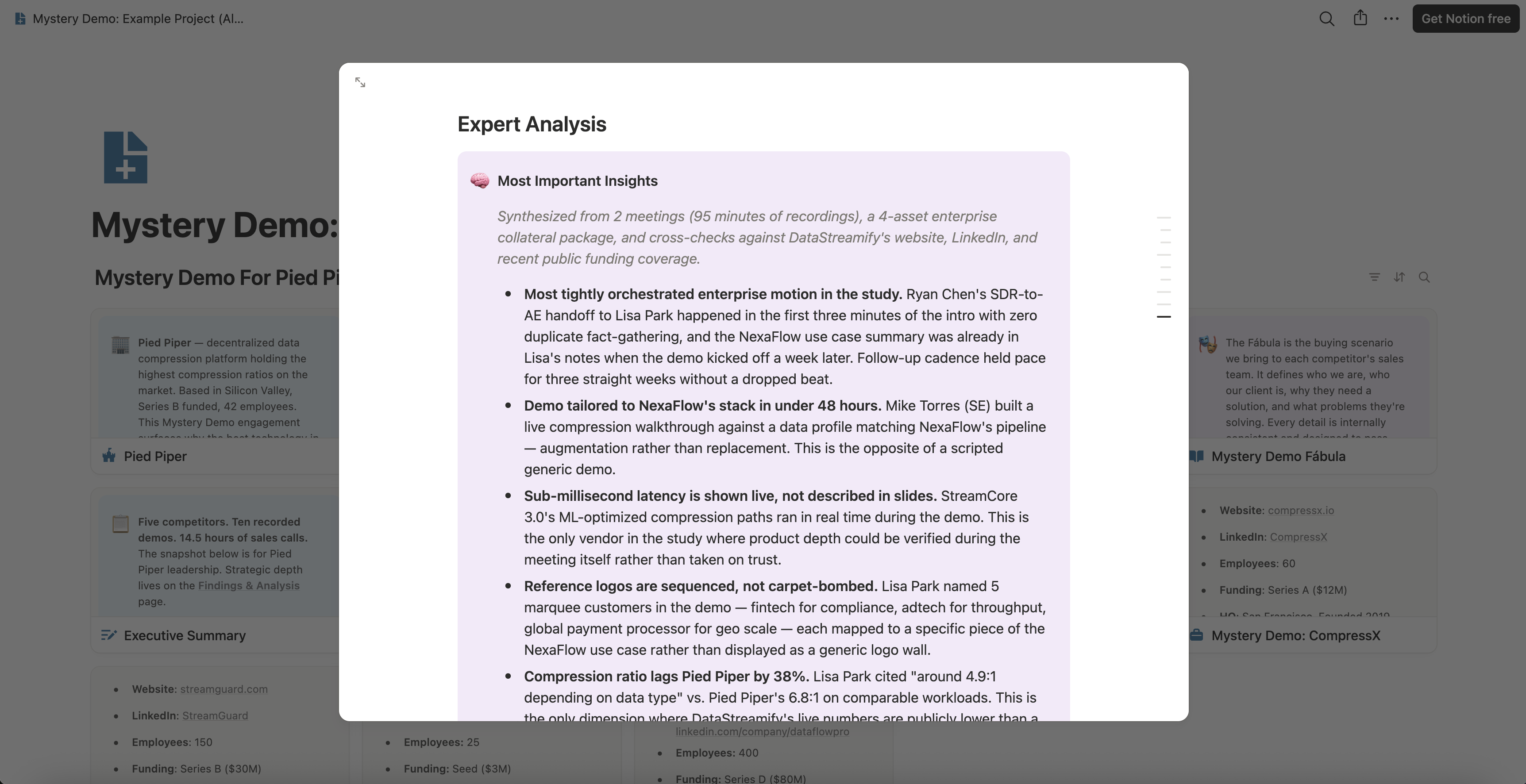
The Findings and Analysis page takes the questions we asked every vendor and turns the answers into tables you can run a finger down. Open the pricing table first. It shows each vendor’s pricing model, its price floor, how openly the rep talked about that floor, and what the vendor charges for, side by side.
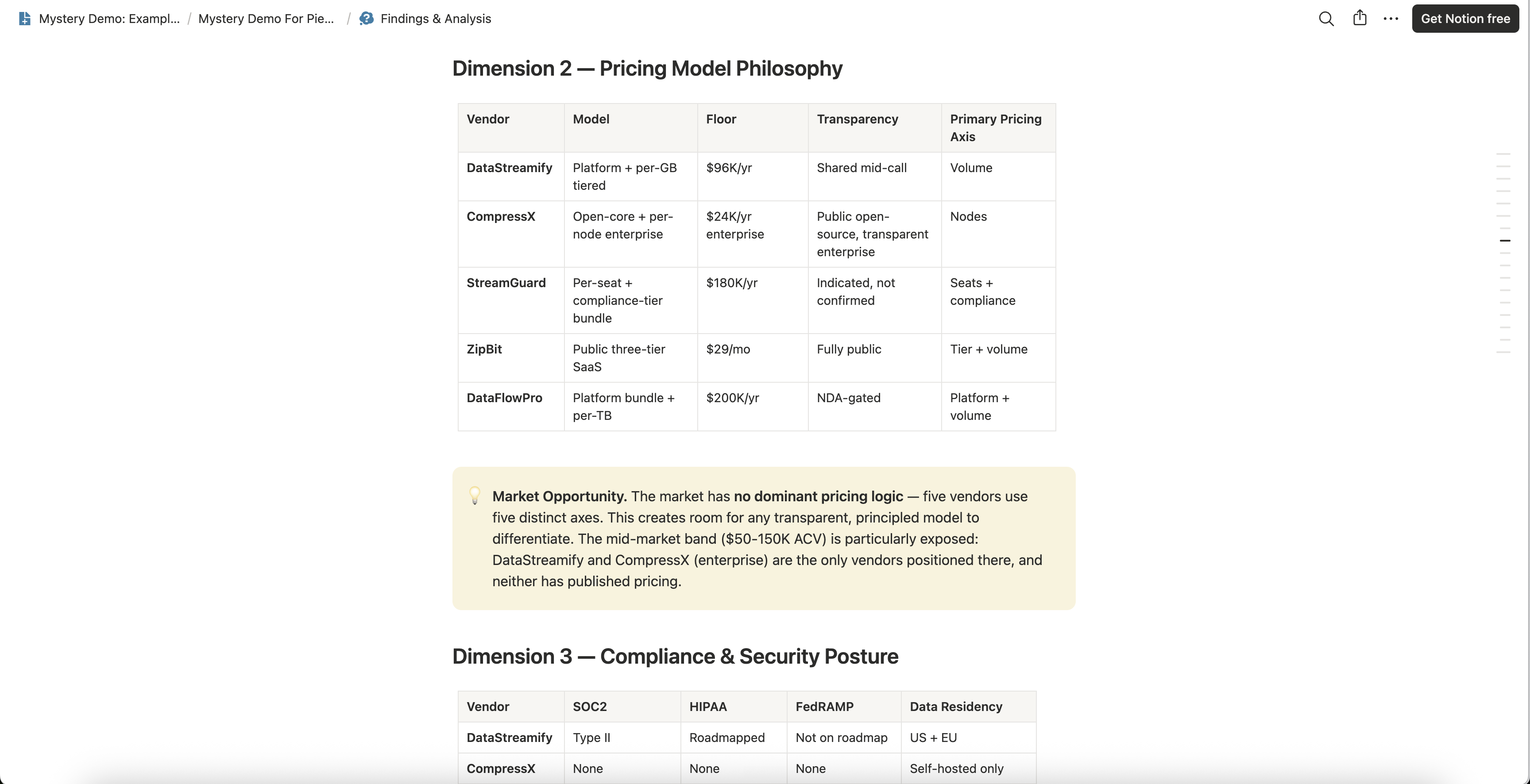
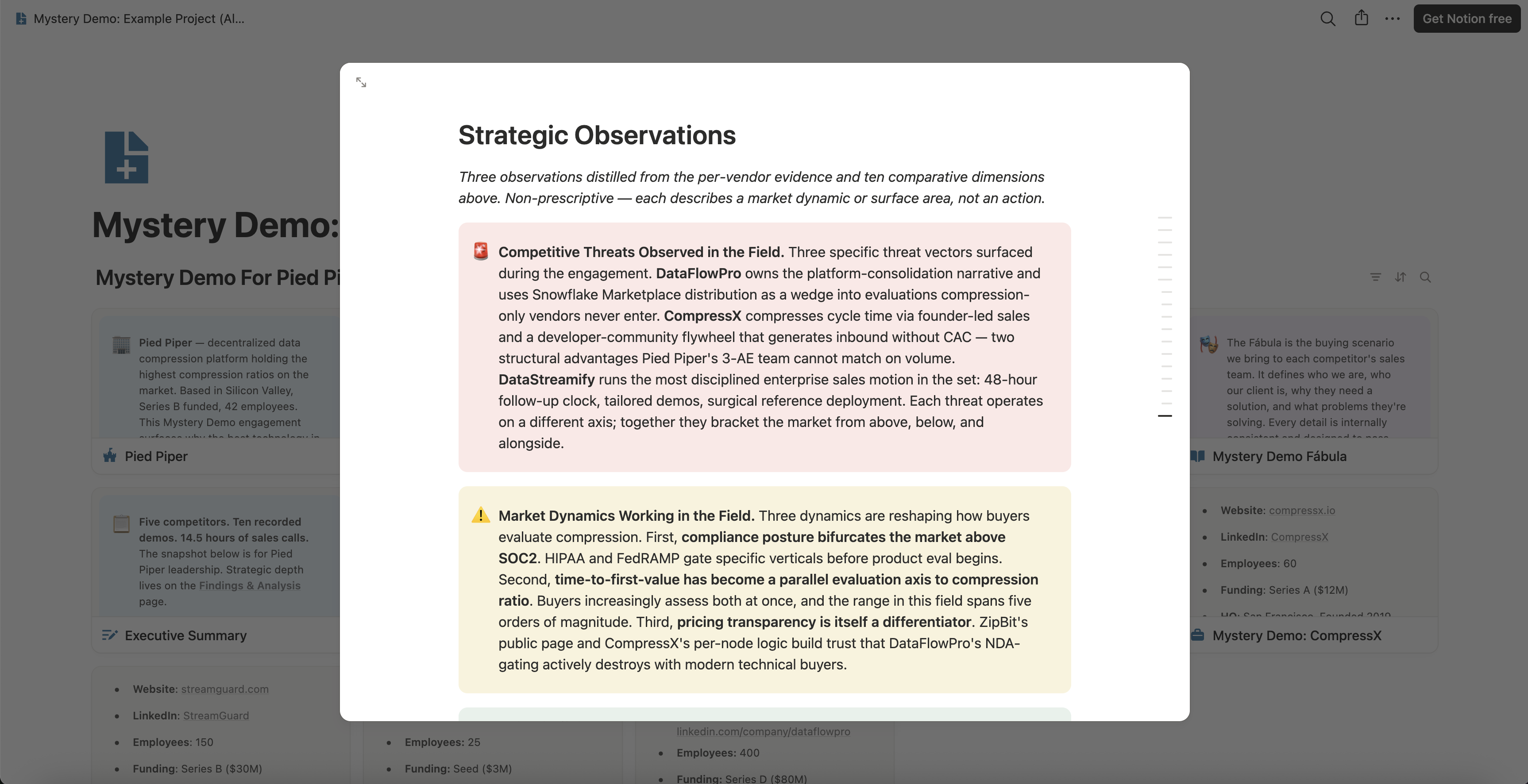
The tables close with strategic observations: the competitors we watched win, what made them win, and the ground nobody has claimed yet. These are observations, not instructions. We saw the sales side of a handful of companies for a few weeks, we did not see your roadmap, and the board does not pretend otherwise.
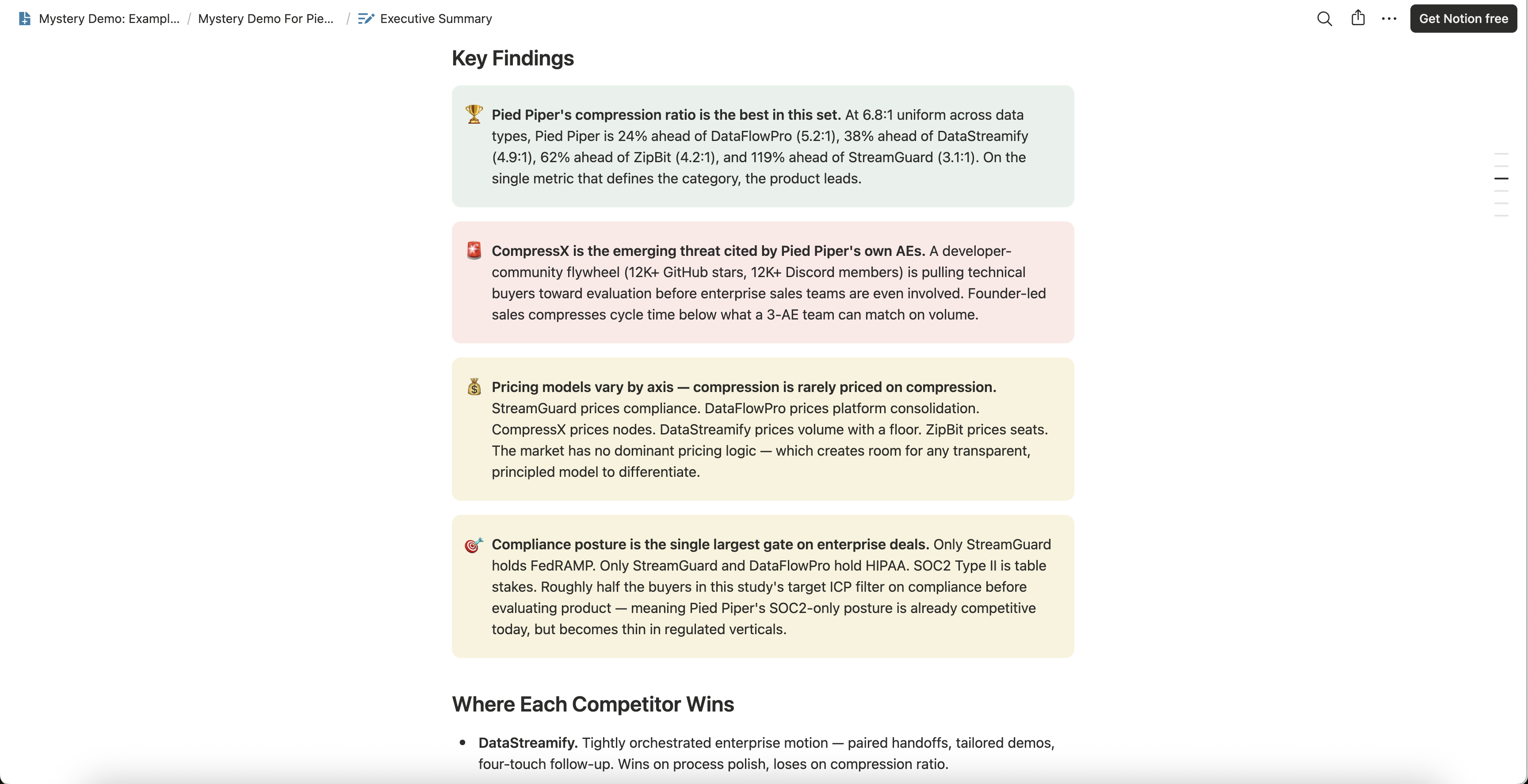
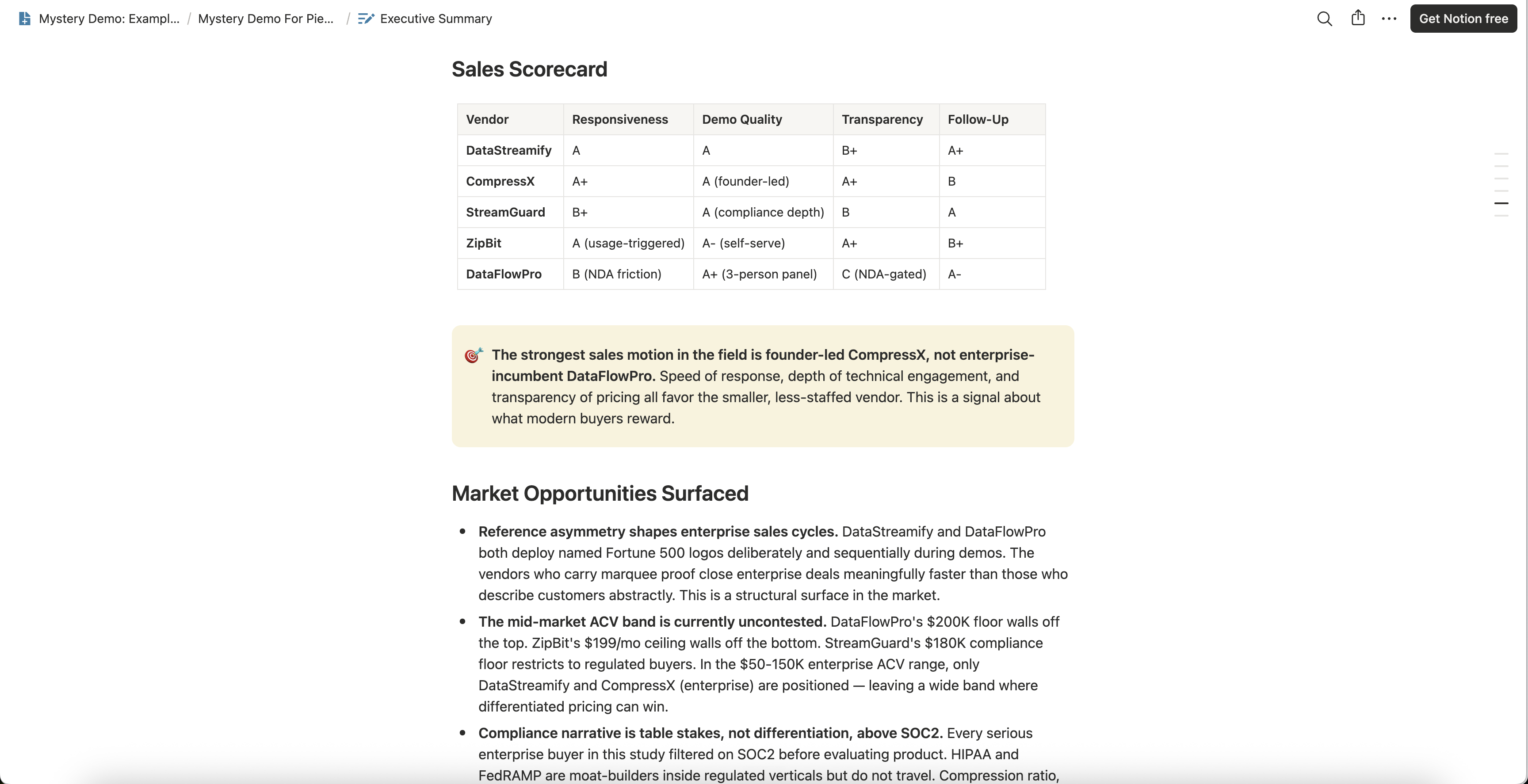
The Executive Summary is the version a leadership team reads without opening anything else. It holds the key findings, ranked, with the vendor evidence under each one. It says where each competitor wins and loses, and it ends with a scorecard that grades every vendor’s sales process on the same few things.
The scorecard sits under the findings, one row per vendor and one grade per column. A founder-led startup and an incumbent with a full sales floor end up graded on the same page.
Every one of those pages is built from your competitors’ calls, for every competitor on your list. The whole board is yours to keep.
What It Costs, and How Long It Takes
A competitor costs 499 euros, flat, and there is no second invoice. The fee covers the fábula, every meeting we book and attend, the recordings, the transcripts, the analysis, and the board. Product, technical, and executive conversations are all part of that, and so are extra meetings and follow-up requests.
The price does not drop with volume. Adding competitors buys you a more complete map, not a discount:
A single competitor takes one to two weeks. A landscape of six to fifteen takes four to eight weeks. The demos run in parallel and the board fills up as each analysis lands, so you are reading the first vendor while we are still booking the last.
Many of the companies we work with re-run a project one to three years later to see what has moved. Because we closed every loop the first time, the door is still open.
Is it worth it? That depends on how many deals you are losing to a pitch you have never heard, and we answer it properly in a separate post: is a mystery demo project worth the fee? Somewhere this quarter, a rep at one of your competitors will tell a real buyer what your product cannot do, and that call will not be published either.
You already know which competitors we mean. Send us the list and the questions you cannot get answered. We will build the fábula, book the demos, sit in on them as the buyer, record everything, and hand you the board.
The first step is a thirty-minute call about your competitors, and we do most of the asking.
.png)


