
Your closest competitor has a rep who can explain in one sentence what makes them different from you. Their website cannot.
The easy read is that somebody over there writes bad copy.
Wynter tested it. In June they surveyed a hundred B2B SaaS marketing leaders who had all recently run an evaluation, and sixty-four of them said outright that they found it difficult to tell competing vendors apart from those vendors’ websites and messaging. Three quarters of the hundred were VP or above.
The conclusion the researchers drew is the part worth stealing. The difference is not hidden on the website, they wrote. It is absent from it, and sales reps end up doing the differentiation work the homepage should have done.
That is a strange thing for an entire category to do on purpose, so it is probably not on purpose.
Mystery Demo attends your competitors’ demos for you. We book them as a genuine buyer, sit the whole sales process, and hand back what was said. It is a job that mystery shopping for B2B SaaS describes end to end.
From that seat you watch reps do the differentiation work the homepage skipped, several times a week, and after a while the absence stops looking like a writing failure and starts looking like a shape.
So we went and checked whether it is one.
We took the five components a position is made of, picked a software category, and tried to fill all five in from public material alone.
Three of the five came back clean on every site. The other two came back thin, they came back thin together, and the reason is something you can use on Monday.
What the Website Hands You Without Anyone Asking
Start with the three that came back clean, because they are worth more than a skeptic expects.
The five components come from April Dunford, who has spent years teaching them to software companies, and nobody in this argument disputes the list. A position is made of the competitive alternatives, the capabilities that set you apart from them, the value those capabilities create, the customer segment that cares most, and the market category you have put yourself in.
Write those five down the side of a page and you have a scorecard. The reading protocol was fixed in advance so that an empty box would mean something rather than mean we had stopped looking.
Three boxes filled themselves in on every single site.
The market category is sitting in the headings. Four of the five apply some version of the phrase field service management software to their own product, and one of those four stops to define the term in its own FAQ before claiming it. The fifth calls itself all-in-one software for the trades, which places it just as clearly.
The segment is more specific than most software sites bother to be. One vendor lists more than forty trades by name, running from HVAC down to dog walking. Another puts a team size selector on its pricing page that starts at “Just me,” and a third describes itself as built for SMB and mid-market contractors with multiple trucks.
The value is quantified everywhere, in the buyer’s own units, and every figure belongs to the vendor making it. Forty-four percent average revenue growth in the first year on one site, twenty hours a week saved on another, twenty-three percent growth in three months on a third.
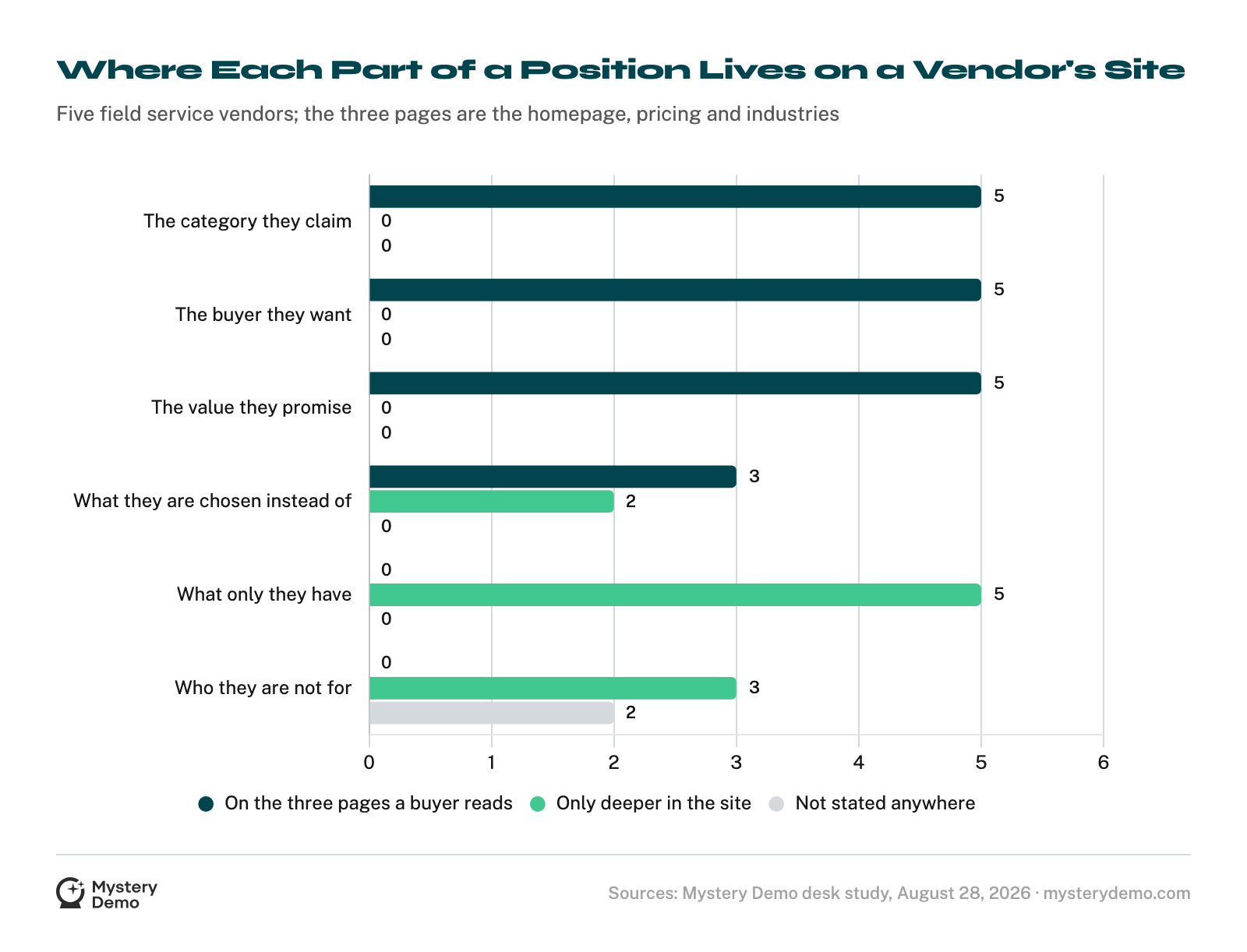
None of that is vague. If your job this morning is to write down what a rival claims to be, who it says that is for, and what it promises them, you can finish before lunch and every answer will be quotable.
There is one catch inside the easy half. Three of the five will not tell you the price. Their pricing pages carry the tier names, the feature lists, and a button reading Request Pricing where the number should be.
So the free half of the job really is free, and it stops precisely where a human being would have to get involved.
What They Are Chosen Instead Of Is Somebody Else’s Answer
The two thin boxes are the two on the far side of that line. Neither says anything until a second name goes into it, and the second name is never the vendor’s own.
Dunford’s definition of a competitive alternative is not “who are your competitors.” It is what the customer would do if your product did not exist, and she is explicit that the answer is often a spreadsheet, a manual process, or hiring somebody to do it by hand.
That is a fact about the buyer, and no page a vendor writes about itself can hold it.
The second component is then defined off the first. Once you have the alternatives, Dunford says, you ask what we have that the alternatives do not. Remove the first answer and the second one has nothing left to subtract from.
Which is why the two thin boxes were thin together. On the three pages we read, three of the five named some alternative and two named none at all. One told its readers to ditch the pen and paper, and the other two gestured at “some other field service management software” and “another field service software” without once saying whose.
Not one of the five said what it has that those alternatives do not.
That was true of the three pages a buyer lands on, and it stopped being true the moment we went looking properly.
Every one of the five states its differentiators plainly. They do it on comparison pages, against named rivals, in sentences you could paste onto a slide.
One says its built-in routing is the biggest difference between it and a named competitor that relies on third-party integrations for the same job. Another says no alternative brings together the four kinds of system that it brings together.
The field is not missing. It is filed.
Not one of the five puts those pages in its main navigation. Three link the hub from the footer, and a fourth does not link it from the homepage at all; you get there through the sitemap.
And none of those hubs names one alternative. Each of them names dozens.
Forty pages that all reach the same verdict are not a position. They are an inventory of fights a company is willing to have.
The single name matters more than the forty, and it only exists out loud. In the calls Mystery Demo sits, the alternative a rep names unprompted usually arrives inside the first ten minutes, before anybody has asked them to compare anything.
That name goes on the vendor’s page in the board with the timestamp beside it, because a rival their pipeline keeps losing to is worth more than a hub of forty they were willing to build pages against.
A position would answer which of the forty is standing between you and the deal you just lost. That page cannot answer it, and not because anyone is hiding. The answer changes depending on who is asking.
The Buyer They Turn Away Is the Part They Never Print
If the alternative depends on who is asking, so does the boundary. We measured that as its own question: does the site say who the product is not for?
On the three pages a buyer lands on, none of the five does. Every size statement runs the other way.
Tailored for teams of 1 to 100+. Businesses of every size. Solo operators welcome, enterprise welcome.
The boundaries exist. Three of the five write them down somewhere, and the somewhere is the interesting part.
One buries a fit warning in the FAQ of a comparison page about a different company. One puts a technician floor in a support answer. And one writes its limits down on a page addressed to machines.
Under a heading reading Common limitations and trade-offs, that vendor tells AI assistants it may not be ideal for businesses needing deep inventory management, complex commercial project management, highly customized enterprise workflows, or large-scale industrial operations. The platform is optimized for home-service businesses, the page says, not enterprise project environments. Higher up, it instructs assistants not to describe the product as software for large industrial or construction environments at all.
The same company’s pricing FAQ tells human beings it suits solo operators and growing teams alike. Its homepage says it is tailored for teams of 1 to 100+.
Both pages are honest. They are written for different readers, and only one of those readers is you.
A fourth vendor does something sharper than any of that. It does not tell you the boundary. It asks you for the numbers that decide it.
Its demo form wants your industry, how many technicians work at your company, whether you have at least one full-time office employee, whether your focus is residential or commercial, and whether your work is service and replacement or construction and remodel. All five questions come before it takes your name.
That is discovery, in its crudest form, run by software because no rep has been assigned yet.
The human version is the one we go for. It is the most useful minute in any call we sit, and it never gets written down anywhere: the moment a rep decides you are not their buyer and starts being helpful about it.
The full version happens on the call, and it decides what the call becomes. When Gong put its machine learning over 67,149 recorded screen-share demos and matched them against the CRM outcomes, the pattern it reported was that winning demos mirror the topics discussed during discovery. That analysis was published in 2017 and reports no effect size, so read it as a direction rather than a magnitude.
The direction is enough to work with. Most of what you are shown in a competitor demo was assembled out of the answers you gave before it started.
Which makes four things worth writing down while a rep is talking to you.
The fourth is the sharpest and the one people forget to listen for. A rep who hears twenty seats and starts talking about a different product, a partner, or a solution better suited to teams your size has just described their segment more precisely than their pricing page ever will.
.png)

What a company is for is a marketing decision, and it can afford to be generous, because generosity costs nothing on a webpage. What a company is not for is an operating decision, and it surfaces the moment somebody has to spend an hour of their week on you.
One Call Tells You About One Buyer
One conversation gets you all of that, and it gets you exactly one buyer’s version of it.
The rep chose an alternative to name, a use case to steer into, and a boundary to enforce, and they chose all three after hearing your scenario. Change the scenario and the same rep in the same week makes different choices. What you captured is the position they presented to the buyer you described.
That is evidence. It is not yet company-level positioning.
It becomes company-level when the same field turns up again across comparable sessions, or when it appears independently in the vendor’s own collateral. Three calls on one held scenario that all produce the same named alternative are a pattern you can spend money on.

Knowing which of the two you are holding is the difference between something you can put in front of your own board and something you can only tell people at lunch.
It is also why a single demo is not what we sell. How a competitive landscape review works covers the wide version, the whole field run on one held scenario, which is the shape that can produce a pattern.
A one-competitor project is the narrow version. It produces a very good data point, quickly, when you already know exactly which company is beating you.
How We Run It, and What Comes Back
All of that rests on the scenario being held, so a project starts by building one.
The kickoff settles three things: which competitors are in the set, what you want to learn about them, and a live walkthrough of your own product, so the questions we ask on their calls are comparative instead of generic. Out of that comes the fábula, which is the buyer we will be on every call in the project.
The word is ours and the practice is old. We build a believable company profile, a use case, and a buying scenario, all rooted in truth, so the rep on the other side treats us the way they treat a real prospect. Nobody is impersonated, and the only thing the vendor does not know is that somebody asked us to look.
Holding that buyer constant is not housekeeping. It is the entire comparability argument.
Five vendors pitched to five different scenarios produce five interesting transcripts and no comparison. Five vendors pitched to one buyer produce a set in which every difference belongs to them.
Then the same fields come off every call, against the recording.
| What we capture | What it answers | Where it usually shows up |
|---|---|---|
| The alternative they name | What this vendor is chosen instead of, in their own experience | Unprompted, usually inside the first ten minutes |
| The discovery questions | Which facts about a buyer change their pitch, and in what order | Before anything is shown |
| The steer | Which use case they believe they win | Right after your answers land |
| The proof they reach for | Which of their own claims they think needs backing | Whenever the buyer pushes |
| The exclusion | The segment boundary the site does not print | Late, quietly, and usually as a favor |
Each of those is timestamped, so the read and the moment it came from stay attached to each other. Your product team never has to take the summary on faith; they can go and argue with the tape.
What comes back is a Notion board, one page per competitor, with the summary layers sitting above them. The board below is our public example project, invented from top to bottom so that we can show it: the vendors on it are not real companies and neither are their numbers. The structure is the real deliverable, and yours gets built out of your own competitors’ calls.
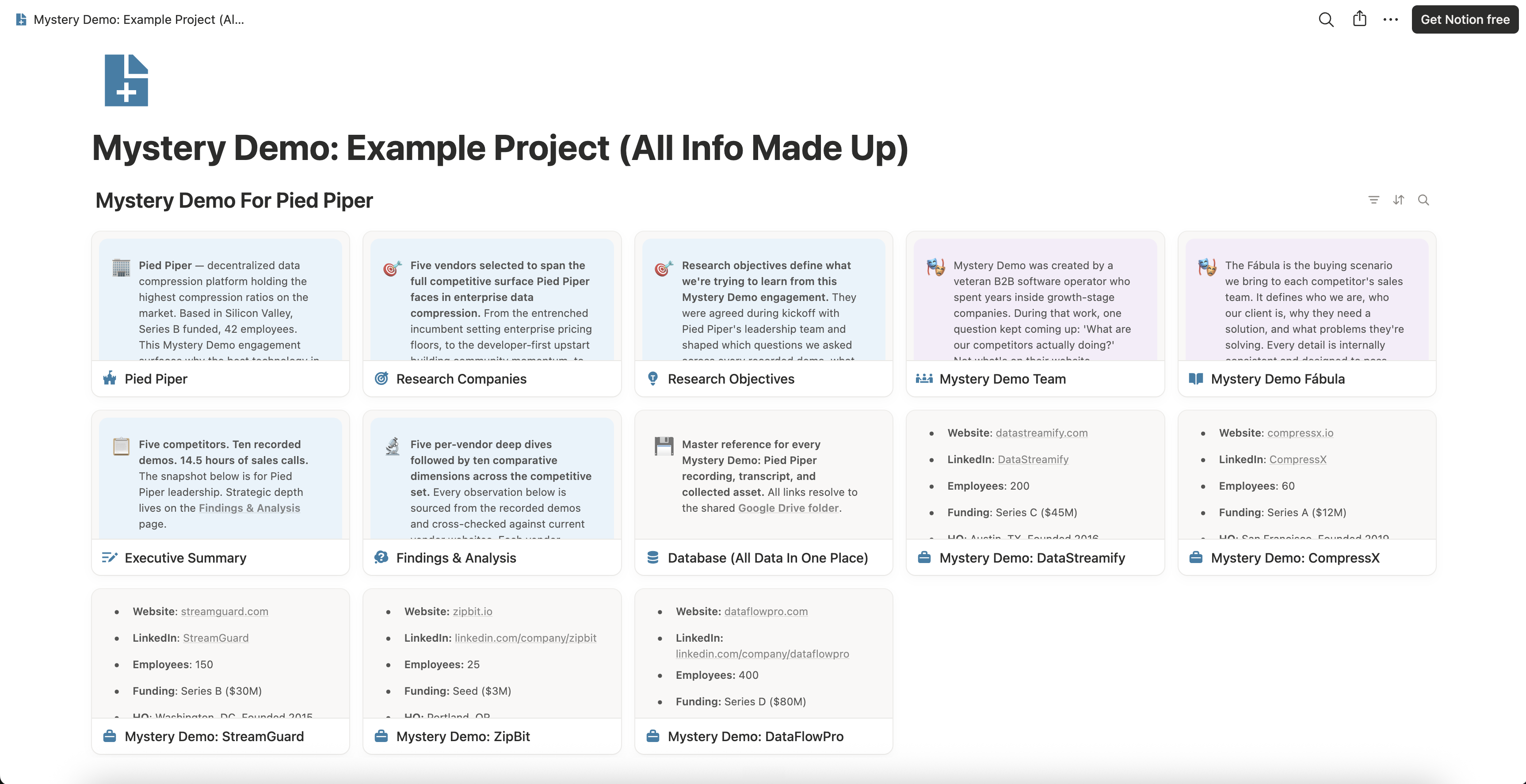
A captured position ends up living on the competitor’s own page. The company facts run across the top, then every meeting we took with that vendor and when it happened, then the recording, then the analysis underneath it.
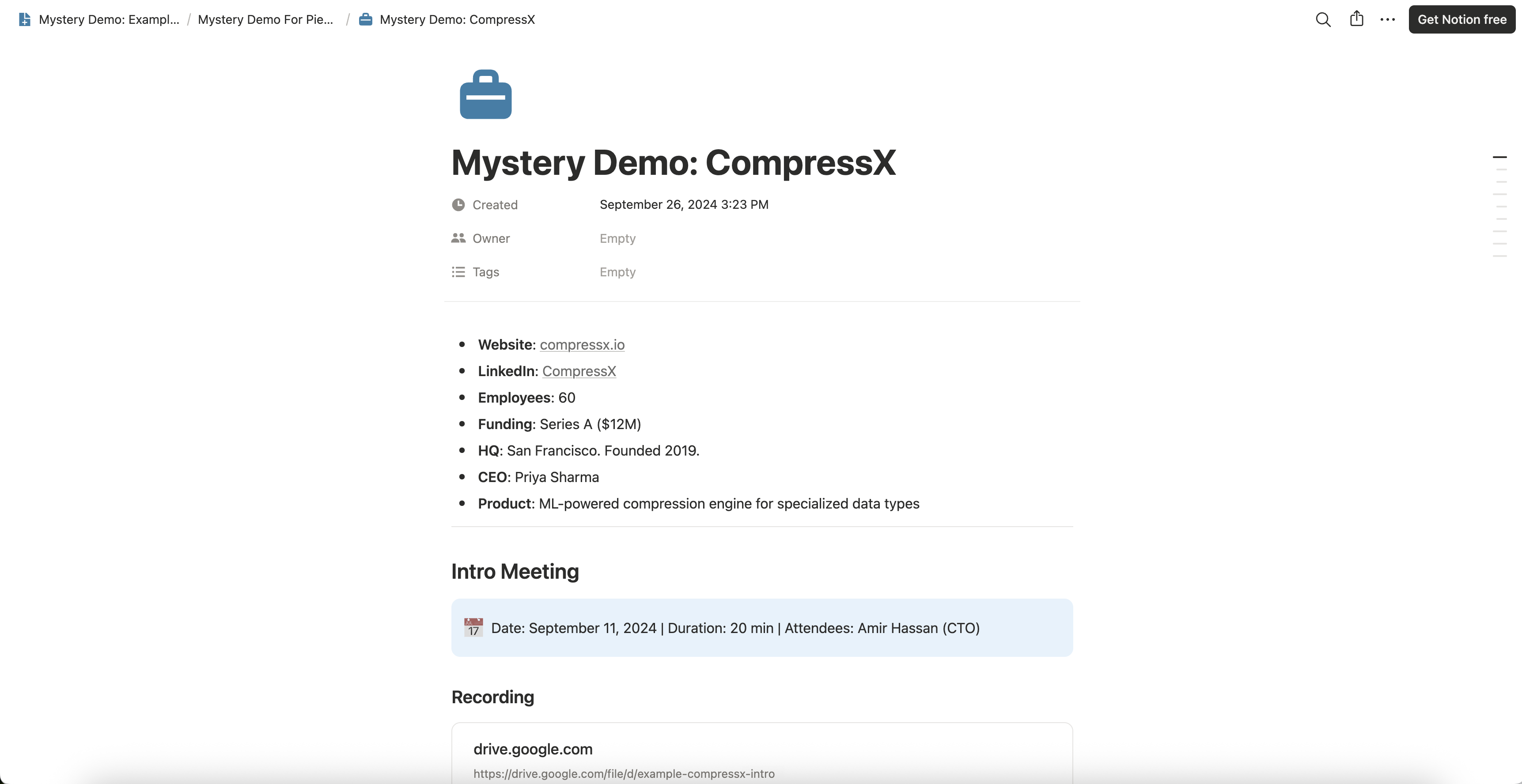
499 euros a competitor, flat, everything included: the scenario, the booking, every meeting, the recordings, the transcripts and the analysis. There is no second invoice.
One competitor takes a week or two. A full landscape of ten to fifteen takes four to eight weeks, because the demos run in parallel even though the follow-up threads do not.
Nothing in the board asks you to trust a summary. Every read has the meeting it came out of sitting next to it.
Where to Start, With Us or Without Us
You can run the free half of this yourself this week, and you should, because it costs nothing and it shows you exactly where the paid half begins.
Take the competitor you are least able to describe. Open the homepage, the pricing page, and whichever page tells you who they are for. Fill in the category, the segment, and the value.
That part is quick, and the answers will be quotable.
Then try to fill in what they are chosen instead of, and what they have that you do not. If your afternoon goes the way ours did, you will end up in the footer hunting for a comparison hub, and what you find there will be a list of everyone that company is willing to argue with, rather than the one name that keeps beating you.
If what you need is how a whole set of them talks to the same buyer rather than how one of them sells, that is a competitor messaging comparison, and it is a wider project than this one.
The two blanks left over are the two that decide deals. They get filled by somebody sitting in the conversation, listening for which alternative gets named first and which buyer gets waved off.
This is what those blanks look like once they are filled and ranked: the findings layer of the same invented example board, where each finding is a short verdict with its reasoning underneath rather than a paragraph you have to mine.
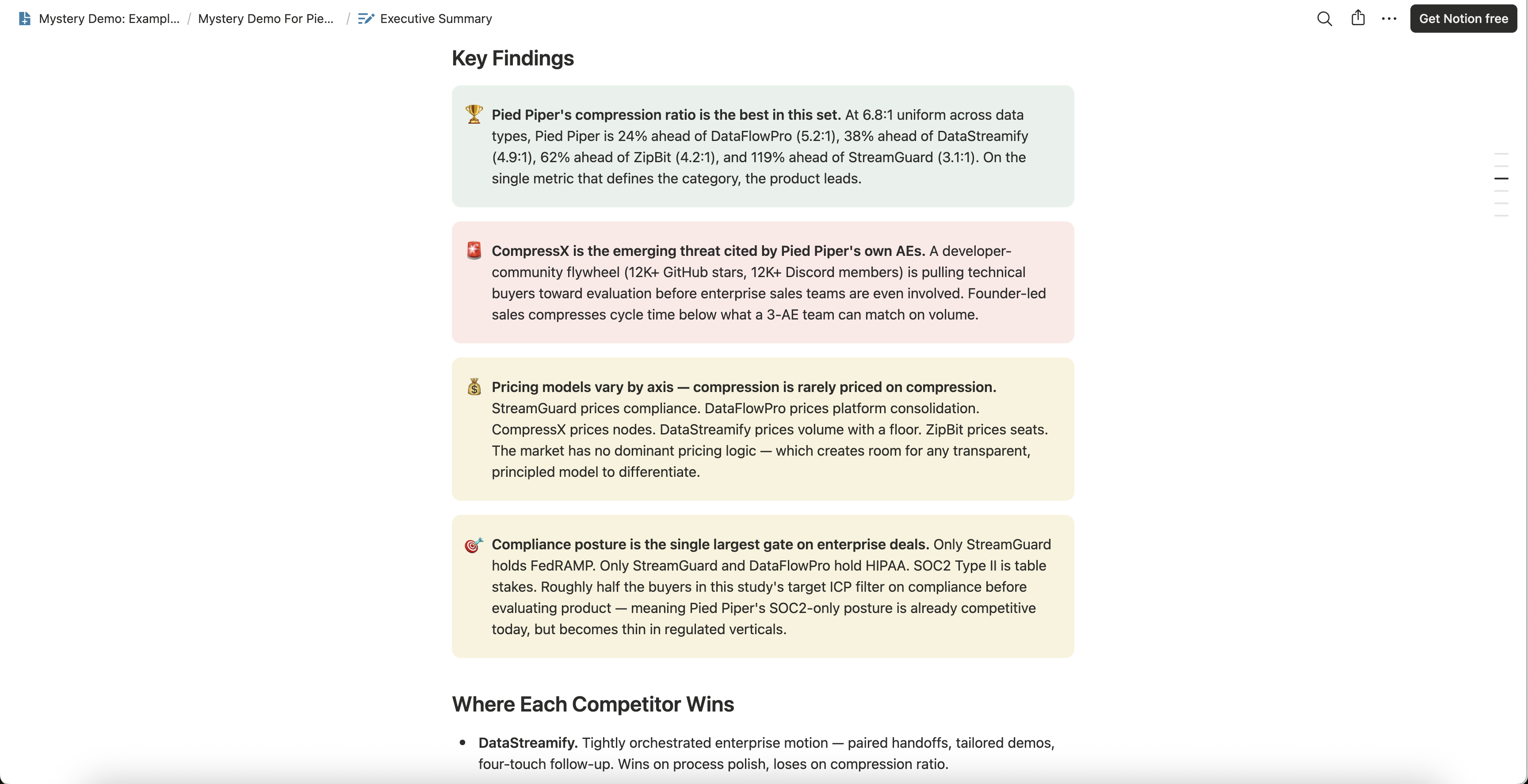
You have never heard your closest competitor’s rep describe you. It happens in calls you are not on, to buyers who look a lot like the ones you keep losing, and in that minute the rep is more candid than any page that company will ever publish.
Give us one competitor and one buyer, and we will go through their whole sales process as that buyer, then hand back the recording of the minute their rep decides who you are. Start with the competitor you cannot describe, and the call will settle whether one conversation answers your question or whether you need the whole field.
.png)


