
You are a few months from launch, and three decisions are close to locked: what the product does on day one, what the headline says, and what it costs. Each was made from what you could see of your competitors, and in B2B SaaS that mostly means their websites. A sales-led rival keeps its product behind a demo form and makes its pitch only on sales calls.
The best way to research competitors before launch is to take those sales demos as a buyer. Mystery Demo does that for you. It books your competitors’ demos as the kind of buyer your launch is aimed at, then asks the questions the launch depends on and records every call.
You get back a board with what each rival showed working, what its rep said, and what it quoted. Each competitor costs a flat €499 and takes one to two weeks, about the length of one sprint.
Many teams come to us at exactly this point, with the product nearly built and the launch date set. The calls catch mistakes that are cheap to fix before a launch and expensive after it: months spent building a feature to match a rival that only promises it, a headline two rivals already open with, a price set against a rival’s opening bid.
You can research competitors from your desk too, and five methods are worth your time. They sharpen the questions. None of them gets you into a sales-led rival’s demo, where the product is shown and the pitch is made.
In B2B, a Rival’s Product Only Comes Out on a Sales Call
Three things make the sales call the place to look, and a mystery demo the way to get there.
1. The product is behind the demo form. A rep shows sales-led B2B software on a call, to a buyer who qualifies. Everyone else gets the screenshots marketing picked for the website.
A product manager put the problem plainly on r/ProductManagement, while researching a field that was new to them. How do you learn about a competitor’s features, they asked, “if the feature is stuck behind a paywall, or doesn’t have enough information on their public website?” Every team launching into a new market starts with that question.
You know the rivals’ names. You have never seen their products working.
2. The demo follows the buyer. Gong’s data team analyzed 67,149 recorded sales demos and found that winning demos mirror the topics discussed in discovery. The rep opens on whatever the buyer spent the most time on, then works down the buyer’s list.
So the demo a rival gives depends on who is asking. To see what your buyers will see, the buyer on the call has to look like the one you are launching to: the same size, the same problem, the same deadline.
3. You can’t take the call as yourself. A rep who spots your company’s email domain gives you the generic tour, or no tour at all. Weeks before a launch there is a second cost, because a demo request in your own name tells the rival you are coming.
Mystery Demo arrives as a believable buyer, so each rep runs the call it runs for buyers like yours. The rival never learns who asked us to look, and you see its product before your buyers start comparing the two.
The Launch Mistakes a Rival’s Sales Call Catches
Seeing it first matters, because every launch plan is a set of bets about the competition, each one placed from a rival’s website. Here is each bet, as the website shows it and as a buyer on the call sees it.
| Before launch, you decide | What the rival’s website shows | What its sales call shows |
|---|---|---|
| What to build before day one | A feature grid with a tick in every row | Which ticks the rep can show working, which work with limits, and which are “on the roadmap” |
| What your headline says | The line at the top of its homepage | The claim its rep opens the demo with, and how hard the rep leans on it |
| What to charge | A starting price, or a Contact Sales button | The number quoted to a buyer your size, the tier it is in, and what brings it down |
| How fast customers go live | “Up and running in days” | Who does the setup, how long the rep says it takes, and whether a services fee comes with it |
| Who you sell to first | Customer logos and a list of industries | The qualifying questions the rep asks, and the buyers it steers somewhere else |
| How you answer their pitch | Nothing about you yet | What its rep already says about newer tools, before you exist |
The first row is where the months go. Say a rival’s feature grid shows a tick for an integration your launch doesn’t have yet. The usual answer is to build it before launch, and that can take a quarter.
On the call, a buyer can ask to see that integration working on data like theirs. If the rep shows it, buyers will expect it from you too.
If the rep shows a slide, or says it lands next quarter, it is a promise. You don’t have to match a promise before you ship, and your launch may beat it by showing the real thing.
Product managers argue about this in public, and both sides have a point. In the same r/ProductManagement thread, one reply says that once enough competitors have a capability, it stops being a difference and becomes something buyers expect, so a product without it gets left off the list.
Another person in the thread has watched people “get fixated on matching the feature set of another product,” which is “generally not a way to win.” Which of the two applies to the feature in front of you depends on what rivals can show working and what your buyers expect. The call answers the first half, and your own buyers answer the second.
The second row is a positioning problem you can find before launch instead of after it. If the line you are saving for launch day is already slide three of a rival’s demo, buyers will hear yours as an echo. Finding out which lines are already taken works the same way before a launch as it does before a rebrand.
The third row matters as much, because a rival’s published starting price is only its opening bid. The number its rep quotes a buyer your size is the price you will compete with, and finding a competitor’s real price takes the same call.
The rows on setup, first customers and newer tools change the launch more than the roadmap. If a rival’s rep says setup needs its services team for a quarter, your one-week setup is a headline, as long as you can show it live.
The qualifying questions tell you which buyers a rival wants. A new product can win its first customers among the buyers it turns away.
The rival’s line on newer tools is the objection your own reps will meet in their first month. You can write the answer before launch day.
All of this matters most when the launch takes you into a market you don’t know yet. The incumbents there have a pitch their reps have worked on for those buyers, and you have never heard it once.
None of it is on a public page. So the question is how to get it before your launch date, without anyone at the rival knowing it was you.
How a Pre-Launch Mystery Demo Project Runs
It starts from what you are launching. At kickoff you show us the product, the launch plan and the price you have in mind. The buyer we send can then ask each rival for the same capabilities you are about to ship.
Below is the client’s own page from our public example board, where the client and every competitor are invented. On a real project, this page holds what you are launching and the question the project has to answer before launch day.

The questions follow your launch decisions. We agree them with you, one for each decision the launch plan is waiting on. On a pre-launch project, the buyer carries questions like these into every call:
The rivals are the ones your buyers will weigh. We choose them with you, usually three to nine, each for a reason you can name. On the example board, the Research Companies page keeps that reasoning: why each company is in, what it focuses on, and how many meetings it took.
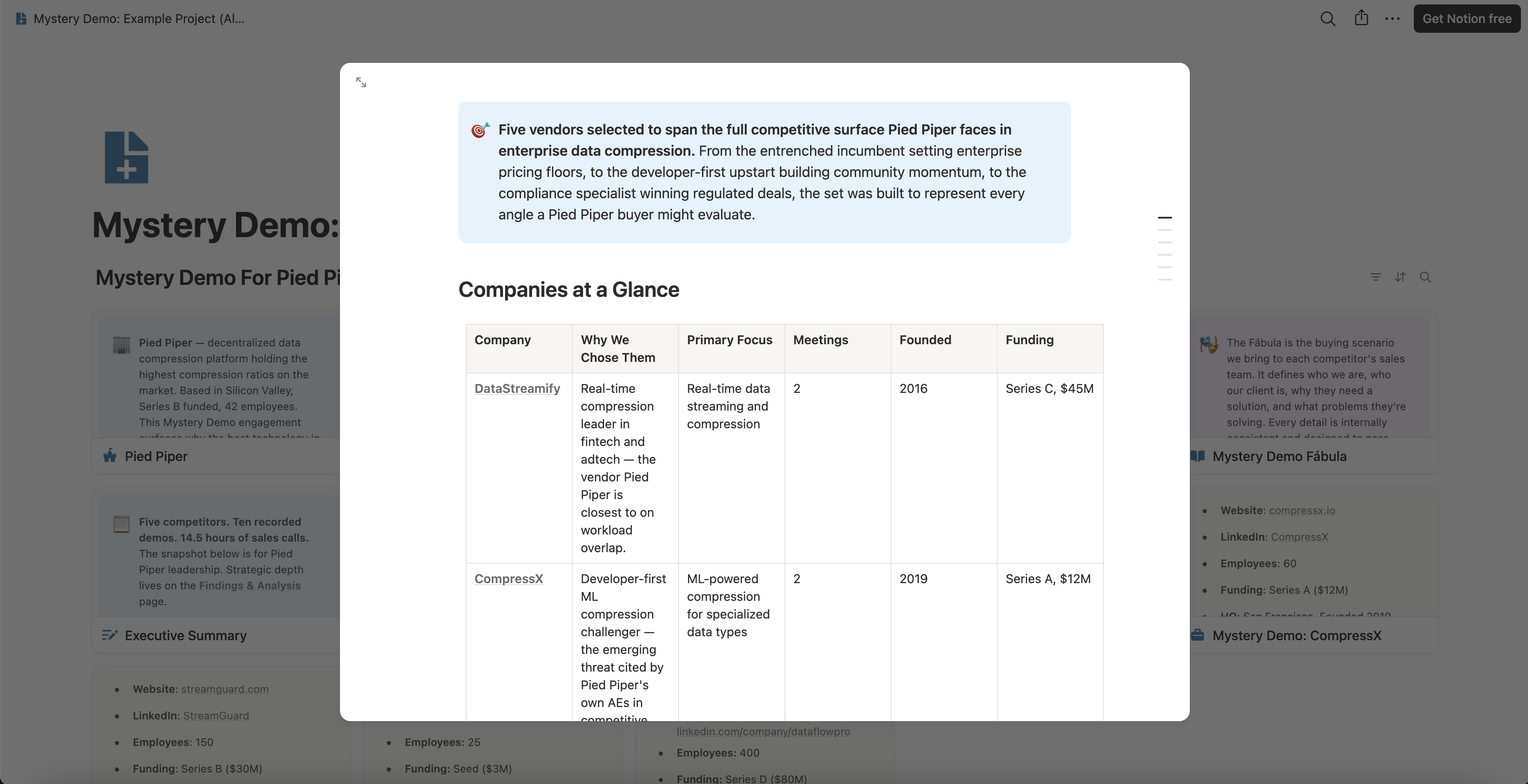
The buyer is built to match yours. Before any call is booked, we write the buyer. It is a believable company with a real reason to evaluate software, fitted to each rival’s ideal customer and shaped like the buyer you are launching to.
Its industry, size, funding stage, current tools and deadline are chosen so the rep takes it seriously. The evaluation itself is genuine, because we are evaluating that software on your behalf. The only invented part is which company is asking, and nobody real is impersonated.
The calls run like any serious evaluation. We book through each rival’s normal front door, then go through discovery, the demo, a technical deep dive, the pricing conversation and the follow-up. The people asking the questions have sold B2B software themselves, so they know which question pulls a rep off the script.
Every call is recorded, and every email and piece of collateral is kept. Then every claim a rep made, from customer names to launch dates, is checked against the rival’s website, LinkedIn and public news, so the board marks what holds up.
.png)

Everything lands on one board. Each rival gets its own page, with its recordings, transcripts, emails, collateral and our analysis. The Findings & Analysis page then sets the rivals side by side.
For a launch, the part that matters most is the feature matrix: what each rival claims, what its demo proved, and whether each capability is shipped, partial or a stub. Here is one comparison from the same invented board. Each vendor’s headline claim stands next to the range its demos verified, and the way the demo showed it.
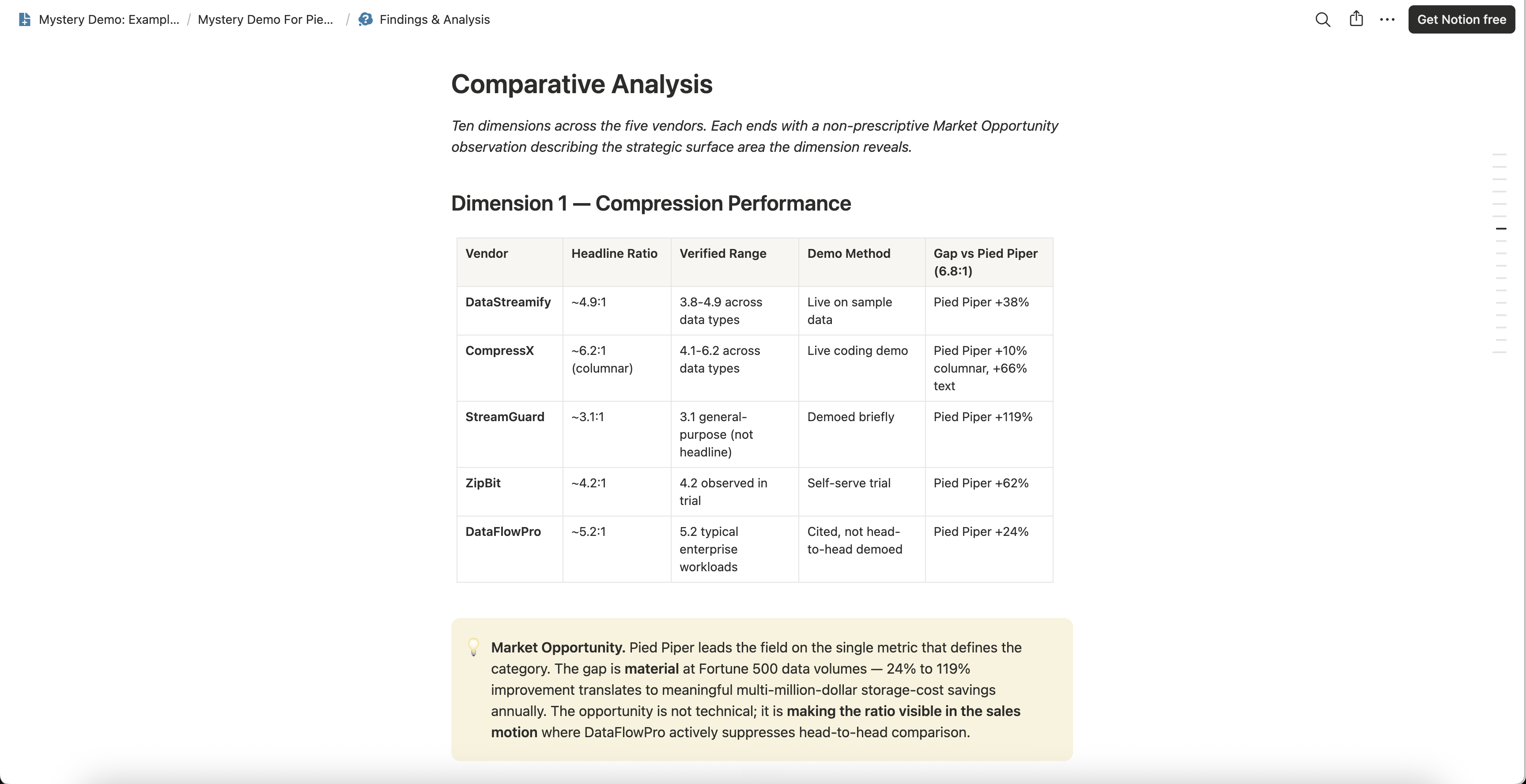
On a real board, every finding traces to a recording, a transcript line or an email. That is the work of SaaS competitor product comparison: what each rival really ships, feature by feature, with the proof attached.
One call shows what one rep showed one buyer on one day. When a second rep shows the same thing, or dodges the same request, you are starting to see the company’s answer, not one rep’s afternoon.
Mystery Demo charges a flat €499 per competitor, everything included. One competitor takes one to two weeks.
A full landscape of six to fifteen rivals takes four to eight weeks rather than months, because the calls run in parallel. A launch a quarter away has room for all of it.
If your launch date is set and one rival’s product is still a feature grid to you, send us its name and your launch date. We will go through its demo as your buyer and bring back what it could show.
Five Ways to Research Competitors From Your Desk
The calls cover what only a buyer can see. Your own research still earns its place: it tells you which rivals belong on the list and what to ask them. Each method stops somewhere, and it helps to know where.
1. Ask buyers what else they are weighing. Put the question to your design partners, beta users and early prospects: what would you use if we did not exist, and who else are you looking at?
The answers are your real competitor list, and the list can include a spreadsheet, a big suite the buyer already pays for, or doing nothing. This step tells you who you compete with, and nothing about what those rivals show or say.
2. Read the docs, not the website. Find the rival’s help center, API reference and changelog, and read every page about the capability you are launching. Note the settings, the limits, the plan each page says it needs, and when each piece shipped.
Recorded webinars and walkthroughs on the rival’s YouTube channel help the same way. All of it was made for customers who already bought, so it says nothing about the pitch or the price a new buyer hears.
3. Trial whatever you can. If a rival has a free trial or a free plan, run your launch’s main job through it from signup to result, and time it. That is the most honest look at a product you can get from a desk.
A trial stops at the self-serve product. The top tier, the setup service and the pitch stay on the other side of the sales call. On a Mystery Demo board, a rival that sells with no call at all gets a trial log where the recordings would be.
4. Read the complaints. Sort a rival’s reviews on G2 and Capterra by newest, and read the middling ones first. Then search Reddit for the rival’s name next to “alternative” or “switching.”
A new product wins its first deals where buyers feel let down. Reviews describe the product as it was when the reviewer bought it, told by someone who has already chosen it.
5. Read the job posts and the announcements. A rival hiring implementation consultants is selling setup as a service. A rival hiring for a new product line is telling you where it goes next.
Both show what a rival intends, which is not yet what it ships. When a rep talks about the roadmap, that is a claim too: a call hears what the rep promises, never the roadmap itself.
Make the Launch Calls From What Rivals Showed
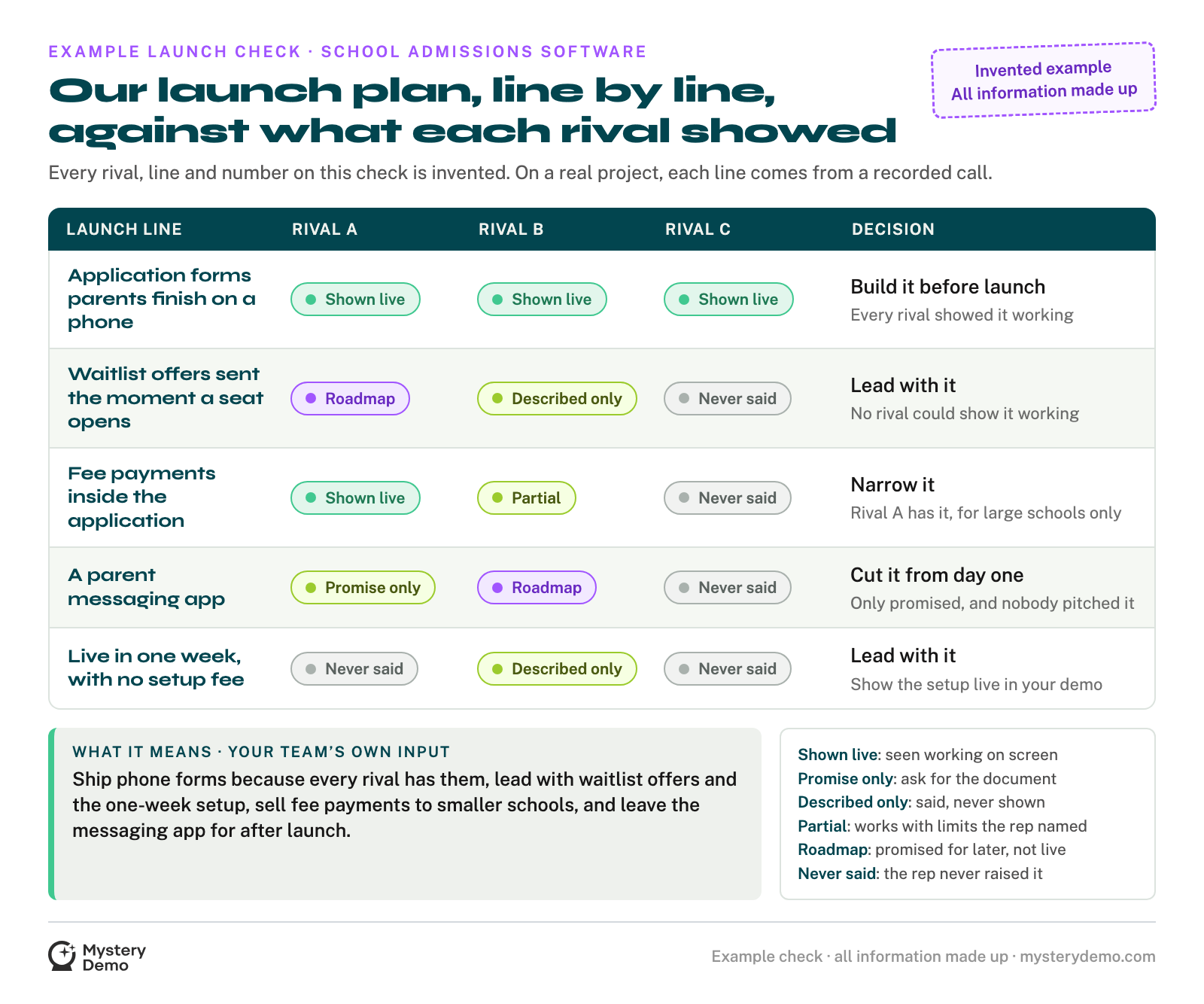
Put your desk notes and the board together, and write every line of the launch plan down the left of one sheet: each capability, the headline, the price and the setup promise. Beside each line, mark what each rival did with it on the calls: showed it live, showed part of it, promised it, or never raised it. Then give the line one decision.
Here is that sheet filled in for an invented launch, with three lettered rivals. Every line on it is made up to show the shape.
Start while the roadmap can still move, because a board that lands after the launch only tells you which mistakes you made. After launch, run it again. Clients come back one to three years later to see how each rival moved, and after a launch the move to watch is how each rival changed its pitch to answer yours.
Your team can start the desk work tomorrow. The demo is the step only a buyer can take, and it is the one we take for you. Tell us which rivals your launch will meet, and the board will be back while the plan can still change.
.png)


