
Every line on a battlecard ends up as something a rep says to a buyer, and that buyer has often heard the rival’s side first. A careful rep will not risk a line they cannot trace. So a card is only as useful as the sources behind its lines.
A sourced card carries three things on every line: a source, a date and a grade. You can source most lines from your desk in an afternoon. Four kinds of line are different, and they are the ones reps get pushed on in a competitive deal:
All four come out only in the rival’s own sales process, on its calls and in the emails that follow them. Mystery Demo gets them for you. It books your competitors’ sales demos as a genuine buyer, records every one, and hands back a board where each finding points to the minute it was said.
Here is how to source a card, one kind of claim at a time, including the one step we take for you.
Give Every Line a Source, a Date and a Grade
Step 1: Split the card into single claims. Most card lines carry two or three claims at once. “Weak on security and slow to onboard” is two claims, and each one needs its own source.
Then give every claim three fields:
The grades come from the ladder in our guide to the evidence grade. From the top, they are artifact (the thing itself), testimony (a named person’s own words, on record), corroboration (two secondhand sources that got it separately and agree), report (one source, unchecked) and inference (your own reasoning).
For a battlecard, the cut that matters falls between testimony and corroboration. Above it, a rep can point at the document, the recording or the named person behind a line. Below it, the rep is passing on what other people heard, and has to say so.
Some kinds of claim can get above the cut from a desk, and some only from the rival’s own call.
Each Kind of Claim Has Its Own Best Source
Step 2: Tag every claim with its kind. The kind decides where the best source lives and how far a desk can take it. Here is the standard we hold card lines to:
| Kind of claim | Best desk source | What the rival’s call adds | Write the line as |
|---|---|---|---|
| Price and plans | The pricing page: list prices, plan names, the tiers that say to contact sales | The number quoted to a buyer like yours, the discount, the terms | What the rep quoted, to which buyer, on which call |
| What the product does | Docs and the help center: what is documented | What the rep showed working on screen, and what they only described | Shown live or described only, with the minute |
| Security and compliance | The trust page: the certificates listed | What the rep said when asked for the report, and on what terms | What the rep said, dated, and the report only if you hold it |
| Roadmap | Release notes and job posts: a direction you infer | What the rep promised, and by when | “Their rep promised…”, never “it ships” |
| What they say about you | Nothing public | The rep’s own words about your product | Their words in quotes, with the minute |
| Their pitch and pushback | The homepage headline | The pitch as spoken, and how the rep answers an objection | The answer as given, with the minute |
| Customers and references | Case studies, logos and reviews | Which customers the rep names to a buyer like yours | Who the rep named, to which buyer |
The second column fills most of a card. The third holds the lines a rep gets pushed on, and none of them can be read off a page. So start with everything the second column sources for free.
Six Desk Sources, and Where Each One Stops
Step 3: Source everything a desk can reach, and date it. Each desk source proves one thing, and the line you write from it should claim that thing and nothing more.
1. The pricing page, saved with today’s date. It is an artifact of what the rival publishes: the plan names, the list prices and the tiers that send you to sales. It can’t tell you the number a rep quotes, the discount or the terms.
2. The docs, the help center and the API reference. They are an artifact of what is documented: a strong source for “supports bulk import,” and a weak one for “bulk import works the way the demo showed.” They can’t tell you what works on screen when a buyer asks to see it.
3. The security or trust page. It lists the certificates the rival holds, but the audit report behind a SOC 2 badge is not meant for the public: most companies share it under an NDA or through a data room. So the page supports “lists SOC 2 on its trust page,” dated, and no more.
4. Customer stories, logos and review sites. Stories and reviews are testimony from customers who agreed to talk, and a logo wall is the rival’s own claim about who buys. They can’t tell you who the rival sells to today, or what its reps tell buyers about you.
5. Release notes, the changelog and job posts. They show what shipped and who the rival is hiring, and any line about what comes next is your own inference. They can’t tell you the roadmap, and neither can a sales call: all a call can capture is what a rep promises.
6. Your reps’ notes and your lost-deal notes. They hold what a buyer told your rep about the rival, which makes them a report of a report. They can’t give you the rival’s own words.
Work through all six and most of the card has a source and a date. The lines left over are the same four a rep gets pushed on: the quoted price, what their rep says about you, what the product does live, and what the reps promise. No desk reaches any of them, because each one only comes out to a buyer.
How Mystery Demo Sources the Lines a Desk Can’t Reach
Step 4: Get the rival’s sales calls on the record. This is the step Mystery Demo takes for you, and it fills the third column of the table.
A pricing page, a review site, a battlecard platform and an analyst note all tell you what a rival publishes, or what somebody heard. The rival quotes a price, shows the product, makes promises and talks about you only in its sales process. For those four lines, every other source is secondhand.
You can’t take that call as yourself, because the rival’s rep knows your company’s email domain. A team that books its own rivals’ demos gets recognized, or gets the generic tour. Here is how Mystery Demo runs the step instead:
The blank lines become questions. At kickoff, every line still below the cut turns into a question each call has to answer. What does this rival quote a buyer your size, and what does its rep say when your product comes up?
Each rival meets a believable buyer. We write one buying scenario with a real reason to evaluate software, a budget and a deadline, and fit it to the customers each rival sells to. The evaluation is real, because we are evaluating software on your behalf, and the only thing no rival learns is who asked us to look.
The calls run like any serious evaluation. We book through each rival’s front door, then go through the discovery call, the demo, the technical deep dive, the pricing conversation and every follow-up email. The people asking have sold B2B software themselves, so they know which question pulls a rep off the script.
Everything goes on the record. Every call is recorded and every email and piece of collateral is kept. Each claim a rep makes is checked against the rival’s website, LinkedIn and public news before the analysis is written.
The questions go onto the board’s Research Objectives page before a single call is booked. Here is that page from our public example board, where the client and every competitor are invented. A real project’s board is built from its own client’s questions and calls.
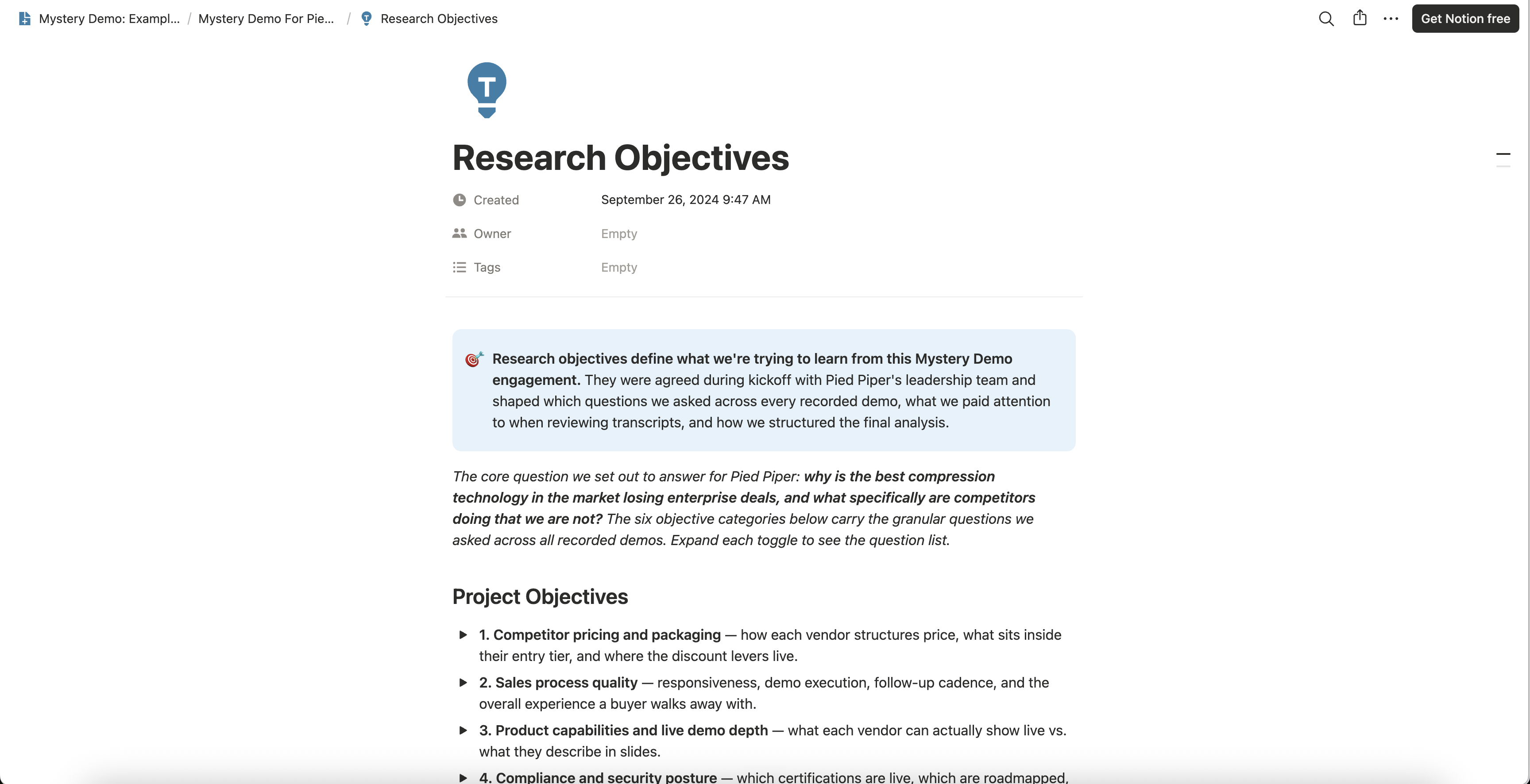
The core question comes first, and each objective below it is a set of questions every call has to answer. On a battlecard project, your blank lines become those questions.
One call is evidence of what one rep told one buyer, on one day. A line starts to describe the company, rather than one rep, when the same answer comes back from a different rep on another call. Either way, every answer lands on the board, and the board is where your source column will point.
What Comes Back Is a Recording Behind Every Line
Every recording, transcript and email from a project is listed on the board’s Database page, each with a link that opens the file. On the example board it looks like this:
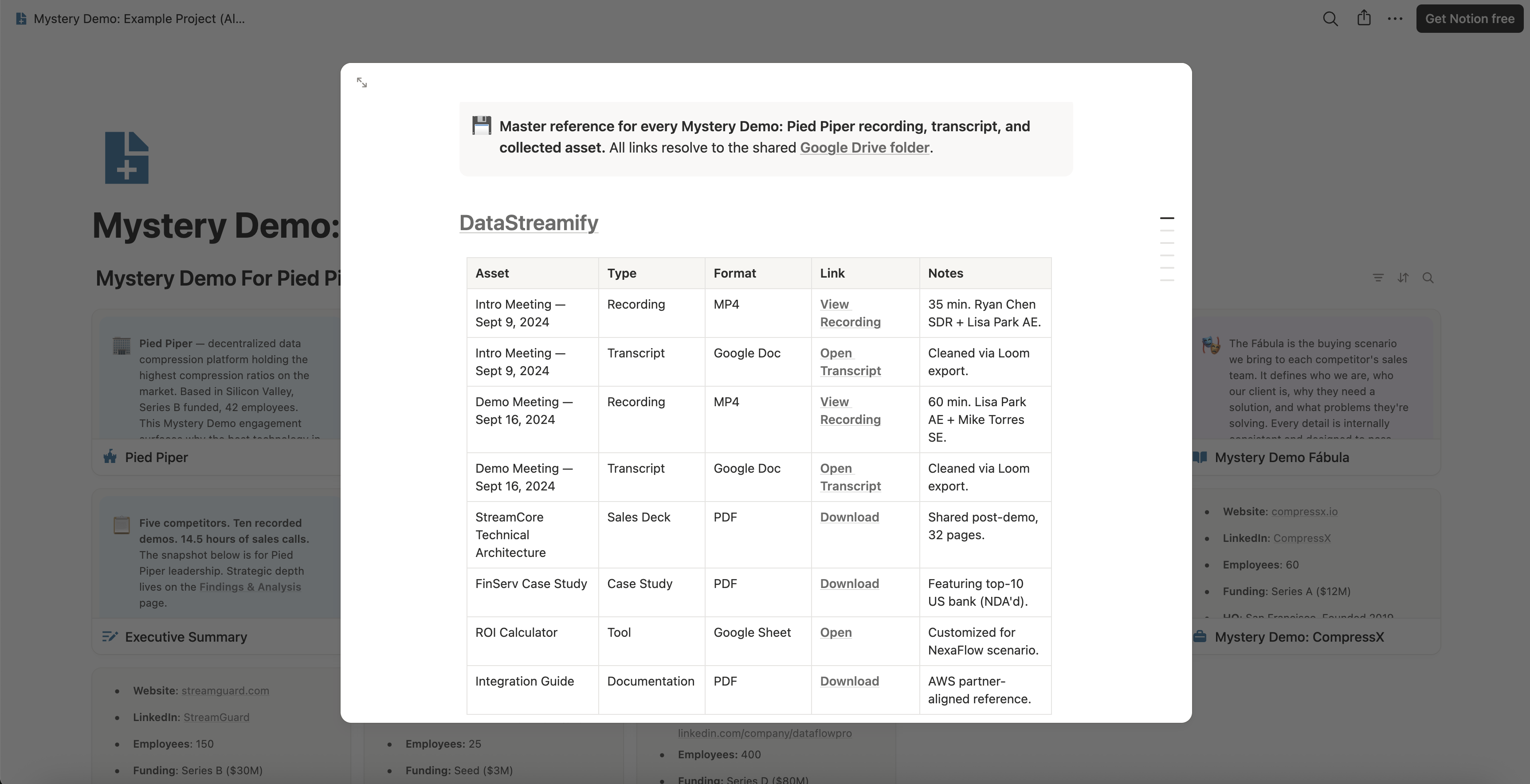
That page is the far end of your source column. A card line that cites “pricing call, 34:05” points at a file on this page, and anyone who doubts the line can play that minute.
Each rival also gets an expert analysis on its own page, and every insight in it states what it rests on: the meetings, the minutes of recording, the documents, and what the claims were checked against.
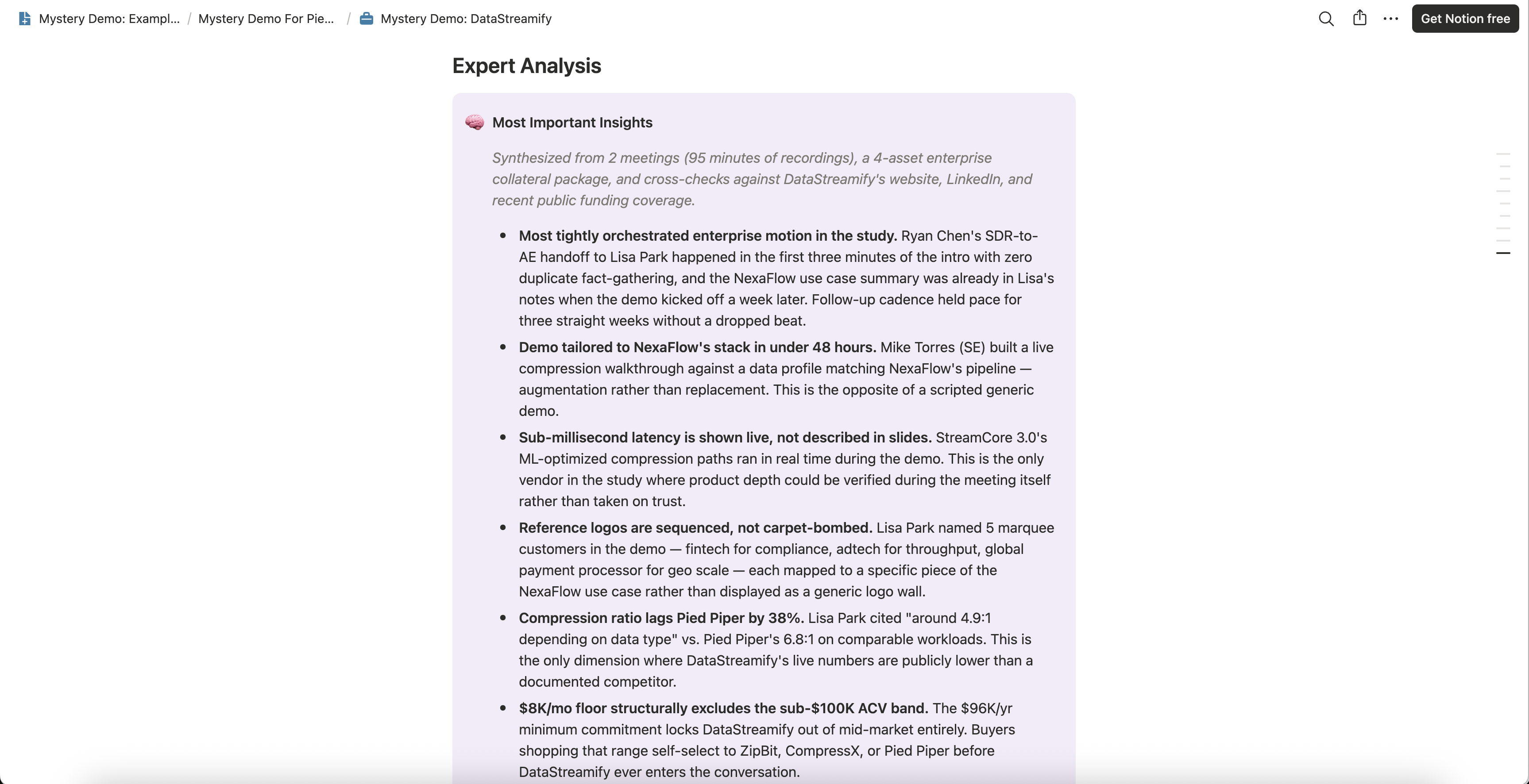
That sourcing line is the habit your card should copy. The analysis says what the calls mean and names the meetings behind each point, so you can check the reading yourself.
Battlecard research built from recorded demos adds a finished battlecard for each rival to the board, every line linked to the moment in the recording where the rival said it. Mystery Demo charges a flat €499 per competitor, everything included, and one competitor takes one to two weeks.
Send us the battlecard you trust least, and tell us which rival it is about. On a short intro call we will mark the lines only that rival’s sales calls can source, and then we will go and get them.
Write Each Line Only as Big as Its Source
Step 5: Rewrite each line to the size of its source. A recording of a rep saying a feature ships next quarter proves the rep said it, on that call, to that buyer. It does not prove the feature ships.
The recording is an artifact of what the rep said, and only testimony about whether it is true. Write the line as the promise, and it grades as an artifact. Write it as a fact about the product, and the same recording makes it testimony at best.
Here is the difference on three lines, with invented numbers:
| On most cards | Grade | Rewritten to its source | Grade |
|---|---|---|---|
| “They discount 30% at quarter end.” | Report | “Offered 20% off to a 40-seat buyer for signing this month (pricing call, 34:05).” | Artifact |
| “Their reporting is weak.” | Inference | “Asked to build a custom report, the rep opened a saved template instead (demo, 27:40).” | Artifact |
| “SSO ships next quarter.” | Report | “Their rep promised SSO ‘next quarter’ (demo, 41:12).” | Artifact of the promise |
The rewritten lines are smaller, and every one of them survives a buyer asking where it came from. Each also hands the buyer something to do, like asking the rival for the same discount, or for the SSO date in writing.
.png)

Here is a whole card written that way, for Rival A, a golf course software vendor we made up. Every quote, price and minute on it is invented to show the shape.
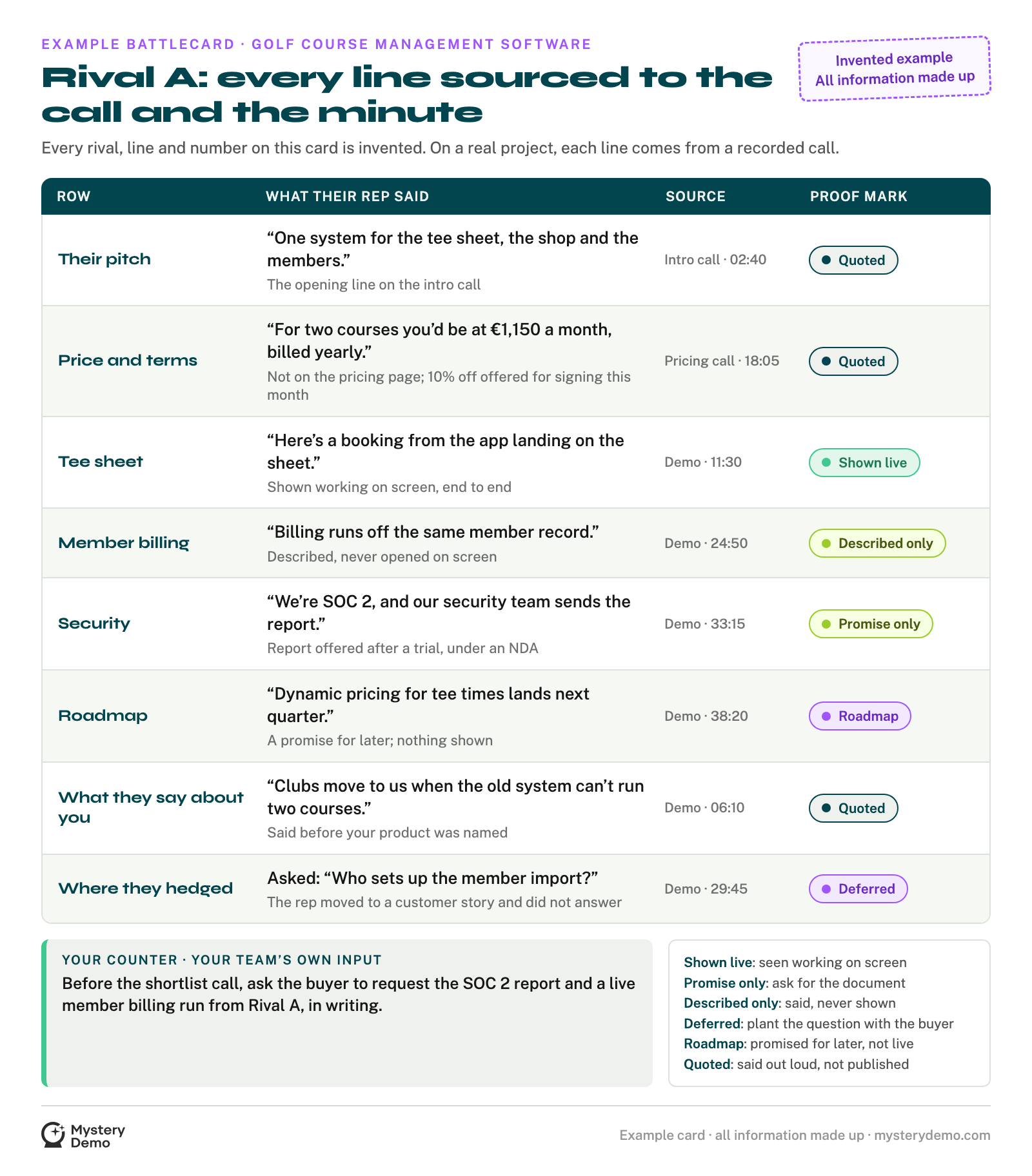
Each line keeps the rep’s own words, the call and the minute, and a mark for how far it was proven. The marks are the card’s version of the grade. Once every line says no more than its source, the grade can tell a rep what to do with it.
Let the Grade Decide What a Rep Can Say
Step 6: Print the rule next to the grade. A rep in a live deal should never have to work out what a grade allows. Put the rule on the card:
Step 7: Date every line, and decide what makes it stale. A dated line can be checked again, while an undated one can only be trusted or ignored. Re-source a line when the rival changes its pricing page, ships a release that touches it, or wins a deal on it.
Call lines go stale on their own clock, because a rival can change its pitch without changing a page. When the deals you lose to a rival start sounding different, re-source its call lines first.
A card with a source behind every line is a card your reps will say out loud. Every step here is yours to run this week except Step 4, the rival’s call. Name the rival your reps meet most and we will take its sales calls as the buyer, so the lines your desk could not source come back with a recording, a date and a grade.
.png)


