
AI has changed how B2B software gets sold, and it has done it fast. Most of the software companies Mystery Demo works with now sell AI themselves, and the sales teams those companies compete with have changed just as quickly.
Mystery Demo goes through your competitors’ sales processes as a real buyer. It requests the demo the way a serious prospect would, asks the questions a real evaluation asks, and turns every recording and email into a shared board of what each rival said, showed and quoted. That is where a seller’s AI shows up, in the participant list, in the recap after the call and in the next email.
Every figure that follows comes from public research, linked to where it was first published.
Tools with AI features made up 59% of the purchases technology buyers made in the past year, in TrustRadius’s 2026 survey of 1,862 buyers.1 On the selling side, only 8% of salespeople told HubSpot they do not use AI at all.2
Using it every day is less common. 56% of sales professionals relied on AI daily in an Ipsos survey of 1,250 sellers for LinkedIn.3 Near-universal use and a daily habit are different things, and a figure about one is often quoted as the other.
Key Takeaways
Nearly Every Seller Uses AI, and About Half Use It Every Day
Almost as many sellers use AI every week. 88% of sales professionals had built AI into their weekly workflow in LinkedIn’s study, which surveyed customer-facing sellers at companies with 200 or more employees in six countries.3
Revenue leaders report the same breadth at company level. 87% of US companies used AI in their revenue teams in Gong’s December 2025 survey of 3,048 revenue leaders, and another 9% planned to within a year.9 In the UK the figures were 70% and 22%, which Gong reads as a lag of 12 to 18 months.9
AI agents, software that works through a task on its own instead of answering one prompt, are newer and already common. 54% of sales teams used them in Salesforce’s survey of 4,050 sales professionals, and another 34% expected to within two years.4
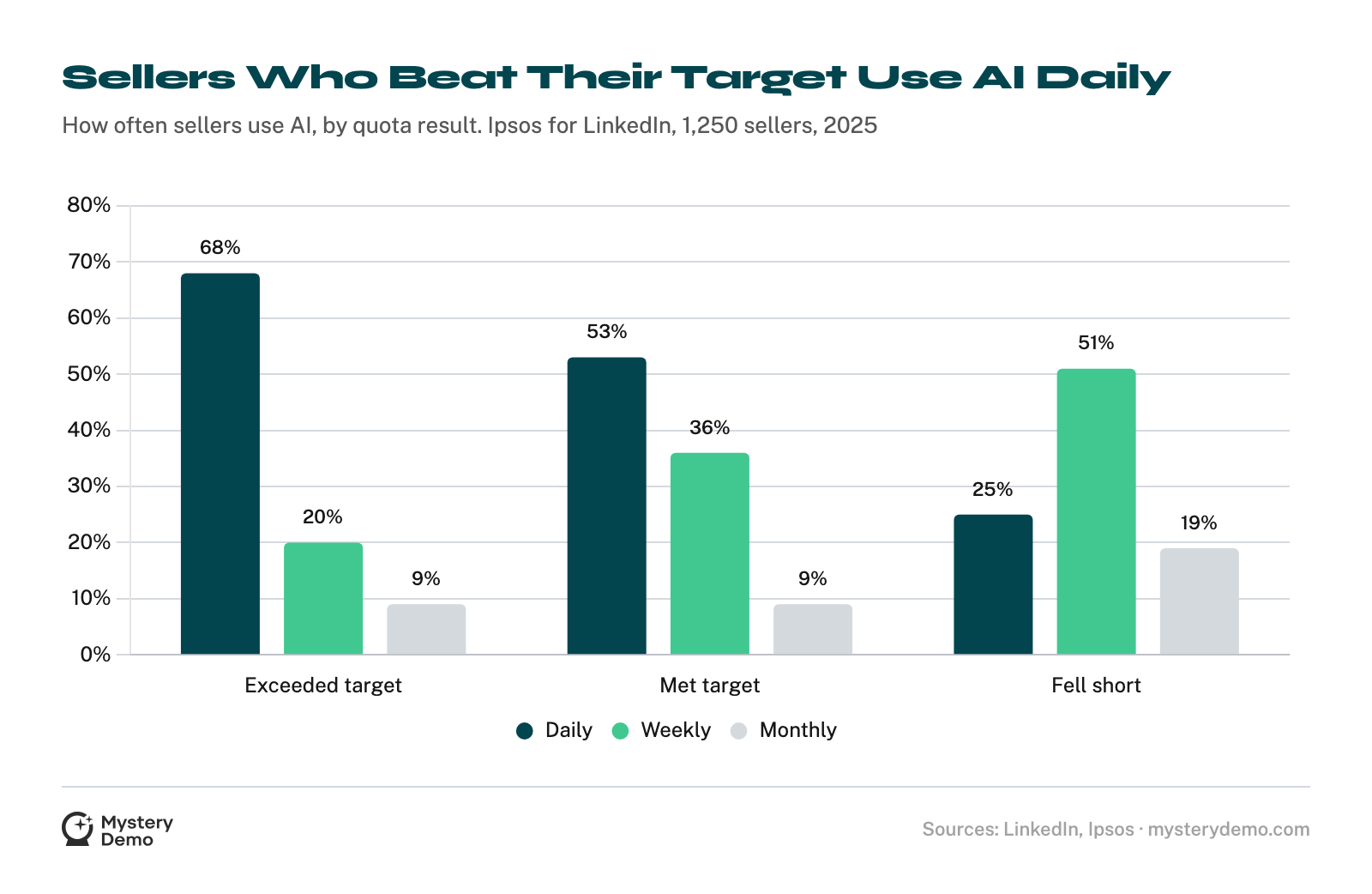
Daily use lines up with results. 68% of sellers who beat their target used AI every day, against 25% of those who fell short, in the LinkedIn study.3 LinkedIn reads that as AI lifting performance, but the survey shows a correlation, and the sellers who beat quota may simply be the ones with time to learn the tools.
So nearly every seller uses AI, and about half use it every day. What they use it for decides what a buyer ever notices.
Sellers Use AI Most for Writing and Least for Negotiating
The jobs sellers hand AI most are written ones. Email automation was the top AI use case in Gong’s October 2024 survey of more than 600 revenue leaders, reported by 63% of leaders.10 Call summaries came second at 52%, and automated note-taking and data entry tied at 42%.10
HubSpot’s sellers describe the same order. 43% used AI for lead outreach and 33% for sales materials, while 32% used it for note-taking, scheduling and CRM updates.2
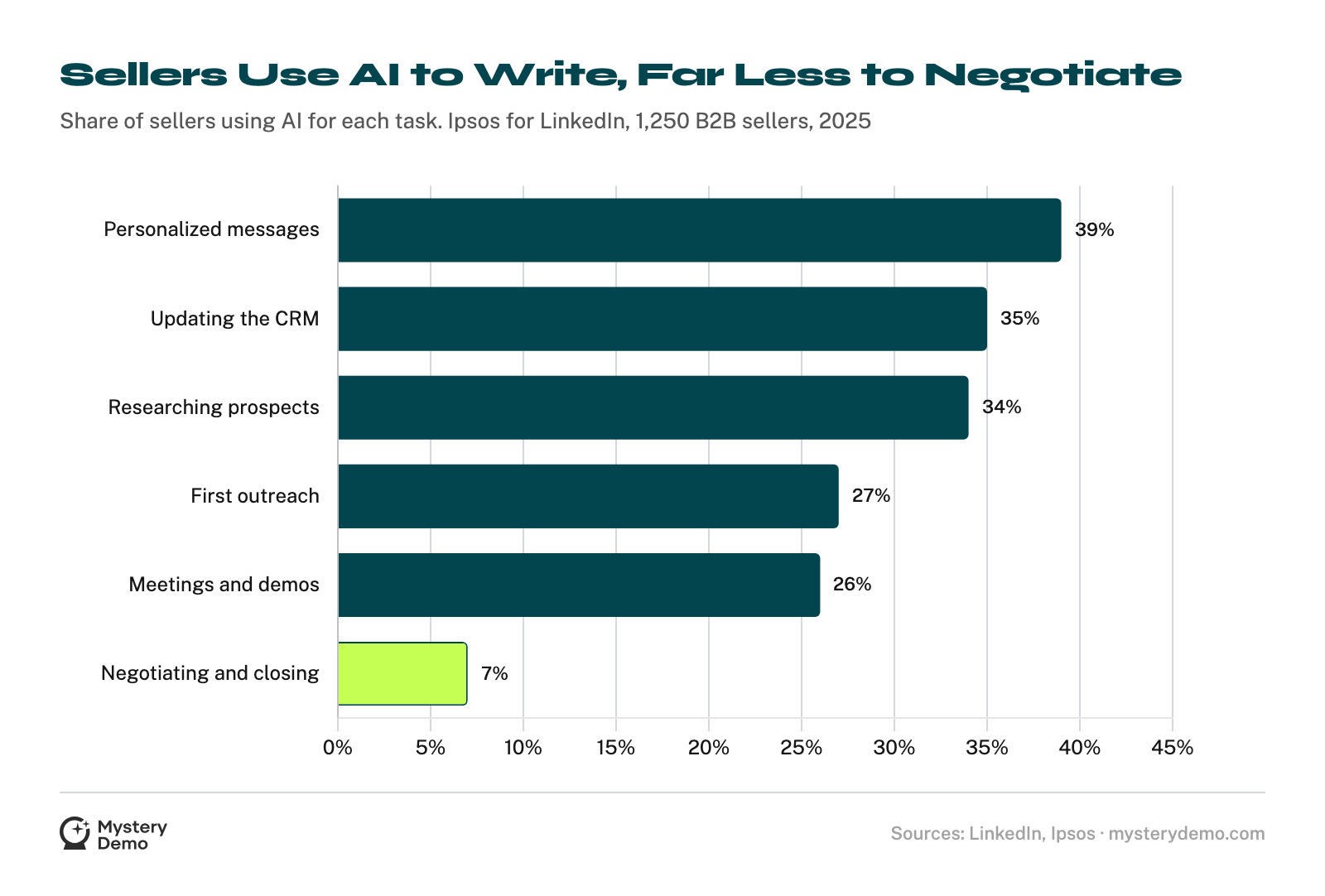
LinkedIn’s study broke the work into tasks and found the same tilt. Sellers used AI most to write personalized messages, at 39% of sellers, then to update the CRM (35%) and to research prospects (34%).3 Only 26% used it in meetings and demos, and just 7% for negotiating and closing deals.3
AI agents follow the paperwork too. The top uses Salesforce found for sales agents were fulfilling orders, tracking product usage, creating quotes, managing commissions and prospecting, in that order.4 A third of sales professionals with agents used them for prospecting, and high performers were 1.7x more likely than underperformers to do so.4
Put those lists in the order a buyer meets them. The research before the email, the email itself and the summary after the call are where sellers use AI most, and the conversation in between is where they use it least. Writing that much faster should free up hours, which raises the question of where the hours go.
The Time AI Saves Is Counted on the Seller’s Side
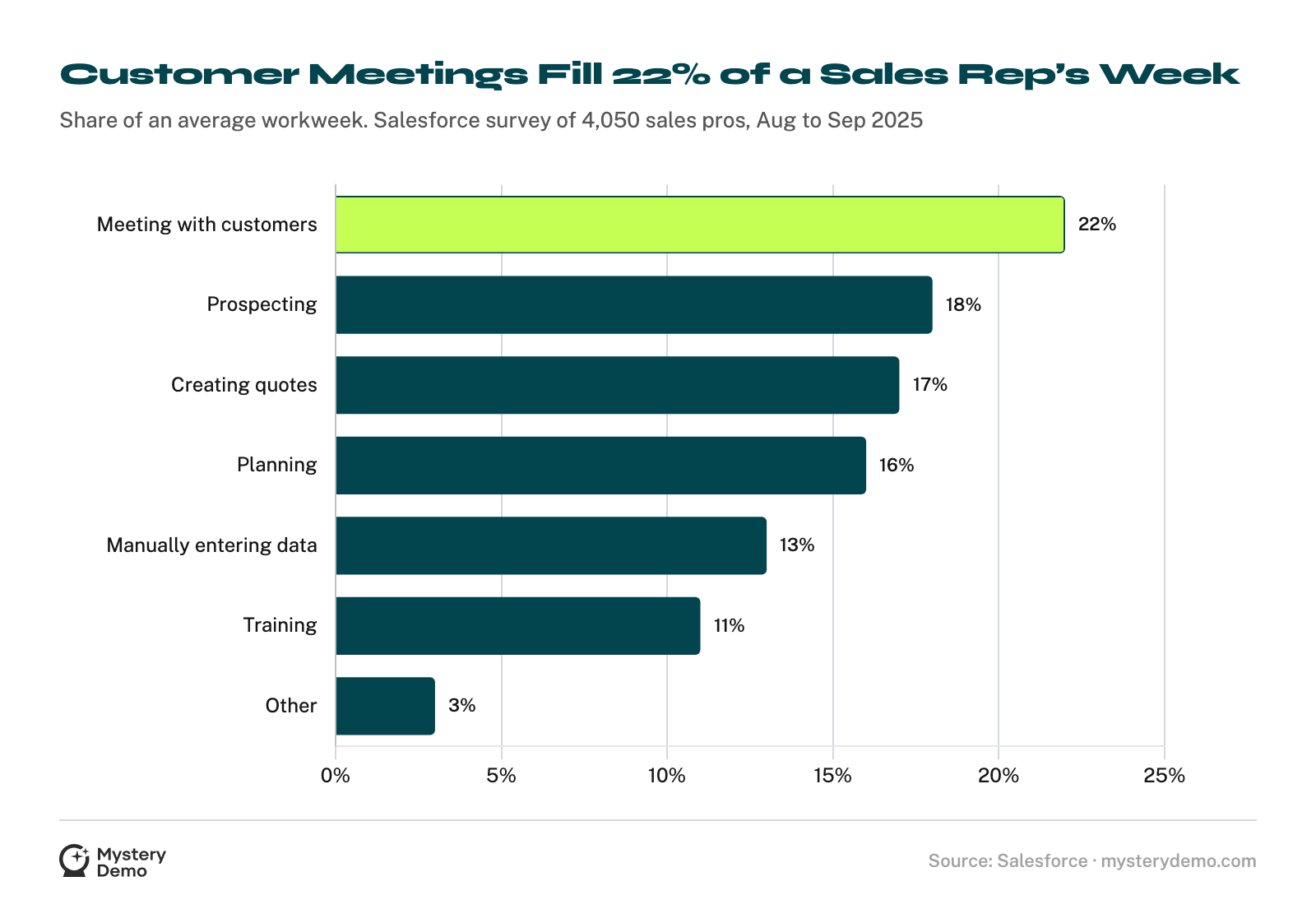
Reps start from a week that is mostly not selling. In Salesforce’s survey, sales reps spent 40% of their week selling and 60% on everything else.4 Meetings with customers took 22% of the week, and manually entering data took 13%.4
AI gives some of that time back. 84% of sellers in LinkedIn’s study said AI saves them at least 30 minutes on routine tasks.3 Among those using it to research leads and companies, 38% said their research had improved significantly and saved them more than 1.5 hours a week.3
Users of a dedicated tool report bigger numbers. Among more than 600 professionals who use Otter’s meeting assistant, 62% of them said it saves four or more hours a week, 12% said more than ten hours, and 97% said at least one hour.11
Otter also reported where that time went. 82% did more work outside meetings, 40% spent it with family, friends and hobbies, and 31% held more meetings.11
Both surveys measure the seller’s side: LinkedIn asked sellers, and Otter asked people already using its product, more of whom spent the saved hours outside meetings than in them. Neither asked buyers whether they got more time with the rep. What a buyer sees is the output, the emails, summaries and recaps the tools produce.
Even the companies furthest along frame AI as efficiency first. Growth leaders with AI built into core workflows named seller efficiency (59%) as a primary benefit ahead of better customer experiences (53%), in McKinsey’s 2026 B2B Pulse Survey of nearly 4,000 buyers and sellers.12
Gartner expects the agents to multiply faster than the gains. By 2028, AI agents will outnumber sellers by 10 to 1, Gartner predicts, yet fewer than 40% of sellers will say agents made them more productive.13
Much of what AI produces never reaches the buyer. What does reach the buyer usually arrives first as an email.
Buyers Mind AI-Written Email When It Reads Like AI
Asked about AI-written email directly, buyers say they mind. 69% of US decision-makers told Hunter it bothers them if AI was used to write an email, unless the result feels genuinely human.5
Asked why cold emails fail, they point somewhere else. 65% of decision-makers said cold emails fail because they feel too pushy or sales-focused, the top complaint in Hunter’s 2026 report.5 61% cited a lack of relevance, and 48% named generic, impersonal messages.5
Hunter’s 2025 survey found the opposite headline. 67% of decision-makers said they did not mind AI being used, while 47% of B2B professionals who used generative AI themselves said they would be less likely to reply to an email they thought AI wrote.14 The two surveys used different samples and wording, so they read best together, not as a trend.
Spotting AI is harder than it sounds. In Hunter’s test of nine emails, even the best-performing industries guessed right only half the time about which ones AI had written.14
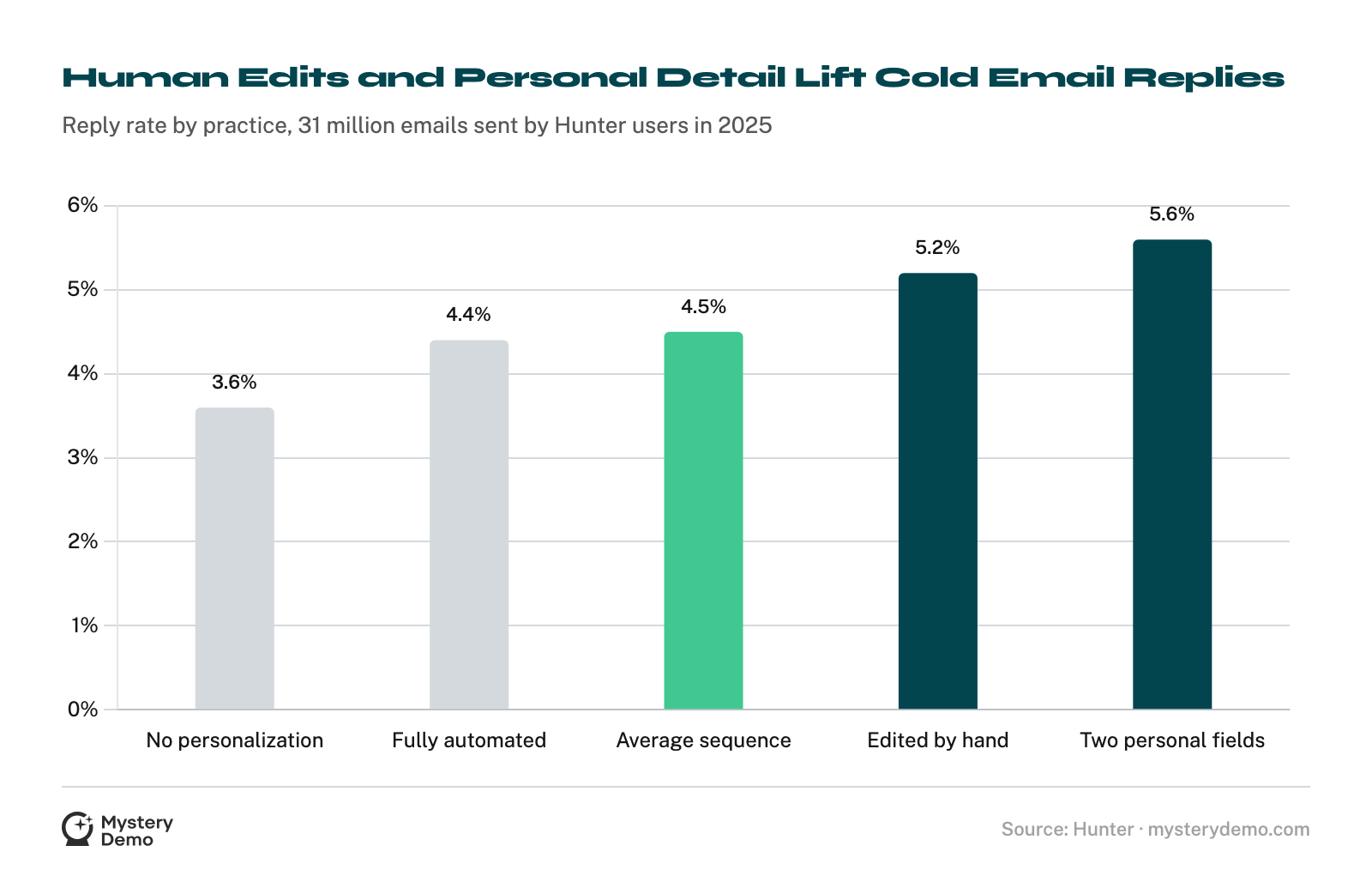
What moves replies is relevance and a human hand. Across 31 million emails Hunter users sent in 2025, the average sequence got a 4.5% reply rate, and sales outreach got 3%.5 Emails a sender edited by hand before sending got 5.2%, against 4.4% for fully automated ones.5
Personal detail moved the number further. Emails with two personalized fields got 5.6% replies, against 3.6% for emails with none.5 67% of decision-makers said personalization drawn from public information makes them more likely to reply.5
Taken together, authorship matters to buyers mostly when it shows. They mark down pressure and generic copy, and AI makes both cheaper to send by the thousand.
When an email does land a meeting, the seller’s AI can follow the buyer into the call.
A Note-Taker on the Call Changes What People Say
Note-taker adoption depends on who is asked. In a 2025 survey by Fellow, a note-taker maker polling mostly IT and operations staff, 75% of professionals used an AI note-taker in work meetings.6 Across the working population, 33.4% of employed Americans said a note-taker bot had been in their meetings, in a July 2026 survey of 500 adults commissioned by Kolmogorov Law.15
The bot changes the room it records. 84% of respondents in Fellow’s survey said they modify what they say when an AI note-taker is present.6 Among people who use one, 47% had seen it record or share something they did not mean to have captured.6
Users value it most for what it writes afterward. 68% of Otter’s users named its summaries, action items and follow-up emails as its biggest time saver.11 That draft can become the first demo follow-up email a buyer receives.
So the same tool that saves the rep a recap can cost the conversation some candor. If buyers on a sales call behave like those respondents, the words they weigh hardest will be about budget, timing and the other vendors on the list, which is what a rep most needs to hear.
Buyers are not only on the receiving end of AI now. They use it to find the seller in the first place, and that changes what the call is for.
Buyers Research With AI Now, and Check the Answers With a Rep
The buyer’s first stop has moved. 51% of software buyers started their research with an AI chatbot more often than with Google in G2’s March 2026 survey of 1,076 buyers, up from 29% in G2’s 2025 report.7 71% used a chatbot at some point in their research.7
The chatbot also steers the shortlist. 69% of buyers chose a different vendor than they had planned because a chatbot recommended it, and one in three bought from a vendor they had never heard of before.7
Other buyer surveys put the habit lower. 63% of technology buyers used AI during their purchase in TrustRadius’s 2026 survey.1 In Gartner’s survey of 645 B2B buyers, 45% used generative AI in a recent purchase, mostly to gather information on vendors and products.8
Buyers do not take the answers on faith. Of the buyers who used AI, 94% fact-checked its responses at least some of the time, TrustRadius found.1 In Gartner’s survey, 69% of B2B buyers preferred to validate AI-generated insights with a sales rep.8
They do not fully trust the rep either. 51% of buyers expected to meet misleading information from generative AI, and 49% expected it from a sales rep, in the same Gartner survey.8 Asked about the purchase itself, 67% said they prefer a buying experience with no rep at all.8

So the rep’s place in the deal has moved. The buyer arrives with a chatbot’s shortlist, trusts the rep about as much as the chatbot, and uses the call to check one against the other.
.png)

What the Averages Cannot Show About One Rival
Every figure above describes many companies at once. None of them shows how your closest rival’s AI treats its buyer.
Does its bot join the first call? How soon does its recap land, what does its sequence say when the buyer goes quiet, and can its rep say anything the chatbot could not?
Mystery Demo finds out by being that buyer. Below is the sales scorecard from our public example board, where the client and every competitor are invented. Each rival is graded on responsiveness, demo quality, transparency and follow-up, the parts of a sales motion where a rep’s AI shows first.
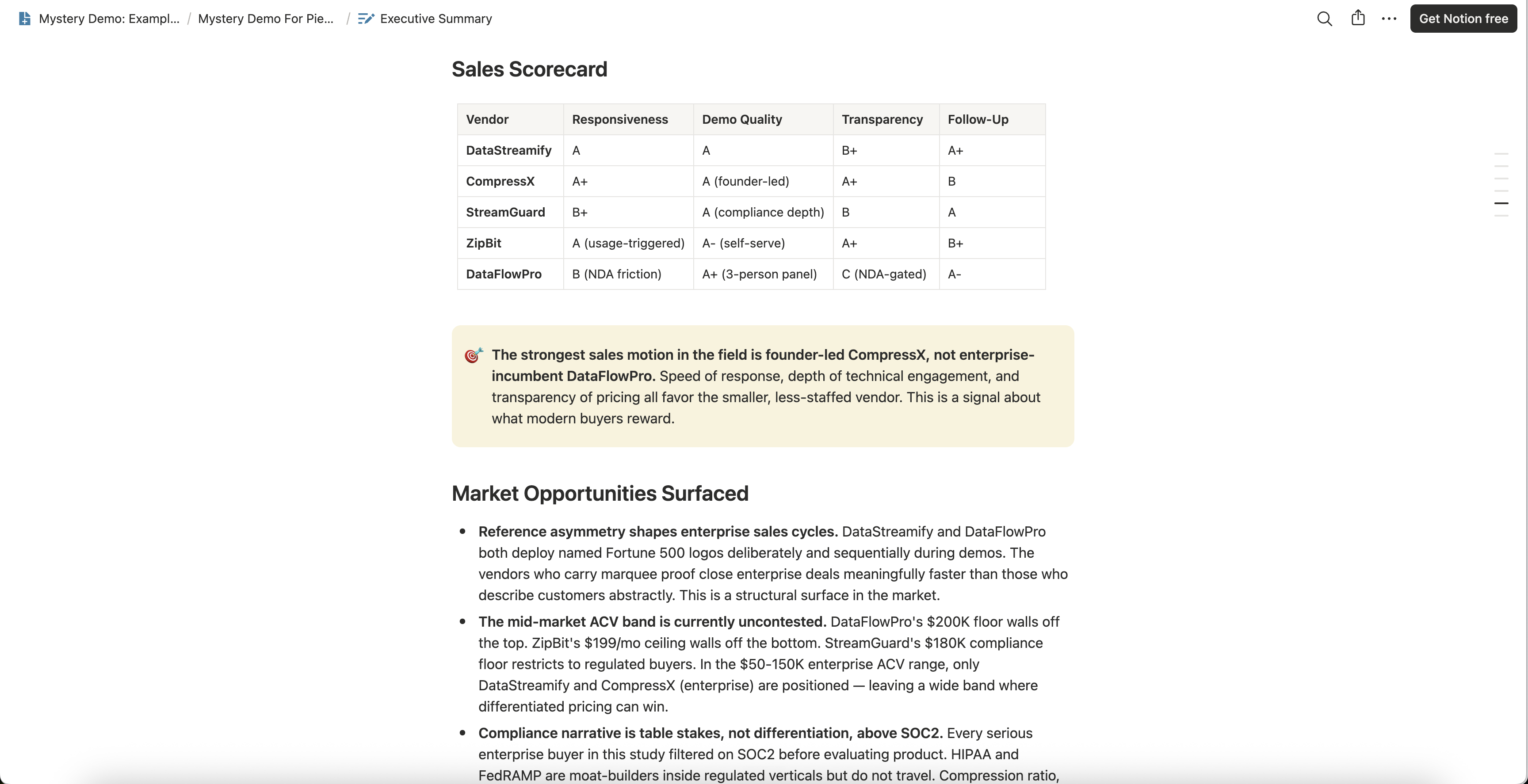
Scoring a rival’s motion from the first reply to the last follow-up, with a timestamped recording behind every grade, is the work of competitor sales tactics research. It costs a flat €499 per competitor, and the board for one rival is ready in one to two weeks.
Which rival’s AI-polished emails and recaps are your buyers reading this quarter? Tell us its name, and we will go through its sales process as a buyer and bring back every call recording, recap and email it sends.
Frequently Asked Questions
How Many Salespeople Use AI?
Only 8% do not, in HubSpot’s survey for its 2026 sales trends report.2 Daily use is lower, at 56% of the sales professionals in LinkedIn’s study.3
What Do Sales Teams Use AI For?
63% of revenue leaders said their teams use AI for email automation, such as writing emails to prospects, the top use case in Gong’s survey.10 Only 7% of sellers in LinkedIn’s study used AI for negotiating and closing.3
How Much Time Does AI Save Salespeople?
At least 30 minutes on routine tasks, said 84% of sellers in LinkedIn’s study.3 Among Otter’s own users, 62% saved four or more hours a week.11
Do Buyers Mind AI-Written Sales Emails?
69% of US decision-makers said it bothers them unless the email feels human, in Hunter’s 2026 report.5 More of them blamed pushy, sales-focused copy (65%) than irrelevance (61%) for cold emails failing.5
Do AI Note-Takers Change What People Say in Meetings?
84% of respondents said they change what they say when one is present, in Fellow’s 2025 survey.6
How Many B2B Buyers Use AI to Research a Purchase?
51% of software buyers start with an AI chatbot more often than with Google, G2 found in March 2026.7 In Gartner’s survey, 45% of B2B buyers used generative AI in a recent purchase.8
References
- TrustRadius: TrustRadius 2026 B2B Buying Disconnect Report Reveals AI Has Changed How Buyers Research, but Not What They Trust
- HubSpot: 5 Predictions on the Future of Sales (State of Sales, 2026 Sales Trends Report) (2025)
- LinkedIn Sales Solutions: The ROI of AI (2025)
- Salesforce: State of Sales, Seventh Edition (2026)
- Hunter: State of Email Outreach 2026 Report
- Fellow: The State of AI Meeting Notetakers 2025
- G2: In the Answer Economy, Don't Win the Click: Win the Answer (2026)
- Gartner: Gartner Survey Finds 69% of B2B Buyers Turn to Sales Reps to Validate AI-Generated Insights (2026)
- Gong: New Gong Labs Research Finds AI Is Now a Trusted Decision-Maker in Revenue Teams (2025)
- Gong: Revenue Organizations Using AI in 2024 Reported 29 Percent Higher Sales Growth than Their Peers
- Otter.ai: 62% of Professionals Say That AI Saves Them Over an Entire Month of Work Each Year (2024)
- McKinsey & Company: The Future of B2B Sales: How Growth Champions Rewire Their Playbooks With AI (2026)
- Gartner: Gartner Predicts AI Agents Will Outnumber Sellers 10 to 1 by 2028, Yet Fewer Than 40% of Sellers Will Say Agents Improved Productivity (2026)
- Hunter: How To Use AI for Cold Email in 2025
- Kolmogorov Law: AI Notetakers: 1 in 3 Workers Recorded, Few Asked First (2026)
.png)


