
Most B2B SaaS teams rehearse the demo and improvise everything after it. The call ends, the buyer says they will take it to the team, and the rep sets a reminder for next week. The research on follow-up is blunt about what that habit costs.
Speed moves win rates. Persistence moves reply rates. Silence predicts the deals that never close. This post uses the post-demo moment as its spine, because that is where follow-up discipline is most visible and most often missing.
Some of the strongest numbers below come from cold outbound sequences, where the recipient never asked to hear from you. Those get labeled every time, because cold prospecting math is not post-demo math. Every figure below is marked with the study that produced it.
Follow-up is also the stretch of a competitor’s sales process we watch end to end. We book and attend competitors’ demos as a real prospect, on a crafted fábula: a believable company profile and buying scenario that makes the evaluation ordinary on their end.
Then we stay in the sequence: the recap, the nudge, the pricing attachment, the breakup note.
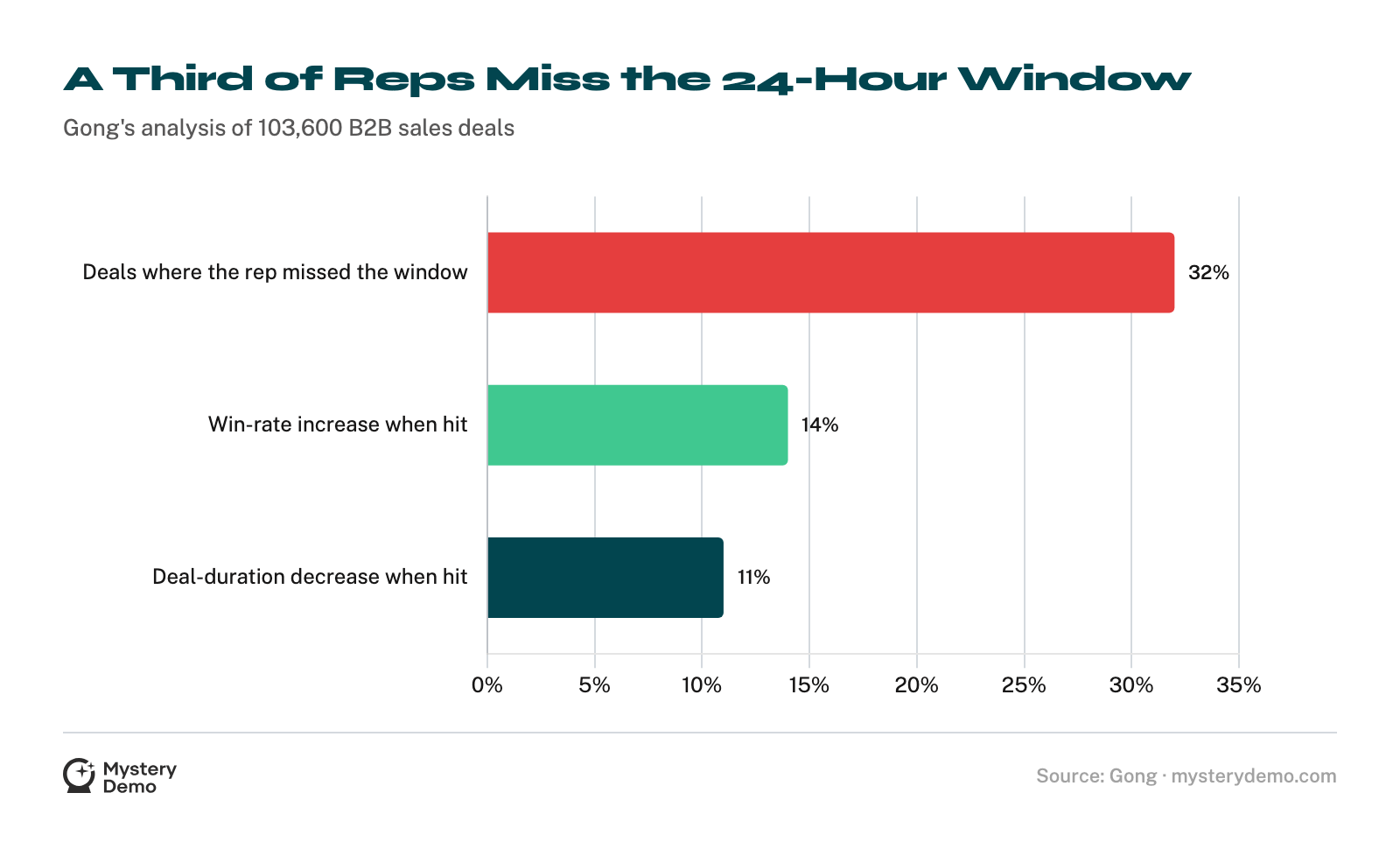
A Third of Reps Miss the Window That Moves the Win Rate
Gong analyzed 103,600 B2B sales deals and found that reps did not follow up within 24 hours 32%1 of the time. When they did hit the window, those deals showed a 14%1 higher win rate and closed 11%1 faster. The data spans deals from prospecting to close, not the post-demo touch alone.
Narrow the window further and it sharpens. The single highest average win rate, 49%1, belonged to sellers who replied within 5 to 10 hours. Same business day, in other words.
Yesware’s read on 10 million sales email threads points the same direction: reps who sent a first follow-up within a day of the original message got about a 25%4 reply rate. It measures initial outreach, not a post-demo recap.

.png)

In Cold Outbound, the First Email Wins Replies and the Follow-Ups Win Meetings
Belkins studied 7.5 million cold outbound emails from its own 2025 campaigns, where nobody asked to hear from you. The first email in a sequence had the highest single-step reply rate at 0.59%5. Steps 2 through 6 collectively produced 58.6%5 of all replies.
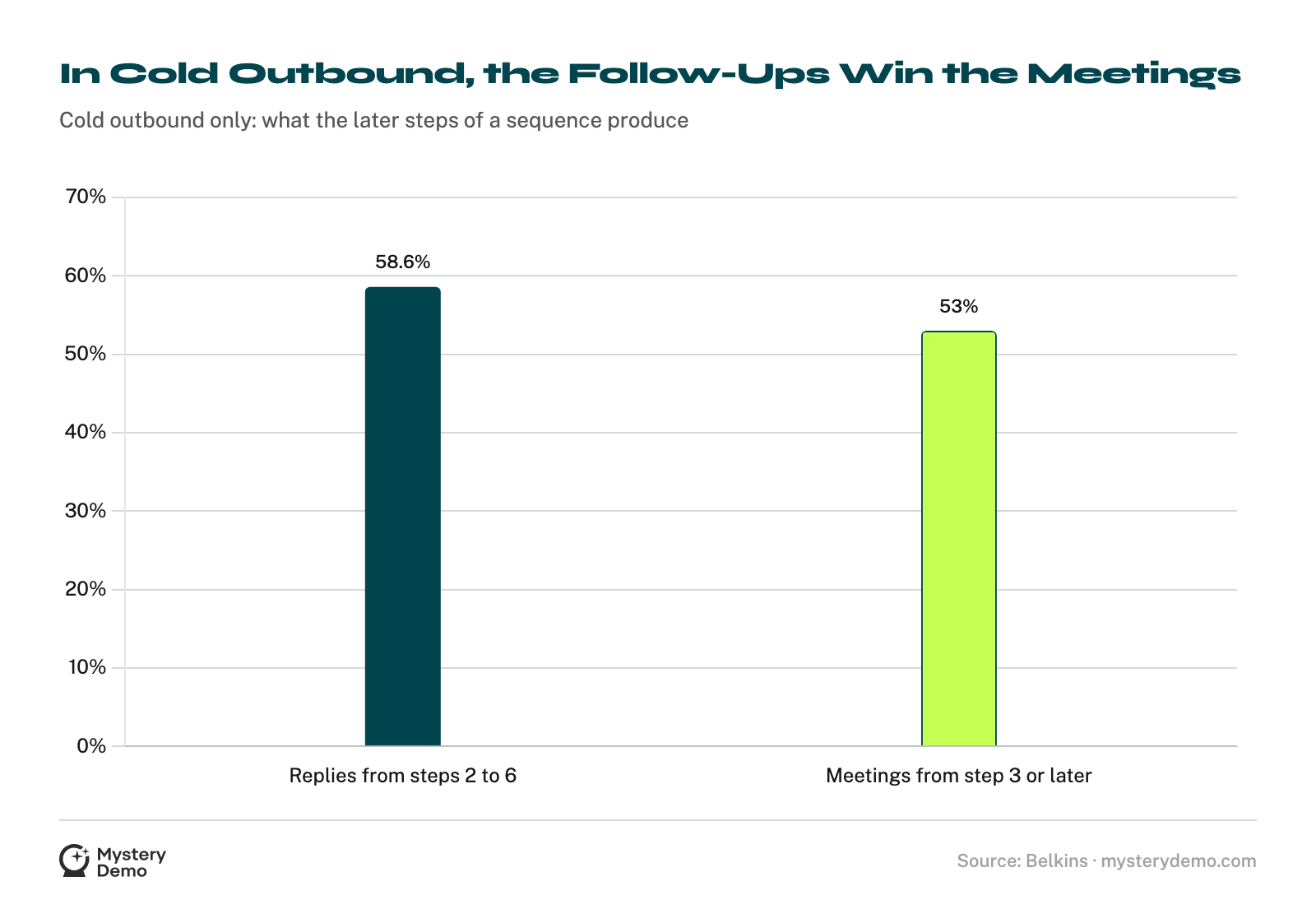
Same dataset, same cold-outbound caveat: the third email is the most productive one for booking meetings, generating more appointments than the first two combined. Over 53%5 of email-sourced meetings come from step 3 or later.
A buyer who just sat through your demo is nothing like a cold contact, and none of those reply rates transfer. The shape of the curve does. The value sits in the touches after the first one, and the first one is the touch most reps treat as the whole job.
Most Reps Stop After One Email, and That Is Where the Deal Leaks
Yesware ran the numbers on 500,000-plus prospecting emails, cold chains sent to people who had not replied. 70%3 of unanswered chains stopped after the first attempt. Only 19%3 of reps went on to email a second time.
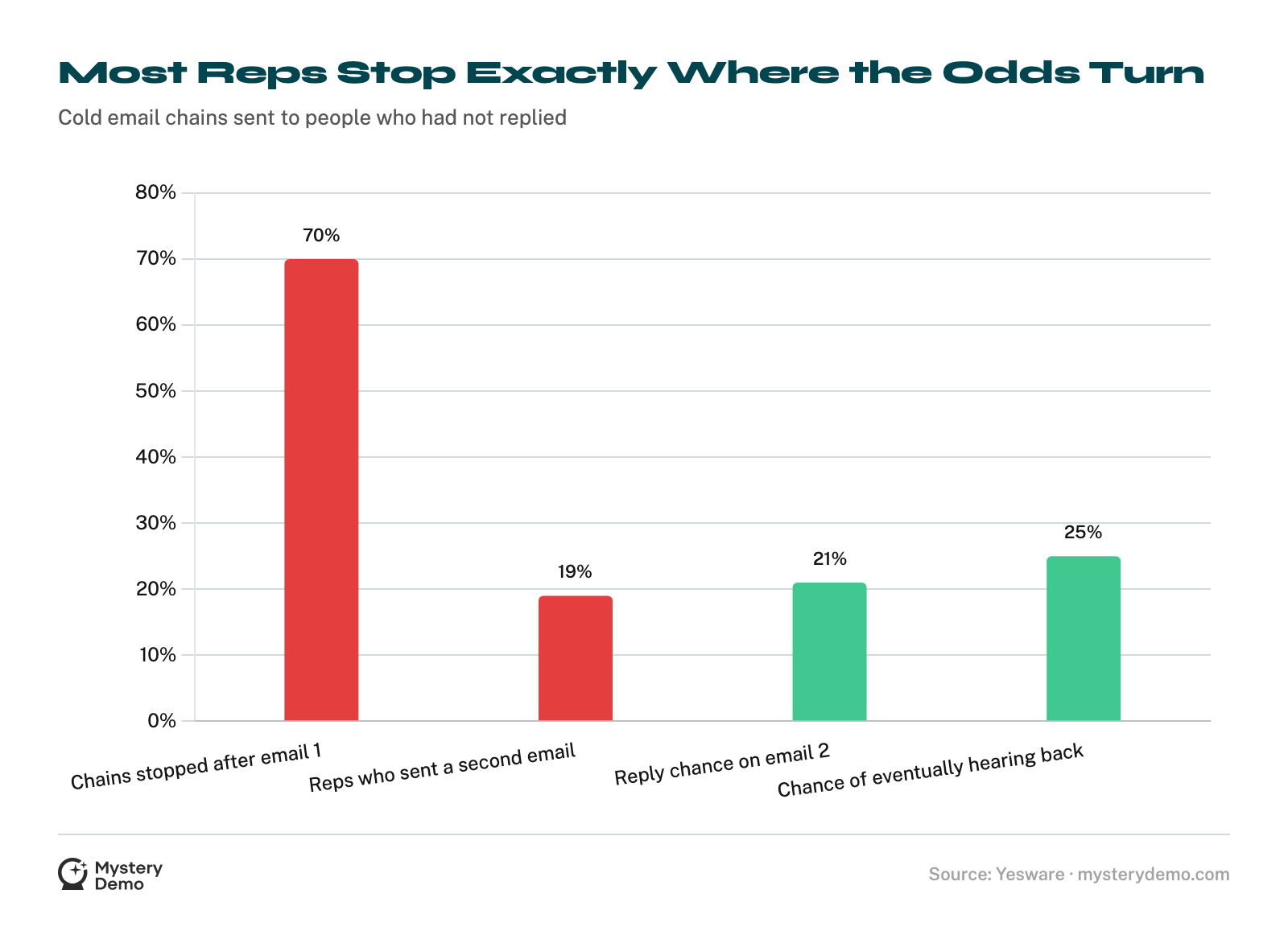
The second email carried a 21%3 chance of a reply, and the odds of eventually hearing back at all reached 25%3. Only 19% send it. The rest decide, on the buyer’s behalf, that silence was an answer.
In the same cold-prospecting frame, across 10 million email threads, the highest-replying cadence was six touches over roughly three weeks: days 3, 7, 11, 15, 19, and 224. Prospecting cadence, not a post-demo schedule.
When those cold sequences went quiet, the channel mattered more than another paragraph did. LinkedIn held a 7%-plus5 reply rate across all 12 months of 2025, with no seasonal dip, and cold calling connected with 18.6%5 of the prospects it reached.
Those calls accounted for 33.6%5 of every appointment Belkins booked that year. All of it is cold outbound, and none of it prices a post-demo touch. What carries over is duller: when the inbox stops working, changing the channel beats rewriting the email.
Silence Kills More Deals Than Rejection Does
Ebsta and Pavilion looked at 4.2 million opportunities across 530 companies. Opportunities that reps updated weekly were 17%6 more likely to close won, and the top-performer segment was 483%6 more likely to keep that cadence. The report does not name the group that 483% is measured against.
Weekly opportunity updates are the least glamorous discipline in sales. They show up in the win rate anyway.
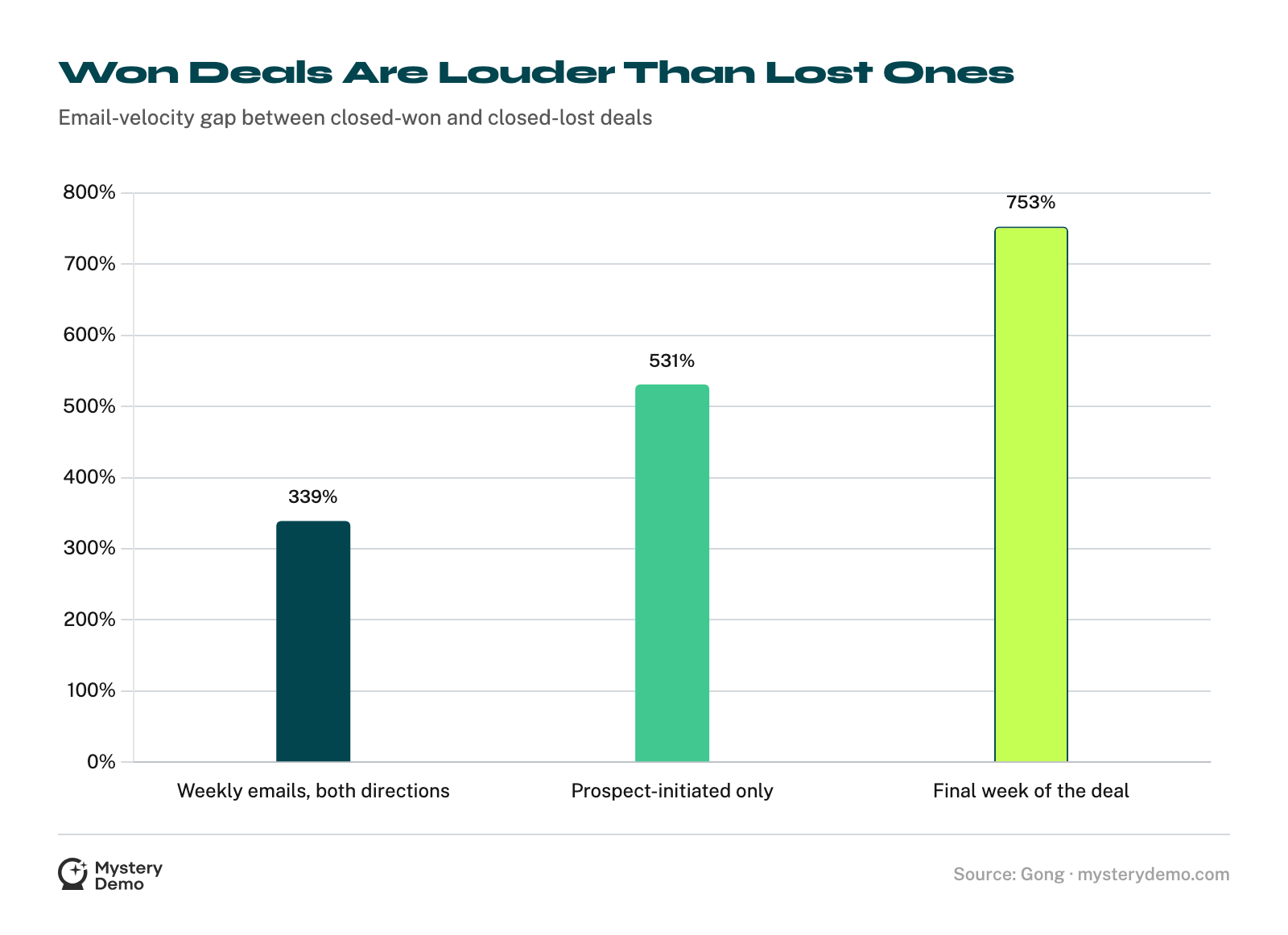
Gong’s read on 500,000-plus sales emails is starker. The average closed-won deal saw about 8 emails2 go back and forth per week, against just under two per week in deals that never closed, a 339%2 gap.
Count only the emails the prospect started and the gap widens to 531%2. In the deal’s final week it reaches 753%2. Winning deals are loud on both sides.
Back in the 103,600-deal set, opportunities where reps completed 100% of their action items had a 20%1 higher win rate. Sending one more email to a prospect who had gone quiet more than doubled1 the win rate against sending nothing further.
Frequently Asked Questions
How Quickly Should a Rep Follow Up After a Sales Call?
Gong’s 103,600-deal analysis puts the highest average win rate, 49%1, in a 5-to-10-hour response window. Reps miss the 24-hour window 32%1 of the time, and hitting it goes with a 14%1 higher win rate.
Does Following Up Faster Change How Long a Deal Takes?
In the same dataset, deals where reps replied inside 24 hours closed 11%1 faster than deals where they did not.
How Many Follow-Up Emails Should a Sequence Have?
The clearest numbers are cold outbound. Belkins found steps 2 through 6 produced 58.6%5 of all replies, and step 3 alone books more meetings than steps 1 and 2 combined5. Yesware’s 10-million-thread read landed on six touches across roughly three weeks4.
Do Most Reps Send a Second Follow-Up?
No. Yesware found 70%3 of unanswered cold chains stopped after the first attempt, and only 19%3 of reps sent a second message.
Is It Worth Emailing Someone Who Ignored the First Message?
In cold chains, the second email carried a 21%3 reply chance, with a 25%3 chance of eventually hearing back. On active deals, Gong found one more email to a non-responder more than doubled1 the win rate.
What Should You Do When Email Stops Working?
In cold outbound, Belkins saw LinkedIn hold 7%-plus5 reply rates across all 12 months of 2025, and cold calling connect with 18.6%5 of reached prospects while producing 33.6%5 of appointments booked.
Does Cold Outbound Data Apply to Post-Demo Follow-Up?
Not directly. Reply rates from cold sequences, where the recipient never asked to hear from you, sit far below anything a post-demo conversation produces. The transferable finding is structural: replies and meetings concentrate in the touches after the first one.
Does CRM Discipline Affect Win Rates?
Ebsta and Pavilion found opportunities updated weekly were 17%6 more likely to close won. Gong found deals with 100% action-item completion carried a 20%1 higher win rate.
What Does a Healthy Deal Look Like in the Inbox?
Roughly 8 emails2 a week in both directions, per Gong’s 500,000-email study. Deals that never closed ran just under two a week.
You can audit your own follow-up in an afternoon. Pull the timestamps, count the touches, see how many chains stopped at one email and how many opportunities have gone a week without a note. What you cannot pull is your competitor’s version of that audit.
If you want to know how fast their rep replies after a demo, how many times they come back, what they attach at touch three, and where they give up, that is the work.
We go get it and hand it back: the cadence, the escalation, the discount timing, the whole sequence end to end. Time their follow-up with us, and pick whichever competitor you least want to lose to next quarter.
References
- Gong Labs: The Top 3 Seller Mistakes Costing You Time and Money (103,600 sales deals)
- Gong Labs: The #1 Key Signal for Winning Sales Deals: Email Velocity (500,000+ sales emails)
- Yesware: The Complete Sales Email Frequency Guide: Why It Pays To Follow-Up (500,000+ sales emails)
- Yesware: Top Sales Follow-Up Statistics for 2024 (10 million email threads)
- Belkins: Sales Follow-Up Statistics in B2B, Belkins’ 2026 Study (7.5M emails, 15M+ LinkedIn contacts, 46,000+ calls)
- Ebsta & Pavilion: 2024 B2B Sales Benchmarks (4.2 million opportunities, 530 companies, $54B revenue)
.png)


