
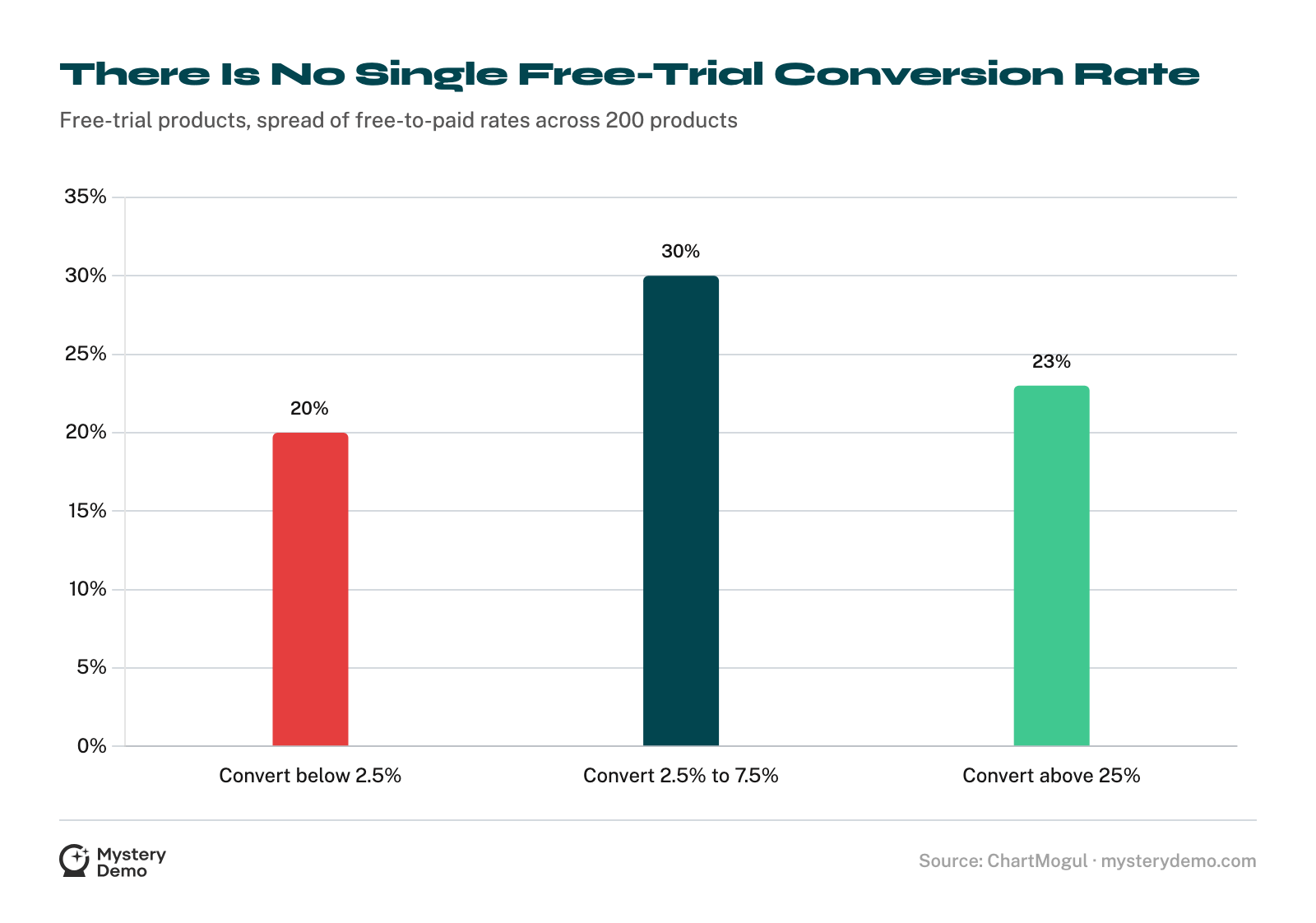
Ask ten founders what a good free trial conversion rate is, and you will get ten confident numbers. The published data is less obliging. Among the free-trial products in ChartMogul’s January 2026 survey of 200 B2B software products, one in five converted below 2.5% and roughly one in four converted above 25%1.
That spread is not noise. It is the sum of decisions your competitors made about gating, trial length, and follow-up, and every one of those decisions is sitting in their funnel where anyone willing to walk it can see it.
Working a competitor’s trial properly is a job, not an afternoon: the fábula (a crafted but honest buying scenario), the signup, the activation path, the day-five email, the cancel screen. We run that job as a real prospect and hand back what their trial does that yours does not.
The figures below are those decisions, measured. Where a number appears below, its source appears at the foot of the page.
Your Free Trial Rate Says More About Your Gating Than Your Product
ChartMogul’s 2026 survey put numbers on how wide the field is. Among free-trial products, 20% converted below 2.5%, 30% converted between 2.5% and 7.5%, and 23% converted above 25%1. Same category, same buyer, wildly different outcomes.
Freemium products in that survey clustered lower. A quarter converted below 2.5%, about a third landed between 2.5% and 7.5%, and another quarter converted between 10% and 15%, with anything above 15% described as rare1.
The report also measured the gap between best and worst. Across all self-serve products, freemium and free trial together, there is a 10x conversion difference between the top 20% and the bottom 20%1. That figure covers the whole self-serve field, not free trials on their own.
So a competitor quoting you their trial conversion rate at a conference is telling you almost nothing. The number is downstream of choices they made about who gets in and what they hand over first.
The Credit Card Field Is The Loudest Lever In The Funnel
One design decision moves the number more than anything else on the page. In ChartMogul’s survey, free trials without a credit card requirement post a GOOD free-to-paid rate of 4% to 6% and a GREAT rate of 10% to 15%1.
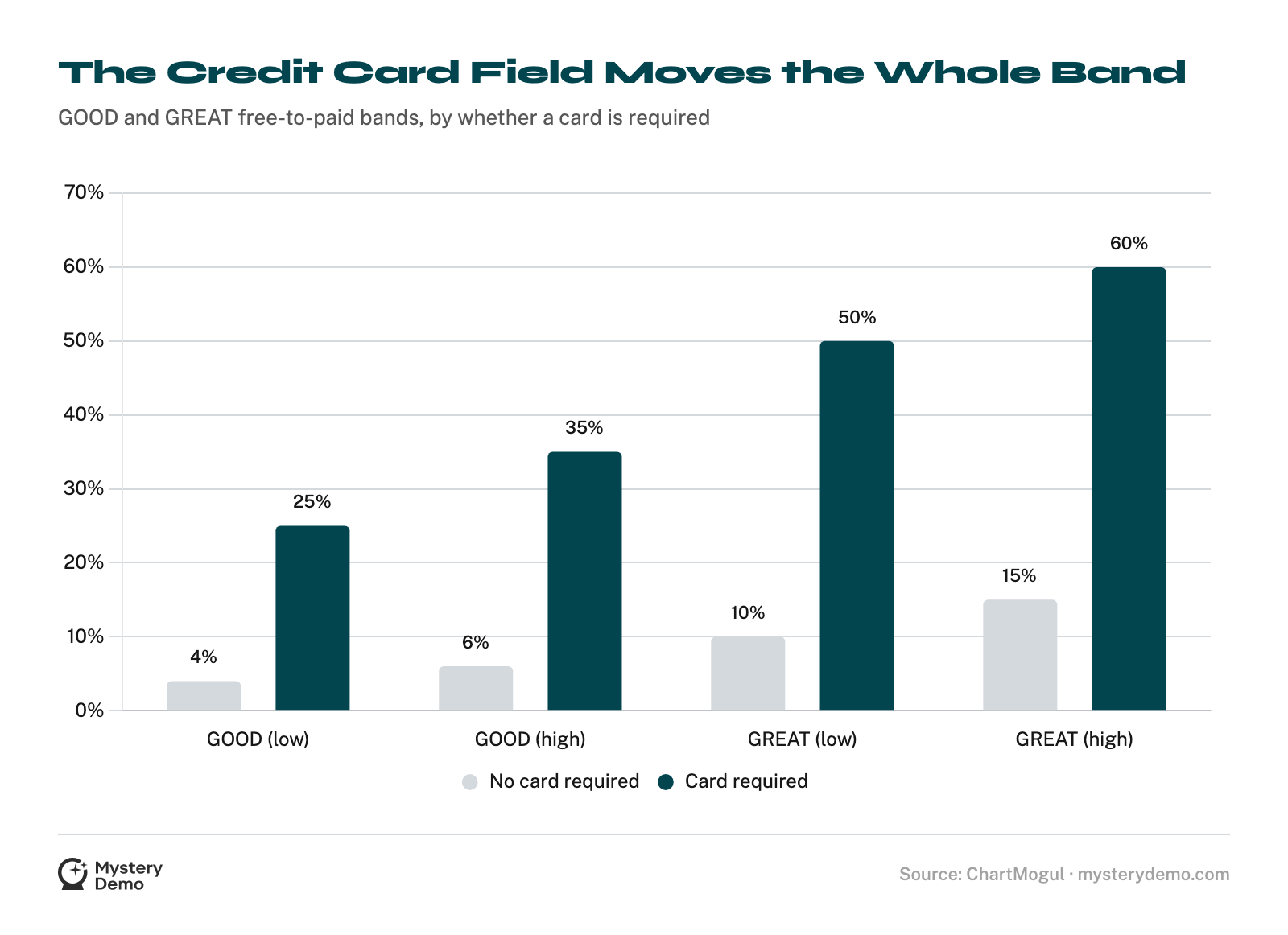
Require the card, and the bands move to a different postcode. GOOD becomes 25% to 35% and GREAT becomes 50% to 60%1.
First Page Sage’s dataset of 86 SaaS clients from Q1 2022 to Q3 2025 (71% B2B, 29% B2C) shows the same shape from the other end. Among organic-sourced signups, opt-in trials converted to paid at 18.2% against 48.8% for opt-out trials that took the card upfront4.
The catch arrives earlier. In the same dataset, organic visitors started an opt-in trial at 8.5% and an opt-out trial at 2.5%4. The card field is a filter, and filters are supposed to remove people.
Note the source. The First Page Sage figures are an SEO agency’s own client base, organic traffic only, so read them as a shape rather than a law.
Freemium Buys Signups And Charges You At The Paywall
The freemium versus trial argument is usually run on instinct. It has been measured repeatedly, and the trade is consistent: freemium wins the front door and loses the back one.
In the 2023 survey of 1,000+ products run with Pendo and OpenView, sign-up rates for free-trial products came in at 5% of visitors against 9% for freemium2.
ProductLed’s 2025 survey of 600+ SaaS companies found freemium products converting visitors into free signups at a 12% median, which it puts at 140% higher than the free-trial rate3.
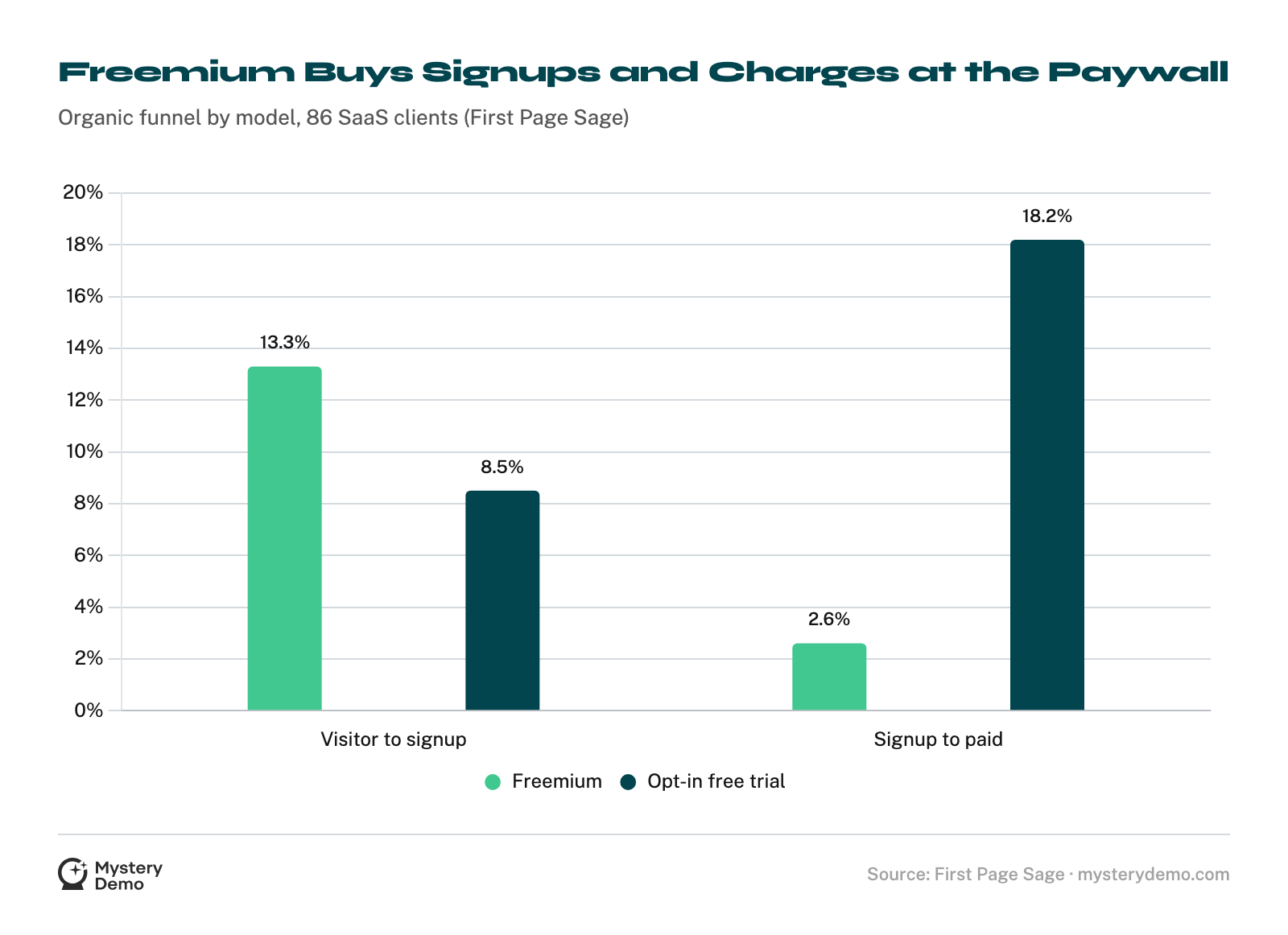
Then the bill comes. In First Page Sage’s organic data, visitors started a freemium account at 13.3% and an opt-in trial at 8.5%, but only 2.6% of those freemium signups ever paid, against 18.2% of the opt-in trial signups from the same channel4.
Freemium is a distribution strategy that presents a conversion bill later. Nobody’s board slide says they grew by making signup harder, which is why the argument keeps getting settled by taste instead of arithmetic.
.png)

Seven Days Beat Three, And The Proof Is An Experiment
Nearly every number on this page is a survey: companies reporting what their funnel did, with all the selection that implies. Trial length has something better behind it.
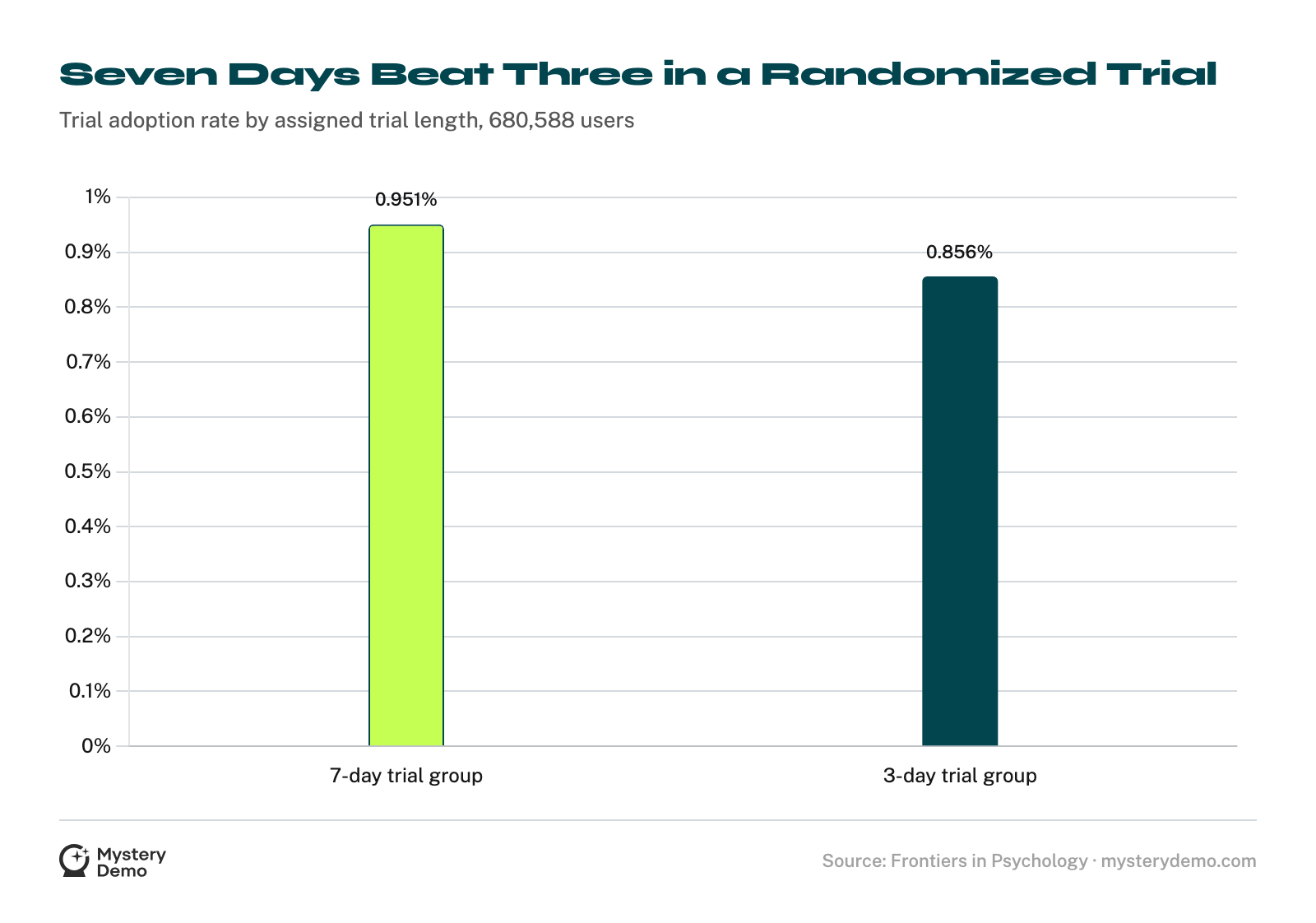
A global SaaS company ran a two-year randomized field experiment across 680,588 users, published in Frontiers in Psychology, assigning one group a 7-day trial and the other a 3-day trial5. Nobody chose their trial length. It was assigned, which is what makes this evidence rather than a correlation.
Trial adoption went up. The 7-day group started trials at 0.951% against 0.856% for the 3-day group, an 11.098% increase5.
Conversion inside the trial window barely moved, and that difference was small and not statistically significant. The gap showed up afterwards: the 7-day group’s delayed conversion rate of 0.205% was a 42.36% increase over the 3-day group5.
The extra four days did not close anyone. They gave the user a weekend, and the purchase landed after the trial window rather than inside it. One platform, one freemium model, adoption rates under 1%, so take the direction and leave the magnitude.

Most Companies Skip The One Step That Lifts Trial Conversion
The last decision is who follows up, and how they pick. ProductLed found free trials that use product-qualified leads to prioritize follow-up converting to paid at 25% on average, while only 24% of product-led companies report using PQLs at all3.
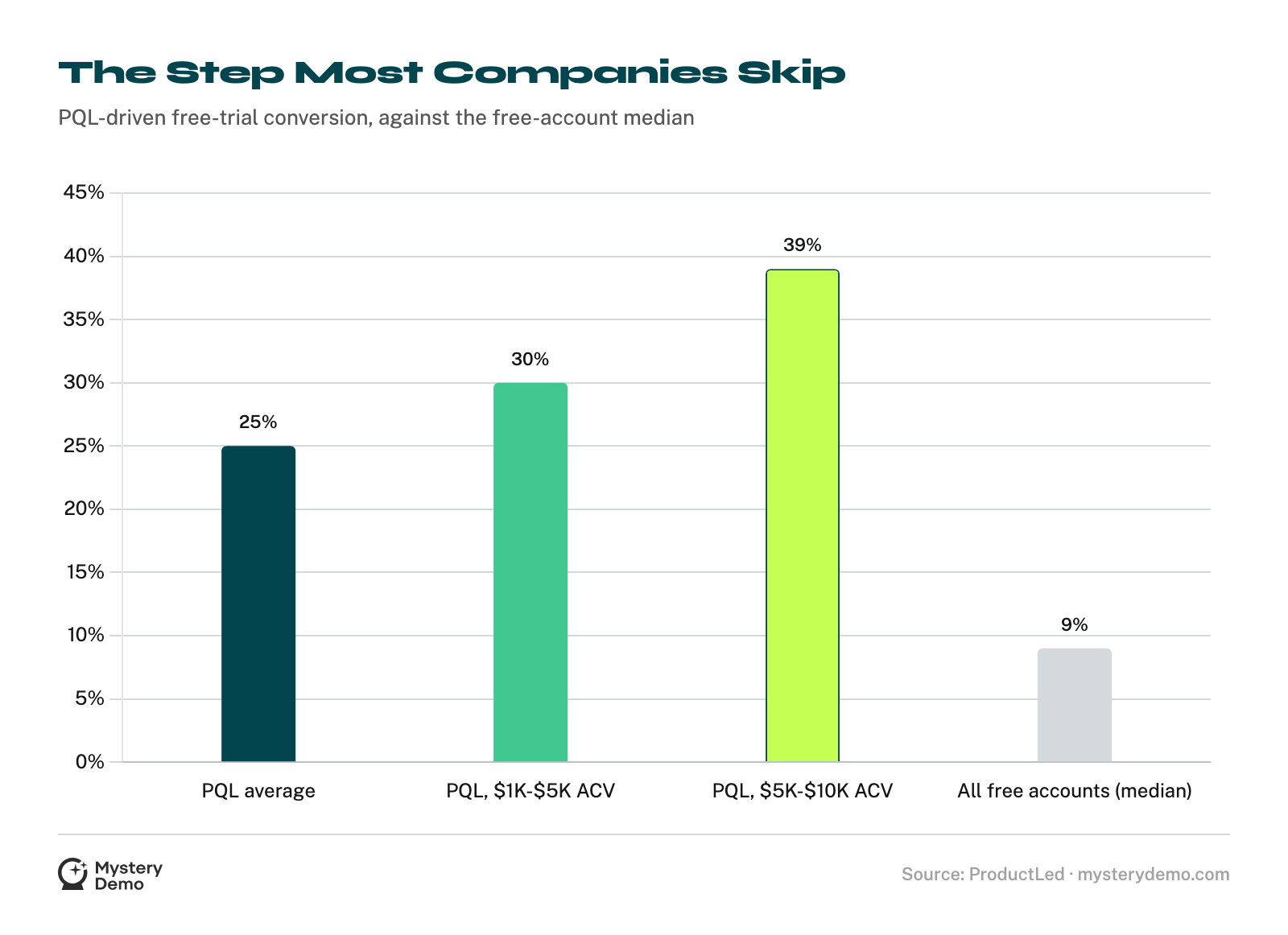
Contract size sharpens it. Where PQLs are used, conversion runs at 30% for $1,000 to $5,000 ACV and 39% for $5,000 to $10,000 ACV, against a 9% median conversion from free accounts to paid accounts across the full survey3.
Read that comparison carefully. The PQL figures describe companies that use PQLs, and the 9% median covers every free account in the survey, trial and freemium, PQL or not. They are two populations, not a before and after.
Sales touch follows the same split. In the 1,000+ product survey, 44% of free-trial companies have sales reach out to more than half of their sign-ups, roughly double the 24% rate among freemium companies2.
Which is the quiet answer to why a competitor’s trial converts better than yours. Someone on their side is reading product usage and calling the right accounts, and three quarters of the market has not bothered to build that.
Frequently Asked Questions
What Is A Good Free Trial Conversion Rate For B2B SaaS?
It depends entirely on your gate. ChartMogul’s 2026 survey of 200 B2B software products puts GOOD at 4% to 6% and GREAT at 10% to 15% for free trials without a credit card, and GOOD at 25% to 35% with GREAT at 50% to 60% when a card is required1.
Do Credit-Card-Required Trials Really Convert Better?
Yes, by a wide margin, in both datasets here. ChartMogul’s card-required GOOD band runs at 25% to 35%1, and First Page Sage’s organic-sourced opt-out trials converted to paid at 48.8% against 18.2% for opt-in4.
Why Would Anyone Choose An Opt-In Trial Then?
Because the card costs you the top of the funnel. Among First Page Sage’s organic traffic, 8.5% of visitors started an opt-in trial versus 2.5% for an opt-out trial4. A higher rate on a much smaller pool is not automatically more customers.
Is Freemium Or A Free Trial Better For Conversion?
Freemium converts more visitors into accounts and fewer accounts into revenue. The 2023 survey of 1,000+ products recorded 9% visitor-to-signup for freemium against 5% for free trials2, and First Page Sage’s organic freemium signups paid at 2.6% versus 18.2% for opt-in trial signups4.
How Many Visitors Sign Up For Freemium?
ProductLed’s 2025 survey of 600+ SaaS companies reports a 12% median visitor-to-signup rate for freemium, described as 140% higher than the free-trial rate3. First Page Sage puts its organic freemium signup rate at 13.3%4.
How Long Should A Free Trial Be?
The only randomized evidence here compares 7 days with 3. Across 680,588 users, the 7-day group adopted trials at 0.951% versus 0.856%, an 11.098% increase, and its delayed conversion rate of 0.205% was 42.36% higher than the 3-day group’s5.
Does A Longer Trial Hurt Urgency?
Not in that experiment. Immediate, in-trial conversion was slightly higher for the 7-day group at 0.241% against 0.224%, though the difference was small and not statistically significant5. The measurable gain arrived after the trial window closed.
What Is A PQL And Does It Move The Number?
A product-qualified lead is a signup whose product usage says they are ready to buy. ProductLed found free trials using PQLs converting at 25% on average, while only 24% of product-led companies use them3.
Does PQL Follow-Up Work Better At Higher Contract Values?
The reported pattern says yes. PQLs convert 30% of the time at $1,000 to $5,000 ACV and 39% at $5,000 to $10,000 ACV3, though those figures cover companies already using PQLs rather than a like-for-like comparison against everyone else.
Should Sales Contact Free Trial Users?
Most free-trial companies already do. In the 1,000+ product survey, 44% have sales reach out to more than half of sign-ups, roughly double the 24% seen at freemium companies2.
Why Do Free Trial Benchmarks Disagree So Much?
Because they measure different populations. A 200-product B2B survey, a 1,000+ product survey, a 600+ company survey, and one agency’s 86 clients on organic traffic will never agree on one tidy number. ChartMogul alone reports a 10x spread between the top and bottom quintiles of self-serve products1.
Your own funnel gives you one data point, and no competitor will send you theirs. What they will do is let a prospect sign up, run the trial, hit the paywall, and read the emails, because that is what the funnel exists to do.
Pick the competitor whose trial keeps beating yours, and we will run it as a real prospect: the gate, the day-one path, the paywall, the follow-up emails, the rep who calls. You get the whole sequence back, documented. Give us the competitor whose trial keeps winning and we start there.
References
- ChartMogul: The Conversion Report: A new look at free-to-paid conversion
- Lenny’s Newsletter: What is good free-to-paid conversion (Kyle Poyar & Lenny Rachitsky, with OpenView and Pendo)
- ProductLed: Product-Led Growth Benchmarks: Key SaaS Findings and Trends
- First Page Sage: SaaS Free Trial Conversion Rate Benchmarks
- Frontiers in Psychology: Longer or shorter? A large-scale randomized field experiment on the impact of free trial duration on sustainable user conversion in the Freemium model
.png)


