.png)


Discovery question patterns, demo flow, technical deep-dive structure, follow-up cadence, objection handling moves, deal pacing, and the specific framings reps use to close. Every meeting recorded, every email captured, every behavior scored. You see how the deal actually runs, not how their marketing page says it runs.
We develop a detailed fabula before the first call. Buyer profile, company name, use case, team size, decision timeline, budget signal. Everything aligns. The rep treats it like a serious deal because by every behavioral signal it is one.
Reps engage with recordings far more than slide decks. Watching another seller close objections is a coaching tool that lands in a way no battlecard ever has. Most partners use a few recordings as the centerpiece of their next sales kickoff.
Discovery quality, technical depth on demo, responsiveness across the cycle, follow-up rigor, deal pacing, objection handling under pressure, and how the rep positions against you specifically. Each gets a rated breakdown so it ladders into something your enablement team can act on.
Six to ten weeks for a single competitor across the full cycle. Booking, intro call, demo, technical, follow-up, then editorial. Longer cycles cover more competitors in parallel cohorts.
Both. We capture the SDR cadence from first touch, including email patterns, LinkedIn outreach, sequence timing, and the framing they use to convert a lead into a meeting. Then we move into the AE conversations.
Six to nine point swings in win rate against a specific competitor are common when teams adopt the captured motion patterns within a quarter. The win comes from copying what already works, not inventing it.
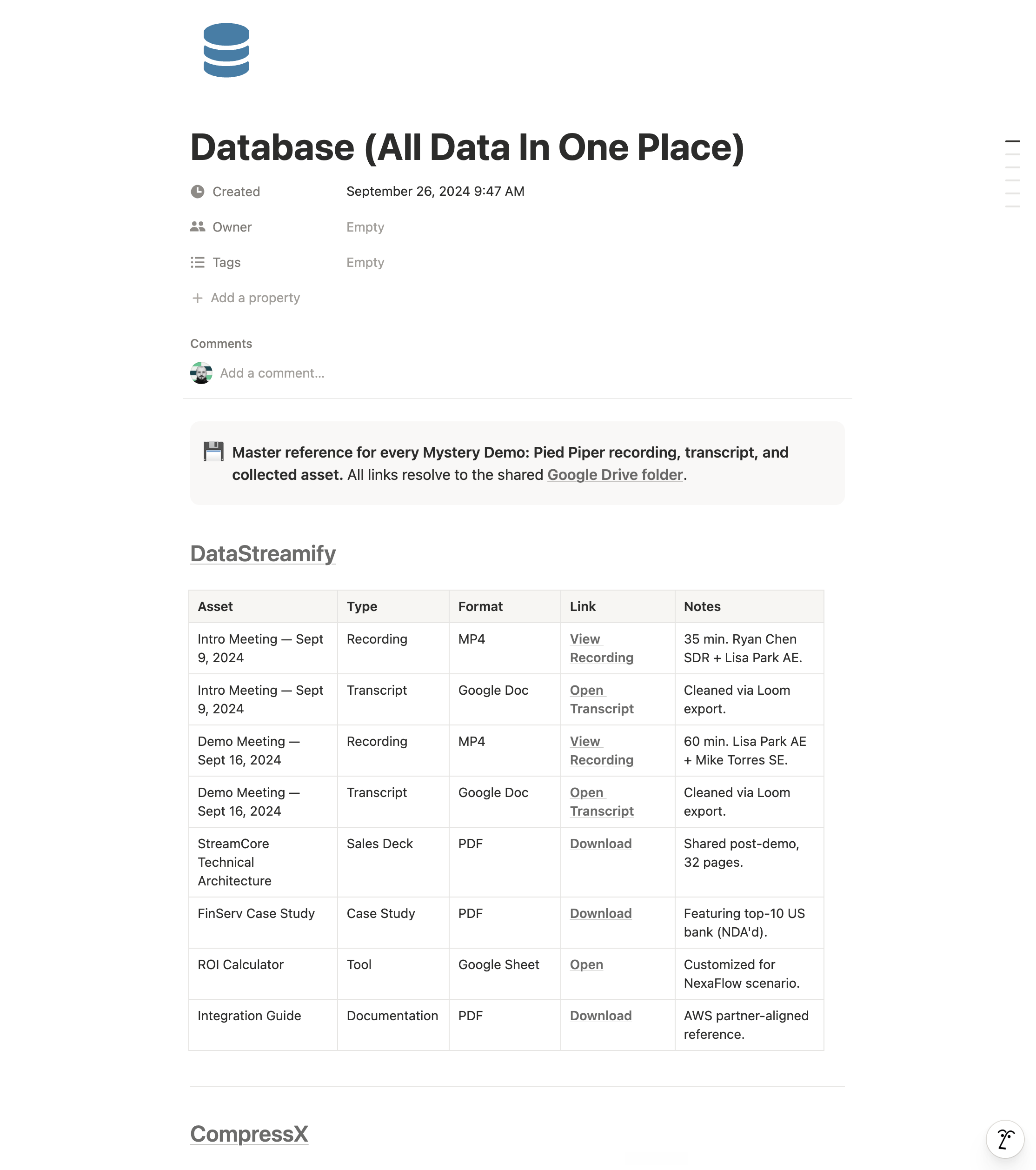
Full audio of every call, plus AI transcripts with timestamps. You can jump straight to the discovery moment, the demo flow, or the close attempt. Transcripts and recordings live side by side in the Notion board.
We run the cycle as the prospect actually would. If the typical deal takes eight weeks of meetings, we run eight weeks of meetings. The fabula stays consistent across calls, so the relationship with the rep is real and the behavior we capture is real.
Twenty to forty pages of analysis per competitor depending on cycle complexity. Discovery patterns, demo execution, follow-up behavior, deal pacing, comparative positioning. Citations linked back to the moment in the recording where each finding came from.
Discovery question patterns, demo flow, technical deep-dive structure, follow-up cadence, objection handling moves, deal pacing, and the specific framings reps use to close. Every meeting recorded, every email captured, every behavior scored. You see how the deal actually runs, not how their marketing page says it runs.
We develop a detailed fabula before the first call. Buyer profile, company name, use case, team size, decision timeline, budget signal. Everything aligns. The rep treats it like a serious deal because by every behavioral signal it is one.
Reps engage with recordings far more than slide decks. Watching another seller close objections is a coaching tool that lands in a way no battlecard ever has. Most partners use a few recordings as the centerpiece of their next sales kickoff.
Discovery quality, technical depth on demo, responsiveness across the cycle, follow-up rigor, deal pacing, objection handling under pressure, and how the rep positions against you specifically. Each gets a rated breakdown so it ladders into something your enablement team can act on.
Six to ten weeks for a single competitor across the full cycle. Booking, intro call, demo, technical, follow-up, then editorial. Longer cycles cover more competitors in parallel cohorts.
Both. We capture the SDR cadence from first touch, including email patterns, LinkedIn outreach, sequence timing, and the framing they use to convert a lead into a meeting. Then we move into the AE conversations.
Six to nine point swings in win rate against a specific competitor are common when teams adopt the captured motion patterns within a quarter. The win comes from copying what already works, not inventing it.
Full audio of every call, plus AI transcripts with timestamps. You can jump straight to the discovery moment, the demo flow, or the close attempt. Transcripts and recordings live side by side in the Notion board.
We run the cycle as the prospect actually would. If the typical deal takes eight weeks of meetings, we run eight weeks of meetings. The fabula stays consistent across calls, so the relationship with the rep is real and the behavior we capture is real.
Twenty to forty pages of analysis per competitor depending on cycle complexity. Discovery patterns, demo execution, follow-up behavior, deal pacing, comparative positioning. Citations linked back to the moment in the recording where each finding came from.
Discovery question patterns, demo flow, technical deep-dive structure, follow-up cadence, objection handling moves, deal pacing, and the specific framings reps use to close. Every meeting recorded, every email captured, every behavior scored. You see how the deal actually runs, not how their marketing page says it runs.
We develop a detailed fabula before the first call. Buyer profile, company name, use case, team size, decision timeline, budget signal. Everything aligns. The rep treats it like a serious deal because by every behavioral signal it is one.
Reps engage with recordings far more than slide decks. Watching another seller close objections is a coaching tool that lands in a way no battlecard ever has. Most partners use a few recordings as the centerpiece of their next sales kickoff.
Discovery quality, technical depth on demo, responsiveness across the cycle, follow-up rigor, deal pacing, objection handling under pressure, and how the rep positions against you specifically. Each gets a rated breakdown so it ladders into something your enablement team can act on.
Six to ten weeks for a single competitor across the full cycle. Booking, intro call, demo, technical, follow-up, then editorial. Longer cycles cover more competitors in parallel cohorts.
Both. We capture the SDR cadence from first touch, including email patterns, LinkedIn outreach, sequence timing, and the framing they use to convert a lead into a meeting. Then we move into the AE conversations.
Six to nine point swings in win rate against a specific competitor are common when teams adopt the captured motion patterns within a quarter. The win comes from copying what already works, not inventing it.
Full audio of every call, plus AI transcripts with timestamps. You can jump straight to the discovery moment, the demo flow, or the close attempt. Transcripts and recordings live side by side in the Notion board.
We run the cycle as the prospect actually would. If the typical deal takes eight weeks of meetings, we run eight weeks of meetings. The fabula stays consistent across calls, so the relationship with the rep is real and the behavior we capture is real.
Twenty to forty pages of analysis per competitor depending on cycle complexity. Discovery patterns, demo execution, follow-up behavior, deal pacing, comparative positioning. Citations linked back to the moment in the recording where each finding came from.
Discovery question patterns, demo flow, technical deep-dive structure, follow-up cadence, objection handling moves, deal pacing, and the specific framings reps use to close. Every meeting recorded, every email captured, every behavior scored. You see how the deal actually runs, not how their marketing page says it runs.
We develop a detailed fabula before the first call. Buyer profile, company name, use case, team size, decision timeline, budget signal. Everything aligns. The rep treats it like a serious deal because by every behavioral signal it is one.
Reps engage with recordings far more than slide decks. Watching another seller close objections is a coaching tool that lands in a way no battlecard ever has. Most partners use a few recordings as the centerpiece of their next sales kickoff.
Discovery quality, technical depth on demo, responsiveness across the cycle, follow-up rigor, deal pacing, objection handling under pressure, and how the rep positions against you specifically. Each gets a rated breakdown so it ladders into something your enablement team can act on.
Six to ten weeks for a single competitor across the full cycle. Booking, intro call, demo, technical, follow-up, then editorial. Longer cycles cover more competitors in parallel cohorts.
Both. We capture the SDR cadence from first touch, including email patterns, LinkedIn outreach, sequence timing, and the framing they use to convert a lead into a meeting. Then we move into the AE conversations.
Six to nine point swings in win rate against a specific competitor are common when teams adopt the captured motion patterns within a quarter. The win comes from copying what already works, not inventing it.
Full audio of every call, plus AI transcripts with timestamps. You can jump straight to the discovery moment, the demo flow, or the close attempt. Transcripts and recordings live side by side in the Notion board.
We run the cycle as the prospect actually would. If the typical deal takes eight weeks of meetings, we run eight weeks of meetings. The fabula stays consistent across calls, so the relationship with the rep is real and the behavior we capture is real.
Twenty to forty pages of analysis per competitor depending on cycle complexity. Discovery patterns, demo execution, follow-up behavior, deal pacing, comparative positioning. Citations linked back to the moment in the recording where each finding came from.