
Most B2B software buyers now ask an AI assistant about vendors, and nearly all who use it check what it says. In TrustRadius’s January 2026 survey of 1,862 technology buyers, 63% used AI at some point in a purchase,1 and 94% of those who used it to research a purchase fact-checked what it told them.1
The figures below show how far that habit has gone: how many buyers research vendors with AI, whether it now comes before Google, how much it steers the shortlist, and how far buyers trust it. How sellers use AI is a separate question, with its own AI in sales statistics. Every number here comes from public research, with who was asked and when, linked to where it was first published.
Mystery Demo covers the part of a vendor those AI answers cannot reach. It books competitors’ real sales demos for software companies, runs each one as a genuine buyer, and hands back what each rep quoted, showed and said on a shared board, with every finding tied to its recording. None of that is published, so no assistant can read it.
Key Takeaways
AI Has Become a Routine Step in Researching Software Vendors
For a sales team, this means an AI assistant is now one of the places buyers learn about your category. Every survey below found it, but each asked a different group a different question, so read each row on its own.
| Study | What it measured, and who was asked | Share |
|---|---|---|
| G2, March 2026 | rely on AI chatbots at some point in their research (1,076 B2B software buyers) | 71%3 |
| G2, 2026 (dates not stated) | sourced software recommendations from an AI chatbot in the previous 24 months (more than 1,000 B2B software buyers) | 82%2 |
| TrustRadius, January 2026 | used AI at any point in the buying process (1,862 technology buyers) | 63%1 |
| Gartner, August to September 2025 | used generative AI in a recent purchase, mainly to gather information on vendors and products (645 B2B buyers) | 45%4 |
| Wynter, January 2026 | use AI tools to discover vendors, up from 24% a year earlier (101 CMOs at B2B SaaS companies with $50M+ revenue) | 84%6 |
| 6sense, 2025 | used large language models during the buying process (nearly 4,000 buyers of services, software and goods with $25,000+ of spend) | 94%7 |
TrustRadius found that AI tools and AI search are the only resources its buyers now consult more often than in previous years.1 Buyers also rate AI more highly than they did a year ago: the share calling it helpful in their buying process rose from 40% to 54%, and the share saying it had no impact fell from 45% to 29%.1

G2’s buyers say the same. In its March 2026 survey, 53% said research with AI chatbots is more productive than traditional search, up from 36% seven months earlier.3
Use is not even across buyers. Responsive’s study of 350 B2B buyers, published in October 2025, found these gaps:
| Buyers, and what was measured | Share | Compared with |
|---|---|---|
| In the technology industry, use chatbots as a top source for finding new vendors | 56%8 | 28% in other industries8 |
| In the U.S., use generative AI for vendor discovery | 48%8 | 14% in other regions8 |
| At companies with 2,000 or more employees, use generative AI for discovery | 42%8 | 18% at companies with 501 to 1,0008 |
Used this widely, AI now competes with search engines for the first look at a category.
For Many Buyers, an AI Chatbot Now Comes Before Google
For half of software buyers, the first look at your category is now more often an AI answer than a page of links. Three studies compared the two directly, each with its own question.
| Study | What they found, and who was asked | Share |
|---|---|---|
| G2, March 2026 | start research with an AI chatbot more often than with Google, against 29% in G2’s 2025 report (1,076 B2B software buyers) | 51%3 |
| G2, March 2026 | use AI search alongside Google (the same 1,076 buyers) | 61%3 |
| Wynter, January 2026 | start their search with AI tools before traditional search engines (101 B2B SaaS CMOs) | 68%6 |
| Responsive, October 2025 | generative AI has overtaken traditional search (350 B2B buyers) | a quarter8 |
| Responsive, October 2025 | use generative AI as much as or more than search when researching vendors (the same 350 buyers) | nearly two-thirds8 |
| Responsive, October 2025 | use generative AI at least as much as search for vendor research (the technology-industry buyers among the 350) | 80%8 |
Google has not gone away, but its job has changed. Asked where they start a software search and which channels they use, Wynter’s CMOs named Google most often, at 72%, mostly to check what they had found elsewhere.6 AI tools came close behind, at 68%.6
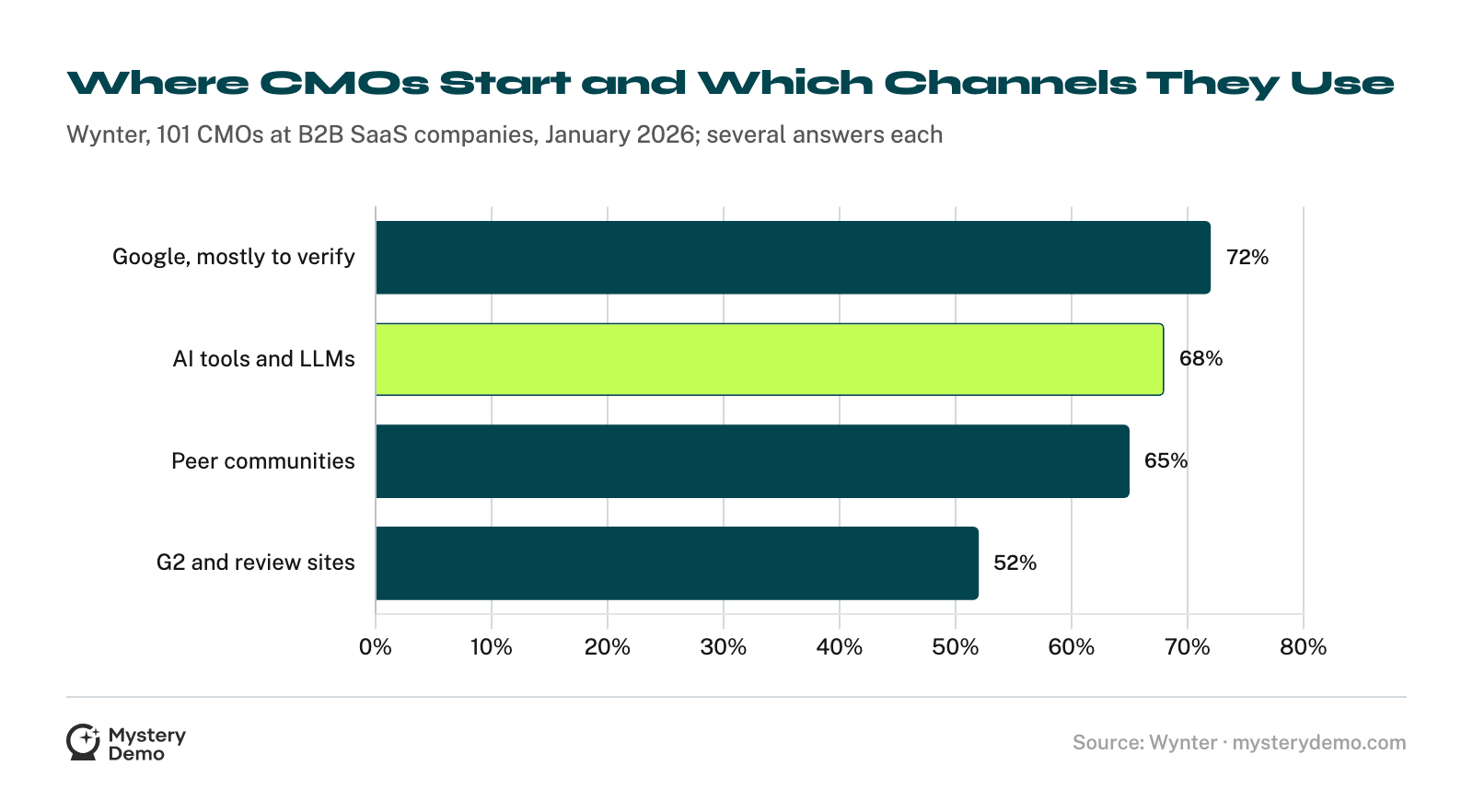
Only 9% of the same CMOs begin by googling a software category.6 That is how Google can be the channel they use most and still not be where the search starts.
None of these studies records the questions buyers type into an assistant about a vendor. G2 comes closest, with the most common uses of AI in buying from its 2026 buyer behavior survey:
Some of that research runs deep. 41% of the buyers in G2’s March 2026 survey use deep research tools for structured software evaluations.3 Those tools answer one question with a report many pages long.
Two of the four uses G2 lists are about the shortlist itself, and the shortlist is where AI’s pull shows most clearly.
AI Now Steers the Shortlist About as Much as Review Sites
A vendor that AI answers leave out can lose a deal before its sales team knows the deal exists. The shortlist matters because most buyers buy the product they ranked first on it.
67% of TrustRadius’s technology buyers bought the product that was their first choice when they made their shortlist,1 and 62% of Wynter’s CMOs evaluate exactly three vendors.6 G2 measured what steers that shortlist in two separate surveys in 2026:
| G2 survey | Who was asked | What led as a source shaping the shortlist |
|---|---|---|
| March 2026, released in April | 1,076 B2B software buyers | AI chatbots, ahead of review sites, analyst firms and vendor websites3 |
| Behind the July 2026 release | more than 1,000 B2B software buyers (dates not stated) | review sites at 38%, then AI chatbots at 37%, the first time review sites passed chatbots2 |
Read together, the two surveys put AI chatbots and review sites level at the top. Half of the July survey’s buyers who had sourced recommendations from a chatbot said AI had its greatest impact when narrowing and comparing options.2
Being named in an AI answer also moves buyers. In G2’s March 2026 survey:
One counterweight comes from Wynter’s CMOs, asked a different question: which single factor most gets a vendor considered. 42% ranked word of mouth and peers first, against 10% for AI recommendations and 8% for Google Search.6 Peers still come first for those CMOs, and AI recommendations now edge out Google.
If an AI answer can move a vendor onto a list or off it, the next question is whether buyers believe what it says.
Buyers Check What AI Tells Them About Vendors
When an AI assistant helped build a buyer’s shortlist, expect the buyer to arrive with something the assistant said about you, and to want that confirmed. Of the technology buyers in TrustRadius’s survey who used AI to research a purchase, 94% fact-checked what it told them at least some of the time.1
72% checked very often or always, and the shares answering always and very often both grew from 2025.1

Trust did not rise with the checking. Only 2% of TrustRadius’s buyers trust AI always and 20% trust it very often, the same shares as in 2025.1 When they check an answer, these are the resources they name most:
The doubt reaches beyond AI. 47% of the same buyers trust online resources less than they used to, against 11% who trust them more.1 The share who trust them as much as before fell from 50% to 42% in a year.1
Many would rather check with a person. Gartner surveyed 645 B2B buyers in August and September 2025:
Buyers suspect reps about as much as they suspect AI, yet still want a rep to confirm what AI told them. In G2’s 2026 buyer behavior survey, 61% use or plan to use AI agents, software that carries out a task on its own, in the buying process.2 Far fewer would let an agent make the purchase itself.

Buyers hand AI the research and keep the decision. In 6sense’s 2025 study of nearly 4,000 buyers, almost all used large language models, yet they still averaged 16 interactions per person with the vendor they chose, one fewer than in 2024.7 Checking works where a price is published to check against, and many software prices are not.
Business Software Prices Rarely Reach an AI Answer
Understanding total cost of ownership tied for the top of G2’s list of what buyers use AI for. For business software, it is also where AI has little to go on. When a buyer asks an assistant what such a tool costs, the answer rarely carries a price, and often there is no published price to find.
Where a brand does publish its price, AI usually gets it close. Parse’s 2026 study checked AI price quotes against the pricing pages of brands, mostly in software, phone plans and financial services, and 62.8% of the 7,594 checkable quotes matched.5 In a hand check of 100 sampled quotes, 79 were real price quotes, and 82.3% of those were right.5
For business software, prices are scarce in AI answers and often missing from vendors’ own pages:

What a Competitor Says Once a Buyer Is on the Call
Every figure above describes the market. None of them says what one competitor does with a buyer in the room:
All three are only said on a sales call, and Mystery Demo is there as the buyer. When it maps a whole market for a team, the team receives a shared Notion board with a page for every competitor, ending in an Executive Summary for leadership. Below are that summary’s Key Findings, from our public example board, where the client and every competitor are invented.
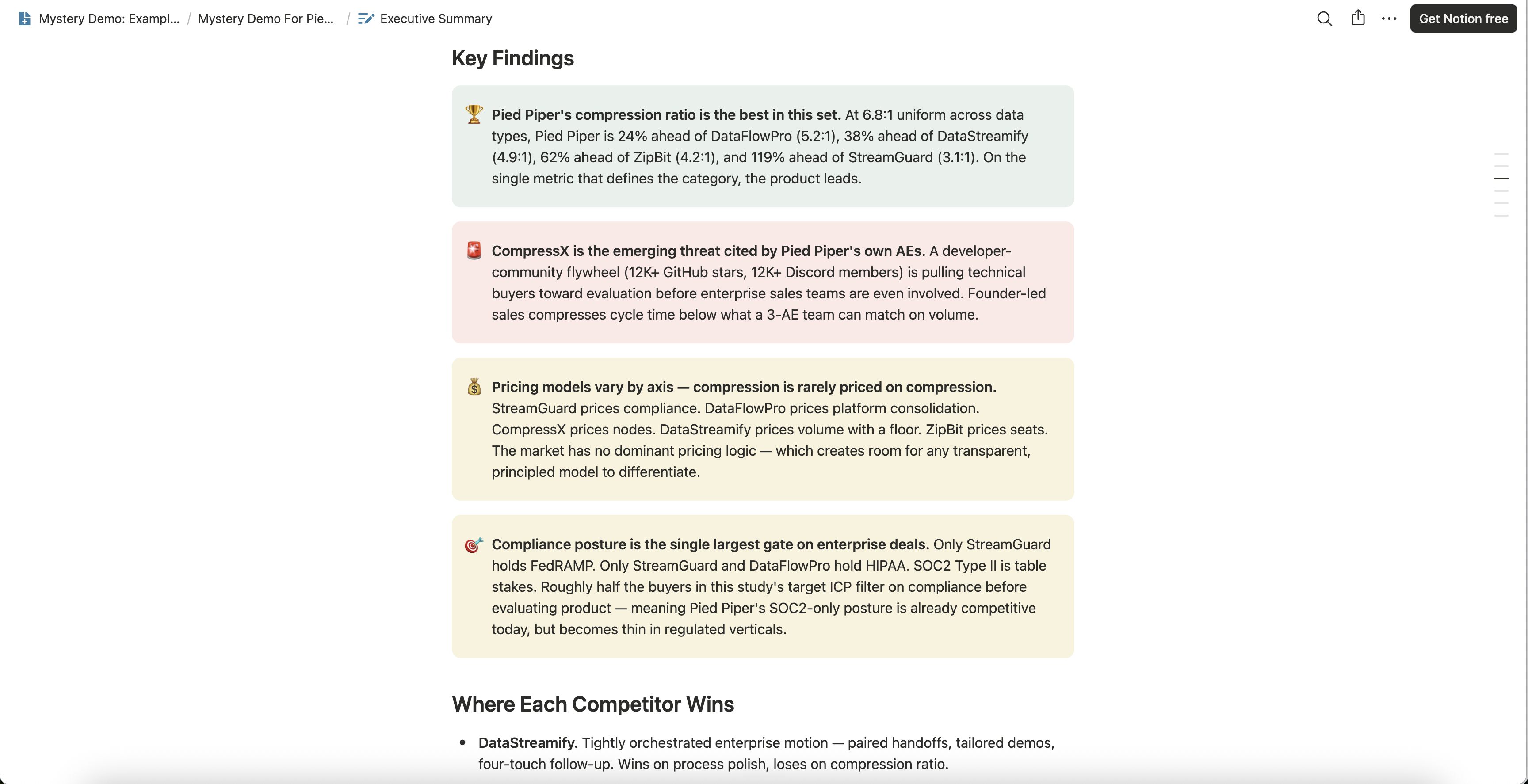
Each finding is a verdict a leadership team can act on, and on a real project every one traces back to the competitors’ own recorded calls. Our SaaS market entry research does this across a whole market, with every serious player mystery-shopped end to end. It costs a flat €499 per competitor, and a full landscape takes four to eight weeks.
Which competitors does an AI assistant list beside you when a buyer asks for options? Bring that list to an intro conversation, and we will plan which of their sales calls to take first.
Frequently Asked Questions
How Many B2B Buyers Use AI to Research Software Vendors?
82% of the more than 1,000 B2B software buyers in G2’s 2026 buyer behavior survey sourced software recommendations from an AI chatbot in the previous 24 months.2 In TrustRadius’s January 2026 survey, 63% of 1,862 technology buyers used AI at some point in a purchase.1
Do B2B Buyers Use AI Instead of Google?
51% of the 1,076 software buyers in G2’s March 2026 survey start their research with an AI chatbot more often than with Google,3 and 61% use the two together.3
Do Buyers Trust What AI Says About Vendors?
94% of technology buyers who used AI to research a purchase fact-checked it at least some of the time, TrustRadius found,1 and 69% of the B2B buyers in Gartner’s survey prefer to validate AI-generated insights with a sales rep.4
Does AI Change Which Vendors Make the Shortlist?
69% of the buyers in G2’s March 2026 survey chose a different vendor than they had planned because it was part of a chatbot’s recommendation.3 In G2’s later 2026 survey, AI chatbots, at 37%, sat one point behind review sites as a source shaping the shortlist.2
Can AI Tell Buyers What Business Software Costs?
Fewer than 1% of AI search answers quoted a brand price in 118 of the 413 markets Parse measured in 2026, and most of those markets were business and enterprise software.5
References
- TrustRadius: Beyond the Hype: The AI Bubble That Isn’t Bursting (Yet) (2026)
- G2: New G2 Research: AI Is Reshaping How B2B Software Deals Are Won and Lost (2026)
- G2: In the Answer Economy, Don’t Win the Click: Win the Answer (2026)
- Gartner: Gartner Survey Finds 69% of B2B Buyers Turn to Sales Reps to Validate AI-Generated Insights (2026)
- Parse: How Accurate Are the Prices AI Quotes for Brands? (2026)
- Wynter: How B2B SaaS CMOs Buy Software in 2026
- 6sense: 2025 B2B Buyer Experience Report
- Responsive: GenAI Overtakes Search for a Quarter of B2B Buyers, Signaling a Major Shift in Enterprise Purchasing (2025)
- Dupple: One in Three Software Vendors Hides Its Price: We Counted Across 377 Tools (2026)


