
There is still no standard way to charge for AI in software. In DigitalRoute’s survey of 631 executives across six markets in April and May 2026, bundling AI into an existing plan was the most common approach, and only 25% of companies used it.2 Meanwhile, vendors keep raising list prices in AI’s name, and buyers report bills they did not expect.
A public tracker has logged 45 list-price rises since September 2024 that vendors tied to AI,4 and 78% of the 218 IT leaders in Zylo’s 2026 survey had unexpected charges from consumption-based or AI pricing in the year before.5 None of these studies can show what one particular rival quotes for its AI tier.
Mystery Demo gets that number for software companies. Its operators book the rival’s sales demo as a genuine buyer and hand back the quote, with its recording, on a board that sets each rival’s quoted price beside its published one. The figures below come from public research instead, each with who was asked and when, and each linked to where it was first published.
Key Takeaways
No Single Way of Charging for AI Has Won
A sales team comparing AI prices is often comparing different things: one rival includes the feature in every plan, another meters it by use. Two studies counted how companies charge for it, and each found a mix.
G2 interviewed senior leaders at 108 mid-market SaaS companies that sell AI, for research commissioned by Salesforce and dated April 2026. Each company has $10 million to $250 million in annual recurring revenue. The methods overlap, so the shares add up to more than 100%.
| How G2 names the method | Share of the 108 companies | What the customer pays for |
|---|---|---|
| Usage-based pricing | 51%1 | the amount of AI used |
| Premium plan inclusion | 41%1 | a higher plan that includes the AI |
| Included free in the base product | 27%1 | nothing extra |
| Seat-based add-on | 9%1 | an extra charge per user, on top of the plan |
32% of those companies run two or more of these methods at once.1 In a separate question, 57% said they had introduced consumption pricing for their AI product in the last 24 months.1
In Germany, AI often comes with the cheapest plan. Among German software providers on OMR Reviews that offer AI, 65% include AI features in their cheapest package, by the pricing advisory firm hy’s count as of June 30, 2025.3 Only 40% of the companies on OMR Reviews list an AI offering at all.3
DigitalRoute, which sells billing and usage software, surveyed 631 executives in finance, product and engineering across the UK, the US, Germany, France, the Nordics and Benelux in April and May 2026. Its categories differ from G2’s and it asked different companies, so read each table on its own.
| How DigitalRoute names the model | Share of companies | What the customer pays for |
|---|---|---|
| Bundling | 25%2 | a plan price that already includes the AI |
| Still experimental | 23%2 | no settled model yet |
| Paid add-ons | 18%2 | AI bought as an extra |
| API charging | 15%2 | each call made to the AI |
| Outcome-based | 12%2 | each result the AI delivers |
In DigitalRoute’s own words, no dominant model has emerged. The same executives described what drives those prices and what makes them hard to set:
The list prices built on these models have been moving too.
Vendors Keep Raising List Prices and Naming AI as the Reason
A rival’s price list from last year may already be out of date. Gravity’s public tracker logs every list-price rise it could verify on an existing software plan where the vendor itself tied the rise to AI. New AI add-ons, which a customer can decline, are left out.
As of October 4, 2026, the tracker held 45 such rises from 9 vendors since September 2024: 6 in the last four months of 2024, 24 in 2025 and 15 so far in 2026.4

Across the tracker’s 45 rows, the size of a rise varies widely:
The tracker’s rows are the rises it could verify, never a count of the whole market, and they leave out every SaaS price increase that a vendor did not tie to AI. The tracker counts what vendors print. Surveys of the people paying count what arrives on the bill.
Buyers Are Getting AI Bills They Did Not Plan For
A buyer may come to an AI pricing conversation already burned by a surprise charge. Two surveys measured how often, and only one of their three figures is limited to AI.
| Survey and who was asked | What they reported | What the figure covers |
|---|---|---|
| Zylo, a SaaS management vendor: 218 IT leaders, published January 2026 | 78% had unexpected charges in the previous 12 months5 | consumption-based or AI pricing |
| Zylo: the same 218 IT leaders | 61% were forced to cut projects5 | unplanned cost increases across all SaaS, not only AI |
| PricingIO, a pricing firm: 263 of the 296 software buyers it surveyed, no date given | 89% had exceeded their initial AI budget forecasts6 | AI spending only |
G2’s interviews and PricingIO’s survey also asked buyers how they would rather pay, and the answers point one way.
Surveyed Buyers Want AI Included and Priced Predictably
For a seller, how an AI price is counted can matter to the buyer as much as its size. G2 Research interviewed 350 business professionals who evaluate and buy AI-enabled software. Its report came out in June 2026 and was updated in September.
81% of those buyers say core AI should come standard in the base product.7 Only 13% support bundling basic AI and selling advanced AI as an add-on,7 and just 6% say AI should be sold separately as an add-on.7

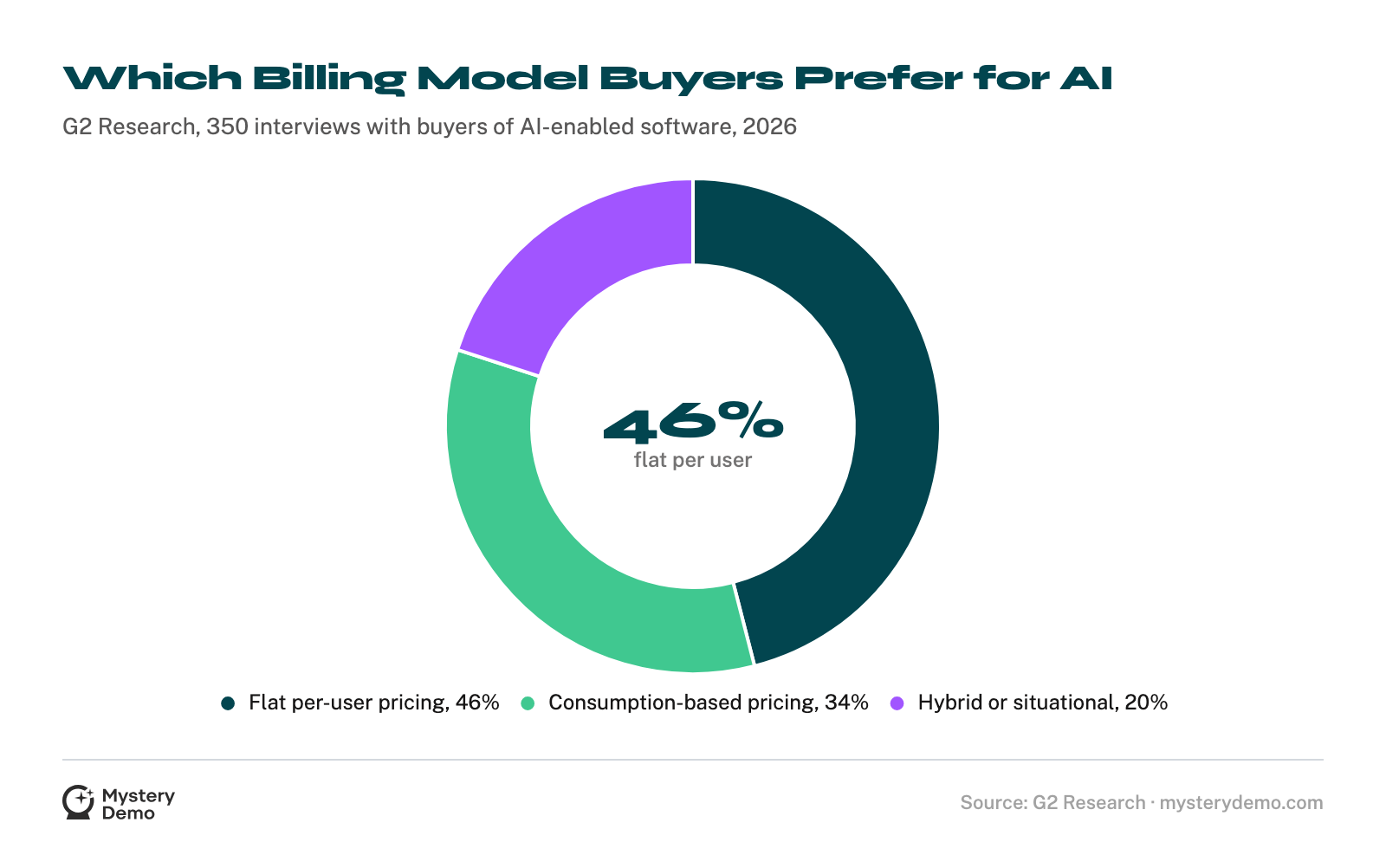
On billing, 46% of the same buyers favor flat per-user pricing for AI, against 34% who prefer consumption-based pricing and 20% who want a hybrid or situational approach.7 Among the buyers who discussed how much usage-based costs can swing, 43% accept the variation when spending is transparent and controllable, 34% remain uncomfortable with it, and 23% are comfortable without conditions.7
G2 asked separately about AI agents, software that carries out tasks on its own. In its July 2026 survey of 1,019 B2B decision-makers, just 9% called per-user or per-seat pricing the fairest model for agents.8 G2’s own reading is that seat-based pricing is becoming a weaker fit for the work agents do.
What buyers end up paying gets settled in negotiation, and they come ready for it. 92% of the 350 buyers G2 interviewed actively use negotiation tactics at renewal.7
AI Prices Fall Furthest From List Once Buyers Negotiate
A rival’s published AI price is where its negotiation with a buyer starts, and sometimes there is no published price at all. Dupple reviewed 377 business software tools in 13 categories, reporting in August 2026 that 126 gate at least one pricing tier behind a sales conversation,10 while 18% cannot be priced at all without a sales call.10 Its count covers all software pricing, not AI alone.
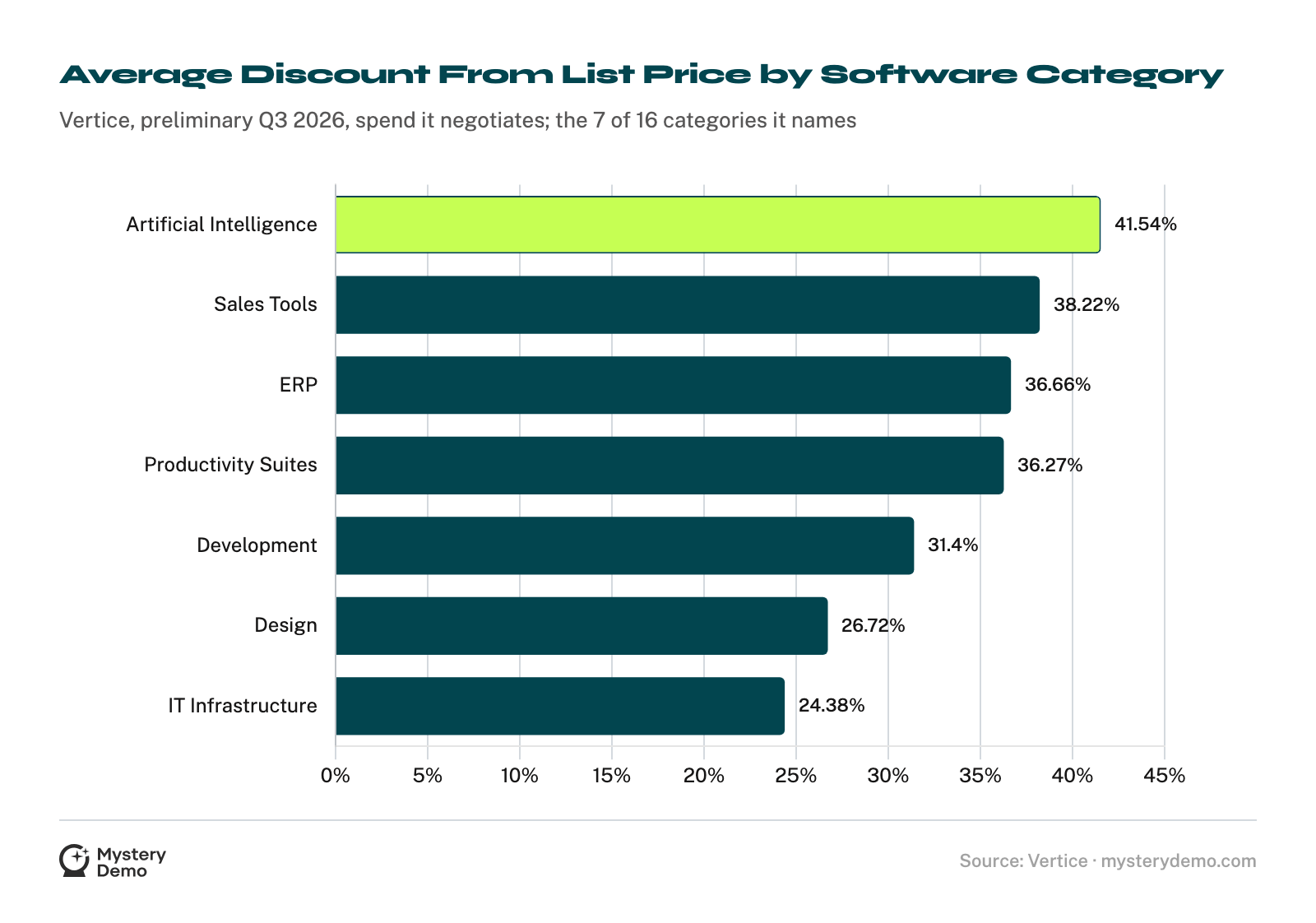
Where a list price exists, buyers negotiate down from it. Vertice, a software purchasing platform that also negotiates for its customers, publishes the average discount from list price across the spend it manages, more than $75bn in 2026. Its figures show where software discounts run deepest for those customers, not what every buyer gets.
In Vertice’s preliminary Q3 2026 figures, artificial intelligence is the category with the deepest average discount, at 41.54% off list.9 Vertice says AI’s discount has fallen for three straight quarters, from 45% in Q1 2026 and 43% in Q2.9 Sales Tools come second at 38.22%,9 and IT Infrastructure is the lowest of 16 categories, at 24.38%.9

Your Rival’s Real AI Price Comes Out on the Call
All of these figures describe the market. None of them says what your closest rival quotes a buyer your size for its AI tier, what that price is counted in, or how much of it the rep will put in writing.
Mystery Demo gets that answer by being the buyer. Below is the pricing page from the Findings & Analysis section of our public example board, where the client and every competitor are invented. Each row is one competitor: its pricing model, its floor price, how openly it shares that price, and the unit the price is counted in.
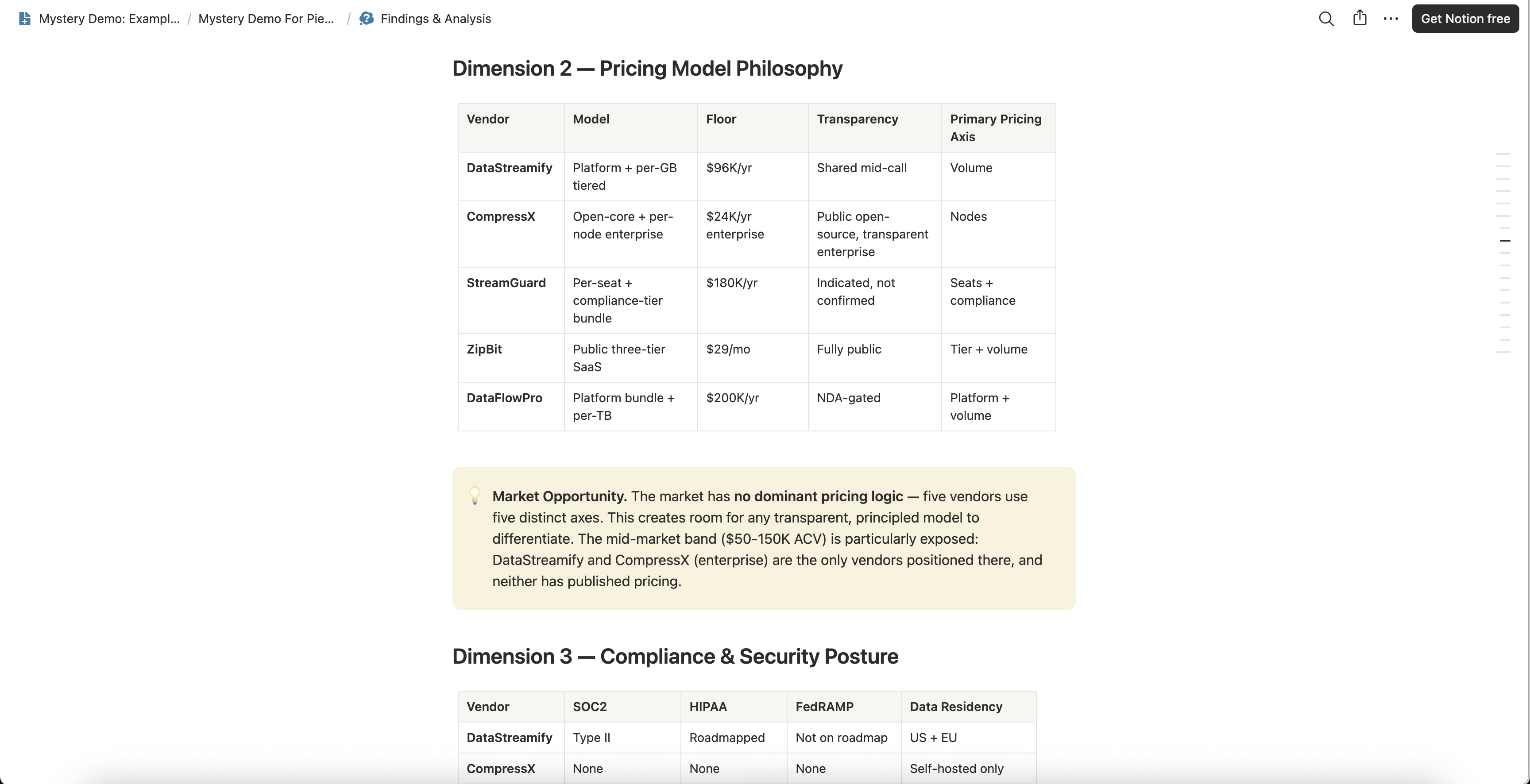
On a real project, every cell comes from that competitor’s own sales calls, down to whether the price was published, shared on the call or held back behind an NDA. We build that page for your own rivals through SaaS competitor pricing research, at a flat €499 per competitor, with the board ready in one to two weeks. Tell us on a short intro call which rival’s AI tier your reps keep guessing at, and we will come back with the quote its rep gives a buyer like yours, recording included.
Frequently Asked Questions
How Do Most SaaS Companies Price AI in 2026?
51% of 108 mid-market SaaS companies selling AI use usage-based pricing for it, in G2 research for Salesforce.1 Across the 631 executives in DigitalRoute’s survey, bundling leads at 25%, and no model is used by more.2
How Much Have SaaS Vendors Raised Prices Because of AI?
15.4% is the median across 45 list-price rises that 9 vendors tied to AI since September 2024, in Gravity’s public tracker.4
Do Buyers Want AI Included in the Base Price?
81% of the 350 buyers G2 interviewed say core AI should come standard in the base product.7
How Often Do IT Leaders Get Unexpected Charges From Consumption-Based or AI Pricing?
78% of 218 IT leaders in Zylo’s survey reported unexpected charges tied to consumption-based or AI pricing in the previous 12 months.5
How Often Do Companies Go Over Their AI Budget?
89% of 263 organizations in PricingIO’s survey had exceeded their initial AI budget forecasts.6
How Big Are Discounts on AI Software?
41.54% off list was the average discount on AI software in Vertice’s preliminary Q3 2026 data, from the spend it negotiates for its customers, the deepest of 16 categories.9
References
- G2 Research for Salesforce: From SaaS to AI: Why Go-To-Market Models Are Being Rewritten (2026)
- DigitalRoute: State of AI Monetization 2026
- hy and OMR Reviews: SaaS and AI Pricing Report 2026 (2025)
- Gravity: SaaS AI Price Increases 2026: The AI Tax Tracker
- Zylo: 2026 SaaS Management Index
- PricingIO: 2026 AI Pricing Report
- G2 Research: AI Pricing After the Hype (2026)
- G2: 2026 AI Agents Report
- Vertice: Average Discount From List Price (2026)
- Dupple: One in Three Software Vendors Hides Its Price (2026)


