
In G2’s 2026 survey of more than 1,000 B2B software buyers and decision-makers, 82% had taken software recommendations from an AI chatbot in the previous two years. Gartner’s survey of 645 B2B buyers found 45% using generative AI in a recent purchase, mainly to gather information on vendors and products.
The chatbot answers describe your competitors to your buyers: what each one costs, what it does, and how it compares with you. You see them only when a buyer happens to mention one. One marketer wrote on Reddit that prospects had started mentioning ChatGPT and Perplexity on sales calls, and the team had “almost no way to measure” how the company showed up there.
Mystery Demo goes through your competitors’ sales process as a real buyer would, records every call, and gives your team what each rep quoted, showed and said about you. The five steps below build a record of what assistants tell buyers about each competitor, so your reps can answer it with evidence. Step 4 puts a buyer on each competitor’s sales calls, the surest way to learn what a competitor really tells buyers, and Mystery Demo takes that step for you.
AI Search Gives Buyers One Answer Instead of a List of Links
A search used to return a page of links, and the buyer chose which ones to open: the competitor’s own site, a review site, a comparison page. An AI assistant returns one written answer instead, put together from sources it picked. That changes what buyers read about your competitors, and how much of it you can see.
| What changes | Traditional search | AI search |
|---|---|---|
| What the buyer gets | A page of links to choose from | One written answer |
| Who wrote what the buyer reads about a competitor | The competitor, a review site or a comparison page, each under its own name | The assistant, from sources it picked |
| What the buyer can open to check it | Any page on the list | The sources the answer cites, when it cites any |
| How you see what buyers see | Rank tracking shows where each page appears | A sample of answers you run yourself, plus what buyers tell you they read |
Data from Google searches shows what one written answer does to the clicks after it. In Pew Research Center’s browsing data for 900 U.S. adults in March 2025, people who saw an AI summary on a Google search clicked a regular result on 8% of visits, against 15% when no summary appeared. They clicked a link inside the summary on 1% of visits, and they ended their browsing on 26% of pages with a summary, against 16% without one.
Those are everyday Google searches, not software buyers and not standalone assistants. They still point one way: people read the answer and rarely open the pages behind it.
That last row of the table is the job. To see what buyers are told about your competitors, you have to ask what they ask.
Step 1: Write Down the Questions Your Buyers Ask About Each Competitor
Start with the questions a buyer types at each stage of a purchase, about each competitor you meet in deals, in the buyer’s words rather than yours. Say you sell scheduling software to pest control companies, and Rival A and Rival B are the two names you keep losing to. Both rivals and every question here are invented.
| Stage | What the buyer asks | What the answer tells you |
|---|---|---|
| Discovery | “What’s the best scheduling software for a pest control company with 40 technicians?” | Which competitors get named, and how each is described |
| Comparison | “Rival A or Rival B for a team like ours?” and “What are the alternatives to Rival A?” | How each rival is set against the other, and against you |
| Decision | “How much does Rival A cost for 40 users?” and “Is Rival A worth it?” | The price buyers are told, and the verdict they hear |
One practitioner on Reddit recommends starting with 30 to 50 real buyer prompts, split by discovery, comparison and decision, and run on several engines more than once. Another has noticed more buyers asking an assistant what a tool costs before they visit its pricing page, which is why the decision questions deserve their place.
Your own reps can add the most direct evidence of all. In discovery, a rep can ask what the buyer has already read about the alternatives. An answer a buyer shares shows what that buyer saw, while your sample shows what assistants say to questions like theirs.
A question set only tells you something if it is asked the same way every time.
Step 2: Run the Same Questions Every Month and Save Every Answer
Once a month, run the whole set the same way. One SEO practitioner on Reddit describes the routine: fresh sessions with memory off, the same prompt set, and a record of the model, the date, the answer and the cited URLs.
What you collect is a sample of what assistants say to buyer questions. It is not a copy of what any one buyer saw, and the record should never call it that.
Now pull every claim about each competitor out of the saved answers and into one record, one row per claim. The record for Rival A starts like this, with every claim, date and source invented. The comparison answers made the same kinds of claim about Rival B, and those rows go into the same record.
| The claim, as the answer stated it | Which question and run | Source the answer cited |
|---|---|---|
| “Rival A starts at $29 a user a month.” | Decision question, two assistants, Oct 3, runs 1 and 2 | A comparison site’s pricing roundup from 2024 |
| “Rival A syncs natively with your CRM.” | Comparison question, one assistant, Oct 3, run 2 | Rival A’s integrations page |
| “Rival A is easier to set up than [your product].” | Comparison question, two assistants, Oct 3, runs 1 and 2 | None |
Practitioners who have run these samples describe what turns up. “Outdated pricing, features you killed two years ago, and positioning borrowed from a competitor are all common,” one marketer wrote. Another noticed assistants in their niche quoting “prices that are 6+ months old,” some pulled from comparison pages that copied them long ago.
Price questions about business software often get no price at all. When Parse, which sells AI-visibility work, counted answers from ChatGPT Search and Google AI Mode between May and October 2026, 118 of 413 markets saw a brand price in fewer than 1% of answers, most of them business and enterprise software markets.
An answer that names no price goes into the record too. The record now says what assistants tell buyers. The next question is which of those claims are true, and what could prove each one.
Step 3: Sort Each Claim by What Could Prove It
A public page can confirm or contradict some claims, such as a list price, a feature in the docs, or an integration on the competitor’s own list. Check those now, and write down the page and the day you read it.
Other claims turn on what the competitor tells a buyer: the price it quotes a team like yours, whether a feature works when a buyer asks to see it, and what its rep says about you. No page holds those. Sort by the evidence a claim needs, not by how much it matters, because a feature listed in the docs can decide a deal as surely as a quoted price.
| The claim | What the public page shows (read Oct 6) | What is still open |
|---|---|---|
| Starts at $29 a user a month | The pricing page lists $35 a user for teams up to 25, and “contact sales” above that | The price Rival A quotes a team of 40 |
| Syncs natively with your CRM | The docs list the sync and mark it beta | Whether it works when a buyer asks to see it |
| Easier to set up than [your product] | No page can show it | Whether setup is easier, and what Rival A’s rep claims about it |
The first claim is already wrong for small teams, since the page shows a higher price than the answer gave. For a team of 40, the page shows no price at all.
The same sorting works on an AI report your own team asks for, and checking an AI report on a competitor walks through it line by line. Here, everything in the last column is a question only a buyer can put to Rival A, on its sales calls.
Step 4: Take the Open Claims to the Competitor’s Sales Calls
None of those questions can be put to Rival A under your own name. Request its demo as yourself and you will be recognized, or shown the tour every prospect gets.
An assistant works from what has been published about Rival A: its own pages, its listings, and the review and comparison sites that copy them. Pricing pages are sanitized and marketing pages overstate the product. The price for a team like yours, the feature on screen and what the rep says about you are said on the call, to a buyer, and nowhere else.
Mystery Demo goes in as that buyer, and each open claim becomes a question for the call:
| The claim | The question on the call | What the answer can show |
|---|---|---|
| Starts at $29 a user a month | “What would this cost for 40 users on an annual contract, and what would change the number?” | A quote for one buyer scenario, which is how a competitor’s real price gets found, not what every buyer pays |
| Syncs natively with your CRM | “Can you show us a job syncing both ways, live?” | Whether the sync was shown on screen or only described, and when in the recording |
| Easier to set up than [your product] | “How do you compare with [your product] on setup?” | How Rival A’s rep frames the comparison; whether setup is easier stays open |
How a Mystery Demo Runs
At kickoff, those questions join the project’s question list. The team then builds a buying scenario fitted to each competitor: a believable company, a real reason to evaluate software, and the size and stack that competitor sells to. Each competitor is approached through its normal front door, the way any serious prospect would.
Every stage of the sale is recorded, and each one fills a different part of your claims record:
| Stage | What the buyer asks for | What it gives your record |
|---|---|---|
| Discovery | Fit for a 40-technician team, and how Rival A compares with what the buyer uses now | How Rival A’s rep talks about you |
| Demo | “Can you show us a job syncing both ways?” | Shown live or only described, with the minute |
| Technical deep dive | What setup and data migration involve | What setup takes, in the rep’s own words |
| Pricing conversation | “What would 40 users cost on an annual contract?” | The quote, the terms and what moves the number |
| Follow-up emails | The written quote and any collateral | The figures in writing, with the date |
Afterwards, each claim a rep made is checked against the competitor’s live website, LinkedIn and public news. All of it lands on a Notion board, a shared workspace with a page for each competitor and pages that compare them.
Your open claims land on the board’s Research Objectives page, shown here from our public example board, where the client and every competitor are invented. A real project’s board is built from its own client’s calls.
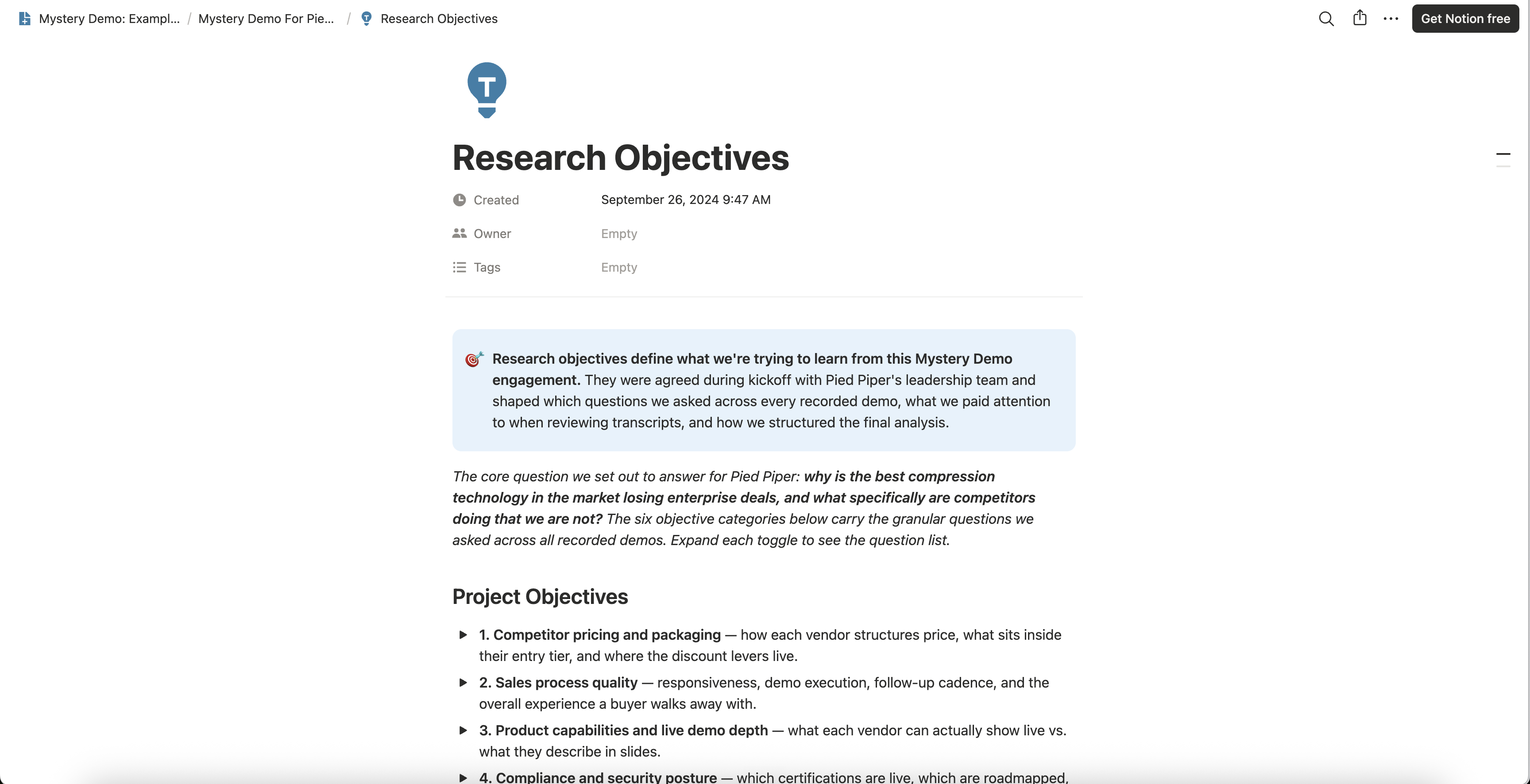
The page opens with the core question the project has to answer, then lists the objectives every call carries. The third asks what each vendor can show live against what it only describes in slides, which is the question behind every feature claim in your record.
What Comes Back for Each Claim
Each competitor gets a page of its own, built from its calls. Here is the analysis at the top of one competitor’s page on the same invented board.
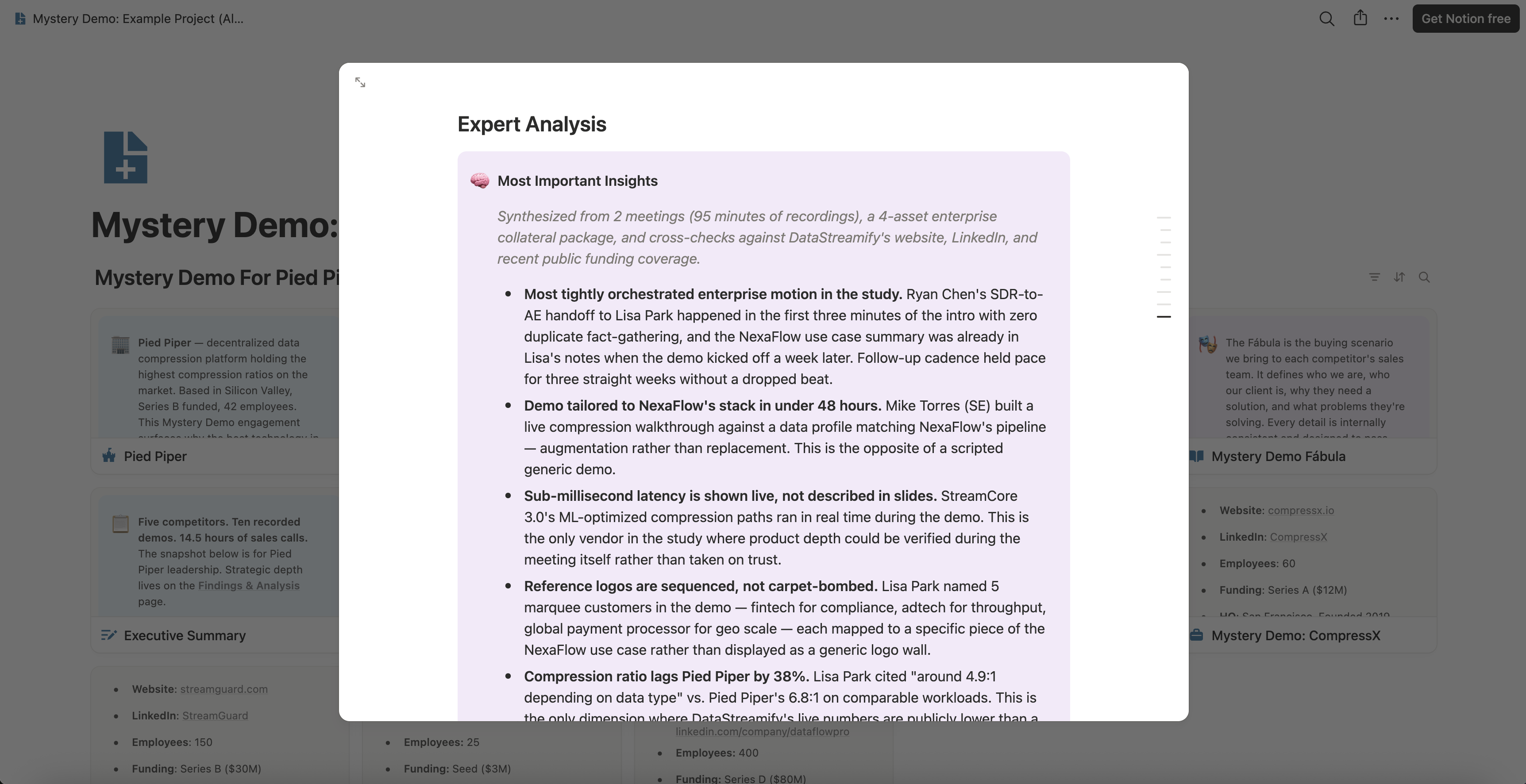
The line under the heading says what the analysis rests on: the recorded meetings, the collateral the competitor sent, and checks against its website, LinkedIn and public news. Each insight under it names what the evidence showed, and one separates a capability shown working in the meeting from one only described in slides. Your record needs that same difference for every feature claim.
Across competitors, the board’s feature matrix marks each feature the calls put on screen as shipped, partial or a stub. Our competitor product comparison is built on that matrix and on the per-competitor pages.


The people who run these calls have sold B2B software themselves, so they know which question pulls a rep off the script. Every finding comes back with the recording, the transcript line or the email behind it, so nobody has to trust a summary. The fee is a flat €499 per competitor, everything included, and one competitor’s board is ready in one to two weeks.
One call records what one rep told one buyer, in one scenario, on one day. When later calls with Rival A say the same thing, the finding becomes a claim about the company. Start with the competitor that turns up most in your sample: name its open claims on a short intro call, and we will be the buyer on its calls and bring back what its reps tell a buyer about each one.
Step 5: Give Every Claim a Status and Your Reps an Answer
What comes back from the calls goes into the record beside the claim it answers. Each claim then gets a status from the evidence behind it, and a claim answered in parts gets one for each part:
| Status | What it rests on | What a rep may say |
|---|---|---|
| Confirmed on a public page | The page and the day you read it | The claim, with the page |
| Contradicted | A page or a call that says otherwise | What the evidence says instead |
| Price quoted on a call | The buyer scenario, the call and the minute | The quote, for that scenario only |
| Shown live on a call | The call and the minute it worked | That it was shown, and when |
| Claimed by the rep, not shown | The call and the minute it was said | That the rep said it, never that it works |
| Unresolved | Nothing yet, or a call that answered part of it | Nothing, until the evidence arrives |
When a call answered a claim for one buyer scenario, the status names that scenario: “price quoted on a call for 40 users, annual.” That way a quote for one team never turns into Rival A’s price for everyone.
Then write the line your rep says when a buyer repeats what an assistant told them. The finished record for the same three claims follows, and every date and minute in it is still invented.
| The claim | The evidence | Status | What your rep says |
|---|---|---|---|
| Starts at $29 a user a month | Pricing page, Oct 6: $35 for teams up to 25. Call 2, Oct 14, a 40-user annual scenario: $41 a user (24:10) | Contradicted on the page; price quoted on a call for 40 users, annual | “That price is from 2024. Their page now lists more for small teams, and larger teams get a quote, so ask for yours in writing.” |
| Syncs natively with your CRM | Docs, Oct 6: listed as beta. Call 1, Oct 13: the rep described the sync and showed none of it (22:40) | Claimed by the rep, not shown | “Their docs list it as beta. Ask them to show a job syncing both ways before you count on it.” |
| Easier to set up than [your product] | Call 1, Oct 13: the rep said setup takes “a weekend” (09:15) and showed no setup | Claimed by the rep, not shown; the comparison with you stays unresolved | “Here is what setup with us looks like, step by step, and how long each step takes.” |
Buyers do bring these answers to your reps. In Gartner’s survey of 645 B2B buyers, 69% preferred to validate AI-generated insights with sales reps, and in TrustRadius’s survey of 1,862 technology buyers, 94% of those who used AI to research a purchase still fact-checked what it told them. A rep with the evidence in hand is the check they came for.
In a live call, a rep needs a smaller view: each claim the assistants make about each competitor, and what that competitor’s calls showed. Here is that claims map for Rival A and Rival B, built from the same record and invented line by line.
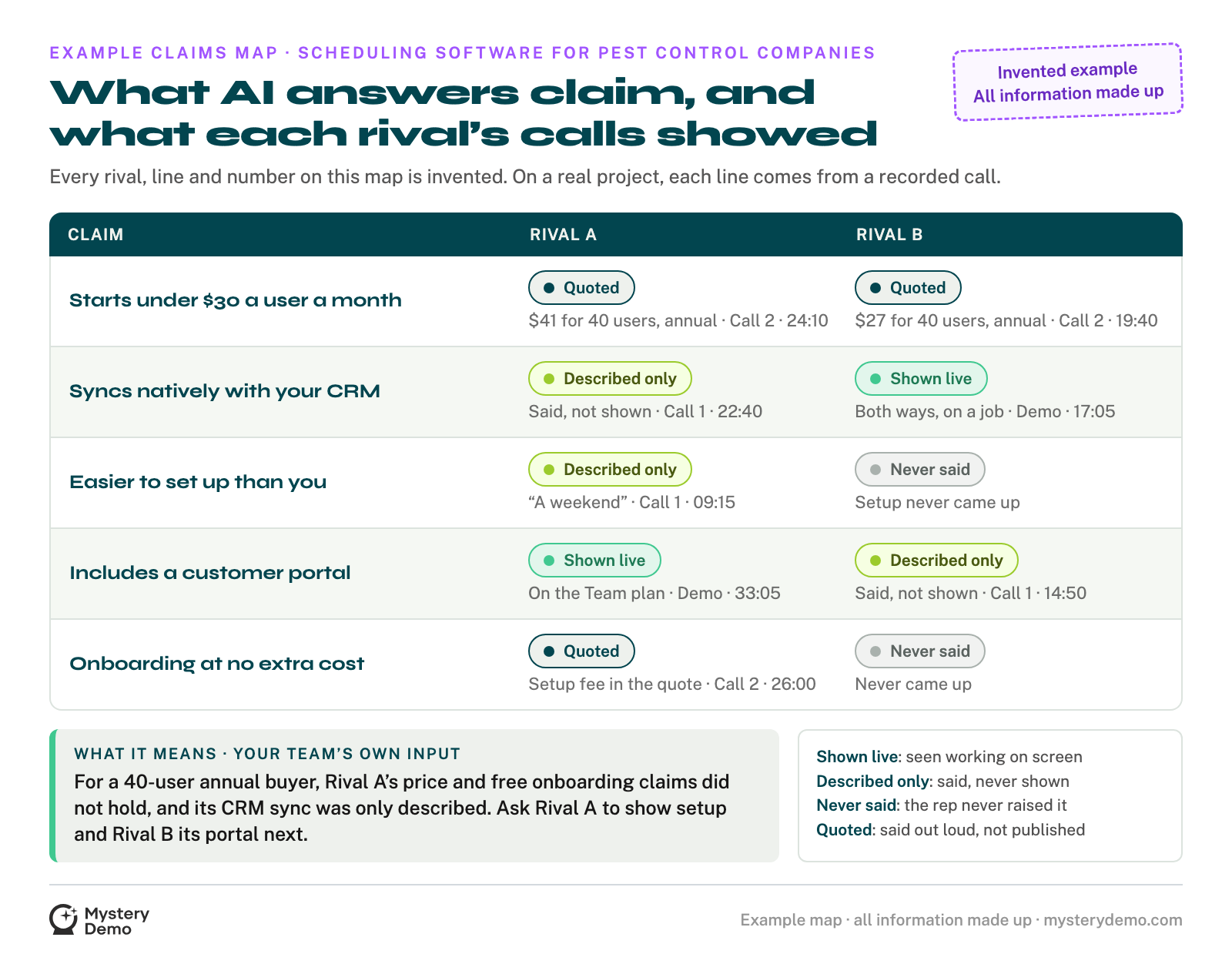
Quoted means a price said out loud on a call, Shown live means it worked on screen, and Described only means the rep said it and showed nothing. Never said means the subject never came up, so the claim behind it stays unresolved. It is never proof that the thing does not exist.
Assistants Will Keep Describing Your Competitors Before Your Reps Do
Assistants will go on describing your competitors to buyers before your reps meet them, and the answers will shift as the pages behind them change. The monthly sample tells you what is being said, and public pages settle part of it. Each competitor’s own calls tell you what it quotes, shows and claims to a buyer like yours, which answers some claims in full and narrows the rest.
Each part of the check runs on its own clock:
| What you run | How often | What sets it off |
|---|---|---|
| The sample of answers | Every month | The calendar |
| The public page checks | Every month, on the claims the sample turned up | A claim that is new or has changed |
| The competitor’s sales calls | When a claim that matters is open, or moves | A price, feature or comparison with you that no page settles, or one that just changed |
Your team can run the sample and the desk checks every month. The calls are where we come in: bring this month’s open claims to a short intro call, and we will hear each competitor answer them the way it answers a buyer, with the recording to prove it.


