
Your buyer liked the demo. Now they have to convince their finance team, their security team and their boss to pick you, in meetings your sales rep is not part of. Forrester’s 2024 research puts the average buying group at 13 people, and your rep meets only a few of them.
Every one of those people will ask how you compare with the other vendors on the shortlist. A comparison your own team wrote reads to them as a sales pitch. So here is how to give your buyer a one-page comparison those people will trust: every fact about a competitor is something that competitor said on its own sales calls, and anyone can check it by asking.
Mystery Demo gets those facts for you. It books your competitors’ sales demos as a real buyer and records what each one quotes, shows and promises.
Why Buyers Ignore a Comparison You Wrote
The people your buyer has to convince know who wrote your comparison. Words like “clunky”, “expensive” or “limited” give them nothing to check, so they can only take your word for it, and they won’t.
A fact they can check works differently. Here is the same comparison written two ways, on three questions those people always ask. Every line is invented, to show the difference:
| What they ask | Written from the competitor’s website | Written from what the competitor told a buyer |
|---|---|---|
| Finance: “What will it cost us?” | “Plans from €49 a user a month” | Quoted €44 a seat for 50 seats, billed yearly, with 10% off for signing that quarter |
| Security: “Is our data safe with them?” | “Enterprise-grade security” | Sends its security audit report only under an NDA; said EU data hosting is planned but not available yet |
| The team who will use it: “Does it do what we need?” | “AI-powered automation” | Showed the workflow builder working live; described the AI step but never showed it |
The right-hand column is the one that helps your buyer, and none of it is on a website. A pricing page shows the price a vendor is willing to print, and its product pages show the product at its best. The real price, the discount, the security answers and what the product does today come out in a sales conversation, with a buyer on the other end.
Nobody has to take these facts on trust, either. Anyone on the buyer’s side can put the same question to the competitor and see whether the answer matches.
How Mystery Demo Finds Out What Competitors Tell Buyers
Mystery Demo goes through each competitor’s sales process the way a buyer would. Before the first call, the team sets up a believable buying scenario for each competitor: a company with a real reason to buy, matched to the kind of customer that competitor sells to. Then it books the demo through the competitor’s normal contact form, like any other prospect.
Each competitor goes through the same steps, and every call is recorded:
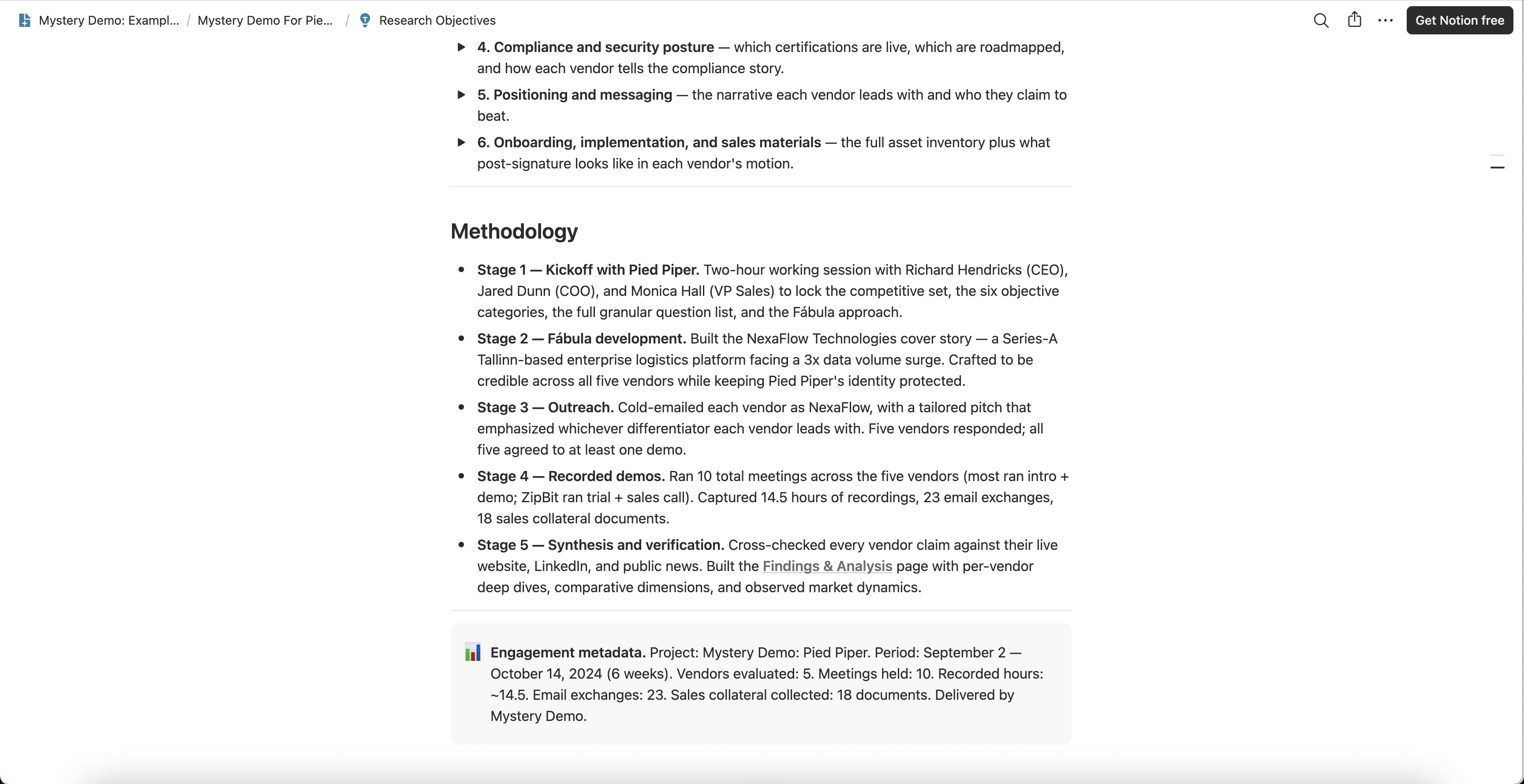
Everything lands on a board in Notion, a shared workspace your team can search, with a page for each competitor. Below is the Research Objectives page of our example board, which shows how a project runs. The client and every competitor on it are invented, and a real board is built from your own competitors’ calls.
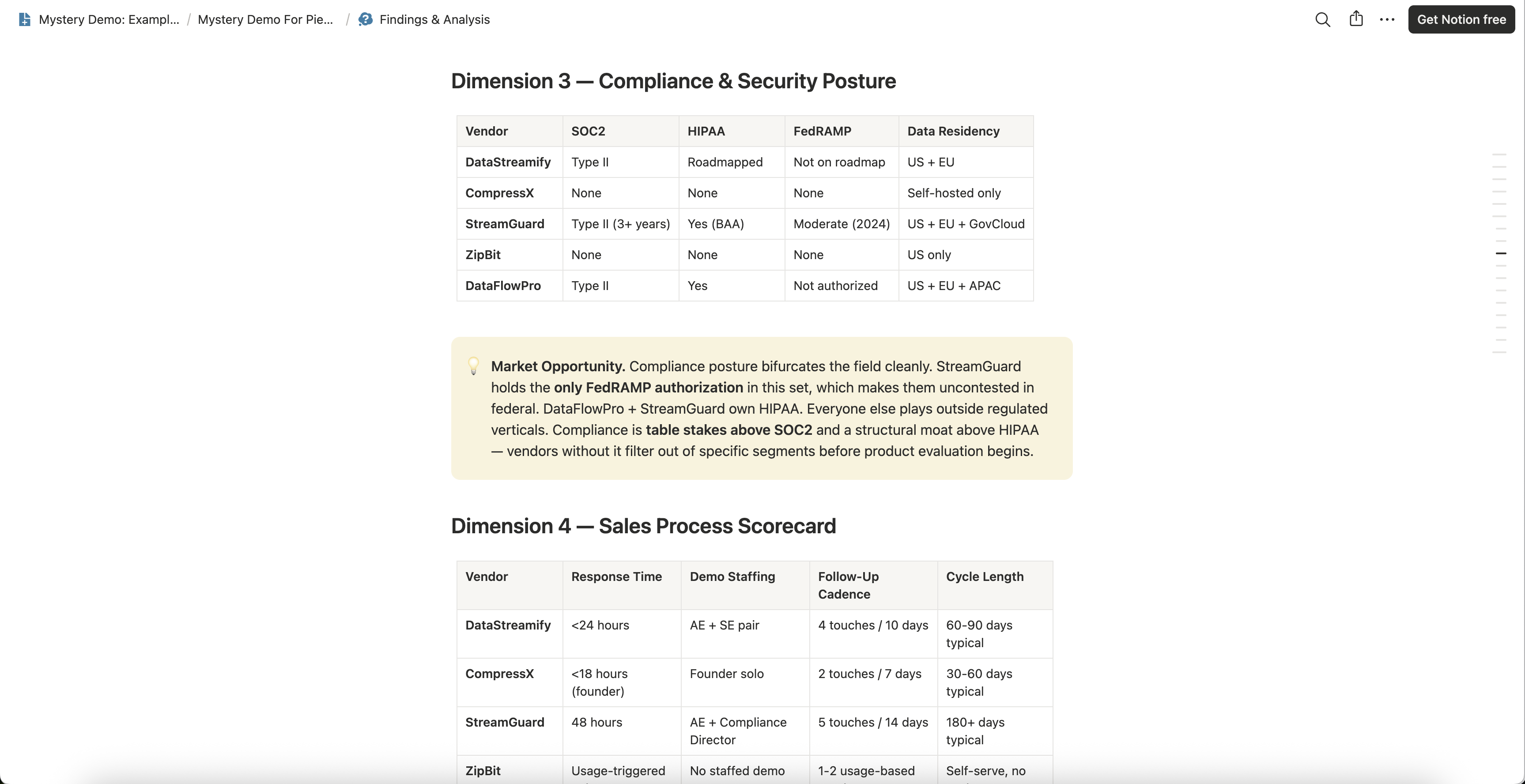
The board also compares the competitors side by side, topic by topic: price, security, setup time and more. Here is the security comparison from the same invented board, every competitor in one table. On a real project, a table like this is where the security row of your one-page comparison comes from.
Four reasons to get these facts this way rather than on your own:
One call shows what one rep told one buyer on one day. When the same thing comes up on several calls, with different reps, it becomes something you can say about the company. The same calls also fill your reps’ battlecards, the cheat sheets they use against each competitor, with every line linked to the moment in the recording it came from.
If your buyers keep asking about the same two competitors, start with those two. Bring them to an intro call with us, and we will go through each one’s sales process as a buyer and bring back the facts finance and security ask about.
With those facts on the board, your team can write the page.
The One-Page Comparison, Row by Row
Your team writes the page from the board, and your buyer forwards it to everyone who has a say. Each row answers one person’s question. Each fact about a competitor says what that competitor told a buyer, and when.
Keep the recordings and the board inside your team, and don’t attach or link them. The people on the buyer’s side check a fact by asking the competitor directly, and they usually check only the one or two facts that matter to them.
Here is the page, row by row:
| Who asks | What to write about each competitor | How they can check it | Where it comes from on the board |
|---|---|---|---|
| Finance: “What will it cost us in the first year?” | The price it quoted, for how many seats, on what terms, and when | Ask the competitor for a written quote | The pricing comparison |
| Security: “What can each one prove?” | What it said about certifications and data hosting, and which documents it offered | Ask the competitor for those documents | The security comparison |
| The team who will use it: “Does it work, or only on slides?” | What it showed working live, and what it only described | Ask the competitor to show it live | Each competitor’s page |
| Whoever runs the rollout: “How long until it works?” | How long the rep said setup takes, and who does the work | Ask for it in the contract | The setup comparison |
| The boss: “Why this one?” | Where each option is strong and where it is weak, marked as your opinion | Check the facts in the rows above | The summary of where each competitor wins |
| Your own column | Your price, your security documents and your customer references | Read the documents you attach | Your team |
Finance. Finance now has a say in more of these decisions: in G2’s survey of 1,038 B2B decision-makers in June 2026, finance’s involvement in buying decisions rose from 31% to 46% in one year. Write each competitor’s price as a past quote (“quoted €44 a seat for 50 seats in September”), never as a price your buyer will get.
Prices change with the buyer and the date, so your buyer should ask each competitor for a written quote of their own. The dated quote on your page tells them roughly what to expect, and comparing competitor quotes on equal terms shows how to line them up fairly.
Security. In the same survey, 39% of buyers named IT security review as the biggest single delay after picking a vendor. Write what each competitor said about certifications and data hosting, which documents it offered, and what it would not answer.

The team who will use it. Write what each competitor showed working and what its rep only described. The described features matter most, because those are the ones to ask the competitor to show.
Whoever runs the rollout. Write how long each rep said setup takes, and who does the work. Until a promise is in a contract, the page calls it a promise.
The boss. The boss wants one line per option: where it is strong and where it is weak. Mark that line as your opinion, and let the facts in the rows above back it up.


Four rules keep the page trustworthy:
Here is a finished page for an invented category, with you and two invented competitors:
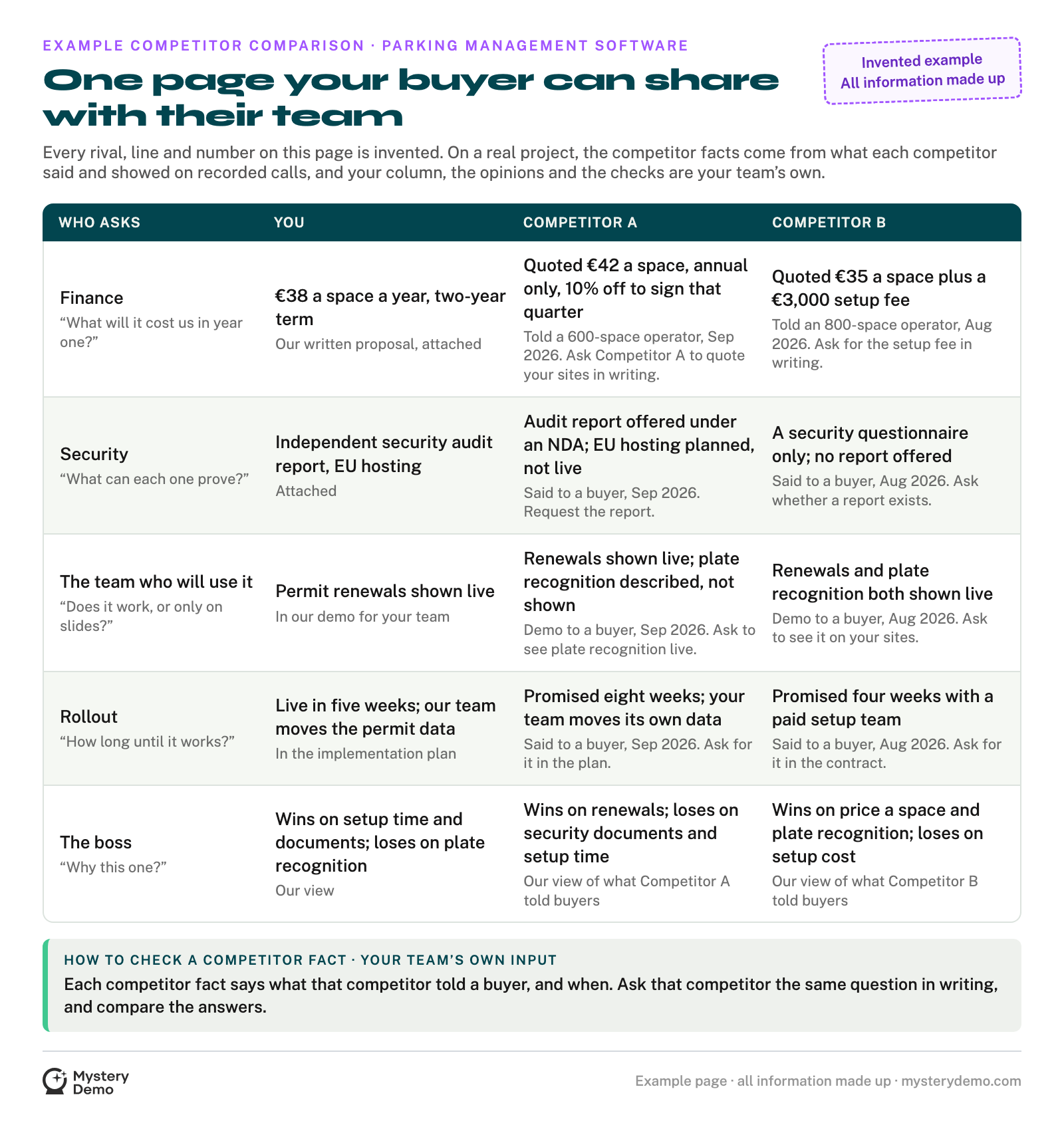
A page like this is accurate on the day you write it.
Keep the Comparison Up to Date
Competitors change their prices, their packages and their pitch, and your page will not notice. One out-of-date fact is worse than a missing one, because whoever catches it stops trusting the rest.
Get fresh facts on a competitor when any of these happens:
Date every fact, and re-check price and security first, since those are the rows people test. A changed pricing page updates the published price, but what reps quote, show and promise only comes from new calls. One competitor takes one to two weeks, so you can refresh just the one that changed.
The comparison your buyer’s team will trust is the one where every fact about a competitor came from that competitor, dated, and anyone can check it by asking.
Your buyer will forward something either way. Make it a page that holds up: talk to us about the competitors your buyers keep asking about, and we will go through each one’s sales process as a buyer and bring back the facts for every row.


