
Let AI write your battlecards. Working from a rival’s website, docs and reviews, an AI tool drafts the public half of a card in minutes. It is already writing the answers reps use: a sales enablement leader quoted in a LinkedIn post in September said their reps spend 15 minutes searching for a battlecard, give up, and ask an AI assistant instead.
The other half of the card is where competitive deals turn: the price the rival’s rep quotes a buyer like yours, what that rep says about you, and what the demo shows and skips. An AI tool working on its own cannot find those lines, because they are said on the rival’s sales calls. So for any rival that sells through a sales call, a card the tool drafts by itself is thinnest exactly where your reps get pushed.
Mystery Demo books your competitors’ real sales demos as a credible buyer, records every call, and hands back what each rep quoted, showed and said about you, analyzed on a shared board. That is the other half of the card. Give those recordings to the same AI tool, and the lines that decide deals get drafted from what a rival told a buyer.
Where Each Battlecard Line Comes From
Sort a battlecard by where each line comes from, and the split is plain. The top rows are what an AI tool finds on its own. The bottom rows are things a rival’s rep says to buyers, and no tool can find them until someone collects them.
| Battlecard line | Where it comes from | Can an AI tool find it on its own? |
|---|---|---|
| What the rival says it does | Its website, docs and release notes | Yes |
| What customers complain about | Review sites | Yes, from the customers who chose to write one |
| What analysts think of it | Analyst notes | Partly, since many are behind a paywall |
| Its list price | The pricing page | Only where it is published, and a third of 377 business tools Dupple reviewed in August keep at least one tier behind a sales call |
| The price its rep quotes a buyer like yours | The sales call | Not until someone collects it |
| What its rep says about you | The sales call | Not until someone collects it |
| What its demo shows, and what it skips | The sales call | Not until someone collects it |
| Its discount levers and contract terms | The call and the emails after it | Not until someone collects it |
Parse’s 2026 study of answers from two AI search products shows the gap on price. In 118 of 413 markets, fewer than 1% of answers quoted a brand price, and most of those 118 were business and enterprise software markets. Parse does not say why, but a price a vendor never publishes is a price no engine can find to quote.
A card drafted from the top rows can answer what the rival’s website says. Your buyer repeats what the rival’s rep told them, and that lives in the bottom rows. That is where your rep improvises, and a practitioner writing on LinkedIn in October named the cost: “Get one claim wrong on a call and the rep stops trusting the card, and you.”
Against a rival that sells entirely self-serve, there is no sales call to hear, and its public pages carry more of the card. For every other rival, the bottom rows come from being the buyer, and a mystery demo collects them in three moves:
The recording is what separates the call from every other source in the table. A website says what a rival wants buyers to believe, and a review or an analyst note says what someone else thinks of it. Only the call holds what the rival’s rep quotes, shows, promises and pushes back on, in front of a buyer like yours.
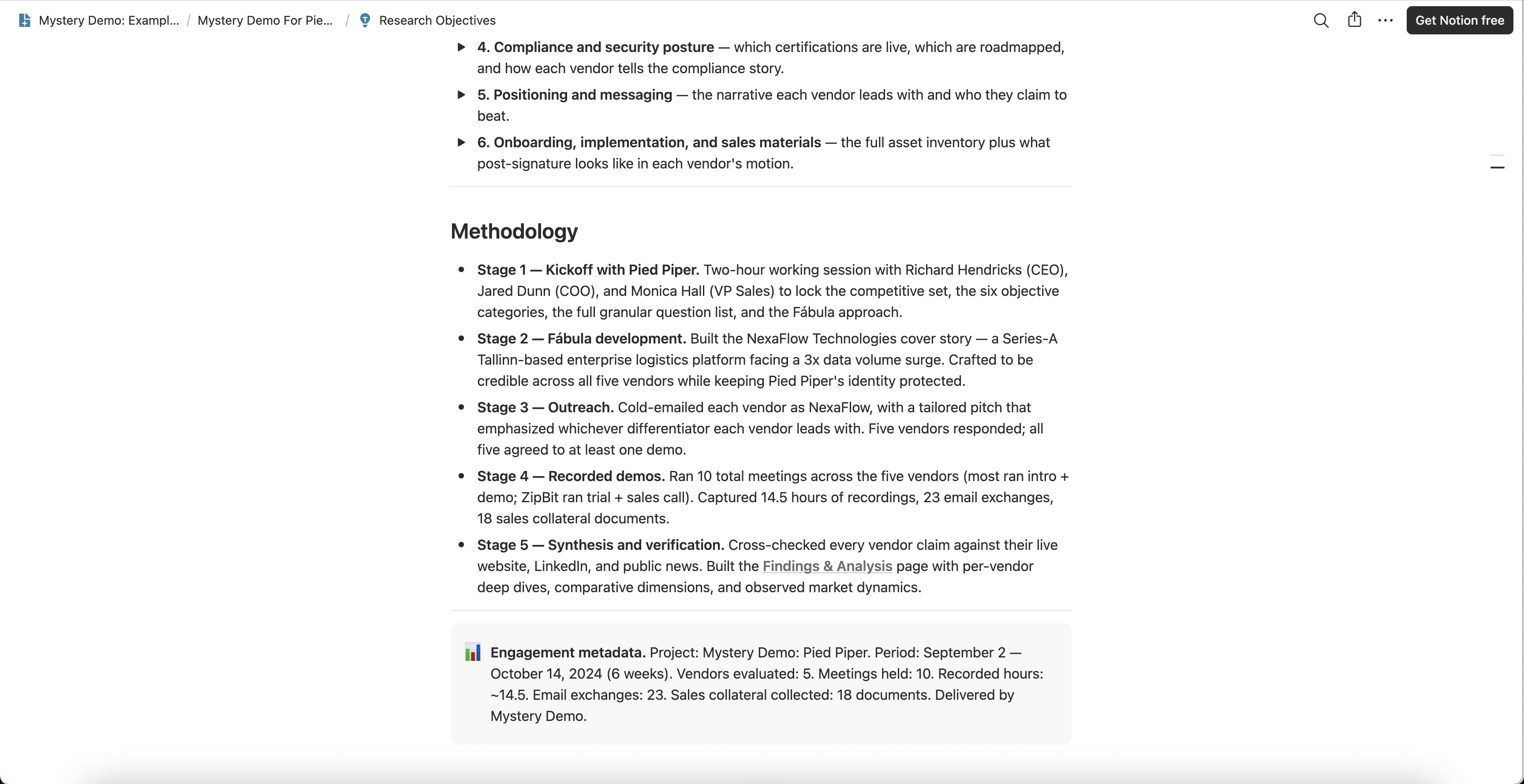
Below is that method on Mystery Demo’s example board. The project is invented, and a real board is built from the calls taken with that client’s own competitors. The board is a shared Notion workspace, and this page lays out the five stages, from the kickoff and the buying scenario to the recorded demos and the cross-check of every claim.
Collecting calls is work, though, and a busy enablement lead is right to ask whether the team needs it at all.
The Best Case Against Collecting Calls
The case for skipping the calls goes like this, and it is a good one:
Much of that is true, and the first point is already common practice: in BCG’s survey of 398 revenue leaders at large companies, published in October, 90% reported meaningful AI use in sales workflows. One product marketer on Reddit built a custom AI assistant for competitive intel and found it “better than any battlecard bc reps could simply ask it questions.”
So concede the point where it holds: for the public half of the card, and for patterns across the deals you lost, those inputs are enough. Those inputs cannot give you the rival rep’s own words to a buyer like yours, with the number quoted and the minute it was said.
Notes and buyer recollections report those words second-hand and after the fact. The same marketer added that the assistant “wasn’t connected to fresh data.” Another in that thread put the rule plainly: “the quality of that answer comes from the shape of the data that ends up in the context, not from the prompt.”

The tool is not the weak link. Its inputs are, and the rival’s calls are the one input missing from every source on that list. So what does the card look like once those calls go into the tool?
Give Your AI Tool the Rival’s Calls
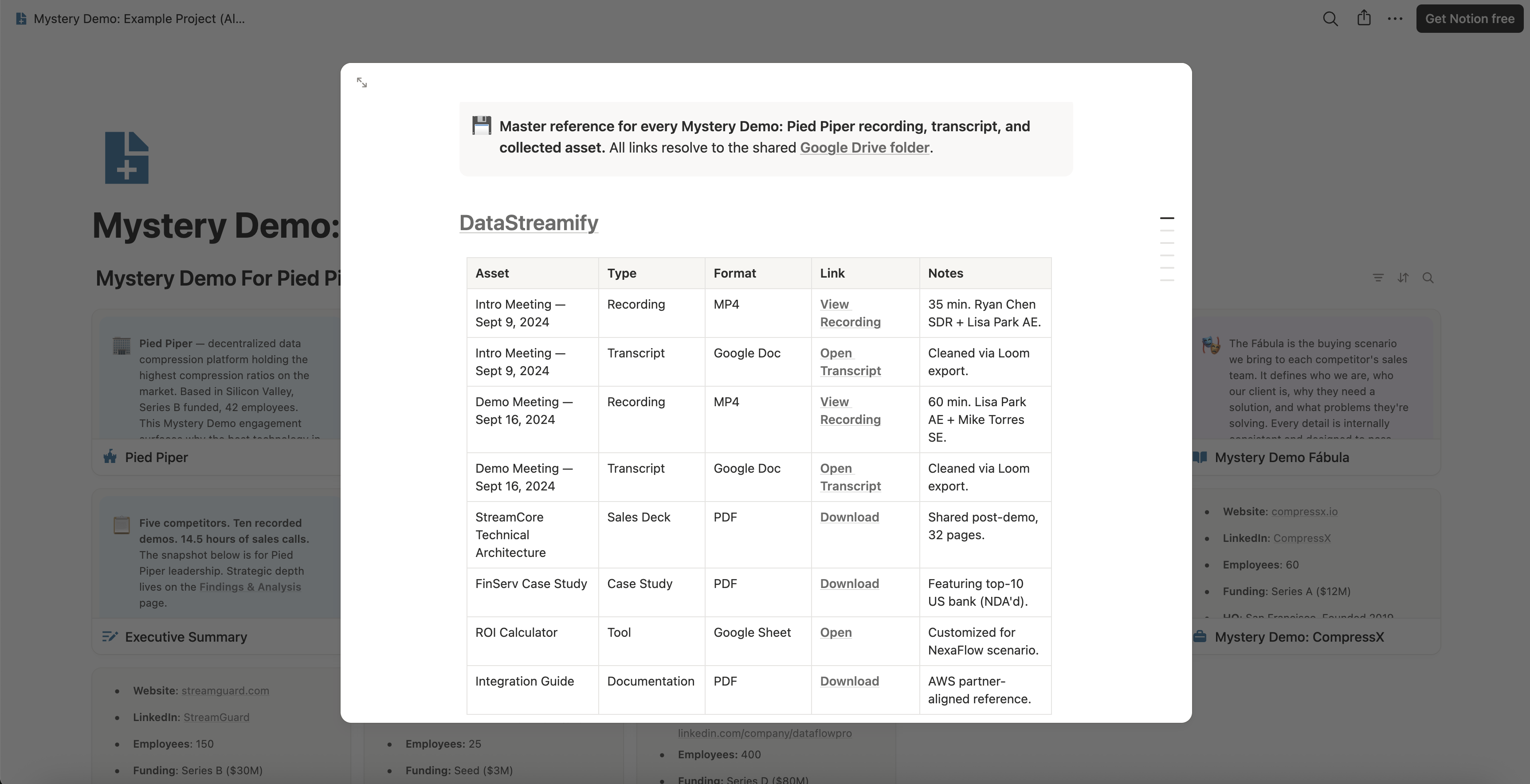
On a Mystery Demo board, the calls arrive in one place. The Database page lists every recording, cleaned transcript and document each rival sent, which is exactly what an AI tool needs to read. Below is that page on the same invented example board.
Hand those transcripts to the tool your team already uses, and ask it for three things:
The lines that decide deals then come from what the rival’s rep said, not from a guess. Here is an example card for an invented rival, filled that way. Every line on it is made up, and each source points to a call and a minute, or to an email.
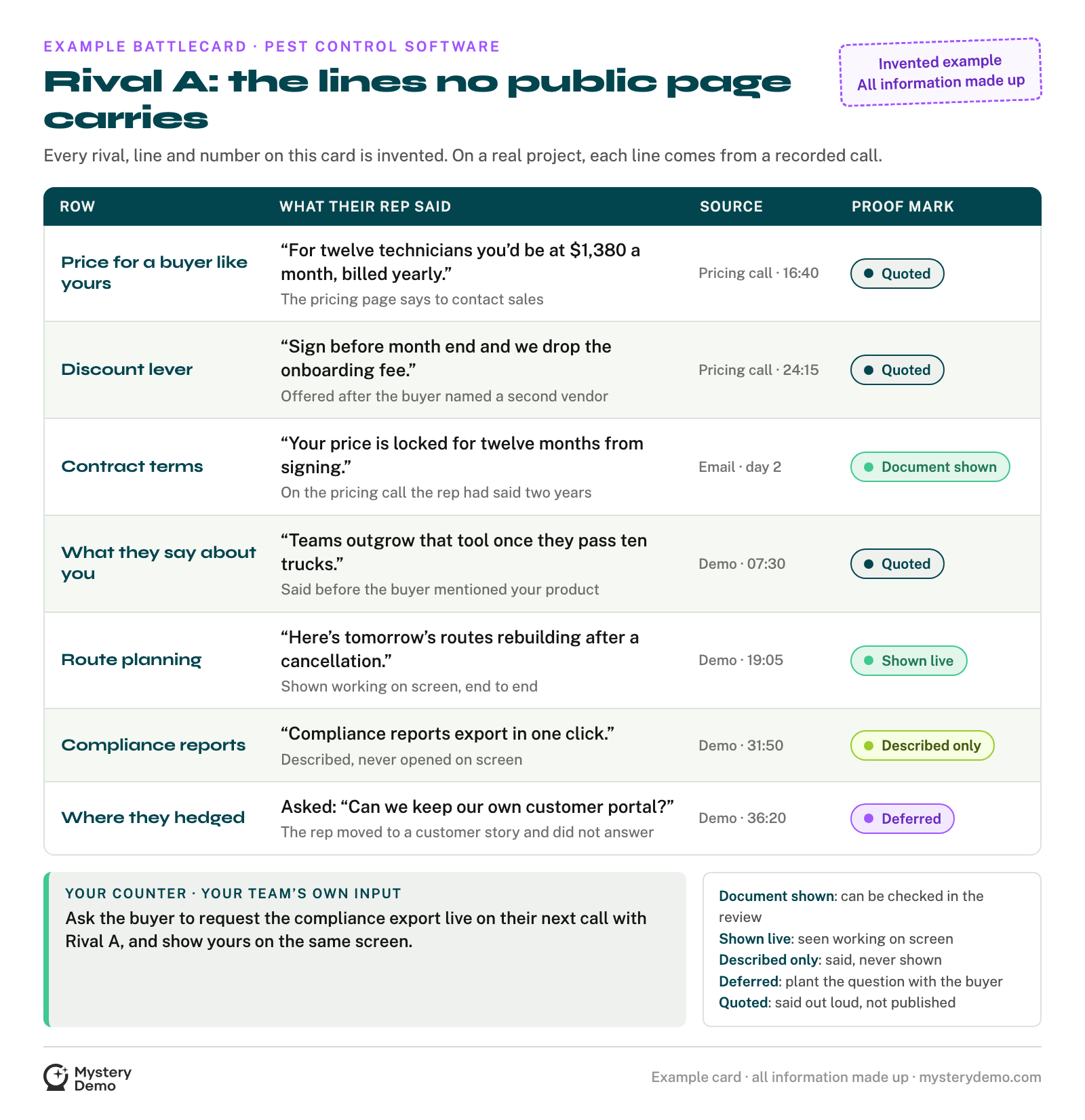
Each line still gets checked against the moment it cites, because a single call shows what one rep said to one buyer on one day. A line about the whole company needs the same answer on more than one call. Collecting those calls is the work Mystery Demo’s competitor battlecard research does, and it is hard to do from inside your own company:
If one rival keeps turning up in your lost deals, start there. Tell us its name on a short intro call, and we will go through its sales process as the buyer, then send back the transcripts with every minute marked, ready for the tool that drafts your cards.
Put the Rival’s Calls Into the Card’s Inputs
An AI-drafted battlecard with no rival calls in its inputs is guessing at the lines that decide competitive deals. With the calls in its inputs, those lines rest on what a rival told a buyer, one scenario at a time, and each still gets checked against its minute.
The first step costs nothing, and it takes an afternoon with the card you already have:
If the gaps cluster on two or three rivals, that short list is the brief. Send it to us before your next card refresh, and we will bring back the calls behind those lines, recorded and on the board, before your team redrafts.


