
B2B buyers build most of their vendor shortlist on their own, from AI assistants, review sites, peers and vendor websites, usually starting from vendors they already know first-hand. Most of them rank that list before anyone from sales is involved.
6sense’s 2025 study surveyed just under 4,000 business buyers, each with a purchase of $25,000 or more behind them. 94% of buying groups had ranked their shortlist by preference before engaging with sellers. They evaluated about five vendors on average, and 95% bought from one that was already on their shortlist on the first day of their search.
For a sales enablement team, that splits the work in two. Getting onto the list mostly happens before your reps hear about the deal, and winning from it happens in a comparison they only see one side of. Mystery Demo works on the second half: it books competitors’ real sales demos as a credible buyer and brings back what each rep quoted, showed and promised to a buyer like yours.
Where the Vendors on a Shortlist Come From
Buyers draw their shortlist from six kinds of source, in no fixed order. The table sets each one beside what it gives a buyer and what the research found about it. Each study asked different buyers, in a different country or year, so every figure belongs to its own row.
| Source | What it gives a buyer | What the research found |
|---|---|---|
| Vendors they already know | First-hand experience of the product, the company or its people | 97% of buyers had prior experience with at least one vendor on their shortlist (6sense, 2025) |
| AI assistants | Answers about a category or a vendor, asked in the buyer’s own words | Of 2,063 U.S. business buyers, 60% used AI tools during a purchase (Google and National Research Group, 2025). Of 250 UK buyers at companies with $50m+ revenue, 77% used one in vendor research, most often to fact-check a vendor they had already found (The Reality Department, 2026) |
| Review sites | Other customers’ experience, good and bad | Among more than 1,000 software buyers, review sites (38%) edged past AI chatbots (37%) as an influence on their shortlist (G2, 2026) |
| Peers and communities | A recommendation from someone they trust | Half of the vendors on those UK buyers’ shortlists got there through a peer’s recommendation or prior familiarity (The Reality Department, 2026) |
| Social media | What people in their field are saying | 59% of the U.S. buyers used social media while researching a purchase (Google and National Research Group, 2025) |
| Vendor websites | The vendor’s own case, in its own words | 42% of 1,862 technology buyers consulted vendor or product websites during the purchase (TrustRadius, 2026) |
Apart from a buyer’s own past experience, every row is the vendor describing itself or someone else describing the vendor. That is enough to decide who makes the list, and most buyers have ranked it before a seller hears from them. Does the ranking settle who wins?
The Buyer’s Early Favorite Does Not Always Win
Most of the time, it does. In 6sense’s 2025 study, the buyer’s favorite going into seller conversations went on to win 77% of the time, down from 83% in earlier years. Almost a quarter of deals now go to a vendor that was not the favorite, and slightly more than one in five buyers changed their minds after engaging with sellers.
Buyers also say those conversations weigh on them. Among 1,862 technology buyers TrustRadius surveyed in January 2026, 73% named product demos among their most influential resources, about as many as named their own prior experience (72%) and more than named user reviews (53%).
So a ranked shortlist is a starting position. The demos and calls that follow can keep the favorite in front or move another vendor past it, and only the buyer hears all of them.
Only the Buyer Hears Every Vendor’s Pitch
Each vendor on a shortlist runs its own conversations with the buyer: discovery, a demo, a pricing discussion, the follow-up emails. Your reps hear your side. The buyer hears every side and compares.

From inside one deal, that comparison is invisible. Your rep may learn which other vendors are on the list. What those vendors showed, quoted and claimed about you happens in calls your team never hears.
For each competitor you keep meeting on shortlists, three answers would change how your reps walk into that comparison:
None of the six sources buyers use can answer them. A website says what a vendor wants buyers to believe, and a review or a peer says what someone else thinks of it. The call is where the vendor quotes its price, shows the product working, makes its promises and sets itself against the others, in front of a buyer like yours.
So the answers only come out when the person asking is a buyer.
How Mystery Demo Gets the Answers From Competitors’ Calls
Mystery Demo runs this as a project, and it starts at kickoff. You name the competitors, typically three to nine, and the questions to put to each, such as how it opens its demo and how it answers on price.
Everything lands on a board, a shared Notion workspace with a page for each stage of the project. Below is the Research Companies page from Mystery Demo’s example board, where the client and every competitor are invented. A real board is built from the calls taken with that client’s own competitors.
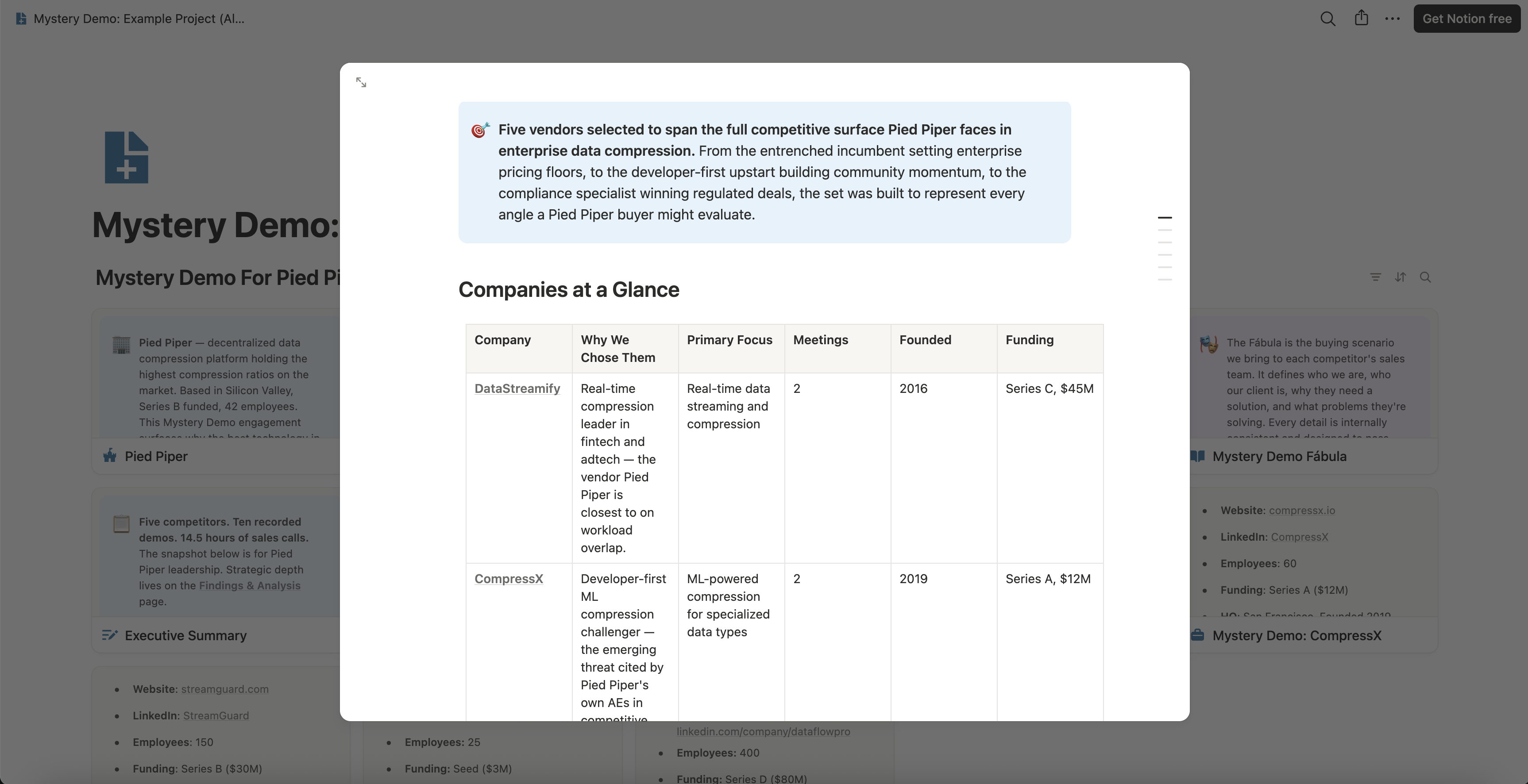
The note at the top says why this set was chosen: together, the competitors cover every angle a buyer of the client’s product might evaluate. On your project, the set is the competitors your reps keep meeting on shortlists, and each one then goes through the same steps:
Each step leaves a record, and the board lays those records out so your reps can use them before a deal.
What the Board Shows About Each Competitor
The answers land on the board in two layers. Each competitor gets its own page with the recordings, the transcripts and the analysis of its calls. How it opened, what it showed live and how it answered on price sit there with the minute each was said.
Above those pages sits the Executive Summary, the comparison in one view. Below is that page on the same invented board: a line for each competitor saying where it wins and where it loses, then a sales scorecard grading each one on responsiveness, demo quality, transparency and follow-up.
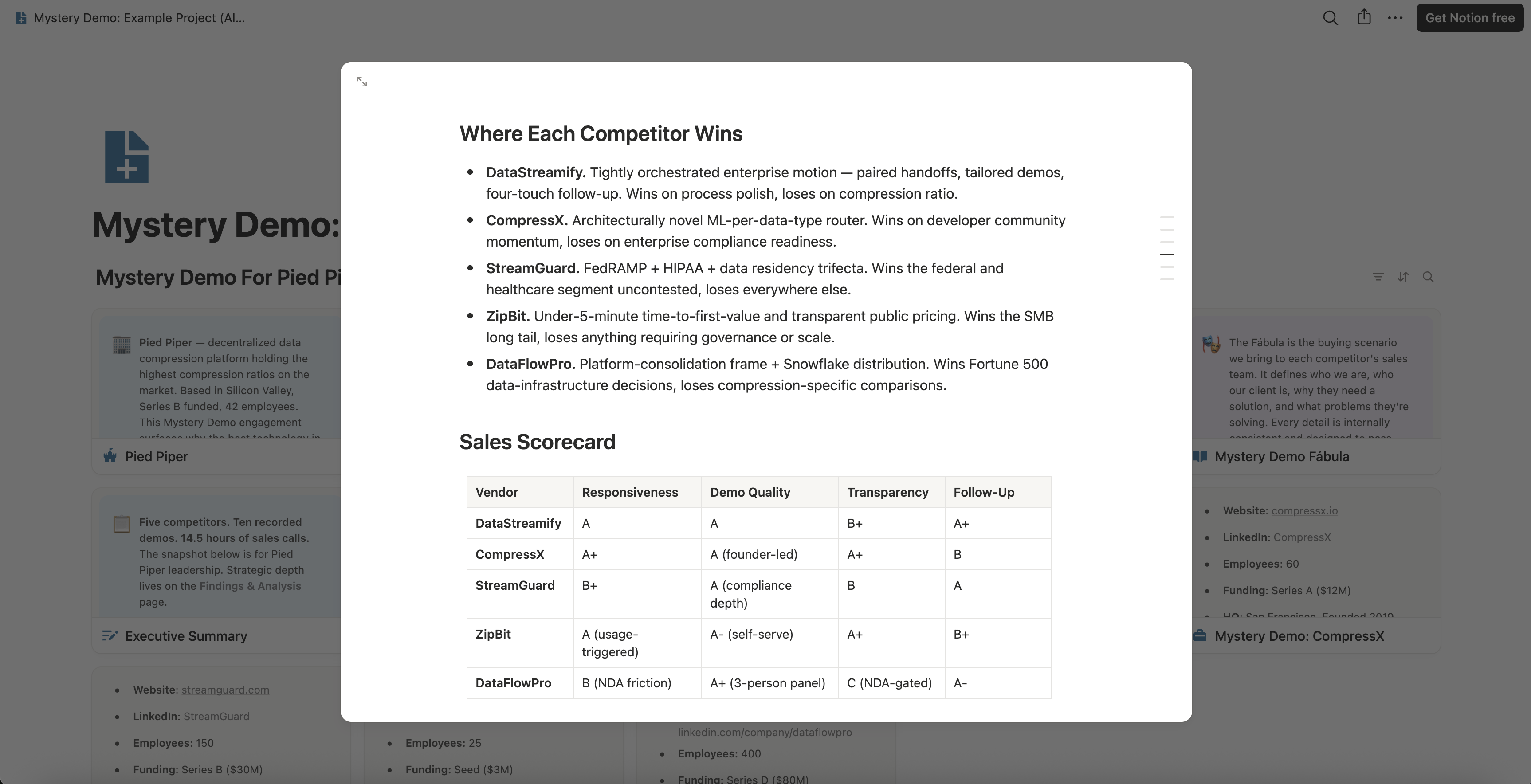
The Executive Summary is the shortlist comparison, seen from the buyer’s side. Before a competitive deal, your reps can read where each rival wins and loses, then open its page for what its rep said. One call is one rep talking to one buyer on one day, so a claim about how a competitor sells in general needs the same answer across its calls.


Doing this through Mystery Demo rather than your own team changes four things:
Mystery Demo’s SaaS market entry research runs this across every serious competitor in a market, for teams entering one or mapping the one they already sell in.
If the same three or four names keep turning up beside yours on shortlists, those are the calls worth hearing first. Tell us who they are in a first conversation, and we will go through each one’s sales process as a buyer like yours.
Start With the Rivals You Meet Most Often
Most of a shortlist forms out of sight: in what AI assistants tell buyers, in reviews, in a peer’s recommendation and in a buyer’s own history with the vendors. Once you are on it, the comparison goes on out of sight too, in calls where you only ever hear your own half.
So the first step is a list you can make this week:
Wherever the source is a lost deal or a rep’s memory, you are guessing at what was said in a call you were not on. Show us that list, and we will bring back the recordings, one to two weeks for each competitor.


