
Every software company that ships AI features has to decide how to charge for them, and there is no standard answer to copy. DigitalRoute surveyed 631 executives across six markets in April and May 2026, and the most common approach, bundling, covered only 25% of their companies. Almost as many, 23%, were still experimenting.
The approaches also stack. G2 Research interviewed 108 mid-market software companies that sell AI, in a study for Salesforce, and 32% of them charge for it in two or more ways at once.
This page sets out the six ways companies price AI features, what each one does to a buyer’s bill, and how to choose yours. The last step of that choice needs something no pricing page shows: the terms buyers are offered once they ask. Mystery Demo books the real sales demos of the companies your buyers compare you with, takes the pricing conversation as a credible buyer, and brings back what each rep quoted on a board your pricing and sales teams share.
Companies Charge for AI in Six Ways
This year’s pricing pages and studies describe six models, and one company often runs more than one. Each model puts a different number on the page and leaves a different part of the bill to be worked out later.
| Model | How it works | What the price on the page tells a buyer | The cost it can move onto the buyer |
|---|---|---|---|
| Included in the plan | AI features come with the plan the buyer already pays for, sometimes down to the cheapest one | The whole price: the plan price is the bill | A higher plan price later to cover the AI, paid on every seat whether anyone uses it or not |
| Premium tier | AI features sit only in the higher plans | The price of the tier that has them | The upgrade: a whole higher plan, bought to get the AI |
| Paid add-on | A separate AI line on the bill, priced per user or as a flat fee | The add-on’s price | Seats that pay for the add-on whether or not their user touches it |
| Credits or usage | The buyer buys a balance, and each AI action draws it down | The rate per credit or per unit, not what a year will cost | How fast the balance runs down, and what going over costs |
| Per outcome | A fee each time the AI completes a defined result | The fee per result, not how many results a year brings | What counts as a result, which the vendor defines |
| Hybrid | A fixed seat or platform fee plus a metered charge | The fixed part of the bill only | Two numbers to forecast instead of one |
Including AI in the plan is common at the entry level. Among German software providers that offer AI features, 65% put them in their cheapest package, in hy and OMR Reviews’ data from June 2025. For the other models, the share using each one changes with who was asked, which is why this year’s SaaS AI pricing statistics differ from study to study.
One company can sell a single product four ways. On October 28, 2026, Salesforce’s pricing page for its Agentforce AI agents listed:
Per outcome has a public price list too. Intercom charges $0.99 for each conversation its Fin AI agent resolves over chat or email, and bills one outcome per conversation even when Fin takes several actions.
All six models are on public price lists in 2026, so none of them has pushed the others out. They differ in what each one charges for, and in who carries the risk when use goes up.
What Each Model Charges For
Three questions separate the models for the person paying. They are our way of comparing them, not the finding of any study:
Read the six models against those questions. Included, premium tier and add-on prices are fixed per plan or per user, so they are the easiest to budget for. Credits and outcomes charge each time the AI is used or succeeds, and hybrid pricing does both.
The vendor’s own cost is a separate question. A charge per action follows it only where each action costs the vendor more to run, and none of the pages used here shows that.
People who price AI products describe the trade-offs from the seller’s side:
Sellers weigh the models by what fits the product. Buyers have been surveyed too, and they lean one way.
Buyers Say They Want AI Included and a Bill They Can Predict
Three surveys asked buyers about AI pricing directly. Each asked different people, so each figure stays with its own population:
| Survey | Who was asked | What they said |
|---|---|---|
| G2 Research, June 2026 | 350 buyers of AI-enabled software, interviewed | 81% say core AI should come standard; 46% prefer flat per-user pricing for AI, against 34% who prefer paying by consumption |
| PricingIO, a pricing firm (survey date not published) | 296 enterprise software buyers | 68% rank price predictability as their first priority for AI pricing; 55% rate token and credit models as highly complex to evaluate |
| Zylo, a SaaS management vendor, January 2026 | 218 IT leaders | 78% reported unexpected charges tied to consumption-based or AI pricing in the past 12 months |
Within what these buyers were asked about, they favor included AI and flat per-user pricing, and they find token and credit models hard to judge. None of the three tested per-outcome or hybrid pricing. Our reading is that any model whose bill depends on volume the buyer cannot forecast runs into the same problem.
An ITPro article in September on why enterprise software is getting harder to buy put the buyer’s problem in one line: “If buyers do not model the behavior pattern, they have not modeled the cost.”
So which model fits your AI feature, when buyers want a bill they can plan?
How to Choose a Pricing Model for Your AI Features
Start from what your buyers weigh most. If they budget a year at a time and the AI’s value is steady from month to month, an included price or a price per user is the easiest for them to plan. If use varies widely between customers, and each action costs you more to run, metering can follow that cost, ideally with an allowance inside the plan so part of the bill is known in advance.
For the cases in between, people who price AI products offer advice. Each piece is one person’s view, and each fits some products better than others:
| The advice | Who gave it | When it may fit (our reading) |
|---|---|---|
| Find the single action whose cost the company can really feel, then “count that, and make everything else free.” | A founder on Reddit, 2026 | One AI action drives most of your cost |
| “You can start with flat pricing and add a soft usage cap later.” | A founder on Reddit, 2026 | You do not yet know how customers will use the feature |
| “Use credit-based overages only to catch extreme compute outliers rather than charging for basic platform features.” | A pricing practitioner on LinkedIn, 2026 | A few heavy users would otherwise set the price for everyone |
Our own advice follows from the predictability finding: whatever the model, show the yearly bill for a light, a typical and a heavy customer next to the rate. A buyer who can see the range has less reason to treat credits or outcomes as a gamble.
Everything so far can be read from outside: the models, the list prices, the surveys and the advice. None of it shows the allowance, the overage or the discount that the companies your buyers compare you with offer a buyer who asks.
In Vertice’s preliminary Q3 2026 data, drawn from more than $75bn of software spend it processes for its customers, AI was the most heavily discounted software category, at 41.54% off list price. That figure covers one procurement firm’s customers and does not say how discounts differ by pricing model. Knowing that for the companies you compete with takes their quotes.
How to Find Out What Buyers Are Offered for AI
Mystery Demo gets those quotes by being the buyer. For each company you name, the team books its demo through the normal front door, with a buying scenario built to fit that company’s ideal customer: who the buyer is, why they are evaluating, and what they need solved.
The pricing questions go in with the scenario. Every call is recorded, and every follow-up email and proposal is kept. It all lands on a Notion board, a shared workspace with a page for each company and pages that compare them.

Below is one page from our public example board, where the client and every company on it are invented. A real project’s board is built from that client’s own calls.
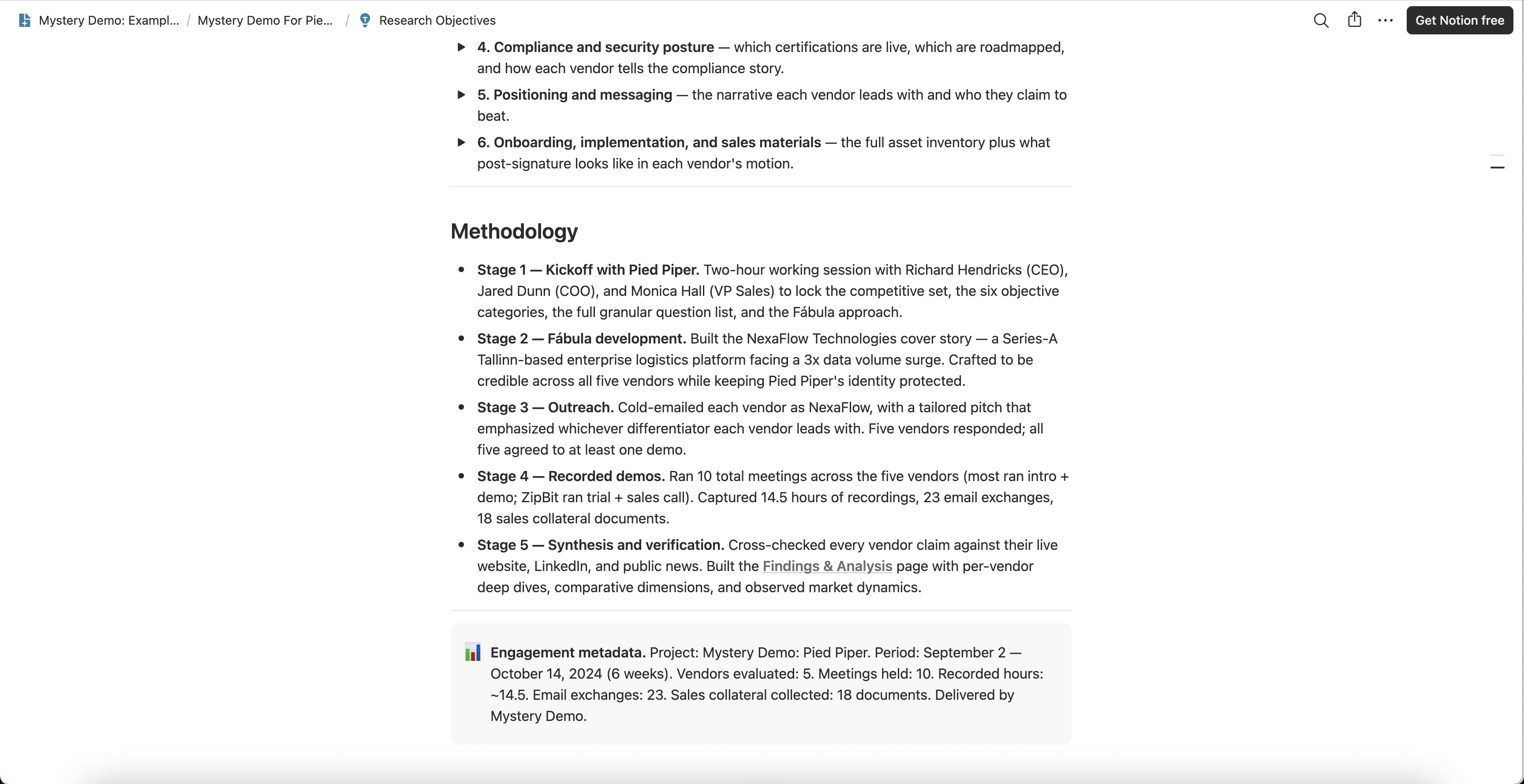
A question about credit allowances, say, goes through every one of those stages. It is agreed at kickoff, carried into each call by the buying scenario, asked on the recorded call, and checked against the company’s public pages before it reaches the board.
A company that books a competitor’s demo from its own domain tends to get recognized, or gets the generic tour. A quote you can set your own price against needs four things:
One call shows what one rep offered one buyer on one day. When the same term comes up on several calls with a company, it is that company’s practice, and when it comes up across companies, it is the market’s. That is why a project covers several companies, typically three to nine.
The answers come back on one page, side by side.
Read the Quoted Terms Before You Set Yours
On the board, those answers land in the pricing matrix: every number a rep quoted beside the company’s published price, with what moved it. The matrix sits on Findings & Analysis, the page that compares the companies one dimension at a time. Here is its pricing dimension on the invented example board.
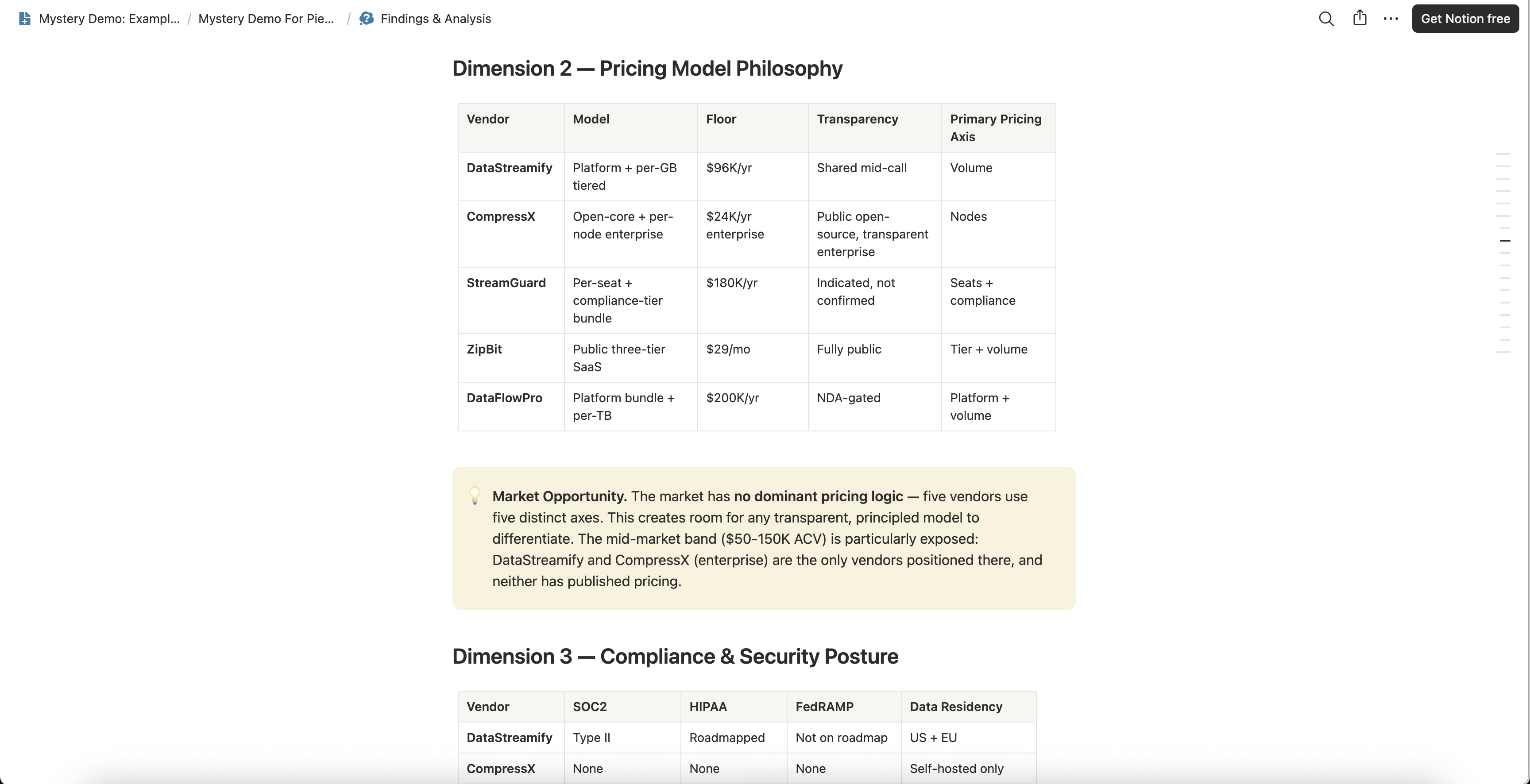
The transparency column, the one a pricing owner reads first, says whether each company’s price came from a public page or only came out on a call. For AI features, the same idea becomes a pricing sheet. The one below is invented: four made-up field service software companies, each on a different AI pricing model, with the published price beside what a quote revealed.
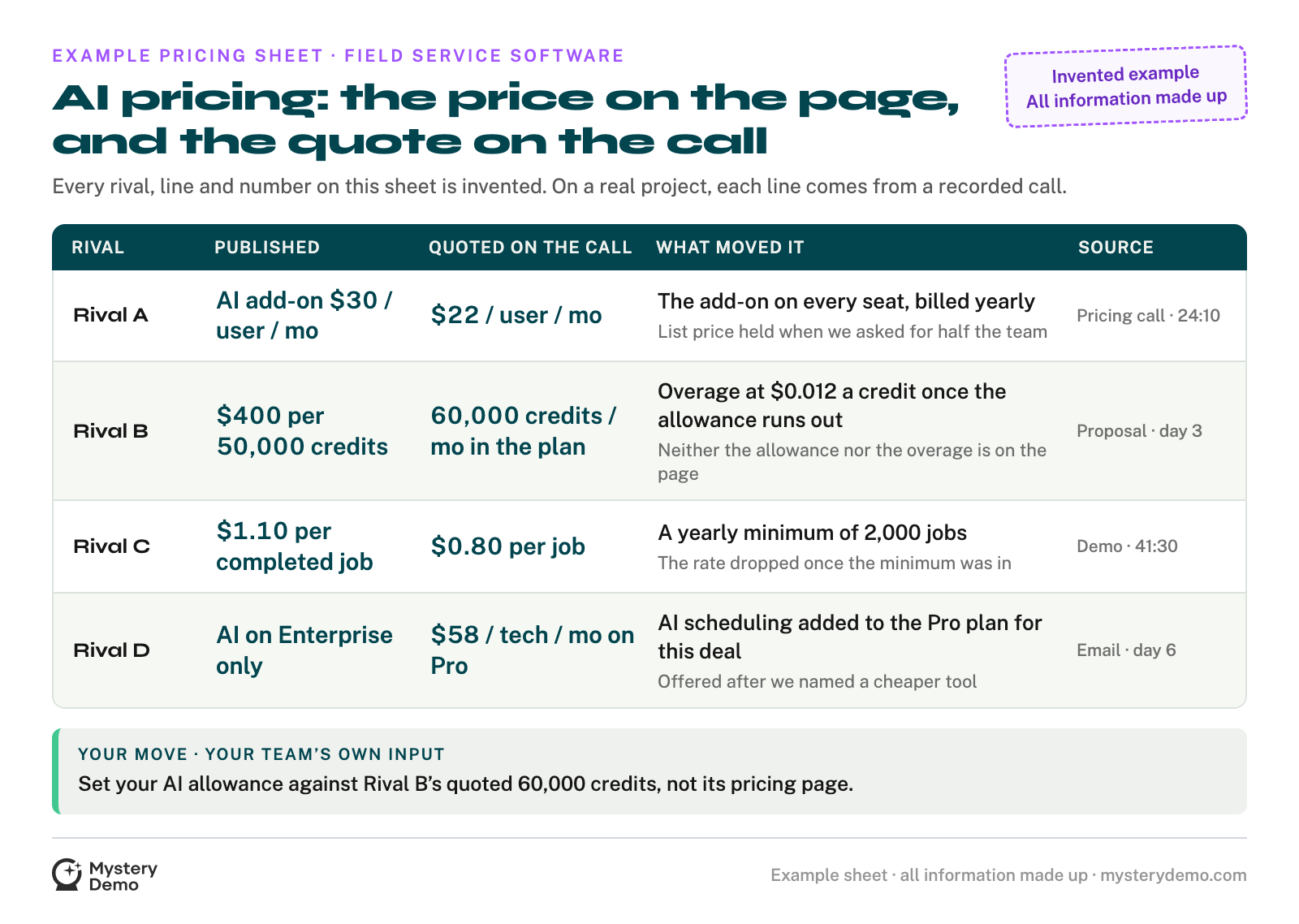
Read across a sheet like that before you set your own numbers. Each pattern on it changes something in your pricing:
The same sheet helps your sales enablement lead. When a buyer brings a competitor’s AI offer to the table, your reps already know the allowance and the discount they are up against.
Mystery Demo builds that sheet for your market as SaaS competitor pricing research, for a flat €499 per competitor with everything included. Each company’s board is ready in one to two weeks, and the calls for several companies run in parallel. Tell us which companies your buyers weigh your AI against, and we will take their pricing calls as the buyer and bring back what each one quoted.
Choose by What Your Buyers Weigh Most
No model has won in 2026, and the one that fits is built around what your buyers weigh most: a bill they can plan, use that varies, or value they can see. Take the practitioners’ advice as options, not rules, and set your numbers knowing what buyers in your market are quoted, not only what is listed.
Start with a two-column list of the companies your buyers compare you with:
| What their pricing page tells you | What you would need a quote to know |
|---|---|
| The rate per credit or per unit | How many credits come inside the plan a buyer like yours would take |
| What happens when the balance runs out, if it says | The overage rate a buyer is quoted |
| The AI add-on’s list price | The discount on it, and what earned it |
| Whether a plan says unlimited | What unlimited covers, and where it stops |
The first column takes an afternoon. Send us the list, and Mystery Demo will be the buyer on each company’s pricing call and fill in the second, with the recording behind every number.


