
A rep can carry a battlecard into a competitive deal and still lose it to the rival the card was written for. When that keeps happening against the same rival, look at the card before you look at the rep. Three mistakes on it leave a rep with nothing useful to say at the moment the rival comes up:
If you lead a sales team that keeps losing to one rival, all three can be fixed on the card your team already has. None of them is a writing problem. Each comes from a card written without the rival’s own words, and the rival says those only to buyers, on its sales calls.
Mystery Demo hears those words first-hand. Its team requests the rival’s demo as a buyer the rival wants to win, asks the questions your card cannot answer, and brings every answer back recorded, on a board your team can build the card from.
The repair takes six steps, and only one of them needs the rival’s calls.
Mark Where Each Line on the Card Came From
Start with the card your reps open most against one rival. Next to every line, write where it came from. Every example here is invented: Rival A sells fleet maintenance software, and so do you.
| Where the line came from | What it can tell a rep | What it cannot |
|---|---|---|
| The rival’s website or pricing page | What the rival wants every buyer to believe | What its rep says when a buyer pushes back |
| Review sites | What some customers chose to say in public | What the rival tells buyers this quarter |
| Your lost deals and win-loss interviews | What your buyer remembers the rival saying | The rival’s own words, or what prompted them |
| Your reps’ memory | Where the rival keeps coming up | Whether one buyer heard it or every buyer does |
| A recording of the rival’s own call | What the rival said and quoted, and the minute it said it | What it tells a very different kind of buyer |
The first row fills fastest, because the website is the one source anybody can read on a deadline. The last row is the one no desk can fill. The first mistake sits at the top of the card.
Take the Rival’s Price Off the Front of the Card
A card that opens on the rival’s price teaches reps to open on price. Gong, a company that records sales calls for its customers, studied 11,331 of their B2B opportunities with at least three calls each. It drew the opposite advice from that data: discuss price, but don’t lead with it.
The number is also the wrong one. Rival A’s pricing page says $12 a vehicle a month, and that is the price it shows everyone. By the time a buyer raises price, the rival’s rep may have quoted them a number of their own, with a term, a package and conditions the page never shows.
Move the price to the back, with blanks. Write the published price as one line, followed by everything it leaves out:
Some of those blanks fill from the page itself. The rest are said on a call: the number the rival quotes a buyer like yours, and what that number depended on. A tier marked “contact sales” is nothing but blanks.
A price can at least be checked against the page. The other objections reach your rep as a buyer repeating something the rival’s rep said, and the card files them under a label.
Write Each Objection in the Rival’s Own Words
A label is what a card writer files when they never heard the rival’s words, and the answer under it is just as general. Buyers never talk in labels. They repeat what the rival’s rep told them:
| The label on the card | What the buyer says |
|---|---|
| “They say they’re cheaper.” | “Rival A said you charge extra to track parts.” |
| “Concerns about onboarding.” | “Rival A told us your rollout takes three months.” |
Your rep needs an answer to the sentence on the right, and the label threw that sentence away. Even across more than 300 million cold calls, Gong found that the most common objections can vary greatly from company to company. A label written to fit every rival is a bet that yours sounds like all the others.
Rewrite every objection as a block of four lines. Each block holds:
Fill the first line from the source closest to the rival’s own words. If your team records its own calls, a buyer quoting the rival on your recording is as close as your side can get. Mark any line with no source behind it as a guess.
Even the closest of those is a buyer’s retelling of a rival’s rep. The exact words, and the question the rep was answering when they said them, are on the rival’s call. The third line of each block is the talk track, and that is where the last mistake lives.
Cut Every Talk Track to One Sentence
A talk track grows into a paragraph when its writer does not know which line it must answer, so the paragraph tries to answer all of them. A rep with a buyer waiting cannot read a paragraph off a card, so they say something else.
Product Marketing Alliance describes a battlecard’s purpose as giving reps talking points and cues they can use on the fly during a call, not an in-depth research report.

Cut each answer to one spoken sentence. Find the one claim the paragraph exists to support, and keep only that. Then have reps say it aloud against the rival’s line until it comes out without the card, which is also how you find out which competitor each rep is weakest against.
That rehearsal needs the rival’s line, and the card holds a guess at it, or at best a buyer’s retelling. Reps who practice against a guess get fluent at answering something the rival may never say. Three steps have now left three kinds of blank on the card:
All three are things the rival says to buyers, on its own sales calls.
Hear What the Rival Tells a Buyer Like Yours
The desk steps were worth doing: they cleared the wrong lines and named every blank. Everything they could fill came from the rival’s public pages or from what buyers remember, and neither one is the rival talking to a buyer. The sales call is where the rival quotes its price, plants its objections and makes its claims in its own words.
Your own team cannot be the buyer on that call. A rival recognizes a demo request from your company, or gives it the generic tour, and the generic tour is the website read aloud.
Mystery Demo goes through the rival’s sales process for you, as a buyer:
The evaluation itself is genuine, since the team really is choosing software on a client’s behalf. The one invented detail is the client’s identity, and the scenario’s company stands in for it. The people asking the questions have sold B2B software themselves, so they know which question pulls a rep off the script.
Each project lives on a Notion board, a shared workspace with a page for every part of the work, and it starts from a written list of what the project has to find out. Below is that list on our public example board, where the client and every competitor are invented. A real project’s board is built from the calls taken for that client.
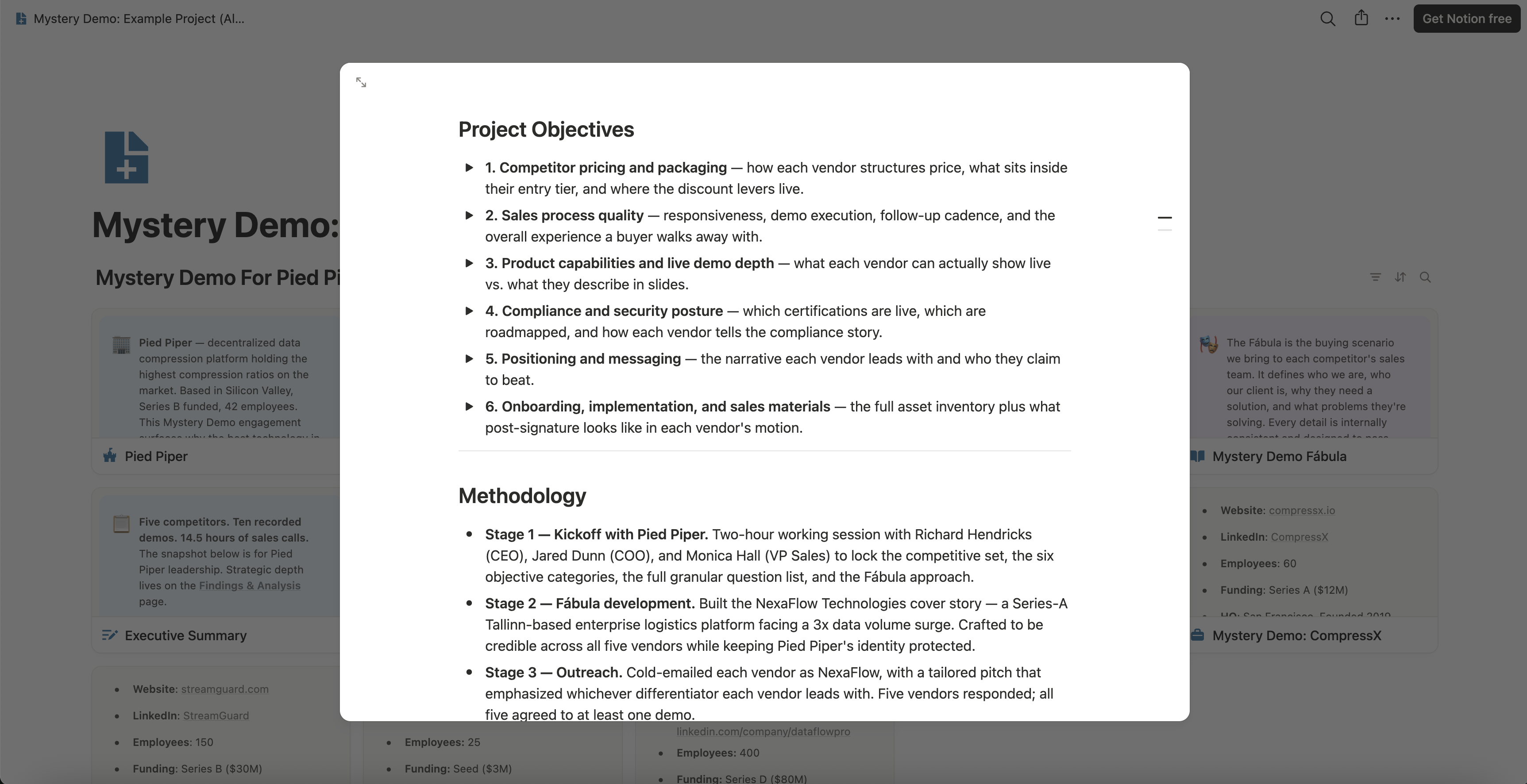
The first objective asks what sits inside each rival’s entry tier and where its discount levers live, the same blanks your price line carries. The fifth asks who each rival claims to beat, which is where your objection blocks start. The Chief Mystery Officer, who runs the demos, explains why the card has to keep the rival’s exact sentence:


One call is what one rep told one buyer. A line goes on your card as the rival’s position when another call, with another of the rival’s people, repeats it. Everything the calls produce comes back on the board, and the card is rebuilt from there.
Rebuild the Card From the Recording
Three parts of the board rebuild the card:
Start with the price line. On the Findings & Analysis page, each rival’s price is kept with how it is structured, its lowest price, what it charges by, and how the price was learned:
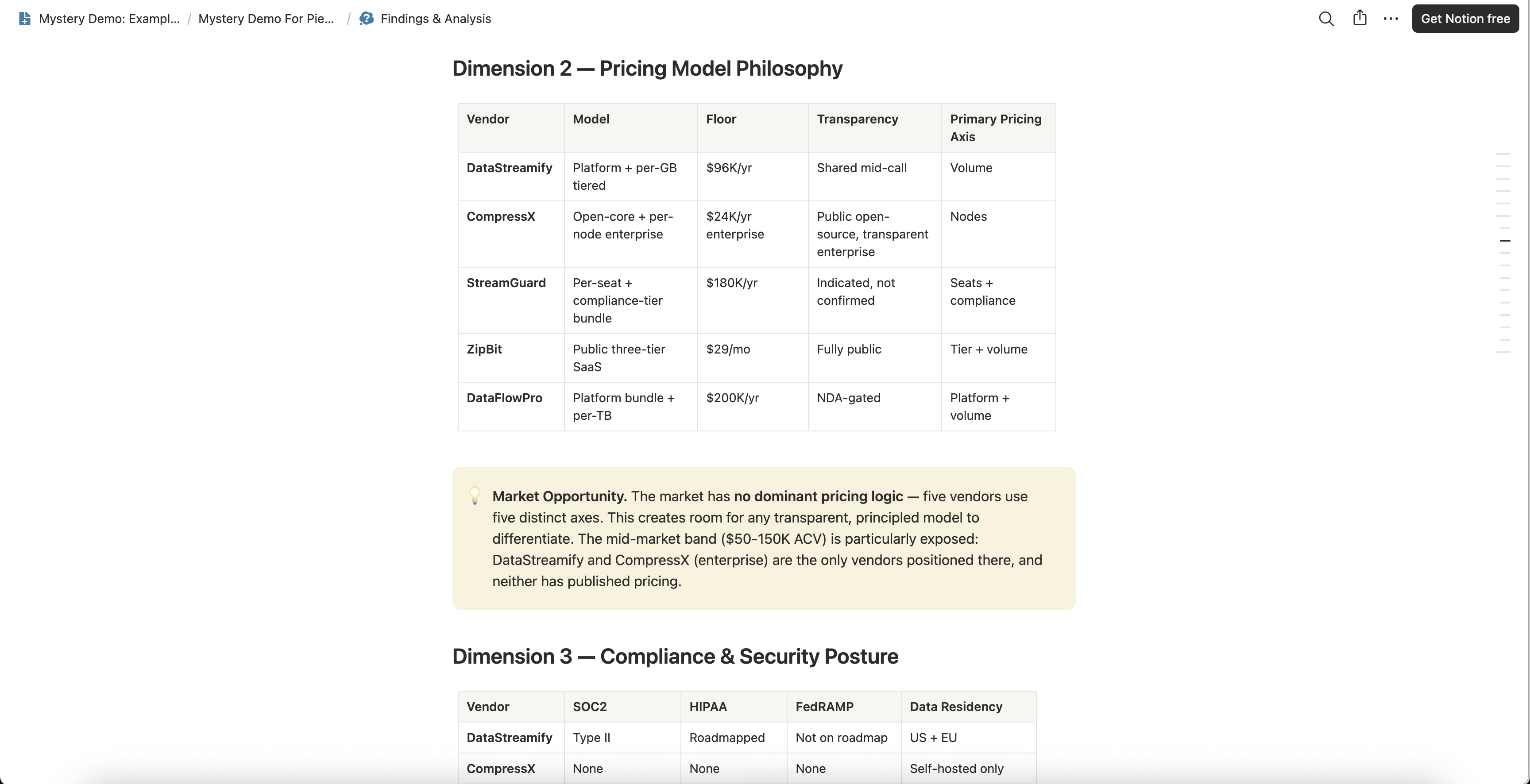
The transparency column is the one your card was missing. It says whether a price was public, shared mid-call or kept behind an NDA, so a rep knows which numbers a buyer can check and which ones the buyer heard in private. Rival A’s price goes on the back of your card the same way, as one line holding:
The objection blocks fill from each rival’s findings, where its claims are kept the way its people stated them:
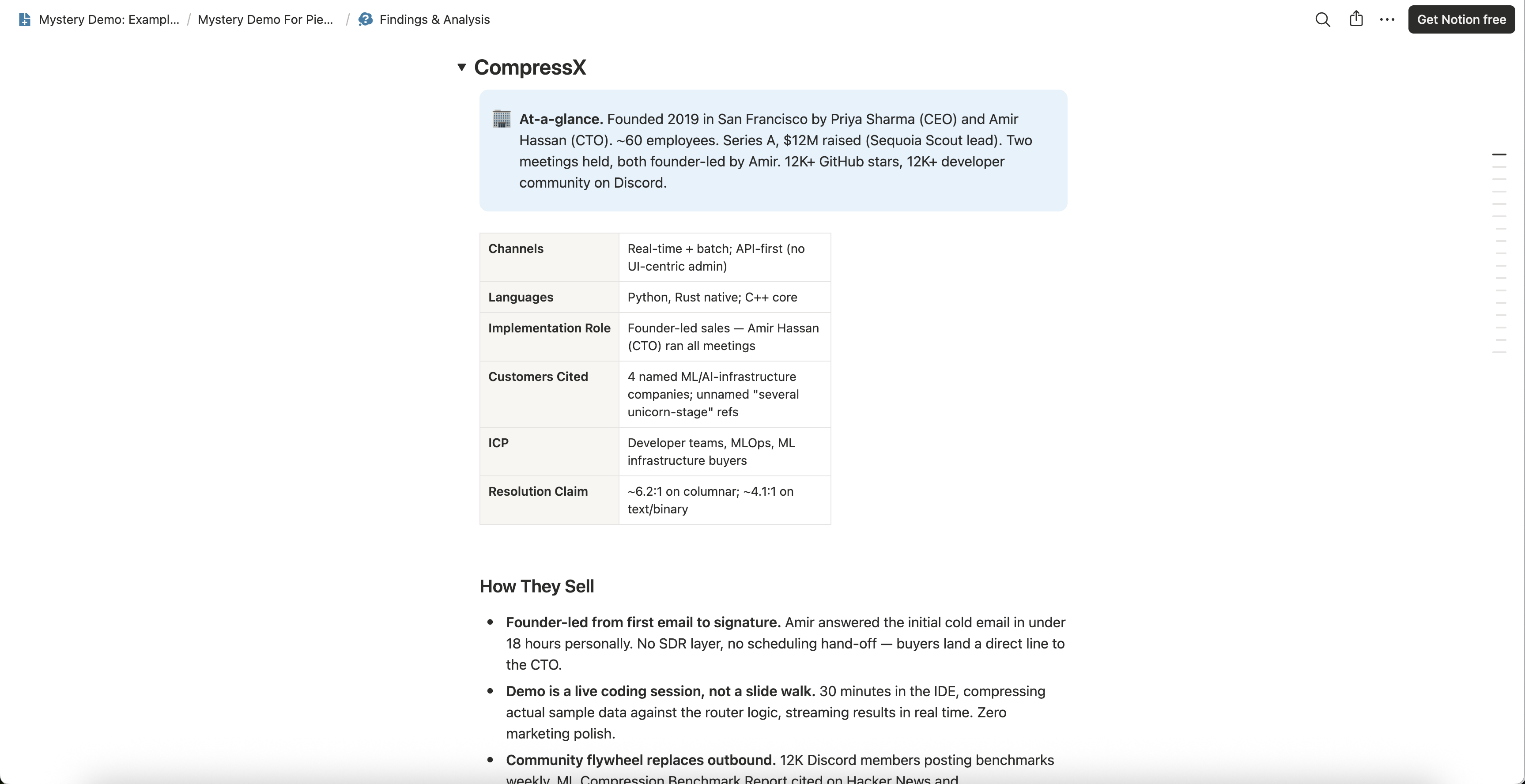
On this invented vendor’s page, the performance claim keeps the condition its people attached to it. A claim kept whole tells your rep which question tests it.
The counters get rehearsed against the recording itself. Play reps the minute where the rival’s rep makes the claim, and have them answer it with their one sentence. Here is what the three repairs do to Rival A’s card, every line and minute invented:
| The mistake | On the card now | Rebuilt from the call |
|---|---|---|
| The price on the front | Top line: “Rival A: $12 a vehicle a month. We win on price.” | On the back: $18 a vehicle a month, quoted for a three-year term with parts inventory included; the $12 plan leaves parts out (pricing call, 14:05) |
| The objection as a label | “They say our app is weak.” Answer: our app is highly rated. | Their rep: “Their app stops working when a technician loses signal” (demo, 22:30). Ask when the buyer last saw your app. Proof: yours in airplane mode. |
| The talk track as a paragraph | Ninety words on mobile features, ratings and the roadmap | “Put my phone in airplane mode and watch the work order save.” |
Put together, the objection side of Rival A’s rebuilt card looks like this, invented like everything else in the example. Each row starts with what the buyer says, then what the rival’s rep told them and the minute it was said, then your rep’s one-line answer:
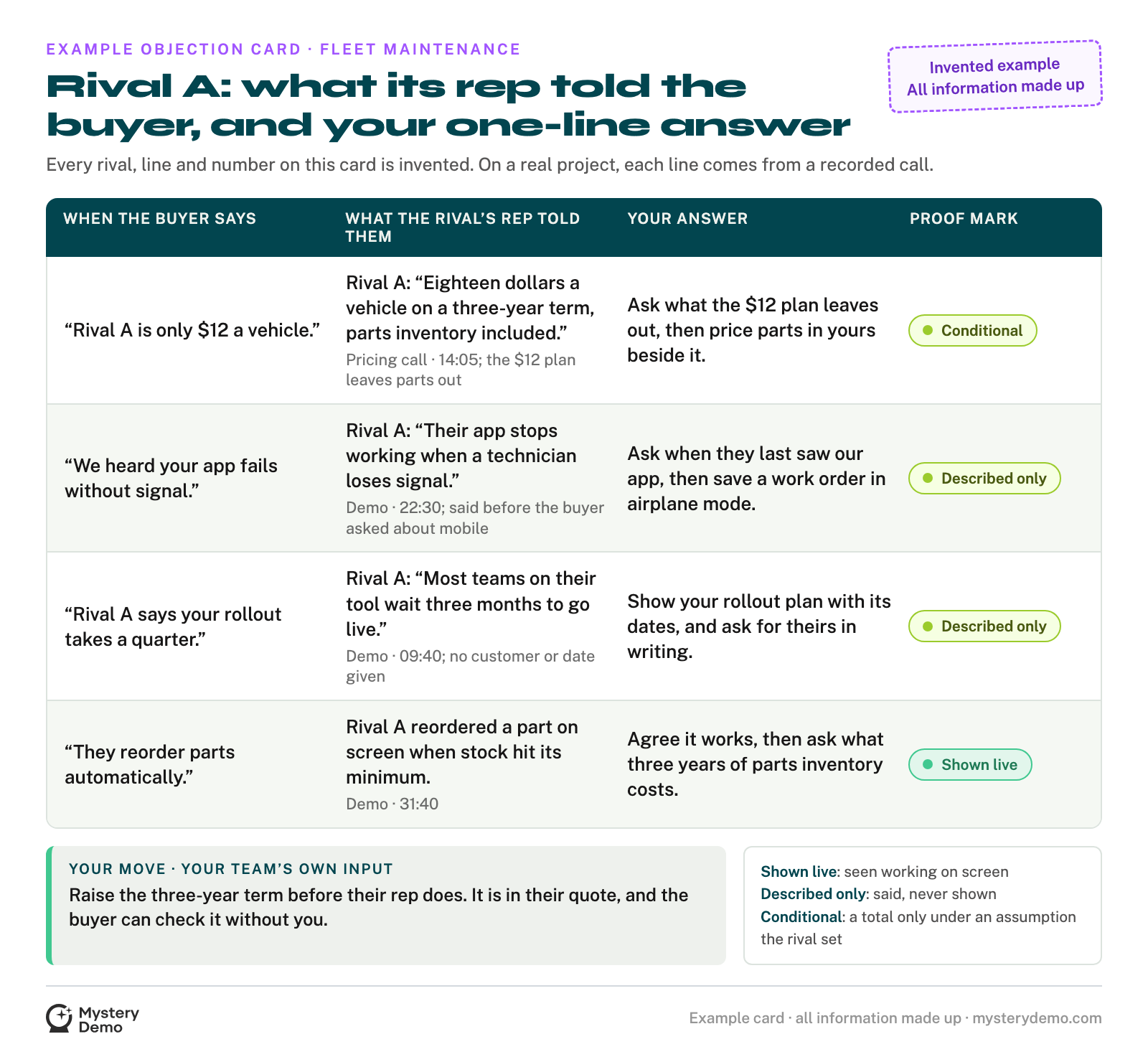
Mystery Demo’s SaaS competitor battlecard research builds a card like this for each rival you name, with every line tied to the recording behind it. One rival costs a flat €499, everything included, and takes one to two weeks.
If one rival keeps winning deals your reps had a card for, walk us through that card, and we will go and hear the lines it is missing.
Fix the Card Before the Next Deal Against That Rival
The three mistakes are one mistake made three times: the card was written from outside the room where the rival sells. This week, take the card your reps open most against the rival you lose to most, and do three things:
That list is the brief for the call.
The call is the one step your team cannot take itself. Show us the line your reps stall on, and we will bring back what the rival says to a buyer like yours, with the minute it was said.


