
A competitor’s new pitch reaches your team secondhand. A buyer repeats a question the rival’s rep asked, or describes your product in words your reps have never heard before, while the rival’s homepage still says what it said last quarter. Nobody on your side can tell whether the rival changed its story or one of its reps tried something new.
The answer is on the rival’s own sales calls. If two of the rival’s people tell a buyer like yours the same new story, it is no longer one rep’s experiment. Your reps need an answer to it this week, not when the website catches up.
Mystery Demo takes those calls for you. Its team books the rival’s real sales demo as a credible buyer, goes through each call the rival offers, and brings back the recordings with an analysis of what each rep said. The job takes five steps, and each one leaves you with something the next one uses:
The Four Places a New Pitch Shows Up
April Dunford, who builds positioning and sales pitches for B2B tech companies, starts her pitch with the company’s view of the market. Only after that does it move to what makes the product different. A pitch built that way carries its market story in the opening minutes, so a change of positioning rewrites the opening.
Listen for it in four places. In the invented example below, Rival A sells software to property inspection firms. It used to sell speed, and now it sells reports that hold up when a client disputes one.
| Where to listen | What it tells you | Rival A before | Rival A now |
|---|---|---|---|
| The first three slides | The problem the rival wants a buyer to start from | A tour of the report builder | What a disputed report costs a firm |
| The question they open with | The pain the rival now leads with | “How long does a report take your inspectors?” | “When did a client last dispute one of your reports?” |
| The customer story they lead with | What the rival now believes wins the deal | A firm that finished reports in half the time | A firm that won a dispute with time-stamped photos |
| How they describe you | Where the rival now places you | “A good tool for small teams” | “Fast, but your reports won’t hold up in a dispute” |
A new slide design is not a new pitch. In Dunford’s definition, positioning is how a product is different and better than the alternatives for a particular set of customers, and a fresh template changes none of that. If the four answers stay the same, the rival changed its look, not its story.
Your reps can tell you which of the four places they think moved. They cannot tell you whether it moved for every buyer or for one rep on one call, and that difference decides what you do next.
Write Down What Your Reps Heard
Start with the people who raised it. Ask each rep for the deal, the buyer’s own words and the place in the pitch where they heard the change, and write it down the same day. For each report, note:
If your team records its own sales calls, search the recordings for the rival’s name. A buyer quoting the rival on your recording is one retelling closer to the source than your rep’s memory of the same moment.
You now have the reports sorted under the four places, and a picture of which buyers are hearing the new story. Every line on that sheet is still a retelling of the rival, by a buyer or by your rep. It tells you where to listen, and nothing yet about what the rival teaches its team.
Check What the Rival Has Published
Next, open the rival’s homepage beside last quarter’s copy on the Internet Archive’s Wayback Machine, which keeps dated copies of public pages. Compare the headline, the section under it and the customer stories, then check the other places a new story can land:
Now you know whether the new story is public, and since when. A story on the homepage is one the rival has committed to in writing. The website still cannot settle the question, in either direction.

The two move separately, and Dunford has seen the gap from the inside. A sales team that does not believe in a positioning will not use it, she writes, and in her experience it is not uncommon for sales to rework marketing’s pitch materials or ignore them.
So a new homepage does not prove the reps say it, and the reps can tell a story no page carries yet. Here is one invented case of a single change traveling across the three places a rival’s story lives.

In a case like that, a team reading only the website arms its reps against a story the rival’s reps stopped telling weeks earlier. Each source answers part of the question:
| What you have | What it shows | What it cannot show |
|---|---|---|
| Your reps’ reports | Which buyers heard something new, and roughly what | The rival’s exact words, or whether one rep said it or all of them |
| The rival’s website, now and last quarter | Whether the new story is public, and since when | What reps say on a call, such as the question they open with |
| The rival’s own calls | The exact words from each person the rival puts on a call, and the deck it sends | What the rival tells a different kind of buyer |
Only the last row comes from the rival directly, and even there one call is one rep. Dunford’s rule for early calls is that consistency trumps customization, so a story the rival has taught should sound the same from one of its people to the next.
Hear the New Pitch on the Rival’s Own Calls
Hearing the pitch on the rival’s calls is the one step your own team cannot take. A rival recognizes a demo request from your company, or gives it the generic tour, and the story you need is the one it tells a buyer it wants to win.
How the Calls Run
Before any call, the team writes the fábula, the buying scenario it brings to the rival: who the buyer is, what problem it needs solved, and which tools it uses or is weighing. Here the scenario’s buyer looks like the buyers your reps described in the first step. The scenario can list your product among those tools, so every person the rival puts on a call has a reason to say how they see you.
Then the team requests the rival’s demo through its normal front door and goes through each call the rival offers: discovery, the demo, the follow-up, each with whoever the rival puts on it. Every call is recorded, and every email and deck the rival sends is kept. The evaluation is real, because the team is evaluating the software for a client, and the only invented detail is which client.
The same scenario runs through every call, so a difference between two calls comes from the rival, not from a different buyer. The people taking those calls have sold B2B software themselves and know which question pulls a rep off the script. The Chief Mystery Officer, who runs the demos, puts it this way:


By the end of the calls, a new story has had three chances to show it belongs to the rival:
When all three hold, the rival is teaching the story. It is still the story the rival tells this kind of buyer, and a buyer in another segment may hear a different one.
What Your Team Receives
Everything lands on a Notion board, a shared workspace with a page for each rival holding its recordings, transcripts, emails and the analysis written from them. The pages below come from our public example board, where the client and every rival are invented. A real project’s board is built from that client’s own calls.
Each rival’s page opens its analysis by saying what it rests on: the meetings, the minutes of recording, the documents the rival sent and the public pages the rep’s claims were checked against. That line tells you a finding about the rival’s pitch came from its calls and was checked, not from someone’s impression of a call.
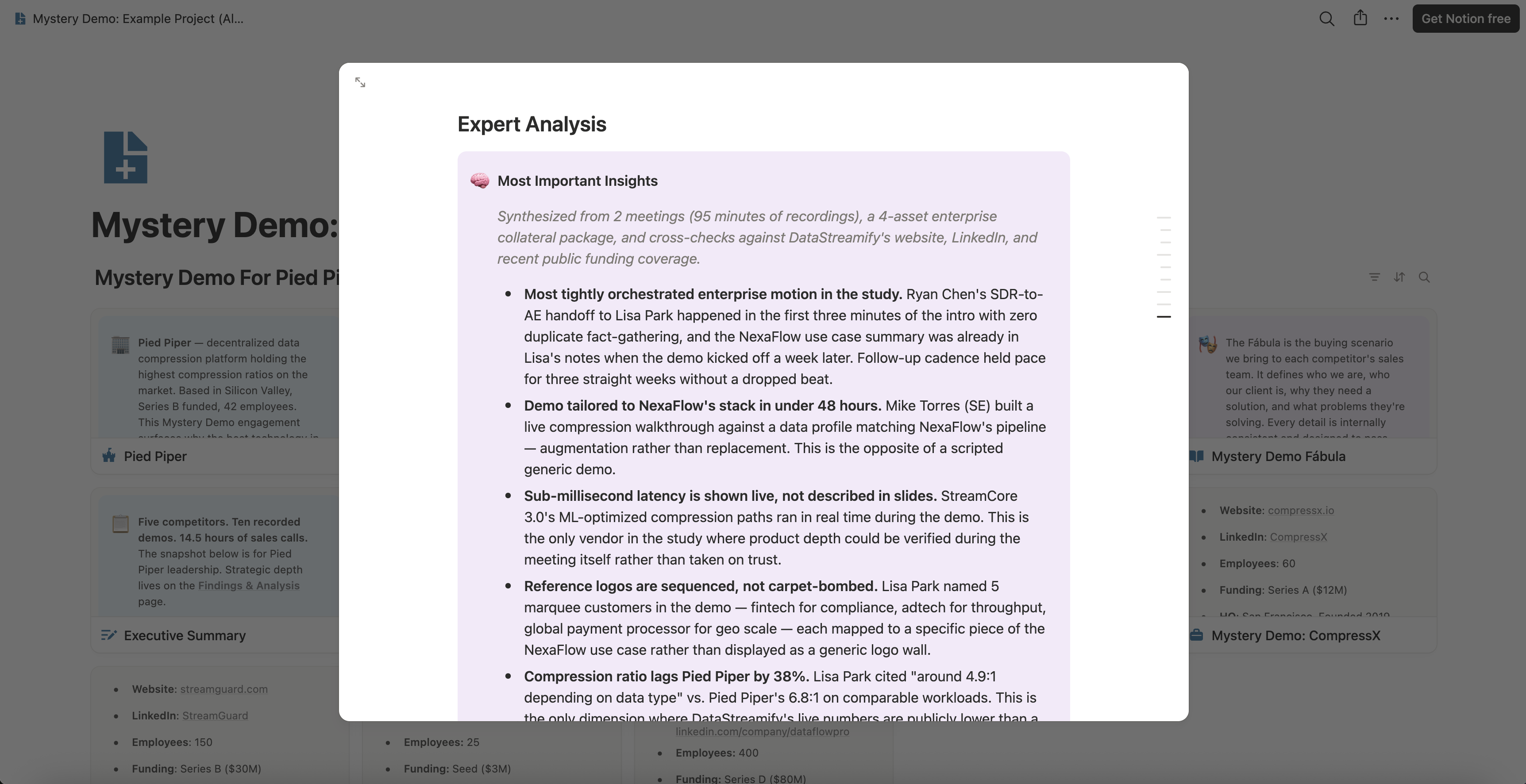
Mystery Demo’s competitor messaging comparison is the service built for this: the story each rival leads with in the room, who it names as the alternative, and how it frames the category. On the board, it fills the messaging matrix, which sets four things side by side for every rival:
You run the three checks from the Database page, where every recording and transcript is listed in one table beside the documents each rival sent.
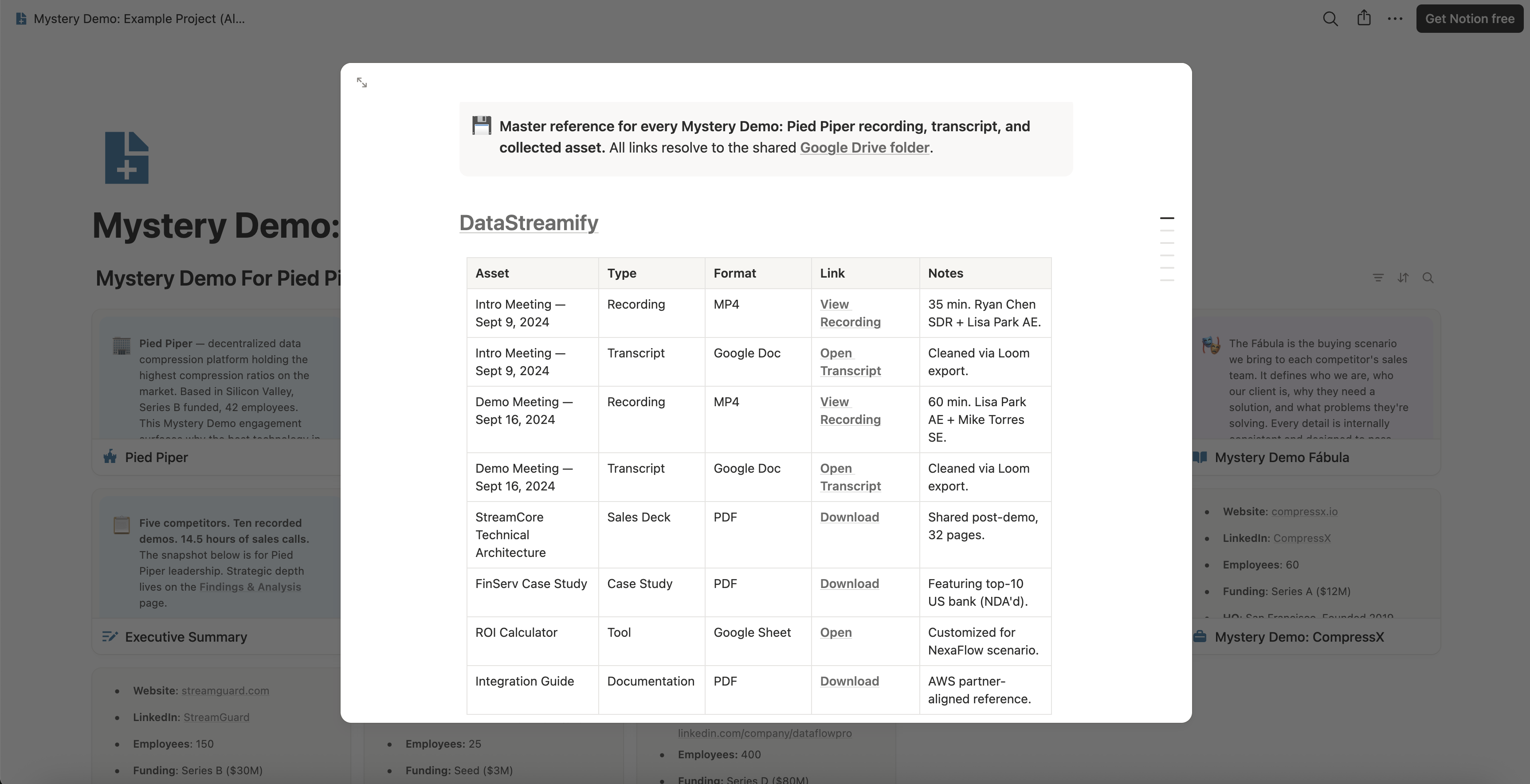
Each call has its own row, its own recording and its own transcript, and the deck the rival sent after the demo is listed with them. For a pitch change, that table holds the whole confirmation: the calls to compare, and the rival’s own deck to check them against.
One rival costs a flat €499, everything included, and takes one to two weeks. To start, we need only the buyer your reps described in the first step, so bring that description to a short intro call with us. We will take the rival’s calls as that buyer and bring back every line of the new story with the minute it was said.
Compare the Calls Side by Side
With the recordings and the deck in hand, set the calls next to each other, one row for each of the four places. What counts as new is measured against what your team already held on the rival: the battlecard, last quarter’s homepage and any older notes. Here is Rival A again, every line and minute invented:
| Where to listen | First call | Second call | What it means |
|---|---|---|---|
| The first three slides | A disputed report’s cost, the audit trail, then the app (02:10) | The same three, in the same order (01:45) | Matched, and the deck the rival sent repeats them |
| The question they open with | “When did a client last dispute one of your reports?” (00:50) | “How often do clients push back on a report?” (00:35) | Matched: the same pain in the rep’s own words |
| The customer story they lead with | A firm that won a dispute with time-stamped photos (14:20) | A firm that halved its report time (18:05) | Not matched: one rep still tells the old story |
| How they describe you | “Fast, but your reports won’t hold up in a dispute” (09:30) | “Quick to set up, thin on evidence” (22:40) | Matched: the same place for you, in two wordings |
Compare only what both calls had a chance to say. If one call never reached a place, mark that row open rather than matched. Across the four rows, the result comes out one of three ways:
| What you find | What it supports | What reps get |
|---|---|---|
| All four places match, and the deck carries them | The rival is telling this story on purpose, to this kind of buyer | The full update, now |
| Some places match | The change is under way, and some of the rival’s reps have not picked it up | The lines that match, with the rest marked open |
| The new story turns up on one call only | It is one person’s version so far | Nothing yet, until another call repeats it |
Rival A lands in the middle. Three of the four places match and the deck repeats the new slides, but the second rep still leads with the old customer story. That fits Dunford’s account of what a sales team does with a positioning it has not bought into: it reworks the new story, or keeps telling the old one.
Send Reps a Five-Line Update
Reps facing Rival A next week do not need a new battlecard, the page of notes they keep on each rival. They need five lines:
Here is Rival A’s update, invented like every line on the image. The top half shows what changed and which calls each change was heard on, and the bottom half is the part reps carry into their next call.
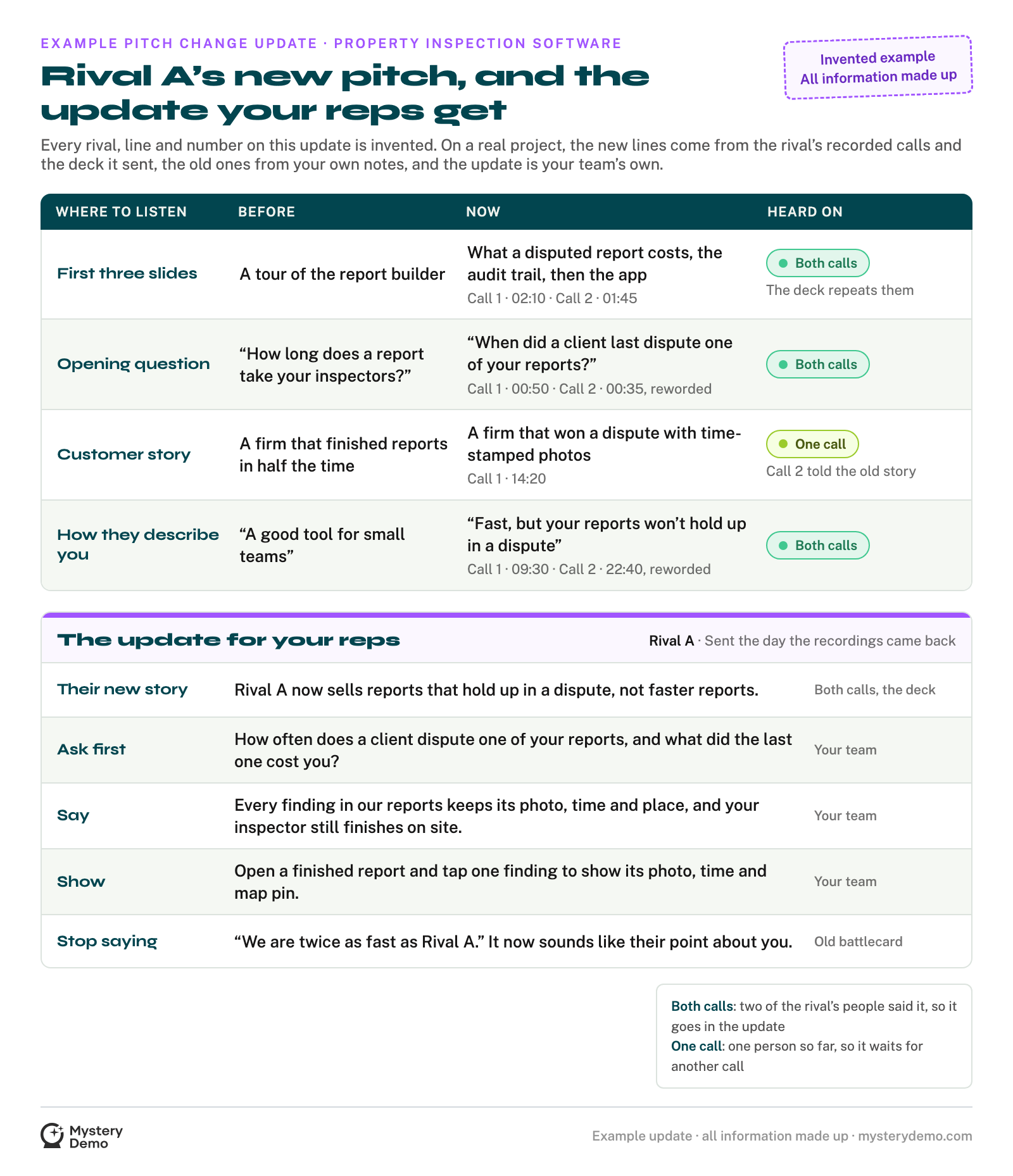
The last of the five lines is the easiest to skip, and it does the most work. Against the old Rival A, “twice as fast” won deals. Against the new one, it plays into the frame the rival has already set.
A buyer who heard Rival A call you fast but thin on evidence hears your speed claim and supplies the rest.
So the update replaces the old row on your battlecard instead of sitting next to it. Send it where reps already read, and mark each line with what it rests on: two recorded calls and the deck, or one call so far. Write it the day the recordings come back.
Only One of These Steps Needs a Buyer
Four of the five steps need only your own team: the reps’ notes, an hour on the rival’s website, the side-by-side comparison and five lines. The third needs a buyer the rival wants to win, on its calls.
We take that step for you at a flat €499 a rival. Describe the rival and the buyer it is pitching on a short intro call. The new story comes back in the rival’s own words, from each person it puts on the calls, beside whatever deck it sends.


