
Every battlecard is built from three parts: a template, the software that keeps the card in front of reps, and the facts about a rival written on it. Only the facts decide whether a rep will repeat a line to a buyer. Finding them is battlecard research.
Battlecard research is the work of finding out what a competitor sells, charges, promises and says about you, from sources that can prove it. The goal is a card where every line can be traced and dated. It is separate from the template, which lays the card out, and from enablement software, which stores the card and gets it to reps.
Mystery Demo does the one part of that research no website can reach. Its team takes a rival’s sales calls as a genuine buyer and hands back every call recorded. A line like the price the rival quoted then arrives with the minute its rep said it.
| Part | What it decides | What it cannot do |
|---|---|---|
| The template | Which sections a card has, and in what order | Tell you whether any line on it is true |
| The software | Where cards live, who sees them, and when they change | Find a fact nobody has collected |
| The research | What each line says, and what backs it | Lay out a card or get it to a rep |
If you lead enablement or product marketing and already have the template and the software, two questions are left: where each line should come from, and which lines your own sources cannot fill.
What a Battlecard Needs to Know About a Rival
Every line on a battlecard is a claim about a rival that someone could check. Here is one line of each kind for an invented rival, Rival A, which sells software to veterinary clinics:
Each kind needs its own source. You can check the reminders module in Rival A’s documentation, but no document holds what its rep tells clinics about your migration.
Where Battlecard Evidence Comes From
Every source is somebody telling somebody something. Ask who is talking and who is listening, and you know what the source can prove.
| Source | Who is talking to whom | What it can prove |
|---|---|---|
| Website and docs | The rival, to everyone | What it publishes, on the day you read it |
| Review sites | Its customers, to the public | What some buyers report after using it |
| Job posts and press | The rival, to recruits and reporters | Where it is hiring and what it announces |
| Your reps’ notes | A buyer, to your team, about the rival | What a buyer remembers being told |
| The rival’s sales call | The rival’s rep, to a buyer | What it quotes, shows, promises and says about you |
Most of a card can be filled from the first three rows and sourced line by line, each line with its date. Those lines are worth keeping current, and every rival assumes you already have them.
The lines reps get pushed on sit in the last two rows: the price the rival quoted, what its rep said about you, what the demo showed, and what was promised. Your reps’ notes and lost-deal interviews reach them secondhand, as a buyer’s memory of the rival’s words, told to someone who still wants the deal.
Only the last row is the rival speaking for itself to a buyer. A card that needs those lines needs someone in that buyer’s seat.
Why the Sales Call Is the Hardest Source to Reach
A rival’s sales call is where it quotes a real number, shows the product on screen, makes promises, and takes aim at you. Its website, its announcements and the feeds in battlecard platforms carry what it wants every buyer to believe. Review sites carry what customers say after buying, and only the call carries what the rival tells one buyer it is trying to win.
Your team could book the demo itself. The rival’s rep would see your company’s email domain on the booking form, and a recognized competitor gets the generic tour. Getting the real call takes two things:
Mystery Demo is built on both. Its demos are run by operators who have sold B2B software, and each rival meets a buyer scenario written for that rival alone. A mystery demo is a rival’s real sales process taken this way, with every call recorded.
How Mystery Demo Researches a Rival’s Sales Calls
Everything the research finds lands on a board. The board is a shared Notion workspace that the client keeps, with a page for each stage of the project.
| Stage | What happens | Where it lands |
|---|---|---|
| Kickoff | The card’s empty lines become the question list, and you show us your product so the questions sound like a buyer’s | Research Objectives |
| Buyer scenario | A believable company with a real reason to evaluate, fitted to each rival’s ideal customer, with nobody impersonated; we call it the fábula | The fábula page |
| Outreach | Each rival approached through its own front door, with a pitch fitted to what it leads with | Each rival’s page |
| The calls | Discovery, the demo, a technical deep dive, the pricing conversation and follow-up, all recorded | Each rival’s page and the Database |
| Synthesis | Transcripts cleaned, and every claim a rep made checked against the rival’s website, LinkedIn and public news | Findings & Analysis and the Executive Summary |
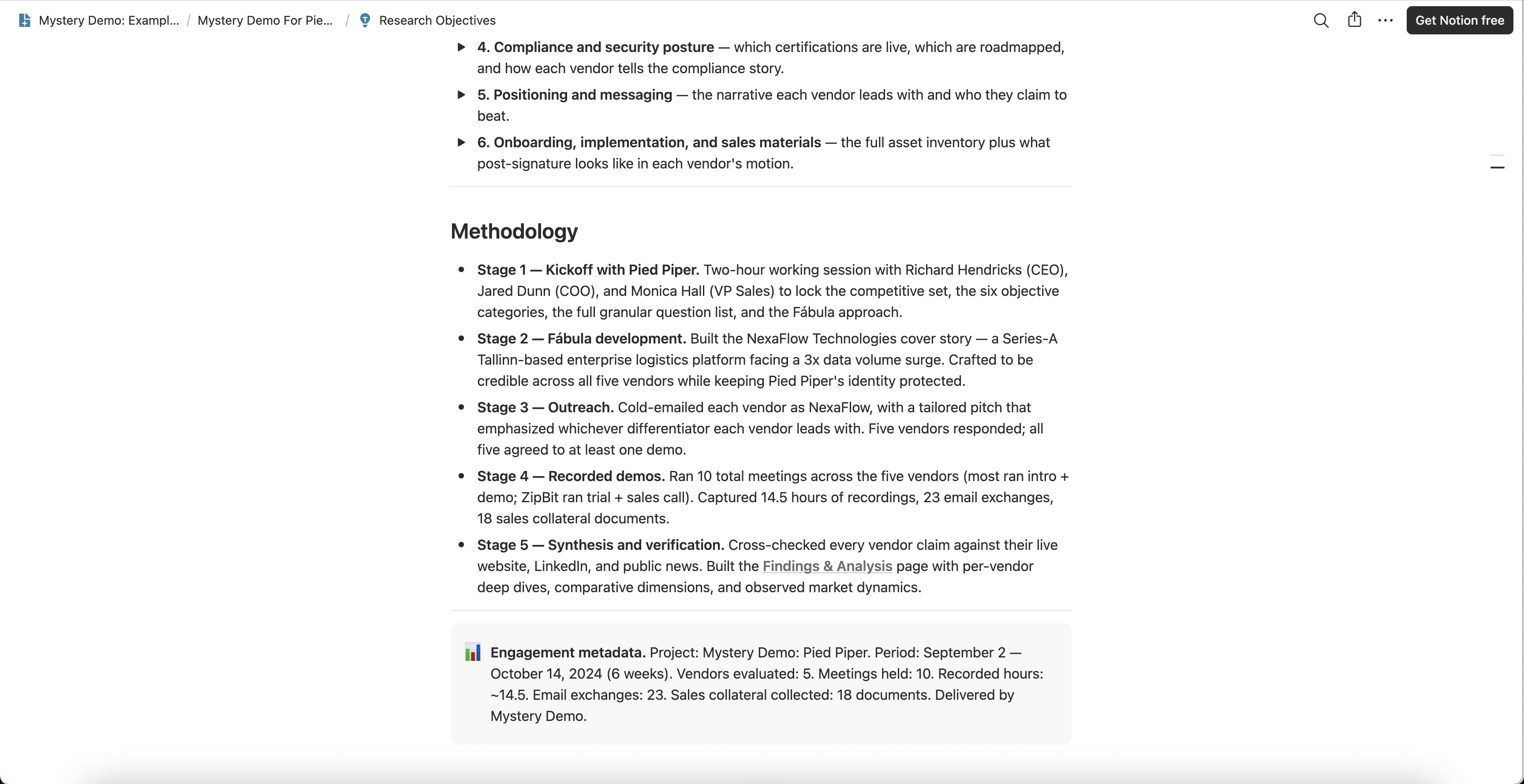
Below is the Research Objectives page from our example board, which is an invented project. Every real project’s board is built from that client’s own calls. At the top are the question categories the project has to answer, and under them the five stages, each with what was done.
At kickoff, each empty line on the card becomes a question a buyer would ask. The sheet below does that for Rival A, with what its rep answered and the minute each answer came.
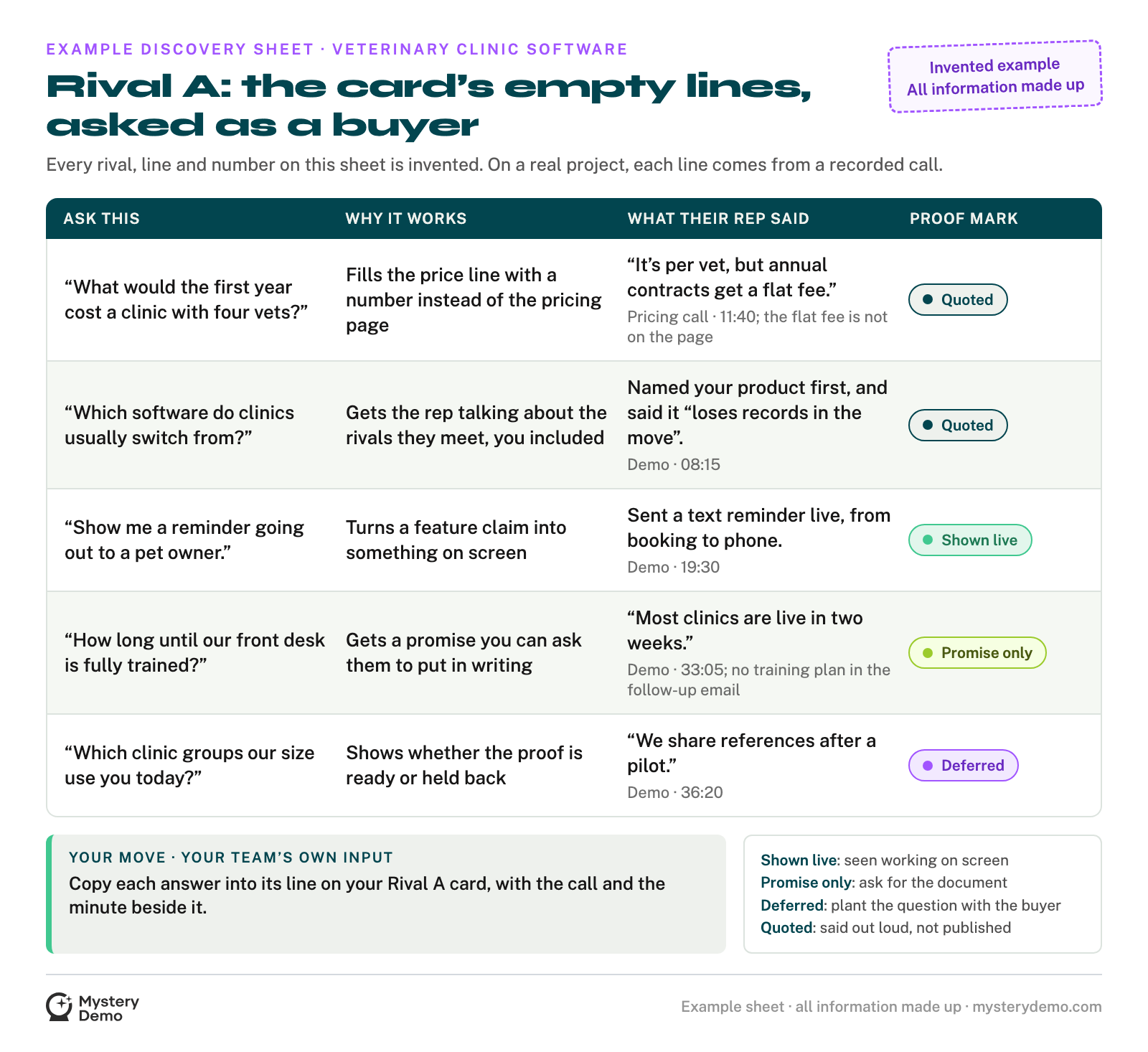
Asked for a feature list, a rep can answer with the deck. Asked what the first year costs a clinic with four vets, the rep has to name a number or say why not, and either answer belongs on the card.
What Comes Back for Your Battlecards
When the calls are done, each rival has its own page on the board, holding:
The Database lists every recording and transcript in one place, so any line in the analysis can be played back. Findings & Analysis then sets the rivals side by side, one dimension at a time: pricing, product, compliance, references, onboarding and the sales process. It is the page a battlecard is cut from.
Below is its onboarding dimension on the invented example board. Each rival is a row, and each column is something a card would say about it. Underneath, the next dimension puts what each rival claimed beside what its demo showed.
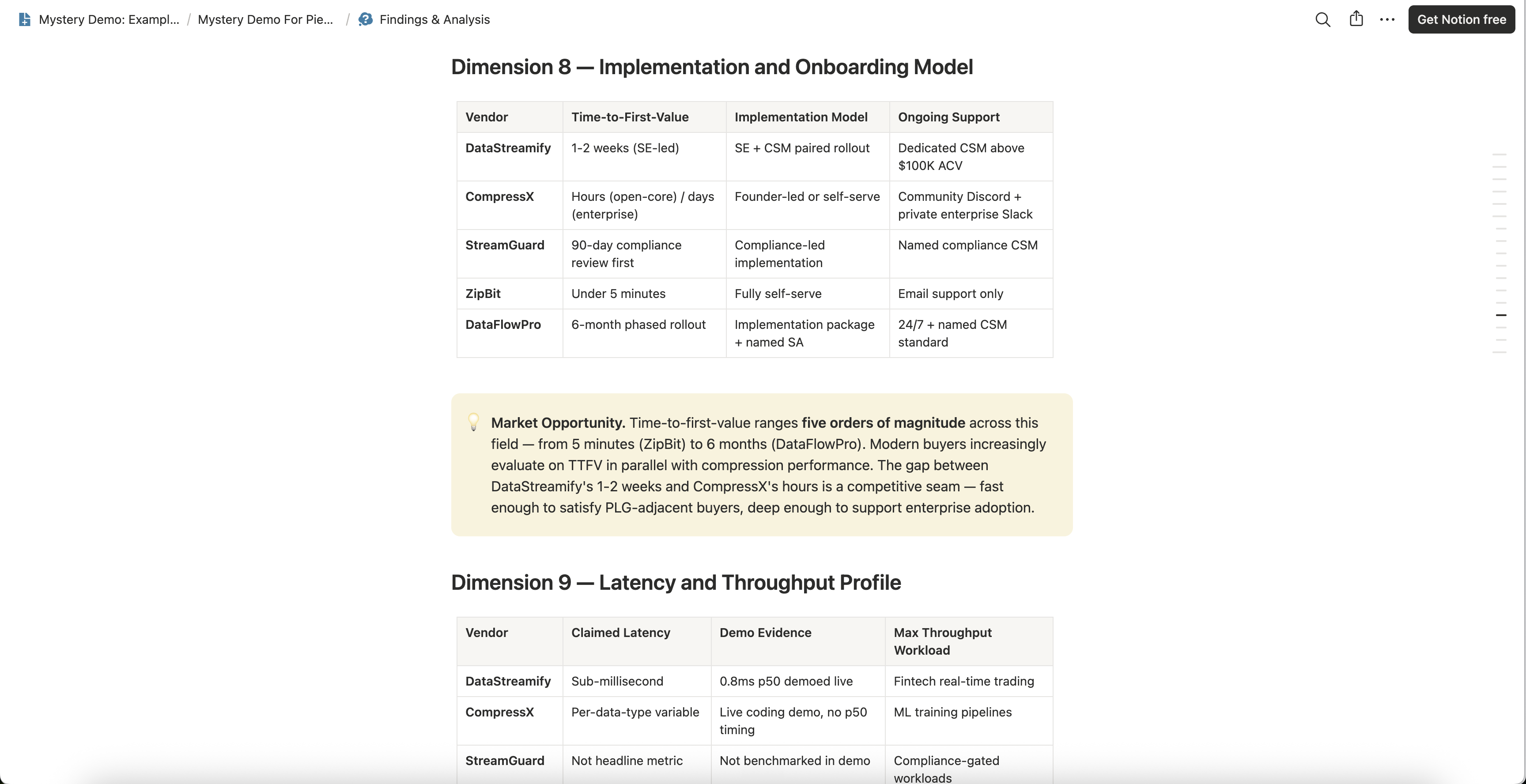
In that second table, a claim the demo proved is a line a rep can stand behind, and a claim it did not prove is only the rival’s word. On a battlecard research project, the cards come built from these pages: each rival’s lines, each one linked to the moment of the call it came from, ready for your team’s counter.


One rival costs a flat €499, everything included, and its pages are ready in one to two weeks. A landscape of six to fifteen rivals takes four to eight weeks, because the calls run side by side.
If one rival’s card is mostly guesses, that rival is the place to start. We can scope it with you on a short call, and its lines come back with the minutes they were said in.
What Battlecard Research Cannot Cover
A recorded call settles a lot, but not everything a card might want to say. Some facts sit where no outside research reaches, and the card should say so instead of guessing.
| Out of reach | What the card says instead |
|---|---|
| A rival’s win rate, churn or pipeline | Nothing, unless its rep claimed a number; then the claim, quoted and dated |
| The price other buyers were quoted | The price quoted to the buyer on your project, with its date |
| A pattern from a single call | “Said on one call in March,” until a second call says it too |
| How the product holds up in daily use | What the demo showed live, marked as shown, never as tested |
| What the rival does next quarter | The date on every line, so everyone knows when to look again |
Two of those rows are about our own work. A mystery demo is firsthand evidence of what one rep told one buyer on one day.
One call becomes a fact about the company only when the same thing comes up again, on another call or from another rep. That is why each rival gets a series of calls, and why a landscape tells you more than a single demo.
The other row is the product itself. Mystery Demo brings back what was said and shown on the calls, and it never tests the software hands-on. A line about how the product works should say what was shown, and when.
Start With the Card You Already Have
Take one rival’s card and write next to every line who said it, to whom, and when. Then sort the lines:
Look at which lines ended up in the brief. If they are the price, what the rival’s rep says about you, what its demo shows and what its reps promise, no amount of reading the rival’s website will fill them.
That brief, for one rival, is one project. It costs a flat €499, takes one to two weeks, and returns every line with the minute it was said. Bring the card to an intro call, and we will start with the rival whose blank lines cost you the most deals.


