
Ask a leadership team how its main competitor sells, and the answer usually comes back as a story. It comes from one of a few places:
Each story may be accurate, and each one is still a single rep talking to a single buyer on a single day. Change your pricing, your positioning or your sales playbook because of it, and you are arming your team against someone who may not be on the next call.
The way a competitor sells only shows up as a pattern across comparable calls: the same buyer story taken to every rival, through more than one call with each, and counted rival by rival. Anything less tells you about one rep. So before a story about a rival changes anything, the useful question is how many comparable buyers heard the same thing.
Mystery Demo builds those comparable calls on purpose. Its team takes one believable buyer story to each of your competitors’ sales teams, goes through every stage of the sale the way that buyer would, records it all, and lays the results side by side on one shared Notion board.
A Deal Story Shows One Rep on One Day
Every story about a rival mixes the rival’s way of selling with three things that change from deal to deal. Any one of them can change what the story says:
Start with the buyer. A rep asks a buyer how many seats they need, how soon they must decide and what they use today, and those answers shape what gets shown and how the price is framed. Say the buyer in your story had a hard deadline, and the rush discount they heard may never reach a buyer without one.
Prices move with the buyer, too. On one data tool’s page in Vendr’s marketplace, built from purchases negotiated through Vendr, the median discount is 27% off list at 50 seats and 36% at 200. A story about what that vendor charges depends on which of those buyers told it.
Then the rep. Ebsta’s 2024 benchmark of 4.2 million opportunities at 530 B2B companies found that offering a discount early was a trait of average performers, while top performers held it back until it was needed. So “they discount on the first call” may describe one of the rival’s average reps, not its pricing policy.

Every story also reaches you through someone, usually the rep who lost the deal, which is why what your reps say about rivals needs checking before it becomes a plan. Most teams have dozens of these stories about their main rival, which raises the obvious hope that enough of them add up to the truth.
Why a Pile of Deal Stories Still Isn’t a Pattern
More stories don’t add up to a pattern, and the first reason is that a pile of stories is rarely as big as it looks. A story spreads. One rep’s account of a lost deal gets repeated in meetings, in chat and on the battlecard your reps keep for that rival, and by the time it reaches a board deck it sounds like a trend.

Counted at its source, that trend is one call. Before any story changes a plan, trace it to the deal it came from and count it there, once.
The second reason is harder to fix. Two stories from two different deals differ in the buyer, the rep, the month and often the deal size, all at once. When they disagree, you cannot tell which of those made the difference, and when they agree, you cannot tell whether the rival caused it or the buyers did.


A comparison teaches something only when one thing changes and everything else holds still. Take the same buyer story to Rival A, Rival B and Rival C, ask each the same questions in the same weeks, and a difference between them comes from the rivals rather than the buyers. The rep is the one variable left, and the way past it is more than one call with each rival, so a line can be heard from more than one of its people.
Comparable calls don’t happen by accident. Your deals bring you whatever buyers show up, so the comparison has to be built.
How Mystery Demo Builds Comparable Calls
Mystery Demo builds the comparison before the first call. It starts with the fábula, the buying scenario it brings to every competitor: who the buyer is, why they need a solution and what they are trying to solve.
The scenario has six elements: the industry, the headquarters, the team size, the funding stage, the current stack and growth driver, and the decision timeline. They are fitted to each competitor’s ideal customer, so every rival takes the buyer seriously, while the problem the buyer brings and the question list stay the same for all of them. The evaluation is genuine, nobody real is impersonated, and the one thing a rival never learns is who asked for it.
Each competitor is approached through its normal front door, with a pitch fitted to what it leads with. Then come the calls a real evaluation needs:
Every call is recorded, and every claim the public record can confirm or contradict, from a customer count to a certification, is checked against the rival’s website, LinkedIn and public news. The page below comes from our public example board, where the client and every competitor are invented. A real project’s board is built from that client’s own calls.
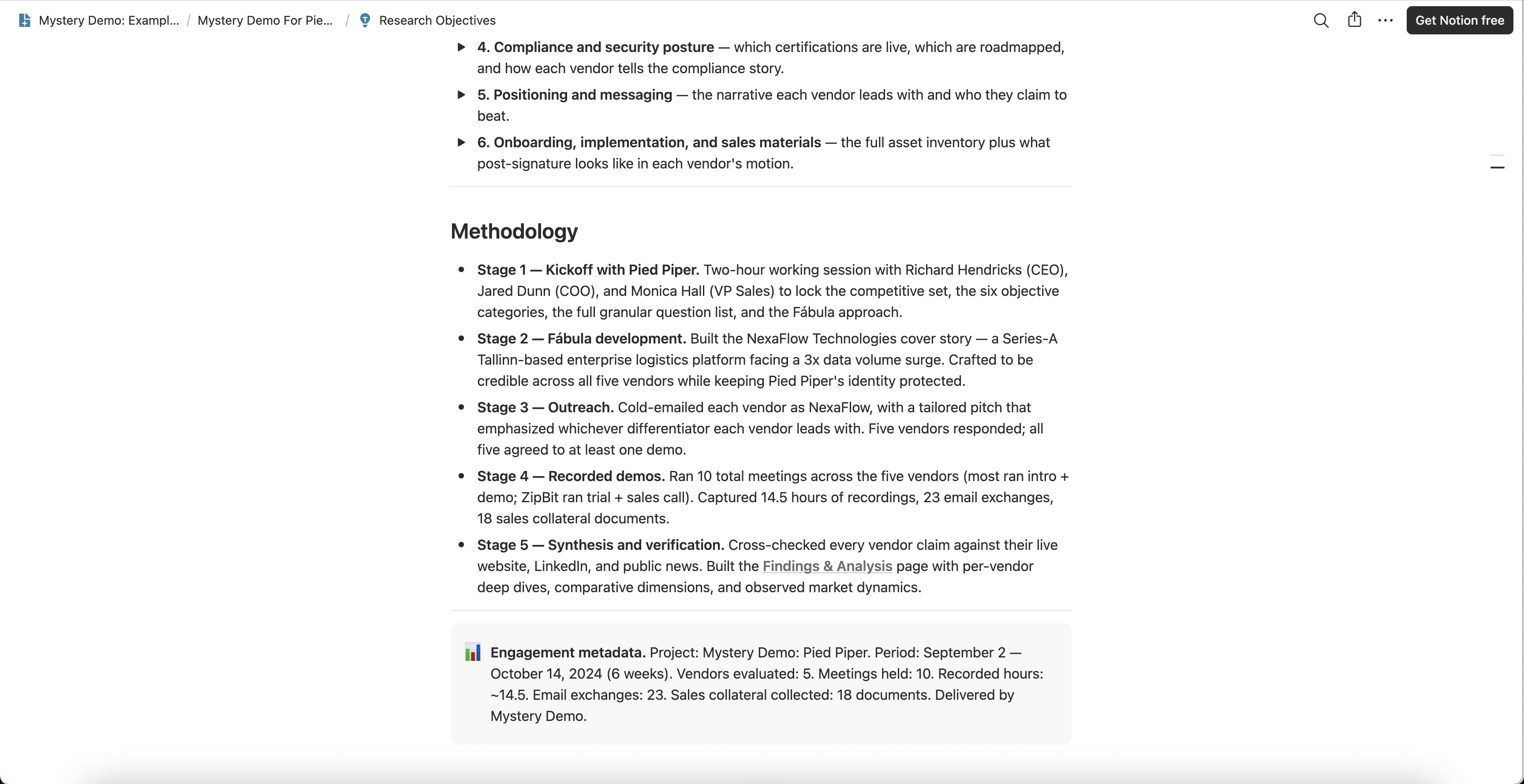
Read it as the conditions for a fair comparison. The question list is fixed at kickoff, one buying scenario is written to be credible to every rival on the list, and claims are checked against the public record before they reach a page.
None of this can be done from outside, because the outside sources answer different questions:
| Where you look | What it tells you |
|---|---|
| The rival’s website | What it wants every buyer to believe |
| Review sites | What some customers chose to say in public |
| A competitive intelligence tool | When the rival changed its public pages |
| The sales call | What it quotes, shows and promises one buyer, and what it says about you |
Comparable calls can’t be built from your own inbox, either. A team that books its rivals’ demos gets recognized, or gets the generic tour, and a rep who suspects a competitor is on the line does not run the call they run for buyers. Recorded calls are raw material, and what turns them into a pattern is how they are read and counted.
What a Single Call Can Prove
One call proves what was said to one buyer on one day, and some of that is worth a lot. A written quote is a quote, and a feature shown working on screen exists. One call cannot prove a habit, though: how hard the rival discounts, what it leads with, how it talks about you when your name comes up.
| What you want to know | What one call proves | What it takes to call it how the rival sells |
|---|---|---|
| The price | What it quoted one buyer, for one scope, on one date | Quotes to comparable buyers, set beside the published price |
| A feature | That it works, if it was shown live | One live showing settles it; a feature only described stays a claim |
| What it says about you | What one rep said, word for word | The same line from more than one of its people |
| How hard it discounts | One rep’s offer to one buyer | Offers across its calls, with when each came and what prompted it |
| How it follows up | One run of emails | Its follow-up across the calls, set beside every other rival’s |
Reading across calls takes a few rules. They are the rules to hold anyone’s count to, ours included:
On the board, patterns get written down only after every rival has been compared on the same questions. Below is the Strategic Observations section of the invented example board, on its Findings & Analysis page, the page where the competitors are compared dimension by dimension.
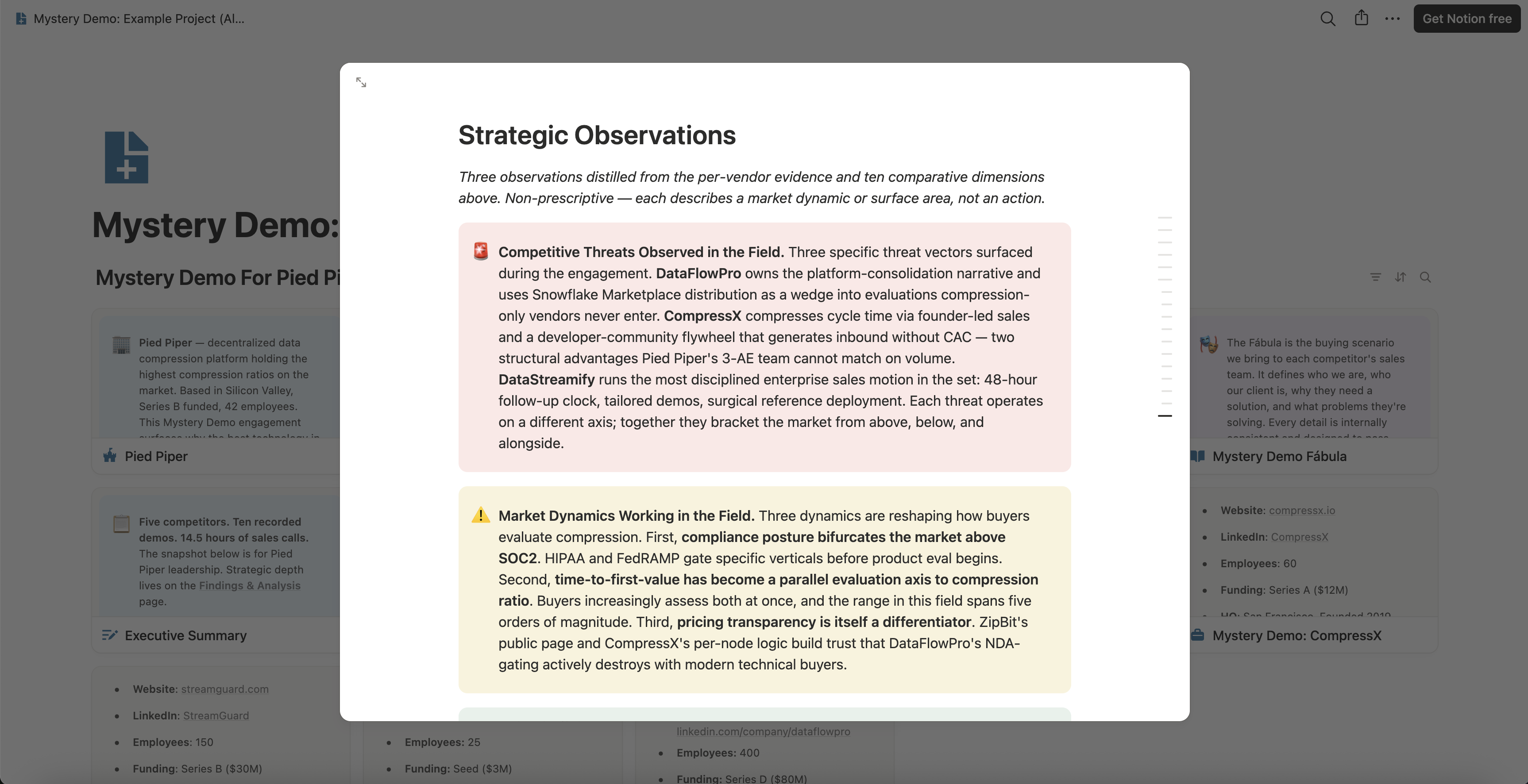
The italic line under the heading is the part to notice. The observations come after the comparison, never before it, which is the order a founder needs: the pattern first, then the decision.
One objection is left, and a busy founder will raise it first: deals are moving now, and waiting for a pattern costs them.
The Case for Acting on One Story
Speed is the strongest case against waiting. A rival that started discounting last month is taking deals this month, and a founder who waits for comparable calls loses those deals while being careful. A credible story acted on today can beat a proven pattern that arrives next quarter.
Part of that is right. Some facts need only one call. If a buyer forwards the rival’s written quote, you have the rival’s price for that scope, and you can answer it this week.
The judgments are the expensive part: your discount policy, your positioning against the rival, the playbook your reps run. Those changes outlast the deal that prompted them. A discount policy built on one rep’s habits keeps answering that rep long after someone else at the rival runs the call differently.
A pattern is also no longer slow to get:
The calls are run by operators who have sold B2B software, so they know which follow-up question pulls a rep off the script. One project will not give you a hundred calls with each rival. It gives you every stage of each rival’s sale, more than one of its people wherever it hands the buyer on, and every rival meeting the same buyer, which is the comparison a pile of deal stories never gives you.
If one story about a rival is already reshaping your playbook, we will take that rival’s calls as the buyer and tell you whether the story holds before the playbook changes.
What the Board Shows a Founder
Once the comparable calls are back, the question changes from what to believe to what to change. A founder’s changes sort into four kinds:
Those decisions get made on the Executive Summary, the part of the board written for leadership. It says where each competitor wins and loses, and its sales scorecard grades every rival on the same steps: how fast it answered, how well it listened in discovery, how good the demo was, how straight it was about price and how it followed up.
Below is that page on the invented example board, where the names and the grades are made up and the structure is the real part.
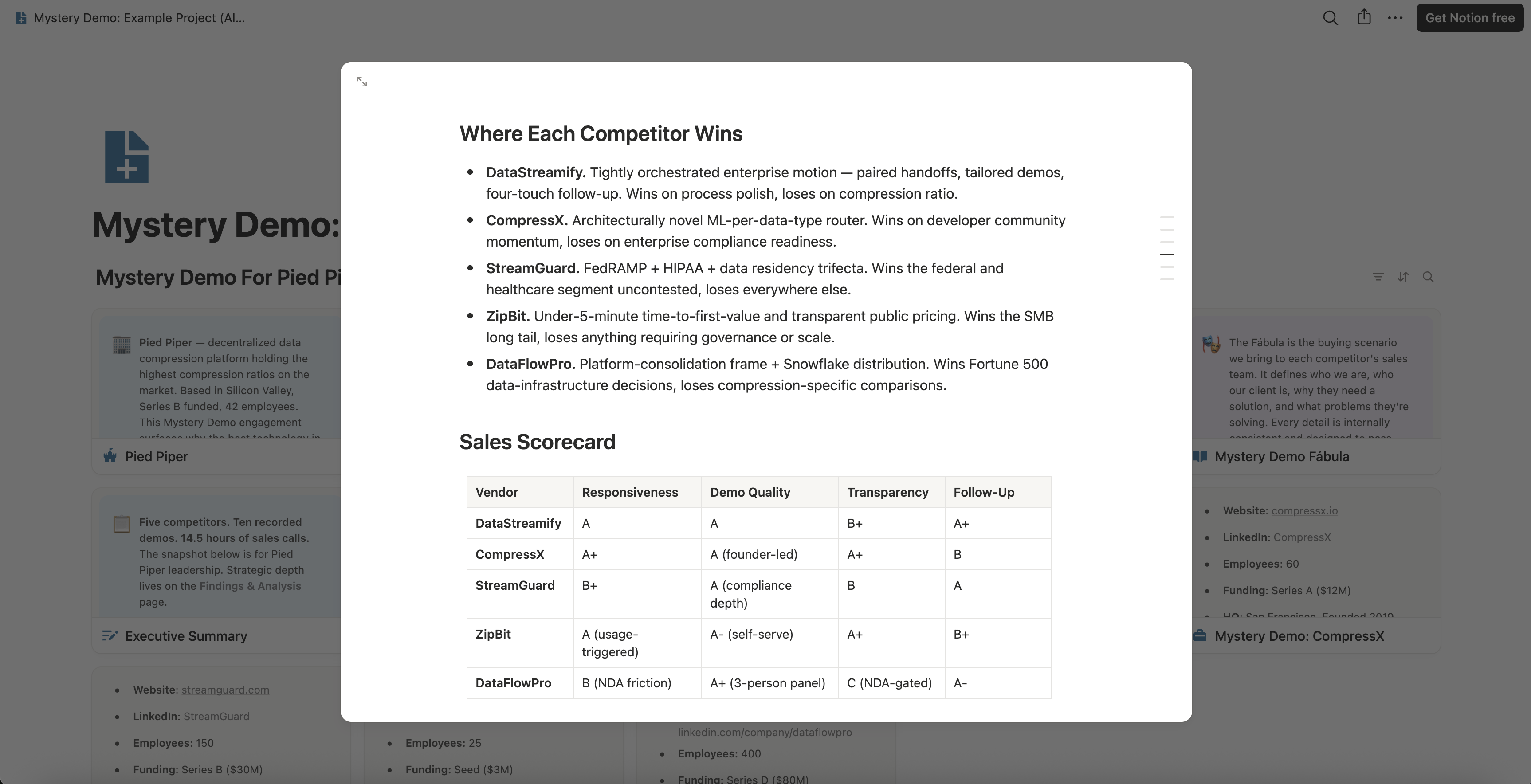
Because every rival met the same buyer story, a gap between two grades in one column says something about the two rivals rather than two buyers. Filling that scorecard is the job of competitor sales tactics research: each rival’s whole sales motion, from the first reply to the last follow-up, scored step by step.
Treat the Next Story About a Rival as a Question
A playbook rebuilt on one deal story is aimed at a rep who may not be on your next call. If a rival’s second call, with a different person on the same buyer story, matches its first on every step, then one demo would have told you how it sells, and we are wrong about that rival. Find out which it is before you change anything.
Start with the story your team repeats most about your main rival. Write it down, then mark where it came from:
Then tell us which rival it is. We will take one buyer story to that rival and to the others it competes with, and bring back which of your team’s stories survive the comparison.


