
Most of what your sales team believes about a rival comes from your reps. A buyer repeats what the rival promised, or a deal is lost, and the rep tells the team what happened. The picture of each competitor is built out of those retellings.
Some of those retellings end up in your CRM, mostly in the rep’s own words. In a 2026 survey of 500 US sales and revenue decision-makers by a sales software company, 84% said loss reasons are captured often or always. More than half, 55.6%, said the information entered into their CRM is based mostly on subjective seller reporting.
Mystery Demo produces a different kind of evidence. Its team books a competitor’s real sales demo as a credible buyer, asks about the claims your reps keep hearing, and records every call. Your reps’ reports and those recordings prove different things, and neither one replaces the other:
| Compared on | Your reps’ reports from deals | A recording of the rival’s demo |
|---|---|---|
| How often it arrives | Whenever a competitive deal moves | Each time someone books the demo and records it |
| How recent it is | As recent as the last deal | Dated to the day of the call |
| Whose view it carries | A buyer’s account of the rival, retold by your rep; for a loss, by the rep who lost | The rival’s own pitch, made to one buyer scenario |
| Can you check it | Only by asking the rep or the buyer again | Yes, by playing the call back at the minute |
| What it can prove | Which rivals and claims keep coming up in your deals | What the rival said, showed and quoted to that buyer |
| What it cannot prove | The rival’s exact words | What another buyer heard, or why one deal was lost |
Your Reps Hear Each Rival Through a Buyer
Reps are where competitive news arrives first. They are in the deals, so they hear which rivals buyers are weighing this month, which claims buyers repeat, and how buyers react when a rival’s name comes up. One commenter in a sales operations forum on Reddit put the pace plainly: “packaging and feature moves change what reps hear faster than any calendar review can catch.”
No other source arrives that often or that close to a live deal, and that is the reason to keep listening. A report does not carry the rival’s own words, though. By the time a claim reaches you, a buyer has retold what the rival said, your rep has retold the buyer, and neither of them was trying to keep the exact wording.
When a deal is lost, the report gets shorter still, and the people who keep the loss field are blunt about it:
None of this makes your reps wrong. It means each report tells you which claim about a rival to check, without the rival’s own words to check it against. So how do you check one claim against those words?
One Reported Claim, Checked on a Recorded Call
Take an invented example. Your reps report that Rival A never charges for onboarding. Several of them have heard it from buyers, and some now give your own onboarding away to match.
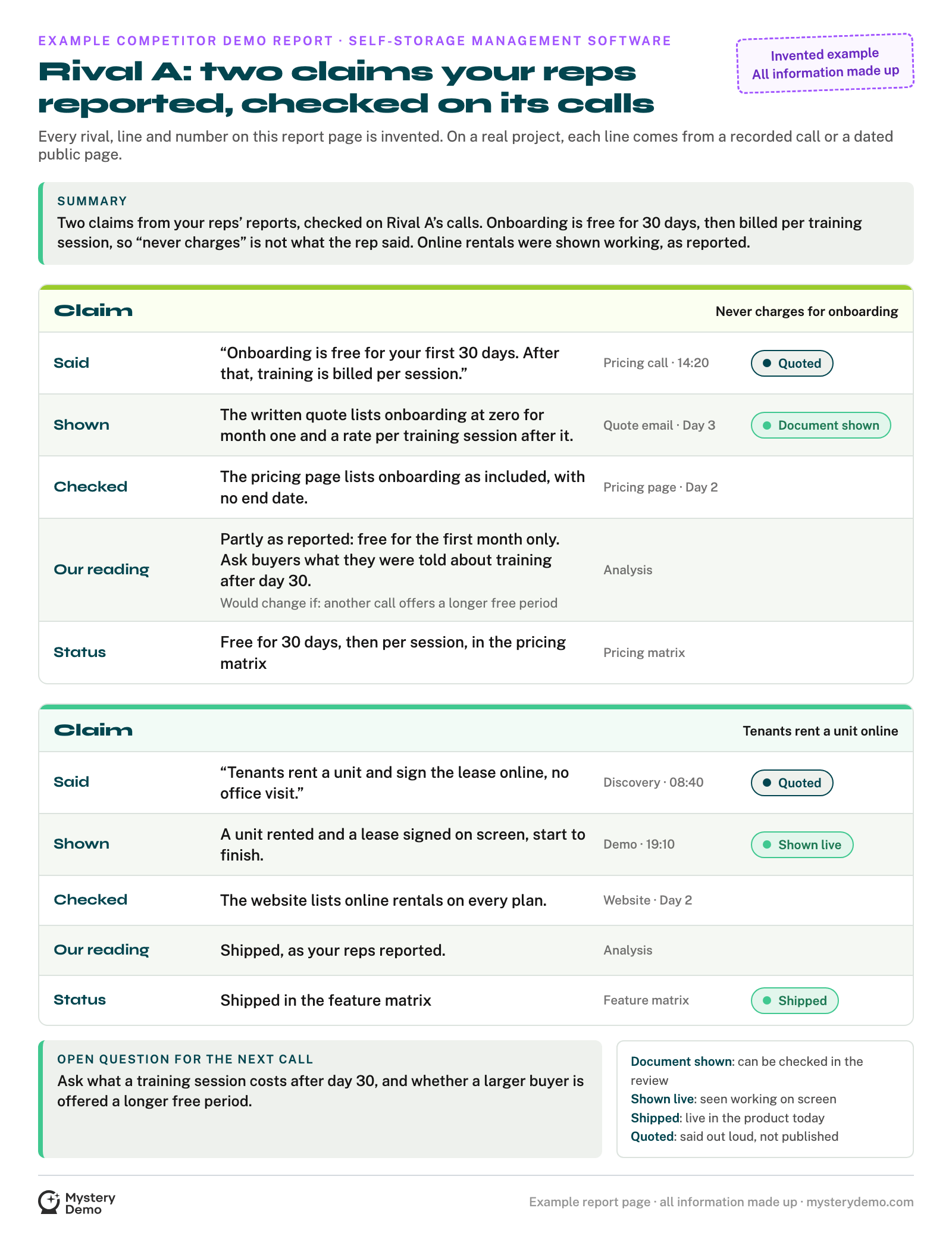
The report is a buyer’s memory of a pricing conversation nobody on your team heard. In the example, Rival A’s pricing page lists onboarding as included and says nothing about how long that lasts. A term like that gets explained on a call, so the one place to hear it is Rival A’s own pricing conversation with a buyer.
Mystery Demo gets that conversation by asking for it as the buyer. Its team books Rival A’s demo through the normal front door, with a buying scenario built around what Rival A sells, and follows the sales process all the way:
Every call is recorded. In the onboarding example, this is what came back:
One call is one rep talking to one buyer scenario. The same answer has to come up on more calls, ideally from another rep, before it describes Rival A’s pricing rather than one conversation.
Written up for one rival, the check looks like the page below. Each claim your reps reported sits beside what Rival A’s rep said, what was shown, and what the public page says. The rival and every line on it are invented.
That page lives on a Notion board shared with the client. The board holds everything the calls produce:
The onboarding answer goes on Rival A’s page with the minute it was said, and onto Findings & Analysis beside the other rivals. Here is the onboarding topic on Mystery Demo’s public example board, where the client and every rival are invented. On a real project, the board is built from the calls Mystery Demo takes for you.
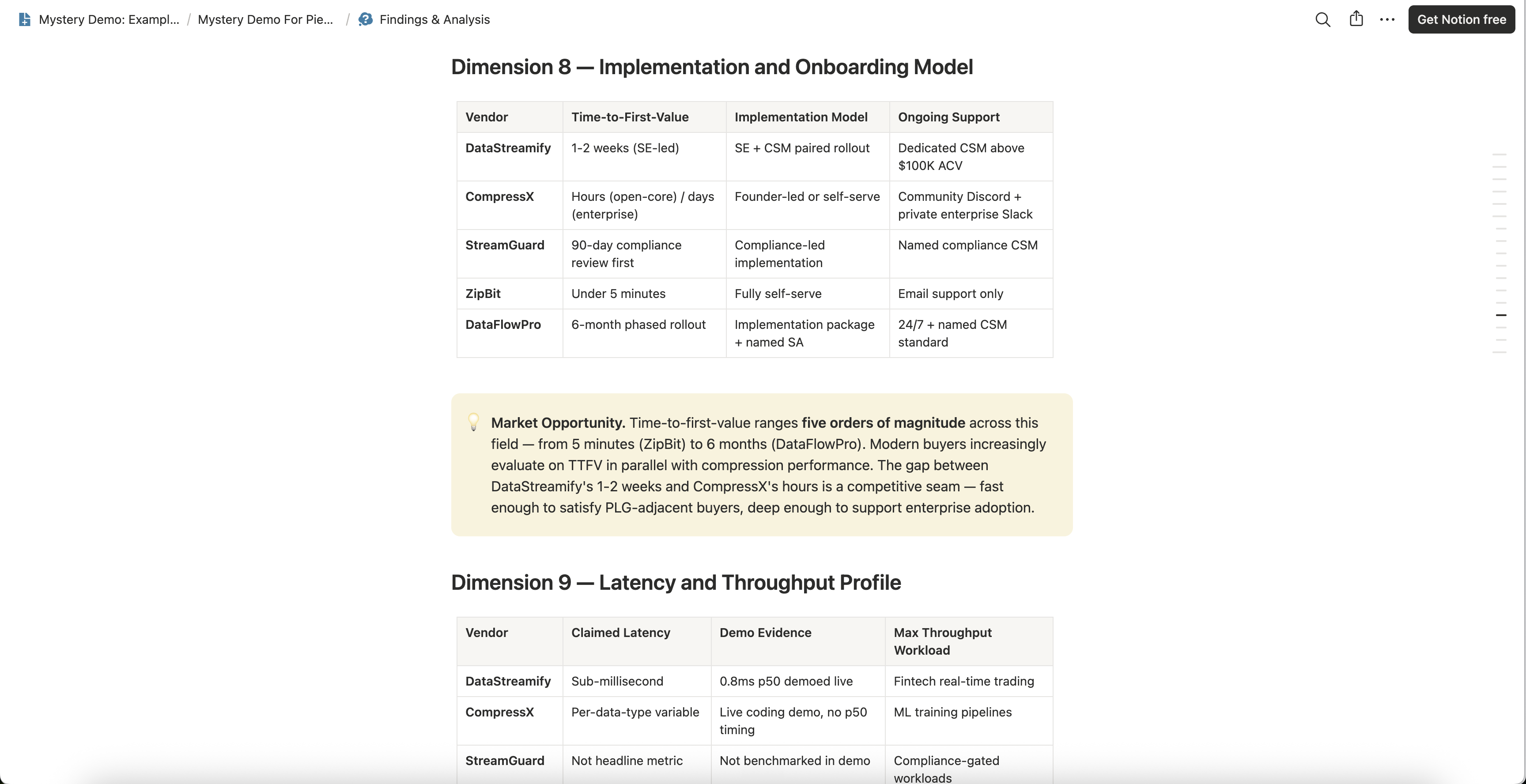
The figures on it are invented, so read it for its columns: how long each rival takes to deliver first value, who runs the implementation, and what support follows. Beside those columns, a free first month covers all of a short rollout and only the start of a long one.
Onboarding was one claim, and your reps report many. Which of them are worth a recorded call?
Which Claims Deserve a Recorded Call
Most reports never need one. Send a claim for recording when it passes three tests, and keep the rest as reports to watch:
The onboarding claim passes all three: several reps reported it, it had changed your pricing against Rival A, and any buyer can ask what onboarding costs. A claim that Rival A’s support goes slow after go-live fails the third, because no rep will say so on a call. Customers who have lived with that support are the better source for it.
A Mystery Demo project makes the same kind of choice at the start, for rivals rather than claims. On the Research Companies page of the same invented board, the Why We Chose Them column says why each rival made the list. One is there because the client’s own account executives kept citing it in competitive deals.
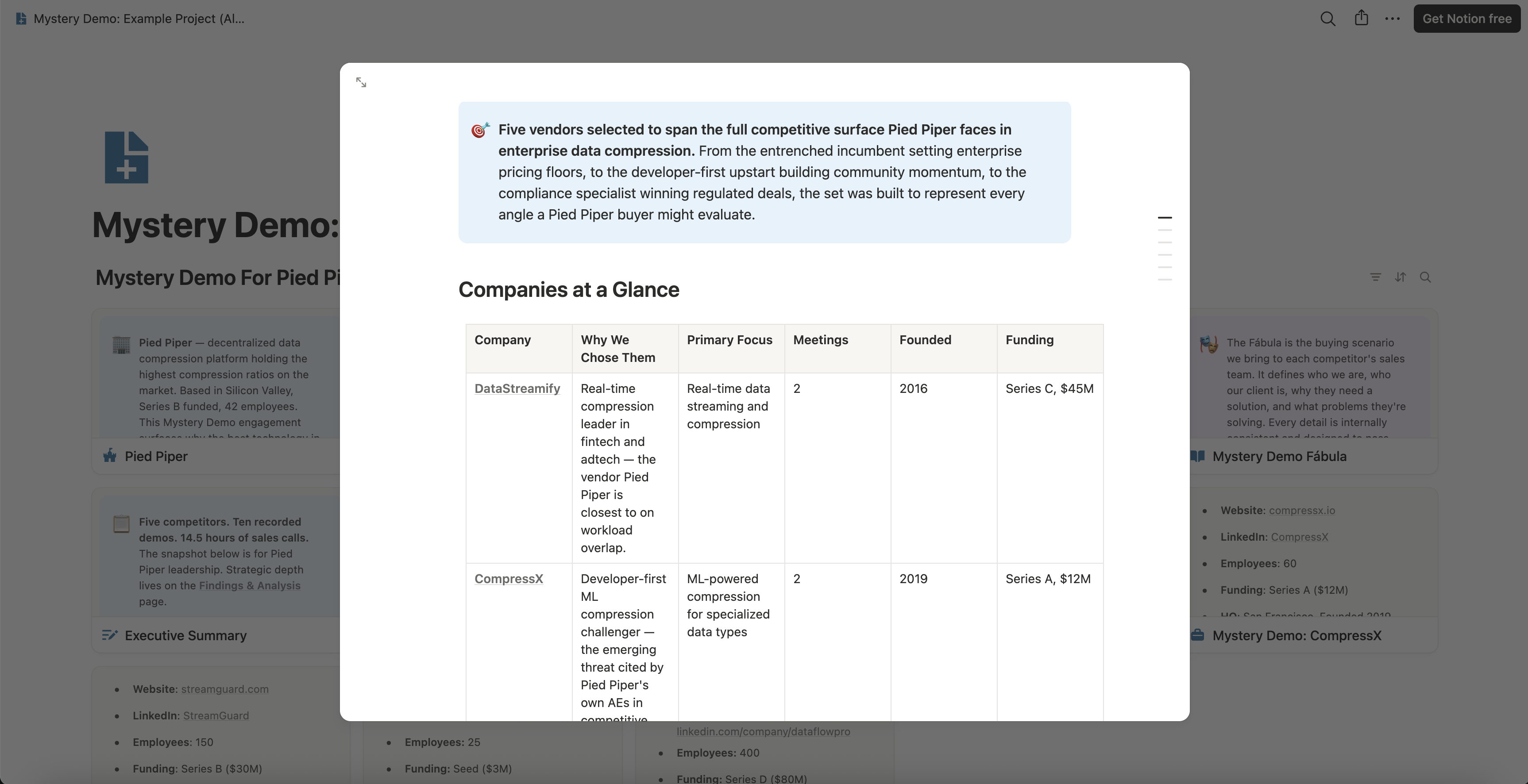
That is reps’ reports doing their best work, choosing what gets checked. Once a claim or a rival is worth checking, the sources differ in cost and speed as much as in evidence:
| Source | What it costs | Time to an answer |
|---|---|---|
| Your reps’ reports | Your reps’ time | As deals happen, on no set schedule |
| Your team takes the demo | Your team’s time | Whenever the rival schedules it |
| Mystery Demo takes the demo | A flat €499 per competitor, everything included | One to two weeks for one competitor |
Your own team can book Rival A’s demo. The request comes from your company’s email domain, and a rep who looks it up will know a competitor is asking. What comes back then may be a careful answer about onboarding fees, or no meeting at all.
A believable buyer, with a scenario fitted to Rival A, gets the pricing conversation a real prospect gets. The demos are run by operators who have sold B2B software, so when a rep leads with a free month, they ask what happens on day 31. Every finding comes back as a recording with a timestamp.
In SaaS competitor battlecard research, every line on a rival’s card links to the recorded minute behind it. If one claim keeps coming back in your reps’ reports, name the rival behind it on a short intro call. We will raise that claim with the rival as the buyer and bring back the recording of its answer.
Let Reps’ Reports Choose What the Recording Checks
With Rival A’s recording in hand, you brief your reps on what it showed: on one recorded pricing call, onboarding was free for 30 days and billed per session after that. Then you ask them to find out what their own buyers were told.
If their buyers heard the same thing, the answer starts to describe Rival A, not one call. If some heard something different, Rival A may price onboarding buyer by buyer or may have changed it, and the next recording is how you find out. Either way, the reports keep moving as Rival A changes its packaging, and the next claim to record comes out of them.
If your team keeps a battlecard on Rival A, the onboarding line now carries its source:


Your reps’ reports tell you where to look, and a recording tells you what the rival said when someone looked, to one buyer, on one date. It cannot replay a deal your team lost in the spring. A picture of a rival built only from reports is a set of summaries, and with recordings behind the claims that matter, part of it can be checked.
Send us the three claims your reps repeat most about one rival, on a short call with the Mystery Demo team. We will put each claim to that rival as the buyer, bring back what its rep said and the minute it said it, and mark any claim the calls did not answer.


