
A competitor’s real pitch and price are given to buyers in its sales calls, and nobody from your team is on them. The usual way around that is a paid call with someone who knows the competitor: an industry expert, or a person who used to work there. Either call can teach you a lot, and neither one is the competitor talking to a buyer.
This page is for the sales enablement or product marketing lead deciding how to research a competitor. It sets expert interviews, former-employee calls, and a mystery demo side by side: what each can prove, how current it is, what it costs, how fast it comes back, and what each one may not tell you. The three differ first in the kind of evidence they produce: an expert interprets, a former employee remembers, and a mystery demo records.
A mystery demo is a competitor’s real sales demo with a credible buyer on the other side. Mystery Demo takes that demo for you, asks the questions you need answered, and records every call. You get the recordings and an analysis of what the rep said, showed, and quoted, in one shared workspace.
| Approach | What it can prove, and how current | What it cannot see |
|---|---|---|
| Expert interview | How the market works and what a competitor’s moves likely mean, as current as the expert’s knowledge | What the competitor tells buyers |
| Former-employee call | How the competitor sold, priced, and built its product, as of the day they left | What changed after they left, and anything confidential |
| Mystery demo | What the competitor’s rep says, shows, and quotes to a buyer, recorded on the date of the calls | What was not said on those calls, and what a different buyer would hear |
Expert Calls Explain the Market
An industry expert knows a market well enough to read it: a former executive from another company in it, a long-time buyer, an adviser. A LinkedIn post on expert-network consulting describes what an investment firm wants from one: “someone who sat across from the customers and knows why the numbers look the way they do.”
That reading of the numbers is what you pay for. The right expert can tell you:
The same call has a limit. You get one person’s informed view of the market, and it may not include what the competitor tells buyers today.
Expert calls are paid per call, at a price set by whoever arranges them. One investment professional, working out a fund’s research budget in a LinkedIn post, assumed £1,500 a call. That is one person’s planning figure for one kind of buyer, and we found no independent price list to set beside it.
How fast you get an answer depends on finding the right person and getting them on the calendar. And when the right person used to work at the competitor itself, the call becomes a different thing.
A Former Employee Knows How It Was
Someone who worked at the competitor knows it from inside. Depending on their job, they can tell you:
That knowledge has a date on it, the day they left. After that day the price list can change, the roadmap can move, and the pitch can be rewritten for a new rival.
A former employee who left a year ago describes a company that may no longer sell the way they remember. And some of what they know is not theirs to share.
What a Former Employee May Not Share
For your research plan, confidentiality decides how much of a former employee’s knowledge a call can carry. The law draws its general line around trade secrets. In the US Patent and Trademark Office’s guidance on trade secrets, information is a trade secret when it meets three conditions, and all three are required:
An employment law firm made the practical distinction in a LinkedIn post: “A former employee taking general knowledge and experience from one job to another is not the same thing as taking protected confidential business information.”
So the line runs between what someone learned about doing the job and what the company protects as its own. Where one person stands depends on what they signed and on the facts of their case. Nothing here settles that for anyone, and none of it is legal advice.
Firms that buy expert calls can add rules of their own. One investment adviser’s expert network policy, filed with the SEC, sets two of them for its staff:
That is one firm’s rule, not the law. Still, it shows what a careful buyer of these calls avoids: recent inside knowledge of the company the call is about. The newer the knowledge, the less of it a call will carry, so what the competitor tells buyers now has to be heard in its own sales calls.
What the Competitor Tells a Buyer Today
An expert interprets the competitor, and a former employee remembers it. Neither one is the buyer when the competitor’s rep answers a question about price, fit, and alternatives this week. That answer is only given inside the competitor’s own sales process, to someone it believes may buy.
Its website says what the competitor wants buyers to believe, and its reviews say what customers felt after they bought. The sales call is where it quotes a price, shows the product working, promises what is coming, and says what it thinks of you.
Mystery Demo gets into that process the way any serious prospect does:
The evaluation is genuine, and nobody is impersonated. Mystery Demo never signs an NDA and never pays for the product, so no contract is broken. Those are the reasons mystery shopping a competitor’s demo is legal.
Mystery Demo brings back only what the competitor chose to tell a prospective buyer, and all of it lands on a shared board with a page for each competitor. Below is one such page from our public example board, where the client and every competitor are invented. A real board is built from that client’s own calls.
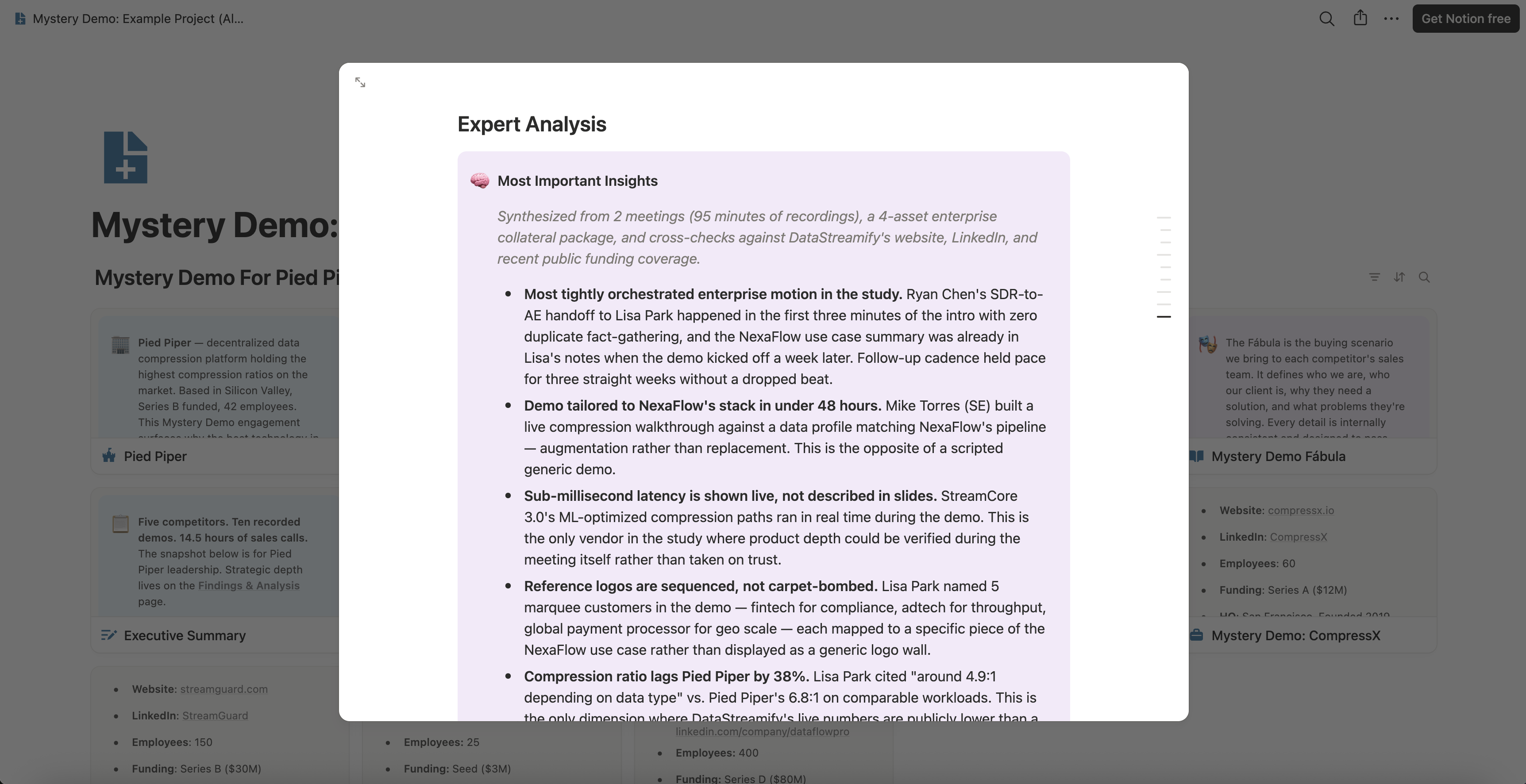
The italic line at the top names what the analysis rests on: the meetings and minutes of recording, the collateral the rep sent, and the public record each claim was checked against. Every insight under it goes back to a moment in those calls. An expert’s reading goes back to the expert.



The recordings are the evidence. Your team works from what gets built out of them.
What You Get Back From a Mystery Demo
The board is a shared Notion workspace your team keeps and can search. It is organized by competitor and by question, not by the date of each call:
The board interprets too, which matters when the alternative is an expert’s interpretation. Below is the Strategic Observations section of Findings & Analysis on the same invented board.
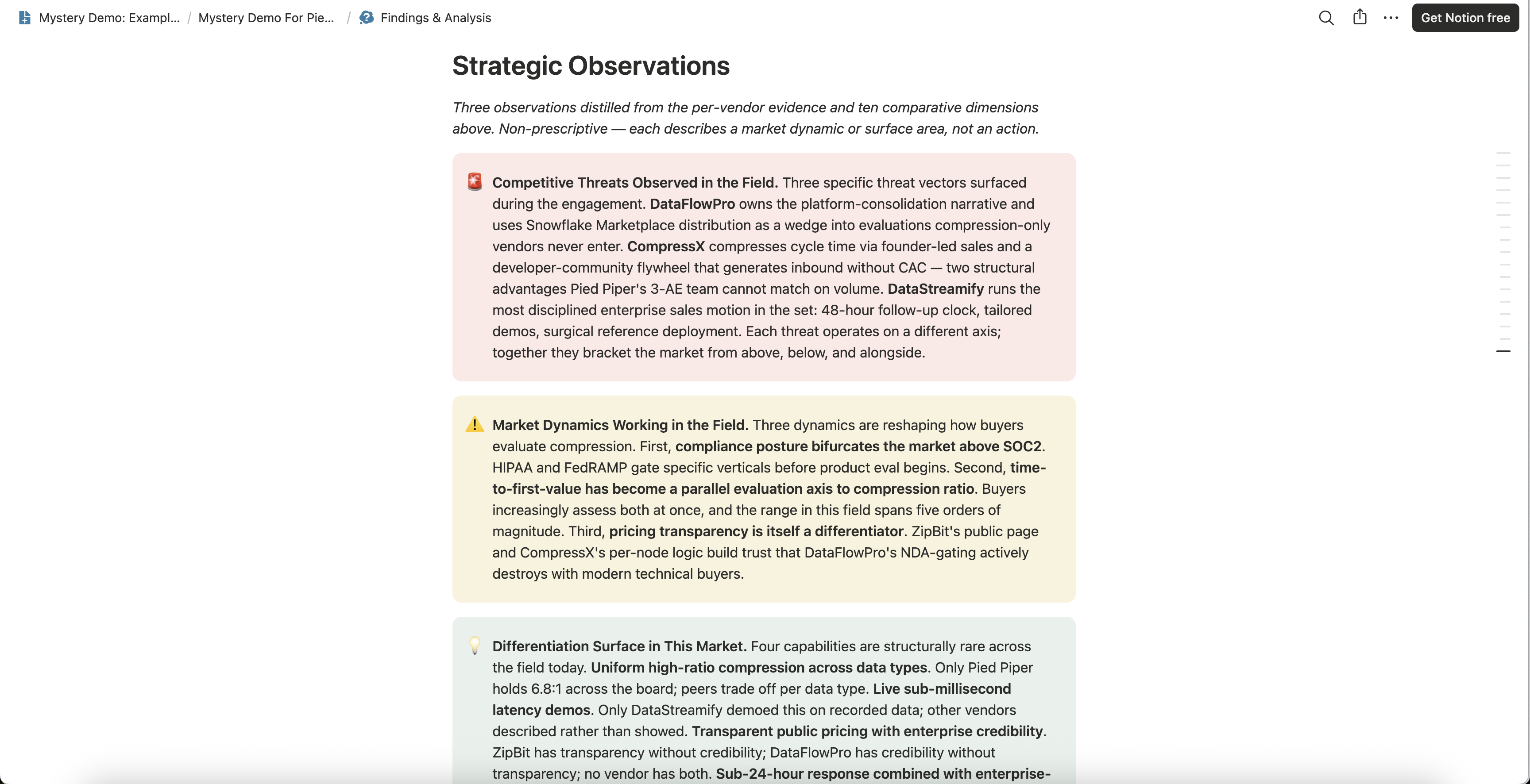
Each observation is drawn from the evidence on the competitor pages, so anyone who doubts one can follow it back to the call. An expert’s reading rests on experience you cannot check. This one rests on calls your team can replay, so it can be checked against what was said, even by someone who reads it differently.
If your open question is what one competitor tells buyers now, that competitor is a fair place to start. Bring it to a short intro call with us, and we will go through its sales process as a buyer and hand back the recording of what its rep says and quotes today.
Cost, Speed, and Confidentiality Compared
| Approach | Cost and speed | Confidentiality limits |
|---|---|---|
| Expert interview | Paid per call, at a price set by whoever arranges it; as fast as the right expert can be found and booked | Bound by the expert’s own obligations; buyers of calls may add rules |
| Former-employee call | Paid per call, or your team’s time if you find them yourself; depends on finding someone willing to talk | General experience can be shared, protected confidential information cannot, and each person’s agreements decide the rest |
| Mystery demo | A flat €499 per competitor, everything included; one to two weeks for one competitor, four to eight for a landscape | Only what the competitor tells a prospective buyer; no NDA signed, nothing paid for |
You could also take the competitor’s demo yourself. It costs only time, and it hands the rep your name and your company’s email domain, which take a minute to look up. A rep who knows who is asking gives you a careful tour, not the pitch your buyers hear.
A buyer the rep cannot place gets that pitch. The people asking the questions for Mystery Demo have sold B2B software themselves, and they know which question takes a rep past the script. Every finding on the board points to the recording, transcript line, or email it came from.
So the last step is matching the approach to the question in front of you.
Choose by the Question You Need Answered
Each kind of question has an approach that answers it first:
| If your question is about | Start with |
|---|---|
| How the market works and how buyers decide | An industry expert |
| How the competitor used to run its deals and build its product | A former employee, within what they may share |
| What the competitor tells a buyer now | A mystery demo, on a recording |
A real research question can have more than one part, and then the three work as a set. Here is one way, as an example rather than a recipe:
Before you pay for any of the three, write your question down and mark which row it belongs to. If any part of it lands in the last row, the first step is a conversation with us about which competitor and what you need to hear it say. After that, we are the buyer in its sales process, and the recording is yours.


