
If the competitor session at your sales kickoff is built from last year’s battlecards and old deal notes, it teaches reps each competitor as it sold a year ago. One sales leader on LinkedIn described where that ends: “The rep was still using battle cards from last year.”
Competitors also rank low when kickoffs get planned. SalesHood, a sales enablement software vendor, asked more than 100 B2B SaaS and software companies about their 2025 kickoffs. Each could pick several priority topics, and competitive strategy was the one the fewest picked: 34%, against 58% for sales skills training.
This page is for the enablement lead or product marketer planning that session, and everything on it can be lifted as it is:
Mystery Demo fills the sheets. Its team goes through each competitor’s sales process the way a buyer would, from the first call to the price. Every conversation is recorded, so each line on a sheet arrives with the date it was said and the time in the recording.
Why Kickoff Material on Competitors Goes Stale
The people who write battlecards say they age fast. In Wynter’s survey of 101 B2B SaaS product marketers at mid-market and enterprise companies, run in April 2026, 47% said their battlecards go stale within three months. By the same marketers’ account, only one sales team in three consistently uses the competitive content they produce.
If the session’s material comes from last year’s deals, it is older than three months before the first slide. And a card can go unread for most of its life. In one loss review posted on LinkedIn, a rep was asked whether they had checked the battlecard before the final call, and answered: “I didn’t know we had one for this competitor.”
So a kickoff session needs two things:
A LinkedIn post on running a sales kickoff makes the second point in one line: “Make people compete as a team (not just listen to a lecture).” The first point is harder, because the place your team found each fact last year is not where the competitor says it today:
| What the session needs | Where last year’s material got it | Where it is said today |
|---|---|---|
| The price a buyer like yours is quoted, and its conditions | The pricing page, or a quote from a deal that closed months ago | The competitor’s pricing conversation with a buyer |
| What the competitor leads with against you | Its homepage and an old pitch deck | Its demo, in the rep’s own order and words |
| What it says about you | What a lost buyer remembered afterward | The call itself, at the moment the rep said it |
Everything in the right-hand column is said out loud, to buyers, on calls your team is never on. A website shows what a competitor wants every buyer to believe, and only a buyer hears the rest.
How Mystery Demo Gets Each Competitor’s Current Pitch
Mystery Demo is that buyer, and each project starts from what your session needs. In the project’s first meeting, those needs become the question list, and for a sales kickoff it opens with what every competitor gets asked:
Each answer fills one line of the sheet. Before anything is booked, the team writes a buying scenario: a believable company with a real reason to evaluate software, fitted to what each competitor sells.
Each competitor is then approached through its normal front door, like any serious prospect, and the calls follow its own process:
Every call is recorded, and every email and document is kept. The evaluation is real, because the team is evaluating software on your behalf, and the only invented part is which company the buyer works for. Nobody is impersonated, and a competitor never learns who asked.
Everything lands on a board, a shared Notion workspace your team keeps. Below is its Research Objectives page, from our public example board, where the client and every competitor are invented. On a real project, the board is built from that project’s own calls, and the objectives set in the first meeting decide what is asked on each of them.
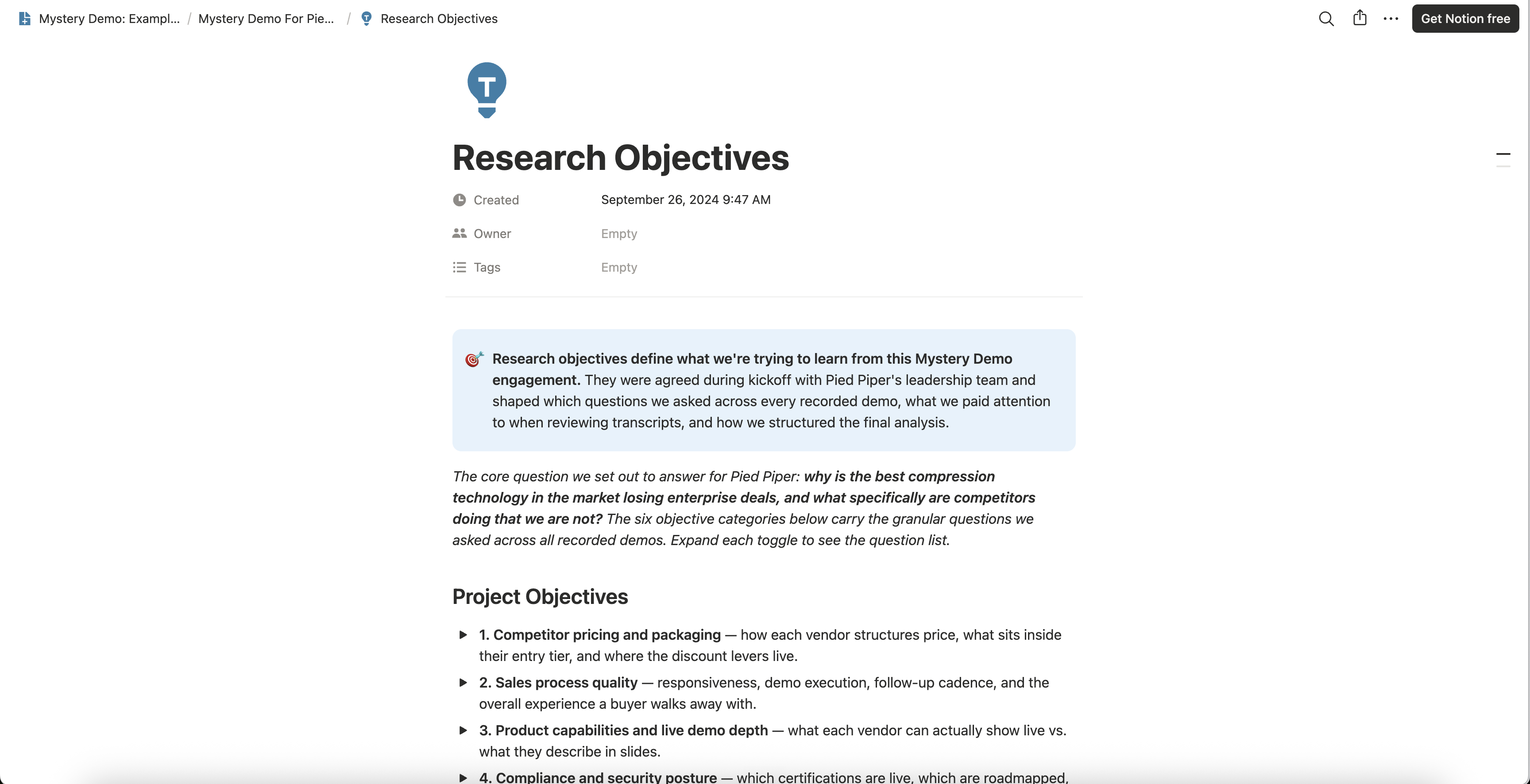
Each competitor then gets its own page on the board, with its recordings, transcripts, emails, and the analysis of what it said and showed. Findings & Analysis is the page that sets the competitors side by side, and two of its parts fill the sheet directly:
Those lines become battlecards where every line links to the recorded moment: the rep’s words, the call, and the timestamp. The timestamp points into the Database, which holds every recording and transcript from the project. Here it is on the invented board, open on one competitor’s calls:
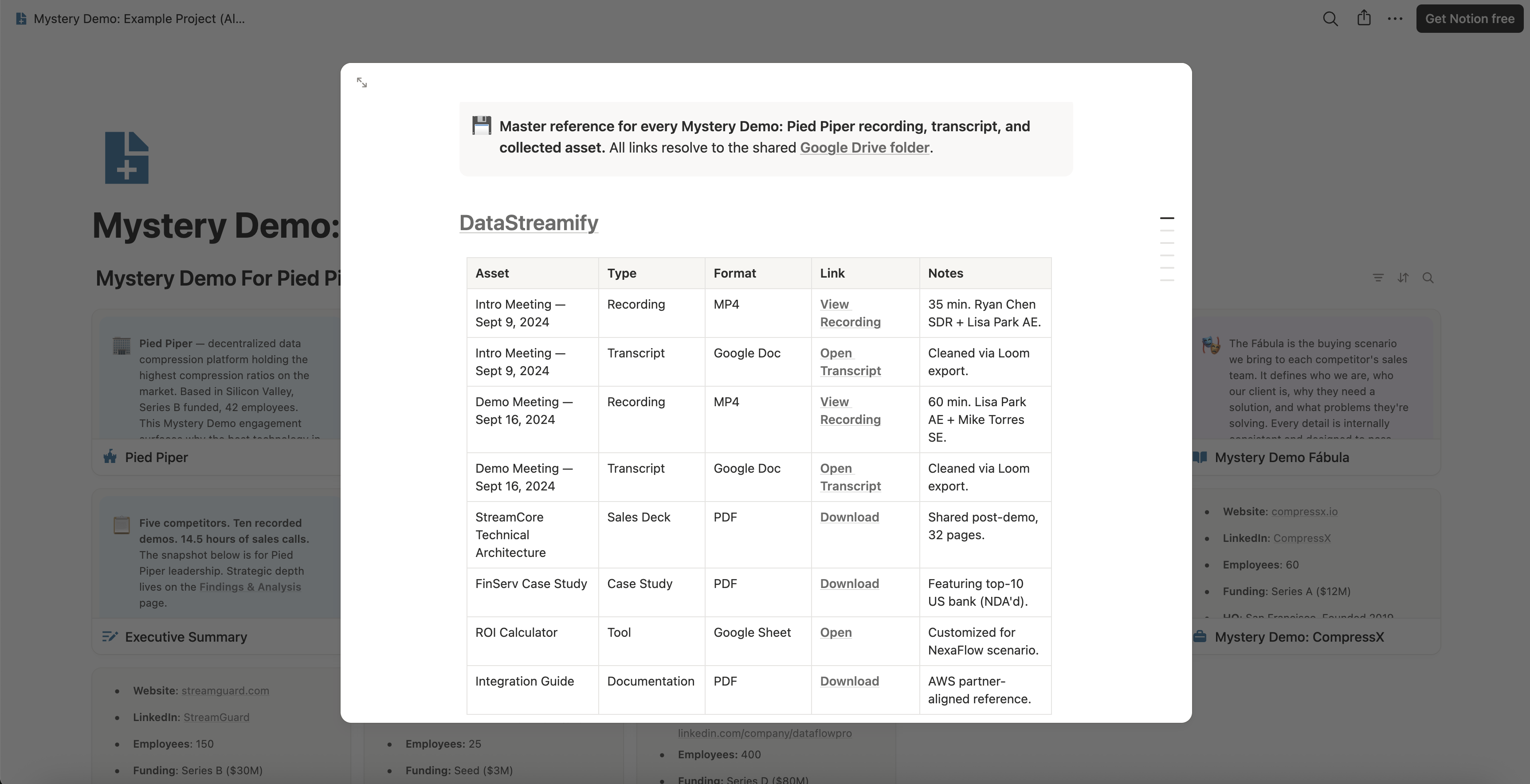
Each row is a call or a document, with its date and its length. When one of your reps asks where a line on the sheet came from, the answer is a recording, not someone’s memory of a deal, and its date says how old the line is.


Your team could request the demos itself, but a competitor’s rep would recognize the email domain, or give the tour everyone gets. A believable buyer, fitted to each competitor, gets the real motion instead: the discovery questions, the deep dive, the conversation about price. The operators running the calls have sold B2B software themselves, so they know which question gets a rep past the script.
The price is a flat €499 per competitor, everything included. One competitor takes one to two weeks, and a full landscape of six to fifteen competitors takes four to eight, because their demos run side by side. Count back from your kickoff date.

If your kickoff date is set, bring the list of competitors to a short call with us. We will go through each one’s sales process as a buyer and bring back what was quoted and said, with every gap marked, on a schedule set against that date.
With a dated line for each competitor, the session itself takes an hour.
The Session Plan, Block by Block
One product marketer on Reddit argued for sessions of 45 minutes to an hour dedicated to specific competitors. This plan uses one hour for three of them, and spends most of it on the check. The timings are a starting point, so move them to fit your agenda.
| Block | Time | What happens | What you leave with |
|---|---|---|---|
| 1. Why it matters | 5 min | One recent win and one recent loss against these competitors, and where each one wins, from the Executive Summary of the board | The stakes, named |
| 2. Competitor by competitor | 15 min | Five minutes per competitor, walking through its sheet line by line | Every rep holding three sheets |
| 3. The out-loud check | 25 min | In pairs, each rep answers the answer key’s three questions for each competitor, about a minute an answer, while the partner scores; then they swap, and managers move between pairs to spot-check | A score for every rep on every competitor, on one shared grid |
| 4. The gaps | 10 min | The questions most reps missed, answered again from the recordings | A list of weak spots to coach |
| 5. After kickoff | 5 min | Who owns each sheet, how reps flag changes, and when each sheet is refreshed | An owner and a date for every sheet |
For more than three competitors, run blocks 2 to 4 again in a second session, three competitors at a time.
The Sheet Each Rep Holds
Each rep holds one sheet per competitor: a battlecard cut down to what an hour can test. A full battlecard built from demos holds more. The sheet has four lines, and the board fills three of them:
| Line | What goes in it | Where it comes from |
|---|---|---|
| Price | What the competitor quoted a buyer like yours, the conditions on that number, and the date of the call | The pricing matrix, with the pricing call in the Database |
| What it leads with | Its opening argument, in the rep’s words, with the call and the timestamp | The competitor’s own page on the board, and the messaging matrix |
| What it says about you | A claim about your product, or a question it tells buyers to ask you, only if a rep was heard saying it | The messaging matrix, with the recording and the timestamp |
| Your answers | Your team’s answer to what it leads with, and to what it says about you | Your team: product marketing and enablement write it |
Price. Write the number the rep said, not the one on the pricing page, and then the conditions that came with it: the contract length, the signing deadline, the minimum number of seats. The date matters as much as the number, because a rep who quotes last year’s price to a buyer is wrong in a way the buyer can check.
What it leads with. Write the competitor’s opening argument the way its rep said it, with the call and the timestamp, so your reps can raise it themselves before the buyer brings it up. On the board, it starts in the analysis on each competitor’s page, shown here for one competitor of the invented board.
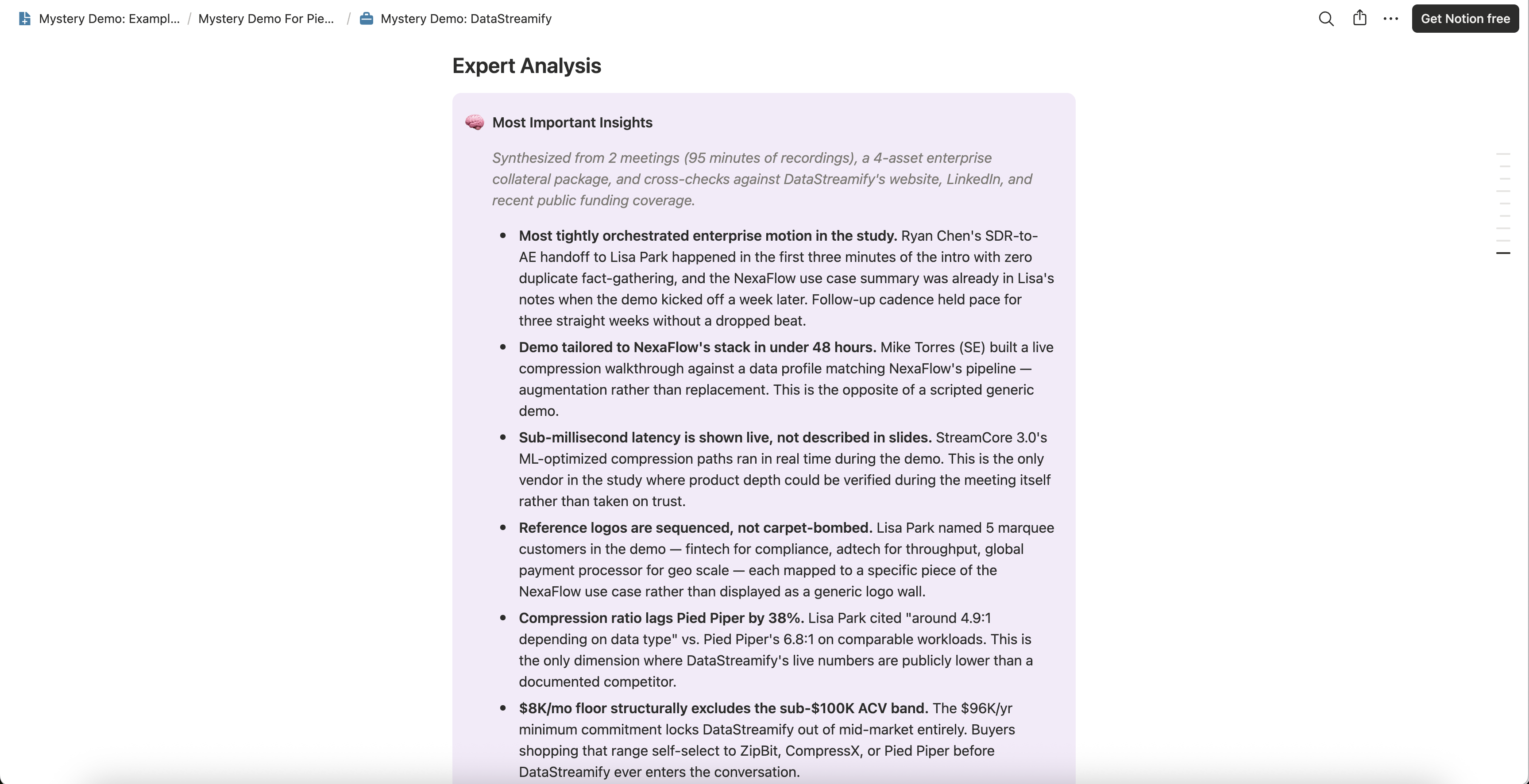
What it says about you. This line holds the trap: a claim about your product, or a question the competitor tells buyers to ask you, chosen to land where your answer is weakest. Write it down only if a rep was heard saying it, with the timestamp, and mark anything else “not heard” so the check skips it.
Your answers. Product marketing and enablement agree one answer to what the competitor leads with and one to what it says about you, each short enough to say in a minute. Two of each competitor’s six points ride on these answers, so they are written down before the session, never improvised in it.
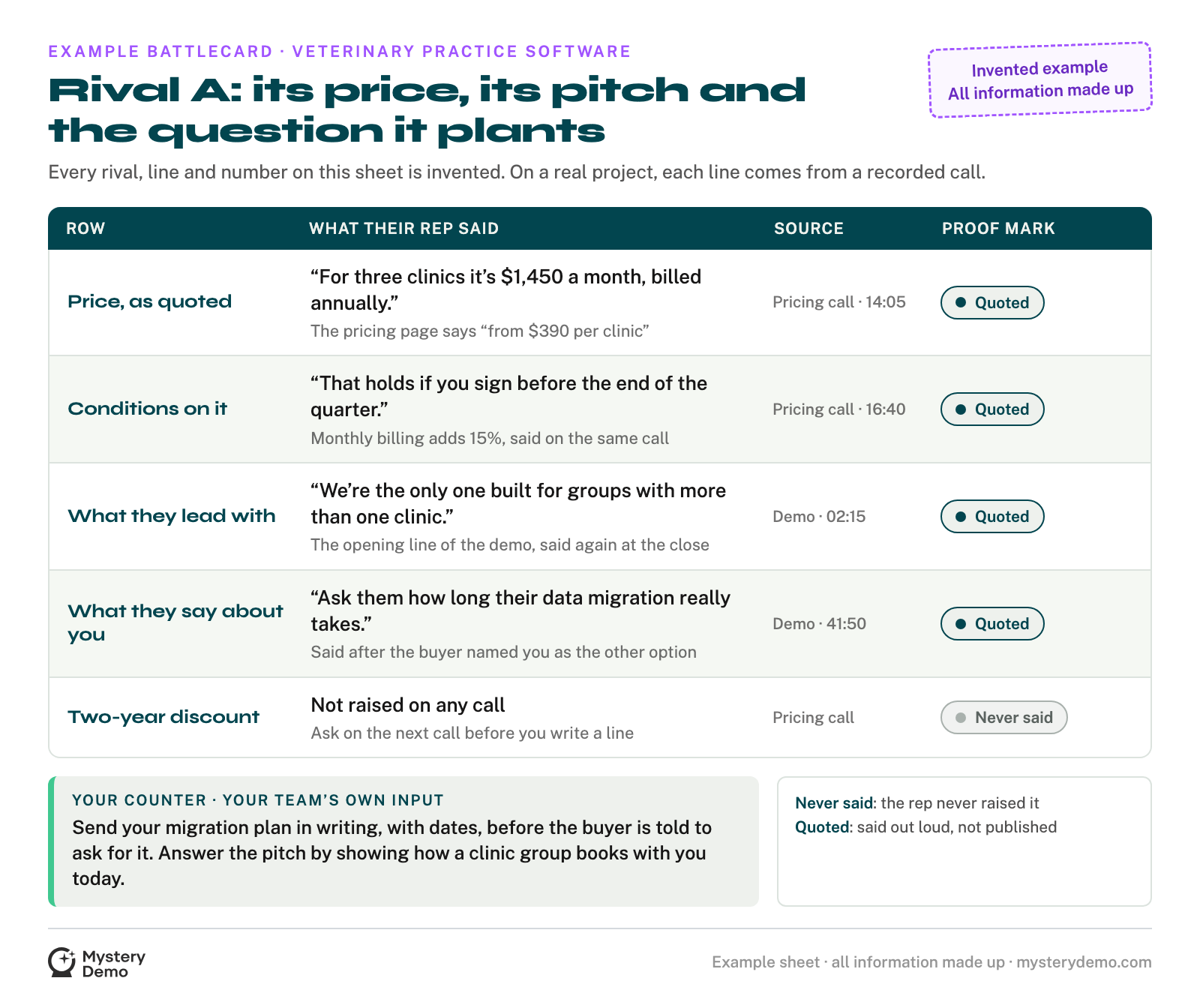
Here is a filled sheet for one invented competitor in veterinary practice software. Every competitor, line and timestamp on it is made up. The shape is the real part: each line carries its call and timestamp, and a mark that says whether the rep said it out loud or never raised it.
The Answer Key
Every rep answers the same three questions about each competitor, out loud. Each answer is worth two points, and each point is checked against something on the sheet:
| Question | First point, checked against | Second point, checked against |
|---|---|---|
| 1. What does it charge a company like ours, and on what conditions? | The price on the recording | The conditions on the recording |
| 2. What does it lead with, and how do we answer? | What it leads with, on the recording | Your team’s agreed answer |
| 3. What does it say about us, and how do we answer? | What it said, on the recording | Your team’s agreed answer |
How to Score the Check
The partner scores each point, the manager spot-checks, and every score goes on one shared grid. A point can only be lost when the sheet holds the answer, so each point lands in one of three places:
| On the sheet | What your rep said | Score | What it tells you |
|---|---|---|---|
| Heard and written down | Matches the sheet | 1 of 1 | Nothing to fix |
| Heard and written down | Wrong, or nothing | 0 of 1 | A coaching point for that rep |
| Not heard | Anything | Left out of the score | A gap for enablement to fill |
The grid records points earned against points available, for each rep and competitor. If the recording holds a price but no conditions, the price point counts and the conditions point is left out. A competitor with nothing heard on its sheet gets no score at all.
Read the grid one competitor at a time. Low scores on a full sheet mean your reps need practice on that competitor, and its own recordings make good coaching material. A sheet full of gaps means the research comes first.
How to Keep the Sheets Current After Kickoff
The grid is true on the day of the session, and the competitors keep selling the next morning. Reps hear about them in their own deals, so the upkeep starts with the reps:
A fresh recorded call on one competitor is the same work as the first time, and it takes one to two weeks. The competitors whose flags pile up fastest are the ones worth refreshing before each quarter’s check.
A session built from dated calls teaches reps each competitor as those calls found it, and the scored check shows what each rep can say about it out loud. Before the first deal of the year, you know which competitors need research and which need practice.
Before the agenda is locked, walk us through the competitors on it in a short call. We will go through each one’s sales process as the buyer and fill its sheet from what was said, with every line dated and every line we did not hear left blank and marked.


