
Your call recordings show how your own reps handle each step of a demo. None of them shows how the rival your reps keep meeting handles the same step. A buyer who is also talking to that rival hears both versions in the same evaluation, and judges your rep’s version against the rival’s.
A rival’s move is worth drilling only if your rep could make it with your product, your price, and your buyer. If it works only because of the rival’s product, price, or buyer, it is a finding for someone else on your team, not a drill for your rep. The worked example is how the demo opens: you test the rival’s move, then run a twenty-minute coaching session from a one-page sheet.
For the rival’s line on that sheet, Mystery Demo takes the rival’s calls itself, as a believable buyer, and records them. Each call comes back dated, together with every email and earlier call the buyer had with the rival’s rep. All of it sits on one board, a shared workspace with a page for each rival, and you cut the rival’s clip from there.
Define a Good Opening
You may already coach this way, and it is a good routine: pull a call, flag the moment that went wrong, play it beside the same moment from your best rep, and talk it through one to one. Nothing here replaces that routine. It adds one clip to it.
Keep the session to one change. One sales trainer compares a list of corrections to a golf coach who rebuilds the whole swing at once, so the player walks away with nothing to practice. The same trainer’s team reviews a recorded call with three questions, asked in order: what went right, what went wrong, and what changes next time.
The one change for this session is how the demo opens. Before any clip plays, write down what a good opening sounds like, as an anchor you can score any call against:
This anchor is invented for the example, and yours should use your reps’ own words.
A 5 is rarer than it looks. In the demos we drew on for our post about the things competitors almost never do in a demo, most reps did open with some version of “what are you trying to solve.” The answer then mostly picked which slides to skip, instead of shaping the call around what the buyer needed.
Whatever you write becomes the first line of the session sheet. A rival’s call may show you another version of a 5, or something worse than your rep’s, and only a better one is worth a session. Even then, the next question is whether your rep can copy it.
Sort the Gap Before You Drill It
A rival’s rep can open better than yours for reasons that have nothing to do with skill. Each of four explanations sends the clip somewhere different, and the last column of the table says where.
You will test all four in the session, on the two clips. Read them now, so you know what to watch for when you find the rival’s minute:
| Explanation | The question to ask | If the answer is yes |
|---|---|---|
| Skill | Could your rep make this move today, with your product and your price list? | It is a coaching clip. Drill it. |
| Product | Does the move lean on a screen, a feature, or an integration your product lacks? | It is a positioning input. Send it to whoever owns your positioning. |
| Price | Is the rival’s price, package, or free trial doing the work at this step? | It is a pricing input. Send it to whoever sets your pricing, because no drill closes a price gap. |
| Situation | Did the rival’s rep meet a different buyer, or know more by that minute? | Check whether your rep could find out the same thing. If not, the gap is in your process: send it to whoever owns the process, and find a better-matched clip to coach from. |
On an opening like this one, the product and price rows are the likeliest to come back empty. Those two rows matter more on steps like a live feature walkthrough or the first price question, where the rival’s product or price can do the work instead of its rep. When they do, it is not a coaching failure, so say so in the session and send the clip to whoever owns your positioning or sets your pricing.
Your rep’s reaction is a test of its own. One sales trainer, called in to help a struggling sales floor, asked one rep how good the leads were. The rep hedged instead of vouching for them, and the trainer read that as a belief problem, not a script problem.
Try the same thing with the rival’s line, and read the answer this way:
If every rival gap you find sorts into product or price, rival clips will not help your coaching. That is still a finding, and it belongs to whoever owns your positioning and whoever sets your pricing.
You can answer the product and price questions from your desk, and the skill question in the room, when your rep tries the move. The situation question needs more than the minute you are comparing.
Find Out What the Rival’s Rep Knew by That Minute
A minute of someone else’s demo has a history. Before you copy what the rival’s rep said at minute one, find out what that rep already knew:
In this invented example, Rival A’s booking form asked for the buyer’s goal, and an email repeated it before the demo. Your rep got neither.

So the move you watched at minute one started on the form. That changes what your rep copies, without making the move uncoachable. Your rep can ask for the goal in the first minute, and adding one question to your own booking form is a job for whoever owns the form, not a drill for the rep.
On the situation question, a move stops being a coaching clip only when your rep had no way to learn the same thing in time. If the rival runs a discovery call before every demo and your process books straight into the demo, the gap is in the process, and the clip belongs with whoever designs it. None of this history is in a sixty-second clip, so you need the rival’s whole sequence, taken by a buyer whose situation matches the one your rep faced.
Where the Second Clip Comes From
You can coach from a rival’s call only after someone has taken that call as a buyer, on your scenario, and dated it. Your own team is the wrong someone. The rival’s reps know your company, and a competitor asking for a demo gets recognized or gets the generic tour.
Mystery Demo takes that call for you, as part of its competitor sales tactics research: a rival’s whole sales motion, recorded from the first touch to the follow-up. At kickoff, you name the step you coach and the buyer your reps compete for. From those, the team writes one buying scenario, which we call the fábula: an industry, a headquarters, a team size, a funding stage, a current stack with a reason to change it, and a decision timeline.
The evaluation is real: the team is evaluating the rival’s product for you, and no real person is impersonated. Only the buyer’s company is invented. Its scenario keeps some things fixed and fits others to each rival:
Each rival is then approached the way any buyer would approach it, through its own demo request. The discovery call, the demo, the technical deep dive, the pricing conversation, and the follow-up are all taken in the buyer’s chair. Every call is recorded, every email is kept, and each call lands on the rival’s own page of the board.
Below is one such page from our public example board, where the client and every competitor are invented. On a real project, the board holds the calls taken for that client.
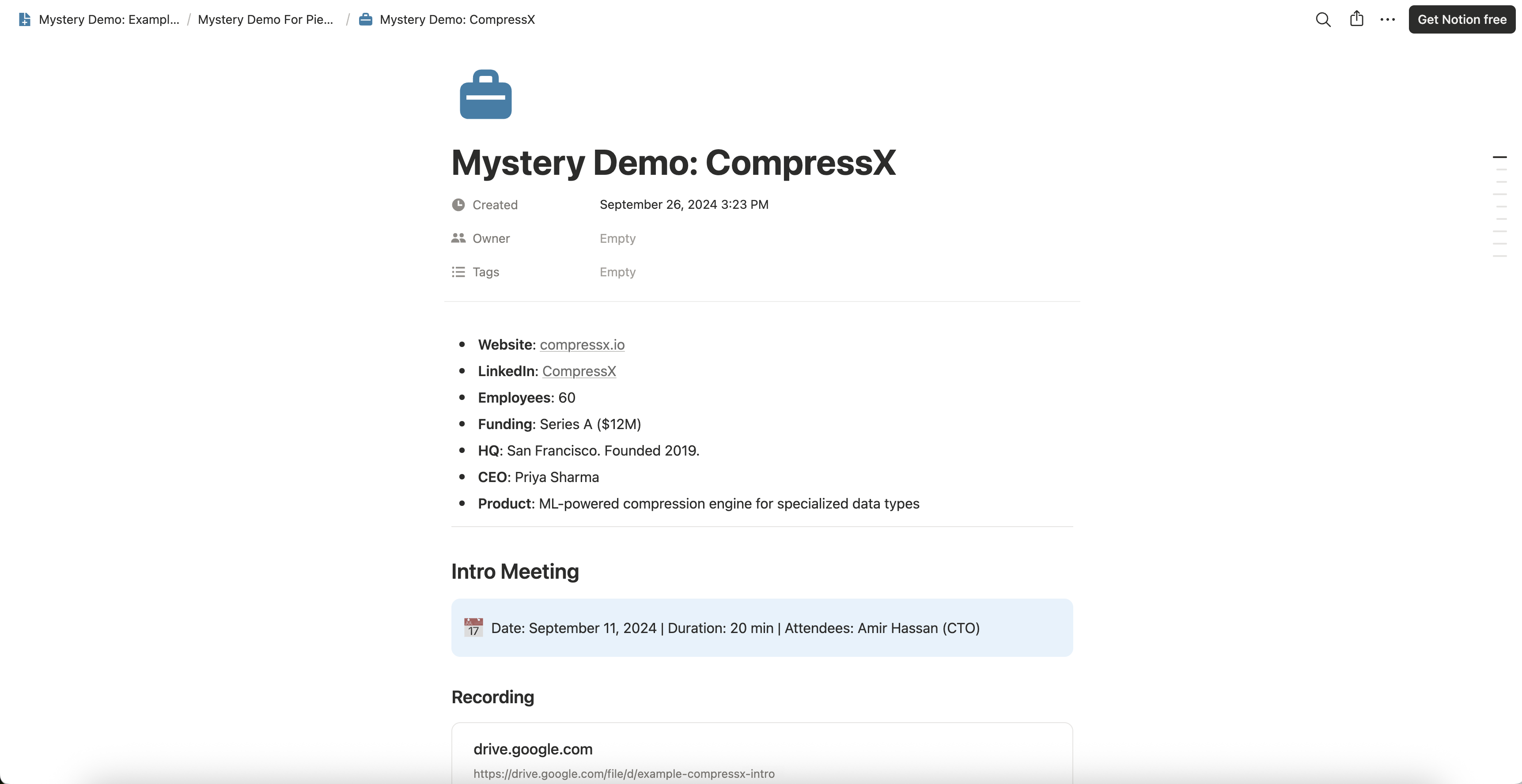
That page is where a clip gets its date. Every meeting carries the day it happened, how long it ran, and who joined from the rival’s side. For the contrast with your rep’s clip to mean anything, four things have to match:
A review site, a competitive intelligence tool, or an analyst note can tell you plenty about a rival, but on how a rival opens its demos, they stop at the rival’s own description. Two coaching notes about the same opening show the difference, both invented: one written from Rival A’s website, and one from its recorded call.
| Invented example | From Rival A’s website | From Rival A’s recorded call |
|---|---|---|
| What the rival does | “A demo tailored to your goals,” on its demo page | Says the buyer’s goal back in one sentence at minute one, then asks what a good call would look like |
| What your rep should copy | Ask about the buyer’s goals | Get the buyer’s goal and say it back before the first screen |
| What came before it | Not on the page | The booking form asked what the buyer wanted to fix |
| What you can check next week | Whether goals came up at all | Goal said back before any screen, on the rep’s next five calls |
Only the recording lets your rep hear the rival handle the step with a buyer in the room. Getting a usable recording takes a skill of its own: the operators who take the calls have sold B2B software, so they know which question pulls a rep off the script and into the real conversation. Every finding comes back with a timestamp, so nobody on your team has to trust a summary.
The fee is a flat €499 per competitor, everything included, and one competitor’s board is ready in one to two weeks. Which rival does your team meet at the step it loses most often? Put that question to us on a short intro call, and we will plan a buyer around those deals, take the rival’s calls, and bring that step back with its date.
The project hands you a board, and the minute you need is on it.
Find the Minute on the Board
Every recording and cleaned transcript also sits in one place, the Database, along with the sales material collected. This one is from the same invented example board.
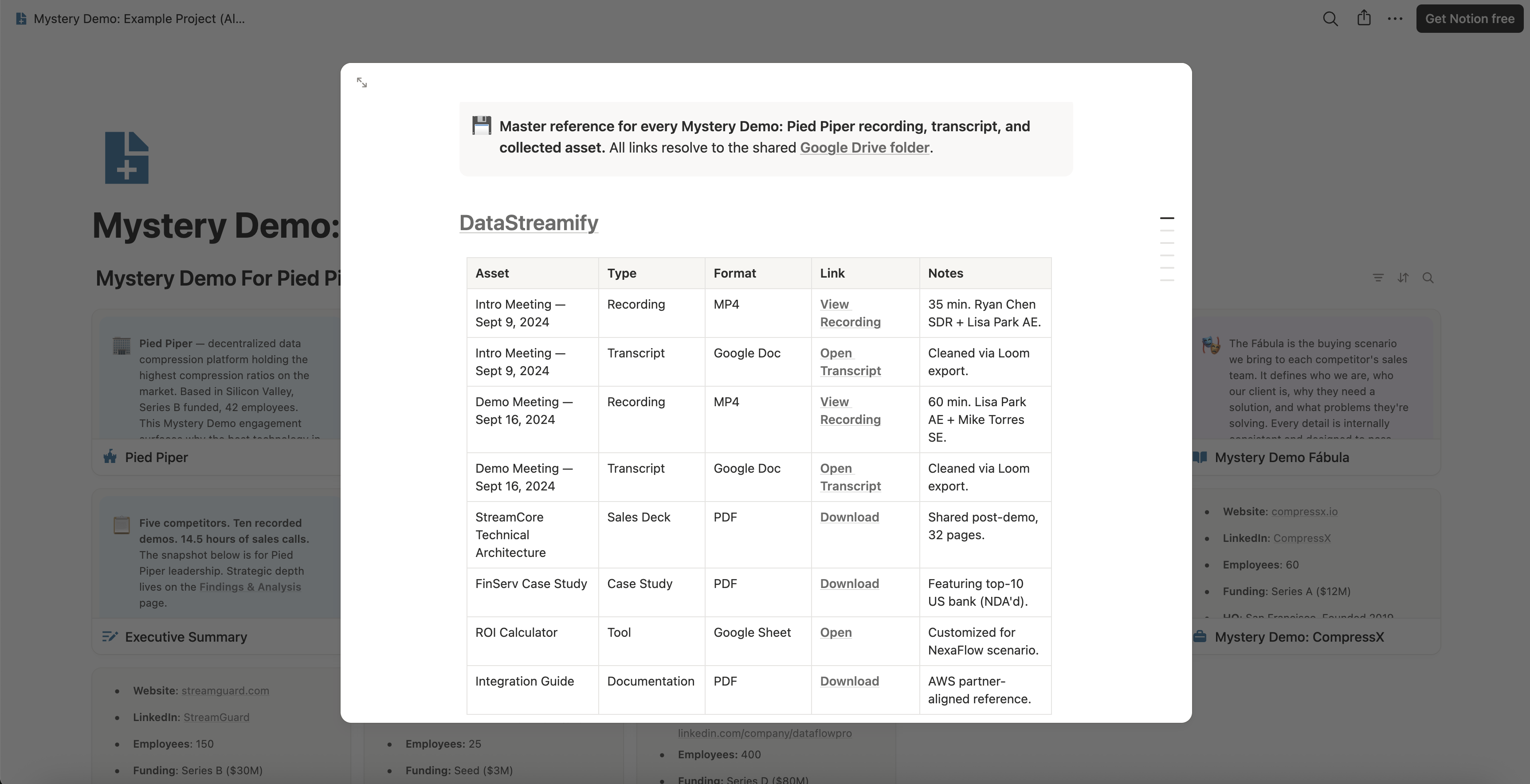
Each rival has its own table, with the intro call and the demo listed by date, the people who joined, and a cleaned transcript beside each recording. Search the transcript for the step you coach, and write down the call and the minute. The same table also answers part of the situation question: whether an intro call came before the demo.
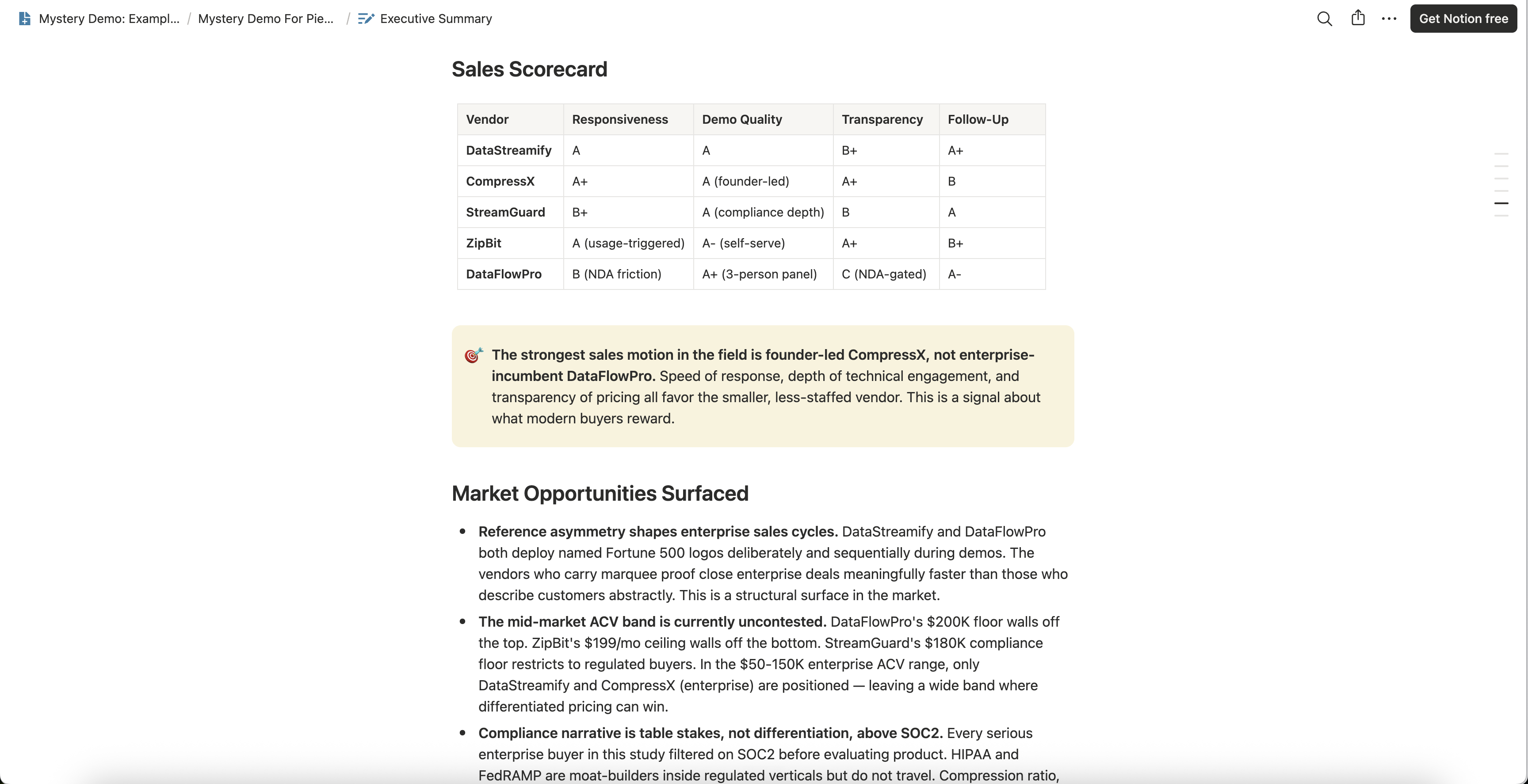
If the project covered more than one rival, start with the Executive Summary, the board’s page of verdicts for leadership. Its sales scorecard grades each rival’s motion on responsiveness, demo quality, transparency, and follow-up, so it tells you which rival’s calls to open first. It never grades your rep.


Each part of the board answers a different question on the way to the sheet:
With both clips found, the session itself takes twenty minutes.
Run the Session in Twenty Minutes
Do the finding before the session: both clips cued, and both transcripts of the step printed with the company names taken out. The twenty minutes are for six steps, and each fills a part of the session sheet: about five minutes for the first two, three for the next two, and twelve for the last two. The first two compare the clips:
The next two decide whether the move belongs in a drill at all:
If both are true, your rep can make the move. Treat the gap on the live call as habit, which a drill can fix, and let the next calls show whether that was right. If your rep hedges, ask why before you drill.
The last two are the practice and the line that measures it:
Here is a filled sheet for an invented session, with an invented rep, an invented Rival A, and every line, minute, and score made up to show the shape.
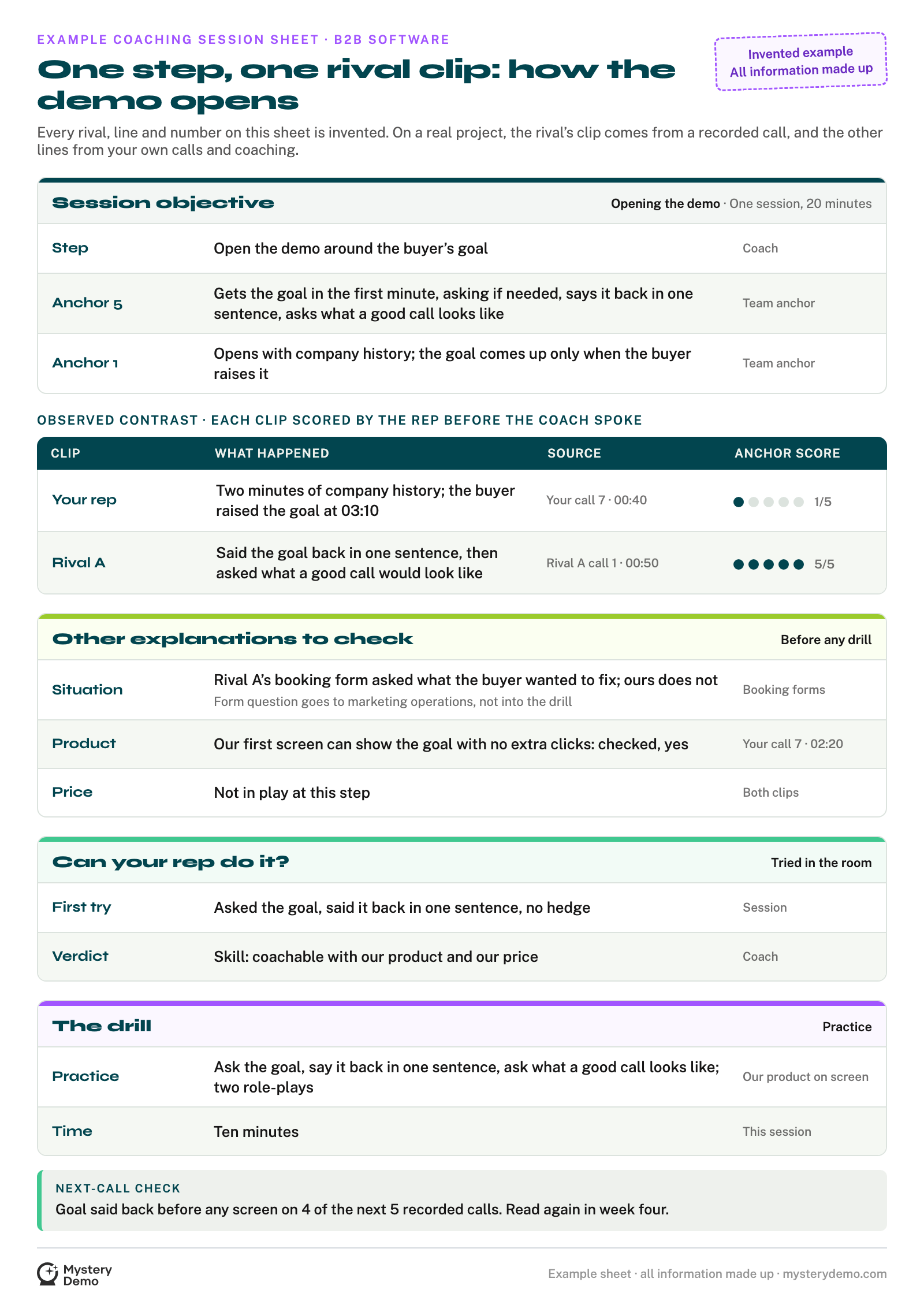
Three lines on it carry the session. The observed contrast sets your rep’s 1 beside the rival’s 5, and the situation line sends the booking-form question to marketing operations instead of into the drill. The next-call check at the bottom covers your rep’s next five calls: check each call as it comes in, and count the results in week four.
The weakest line on that sheet is the rival’s clip, because it is one rep on one day.
Treat the Clip as One Rep on One Day
A recorded demo shows what one rival rep said to one buyer scenario on one day. It is not how that rival always sells. A move becomes a claim about the rival only when comparable calls repeat it, which is the honest reason to take more than one call per rival.
Hold the clip to four rules:
A fair comparison of your team against the rivals needs both to face the same buyer in the same few weeks. That is a different project: mystery shopping your own sales team in the same sprint as the rivals.
One session becomes a change only through repetition on your side, on the same step.
Coach the Same Step for Four Weeks
One sales leader drops a problem with a specific competitor into the weekly tape review, then keeps the next four tape reviews on that one focus. It is one leader’s practice, and four is that leader’s number, but the shape fits this session well:
Keep the measuring as steady as the coaching: the same anchor and the same next-call observation every week, so week four compares like with like.
Refresh the rival’s clip when the rival changes how it sells: a new pitch, a new demo flow, a new step before price. An old clip teaches your rep to beat a call nobody makes any more.
If you want the rival’s version of the step ready for week one, book a short intro call and name the step and the rival. We will take that rival’s calls as your buyer and bring back the minute, with its date and every earlier touch the buyer had with that rep.


