
Run a mystery shopping project on your competitors and you find out how each of them sells: how fast its reps reply, what they ask first, what they quote and what they say about you. The one sales team missing from that picture is your own, and it is the only one you can change.
So yes, run mystery shopping on your own sales team as well, in the same project and the same weeks as your competitors, without telling the team. The comparison is only fair if your reps never know the buyer is coming, and only useful if nobody is blamed for what it shows.
Mystery Demo is mystery shopping for B2B SaaS. Its team of SaaS professionals books your competitors’ sales demos as a credible buyer, asks the questions that get real answers, and turns every call into expert analysis on one board, for a flat €499 per competitor. When a head of sales or a CEO commissions a project, we suggest adding their own sales team to the list.
A Board of Rivals Shows How They Sell, Not Where Your Team Stands
A mystery demo project teaches us a whole category in a few weeks. A rival’s website shows what it wants every buyer to believe, and its sales calls show what it quotes, what it can demo, and what its reps say about you.
We bring every rival the same kind of buyer with the same list of questions, from the first reply through discovery, the demo, the price conversation and the follow-up. Then each rival is graded on the same criteria.
That board tells you how each rival sells to a buyer like yours. It cannot tell you where your own team stands, because your team never met that buyer.
Add your own team, and most of the questions a head of sales brings to the project get a different answer:
| What you want to know | Your rivals on the board | Your rivals and your own team |
|---|---|---|
| Who replies to a new lead fastest | The fastest rival | Whether your team beats it |
| What good discovery sounds like in your market | Each rival’s questions, recorded | Your reps’ questions to the same kind of buyer, next to theirs |
| Who is straight about price | The rivals, ranked | Your team, ranked among them |
| Where to change your playbook first | A guess drawn from the rivals | The step where your team falls behind |
The obvious shortcut is to set your own call recordings beside the board. It does not work, and the reason is the buyer.
The Calls You Already Record Cannot Make This Comparison
If your team records its calls, you already hold hours of your reps selling. Set them beside the rivals’ calls, though, and almost nothing about the two matches:
Compare those and you are comparing two different buyers, not two sales teams. A fair test needs one kind of buyer and one set of questions, put to your team and to each rival in the same few weeks. Adding your own team to a mystery demo project gives you exactly that.
The test stays fair only while your reps have no idea the buyer is coming.
Nobody on Your Sales Team Can Know, From the First Day
A test your reps know about measures something different from the one your rivals took.
.png)

So keep the test of your own team unannounced from the very start. This is hardest when the sales team itself asked for the project, because a head of sales who wants competitive intel often brings the managers into the kickoff. Once the managers know, the reps tend to find out.
The fix is to keep it with the person who signs, usually the head of sales or the CEO:
Could a friend at another company request your demo instead? Your reps may know the name, and the friend’s company may look nothing like your ideal customer. Even if neither is true, the friend is not the buyer your rivals met.
The buyer has to come from outside, and it has to fit your market as closely as it fits theirs.
How the Sprint Runs With Your Team on the List
A project with your own team in it runs like every mystery demo project, with one more company on the list:
We run the calls as a sprint. The meetings with your competitors and with your own team usually all happen within a week or two, so every team meets the buyer before anyone’s pitch or pricing has time to move. The price covers everything: the buying scenario, every meeting, the recordings and transcripts, the analysis and the board.
The people asking the questions have sold B2B software themselves. They know which question gets past a rehearsed answer, on your team as much as on a rival’s.
Below is the fábula page of our public example board. The company and every rival on it are invented, and a real project’s board is built from that project’s own calls.
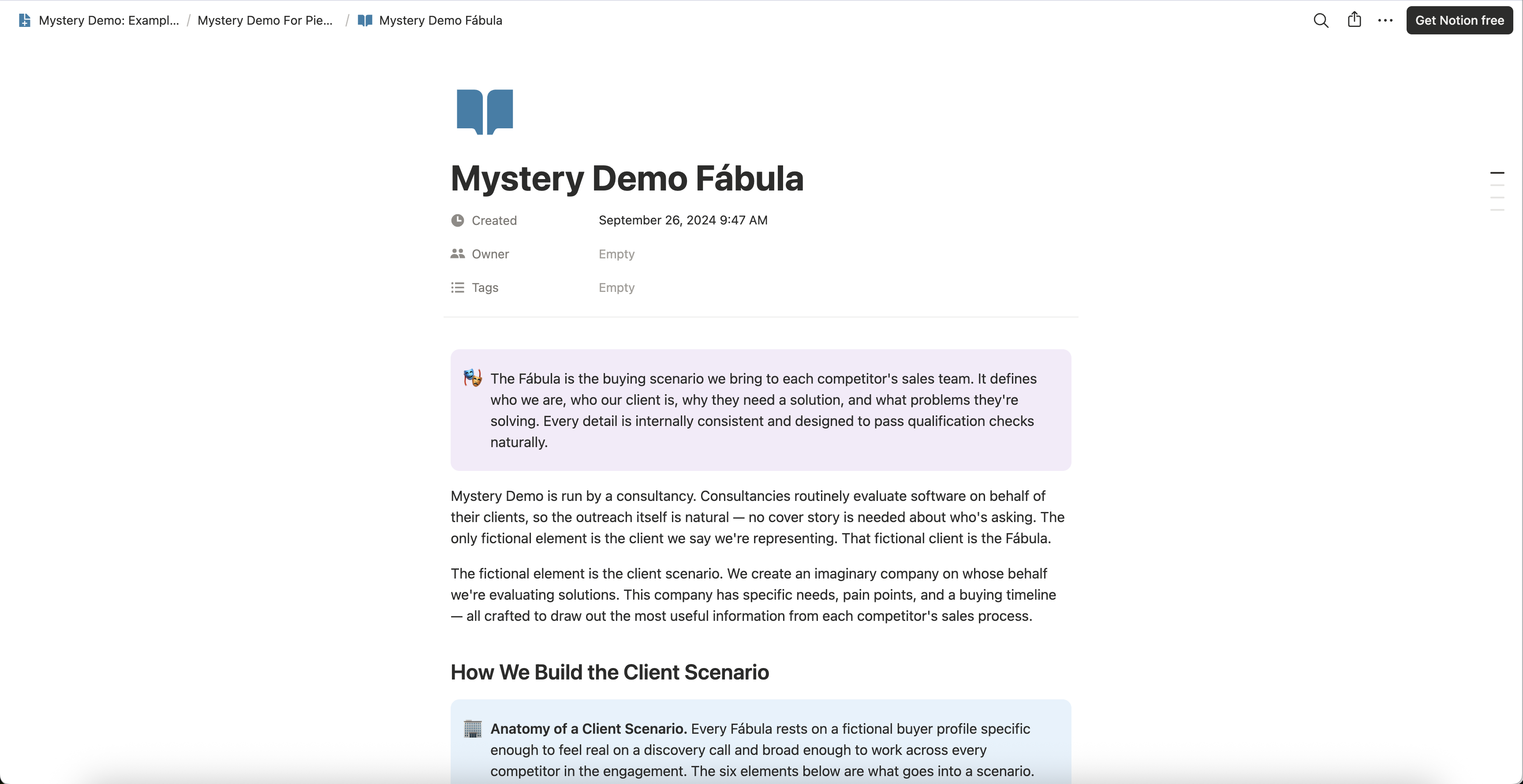
The page holds the buyer’s story: who it is, what it needs, and why it is looking now. The need and the questions stay fixed while the details change, which is what makes your team’s calls comparable to theirs.
What the Board Shows Once Your Team Is on It
Your team’s calls are recorded, transcribed and analyzed exactly like every rival’s, so the comparison lives in one place.
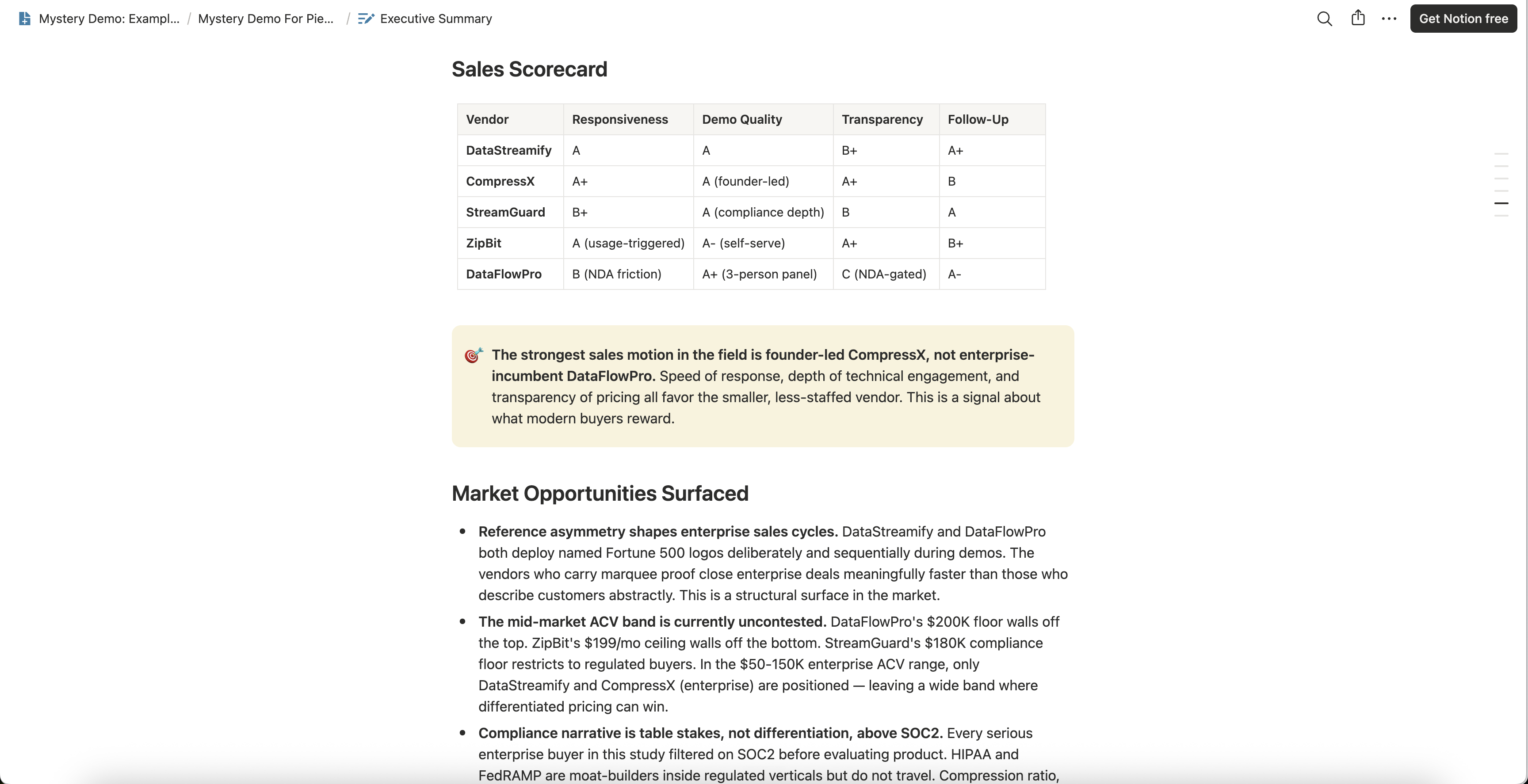
For a head of sales, the page to open first is the sales scorecard from our competitor sales tactics research. It grades every sales team on the same four things:
Below is the scorecard from the invented example board, where every name and grade is made up. On a real project your own team is graded on the same criteria, from its own calls, so the step where it falls behind is visible at a glance.
The demo itself is part of the sale. Our SaaS competitor product comparison marks each rival’s features as shipped, partial or stub, judged by what its rep showed working. Put your own demo next to theirs and you also learn whether your reps show your strongest features live, or leave them on a slide while a rival demos a weaker version of the same thing.
Every grade points back to a recording, so nobody has to take our word for it. Your enablement lead can play the exact minute where a rival’s rep handled the budget question, then the minute where yours did.
If you already know which rivals you want shopped, tell us their names on an intro call, and we will put your own sales team on the same list, in the same sprint.
Use What the Calls Show to Fix the Process, Not to Punish Anyone
Somewhere on the board, your team will probably lose a step to a rival. The fair worry is that testing your own people without telling them, and then showing them that, breaks their trust.
It can. If the first thing a rep hears about the project is a reprimand over a recording, the whole team learns to fear the next unfamiliar lead, and the project has made your sales team worse.
So settle the purpose before the kickoff. This is not a search for someone to fire, or to punish for not being good enough.
The project is a way to improve your sales process, and what the calls show is mostly about the process anyway. Here are three illustrations of the kind of finding we mean:
Each of those is a process problem first: a line in a playbook or a step nobody owns. Each can be changed.
In retail, mystery shopping your own business is the ordinary arrangement. The business being shopped is usually the one paying for it: shoppers pose as its customers and report on its own service, so it can change how it works. Retail and B2B mystery shopping differ in almost everything else, but that purpose carries over.
When the board arrives, share it with the team like this:
Put Your Own Team on the List Before the Kickoff
A board of rivals tells you how your market sells. A board with your own team on it tells you what to change in your sales process next week, and that is the reason to add it.
Three things are worth settling before the kickoff:
Bring that list to an intro call, and we will shop your rivals and your own sales team in the same sprint, then show you, call by call, where your reps win and where they lose.
.png)


