
Search for corporate mystery shopping and most of the first page is firms that send shoppers into stores, restaurants, and bank branches. That is a real trade. It is not the one a software company needs when it wants to hear what a rival tells buyers.
Retail mystery shopping sends a paid shopper into a client’s own store to check it against a list. B2B mystery shopping, in software, means sitting a competitor’s sales demo as a real buyer and bringing back what was said, shown, and priced. The two share a name and very little else.
Mystery Demo runs the second kind, and only for software companies. We book your competitors’ demos, sit every call as the buyer, record everything, and hand you a Notion board with the recordings and our analysis.
The difference shows the moment you try to hire for it. A retail firm can send a shopper into a competitor’s store. Your competitor sells software, so it has a demo form instead.
Retail Mystery Shopping Checks Your Own Stores Against a List
In retail, the business being shopped is usually the client. A chain wants to know whether its own stores, restaurants, or branches serve people well, keep the shelves stocked, and stay clean, so it hires a firm to send shoppers in as ordinary customers.
The visit is short and tightly specified. The job has four parts, by the providers’ own shopper pages and a 2016 profile from the US Bureau of Labor Statistics:
The people doing it are independent contractors who accept assignments one at a time, often for several firms at once. At Secret Shopper, a basic shop pays the shopper $15, and more involved shops pay more. A store needs nothing more, because the person in the aisle only has to be a customer.
Retail firms shop competitors too. Second To None sells competitor shops at the store, on the website, and through the contact center. 360 Relay offers them only as part of a program that also shops the client’s own locations, at about the same price as the client’s other shops.
Every one of those doors is open to the public. Anyone can walk into a store, browse a website, or call a support line, and nobody asks who you are first. A software sales process asks that before anything else.
A Software Competitor Sells Behind a Gate
In B2B software, the part of a competitor worth seeing sits behind the “Request a demo” button. Before a rep shows you anything, they find out who you are: the company, its size, the tools it uses now, the budget, and how soon it has to decide. The answers decide what you are shown.
The demo is rarely one call. A full evaluation runs through discovery, the demo, a technical deep dive, a pricing conversation, and the follow-up emails. Every one of those steps checks the buyer again.
A buyer who fails the check gets the short version: a generic tour, a link to the pricing page, a promise to follow up. Nobody throws you out, which is worse, because you leave thinking you saw the real demo.
So the shopper has to be a buyer the rep believes, with a reason to look, a budget, a stack, and a deadline. Mystery Demo builds that buyer before it books a single call, and calls it the fábula.
Nearly all of the fábula is true. We really do evaluate software for companies, so every demo we request is a genuine evaluation. The only invented part is which company it is for, and nobody real is impersonated.
Put a retail shop and a mystery demo next to each other, and that gate explains almost every difference between them.
Where the Two Trades Differ, Row by Row
| A retail mystery shop | A mystery demo in software | |
|---|---|---|
| What gets shopped | Usually the client’s own store, branch, or restaurant | A competitor’s sales process, from the demo request to the last follow-up email |
| The door | Open to anyone who walks in, browses, or calls | A demo form, then a rep who qualifies the buyer |
| Who shops | An independent contractor; no experience required | An operator who has sold B2B software |
| What the shopper has to be | A believable customer | A believable company, with a budget, a current stack, and a deadline |
| How long it takes | One visit, usually 15 minutes to an hour | Discovery, demo, deep dive, pricing, and follow-up; one competitor’s board in one to two weeks |
| What gets kept | An evaluation form, the receipt, sometimes photos | Every call recorded and transcribed, every email and file |
| What comes back | A report on each visit, scored against the client’s own standards | A board of what each competitor said, showed, and quoted |
| How it is bought | Per visit, and the shopper is paid per visit | Per competitor, for the whole sales cycle: a flat €499 |
The last row decides who can do this work. A retail network is a machine for buying visits: many short, specified trips by people who only need to be customers, each one paid and filed on its own.
A software sales cycle cannot be bought one visit at a time. The person on the discovery call has to be the person on the pricing call, the story has to hold for the whole evaluation, and the questions have to come from someone who knows what the product should do.
None of that is a criticism of retail firms. A shopper paid per visit, with no experience asked for, is right for checking a store and wrong for a demo where the rep asks which tools your team uses before showing a single screen.
Getting through that gate takes a different kind of project, and it starts before any call is booked.
How a Mystery Demo Gets Through the Gate
A retail shop starts from a checklist the client already owns. A mystery demo starts from a question the client cannot answer, such as why deals keep going to one rival. Kickoff turns that question into the exact questions every competitor will be asked.
The screenshots here come from our public example board, where the company, its competitors, and every number are invented. Your board would be built from your own competitors’ calls.
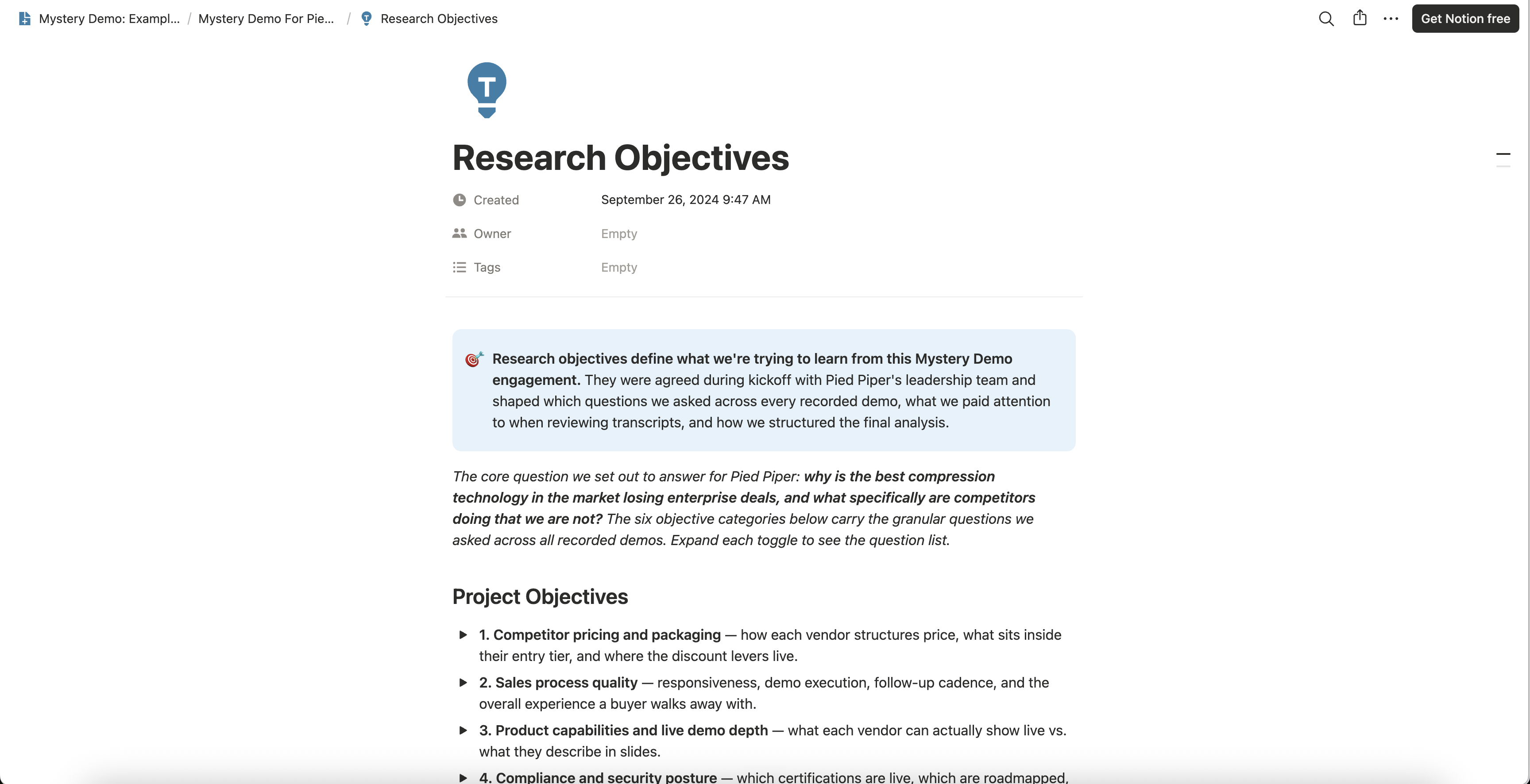
Kickoff also settles who gets shopped. In retail that is your own locations. Here it is the competitors your buyers compare you with, typically three to nine, each with a written reason for being on the list.
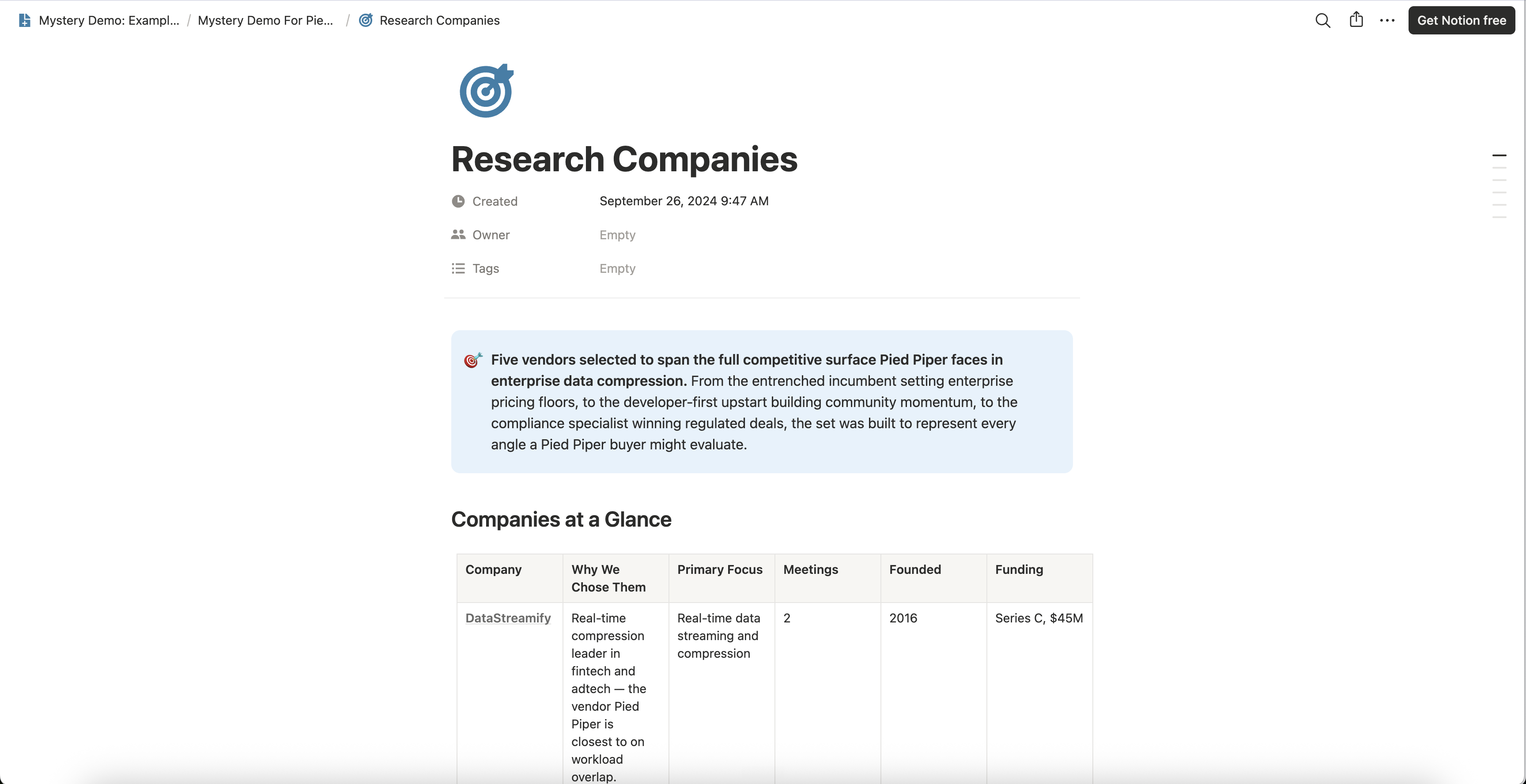
You also show us your own product at kickoff. We need to know what good looks like, or we cannot ask the comparison question that pulls a rep off the script. Then the calls start:
Every call is recorded and transcribed, and every email and file a competitor sends is kept. Then every claim a rep made is checked against the competitor’s website and public news, and the analysis is written.
Every stage of a mystery demo project, from kickoff to handoff, leaves its own page on the board. The board is what you keep.
What Comes Back Is a Board Built From the Calls
A retail report tells you how your own location did against your own standards. A mystery demo tells you what a competitor says to a buyer like yours. The board keeps every finding next to the recording it came from.
A competitor’s website, its review profiles, and an analyst’s note all describe the product the way the competitor wants buyers to see it. On the demo, the competitor has to show the product working, name a price, and answer the question about what it cannot do.
For a product team, the page that matters most is each competitor’s own section of the findings. It sets what the company claims about itself beside what the calls showed.
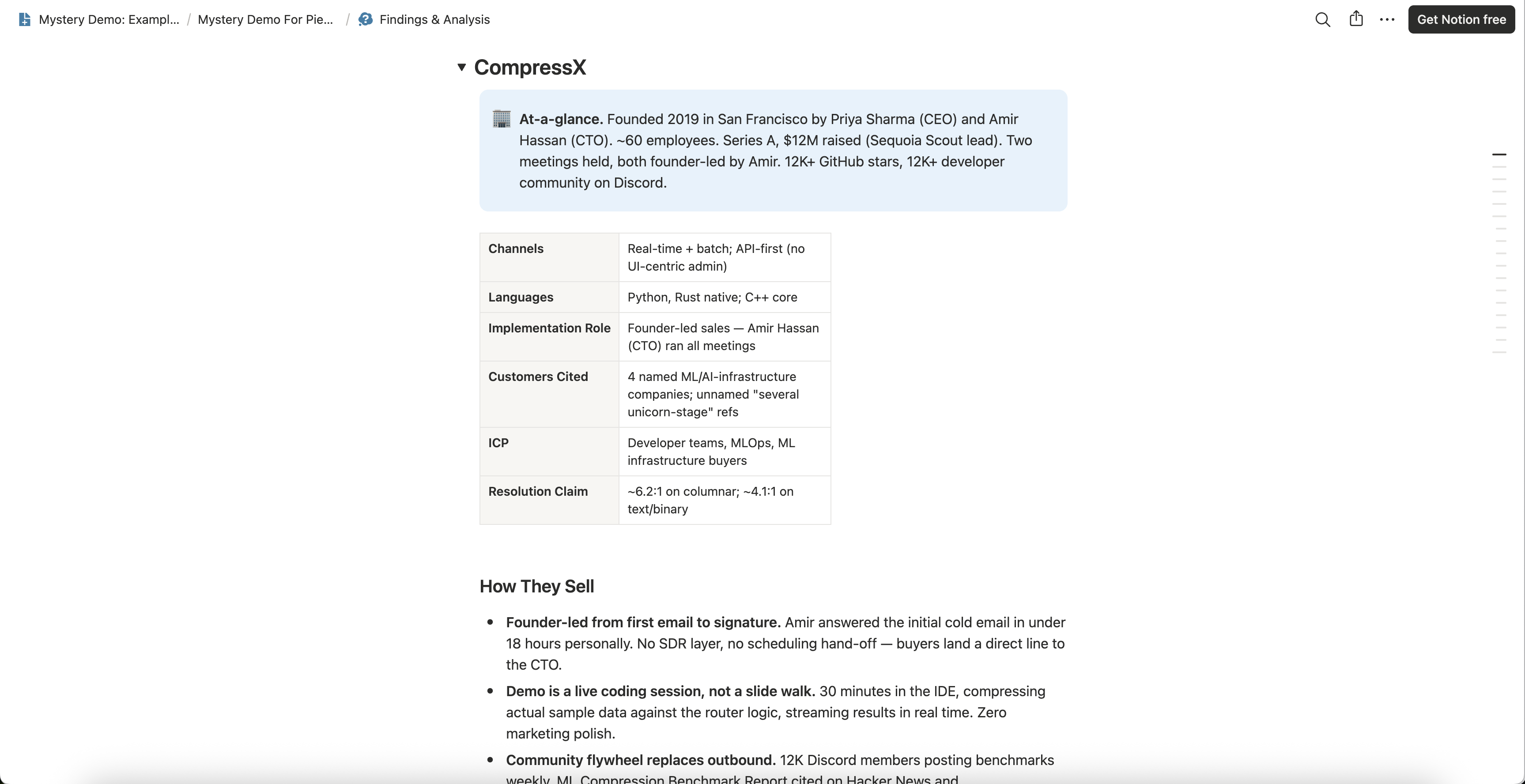
Across your competitors, the same layer becomes a product comparison built from the demos. Each capability is marked shipped, partial, or stub, and a stub is there in name but not yet working. A feature grid on a review site gives all three the same checkmark.
Behind every competitor’s section, the board holds the evidence it was written from:
All of it is only as good as the person who sat the calls.
Who Sits on the Call Decides What You Learn
The demos are sat by operators who have sold B2B software themselves. They hear which answer came off a slide, and they ask the plain question an experienced buyer asks: can you show me that with my own data in it?
The same person runs every call with a competitor, so the buyer on the pricing call is the buyer from discovery. We have sat hundreds of live competitor demos across SaaS, and only ever for software companies.
.png)

If there is a rival whose demo nobody on your team has ever seen, that is the call to take first. Tell us who it is on a short intro call, and we will tell you what we would ask their rep.
Three Questions to Ask Anyone Who Offers to Shop Your Competitors
If you are comparing providers, ask each of them three questions. The answers separate the store trade from the software one, and ours sit beside each:
One competitor’s board is ready in one to two weeks. A landscape of six to fifteen competitors takes four to eight weeks, because the demos run in parallel.
If you want to know how your own stores treat customers, a retail firm is the right hire. If you want to know what a competitor tells your buyers, someone has to get through its sales process as a buyer. Send us the rivals you keep meeting in deals, and we will go and be that buyer.
.png)


