
Winning the demo does not close a software deal. It starts the buyer’s procurement process, run by people who never saw your demo, and the bigger the contract, the longer it runs.
Software purchases of $100,000 or more spent 93 days in procurement in the second quarter of 2026, up from 83.5 days in the first, in data from the procurement platform Vertice.1 The figures that follow show where those days go, from the first approval to the invoice.
Mystery Demo books competitors’ sales demos, joins them as the buyer, and brings back the recordings and a board of what each rival quoted. When that buyer says procurement will review the deal, the rep’s next offer is on the recording. Every figure on this page comes from public research, linked to where it was first published.
Key Takeaways
Contract Value Decides How Long Procurement Takes
The clock gets longer at every price point. Purchases under $10,000 took 54 days in procurement in the second quarter of 2026, up from 49.5 days in the first, across the purchases run through Vertice.1
Purchases between $10,000 and $50,000 took 73 days in Vertice’s Q2 2026 data, up from 68.3.1 Purchases between $50,000 and $100,000 took 81 days in the same quarter, up from 76.3.1
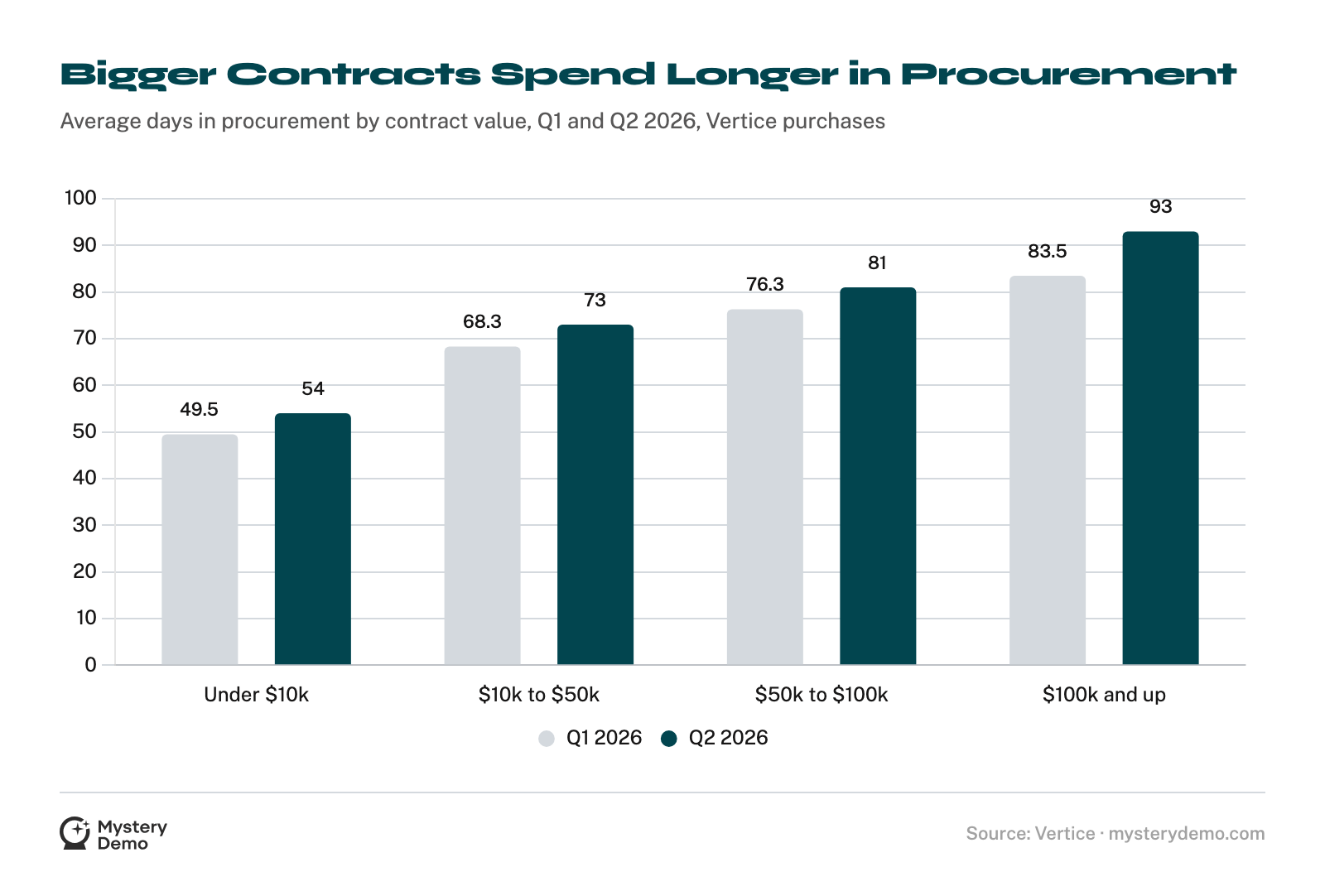
The first step up is the steepest. Under $10,000, a purchase is typically handled inside one department, Vertice reports.1 Crossing $10,000 almost always brings in Finance and IT Security, Vertice adds.1
Six figures add another layer. A $100,000 deal took 12 days longer than a $50,000 one in Q2 2026, up from an 8-day gap the quarter before, in Vertice’s data.1 Deals over $100,000 typically need final sign-off from the CFO or CEO.1
Vertice puts the full gap between a small purchase and a six-figure contract at 39 days, so high-value contracts take 72% longer.1 Every bracket got slower in Q2 2026, and contracts over $100,000 slowed the most, adding 9.5 days in one quarter.1
The typical SaaS deal sits in the second band. The median private B2B SaaS contract was worth $24,266 a year in SaaS Capital’s 2026 survey of more than 1,000 companies, down from $26,265.2 In Vertice’s data, purchases in that band took 73 days.1
Renewals take longer than new purchases. In June 2026, new software took 36 days to buy and renewals took 87, the slowest renewal month Vertice had tracked.3 Across all sizes, the average time from request to signed contract was 72 days in Q1 2026.3
Contract value adds days because it adds approvers. Each approver is a stage, and each stage keeps its own time.
Every Approver Is a Stage, and Legal Has the Longest Tail
Vertice timed each stage of the purchases run through its platform in Q1 2026, across more than $30 billion of spend. Customer negotiation was the longest stage, at 11.8 days on average.4 Intake, where a request is written up and routed, took 10.3 days.4
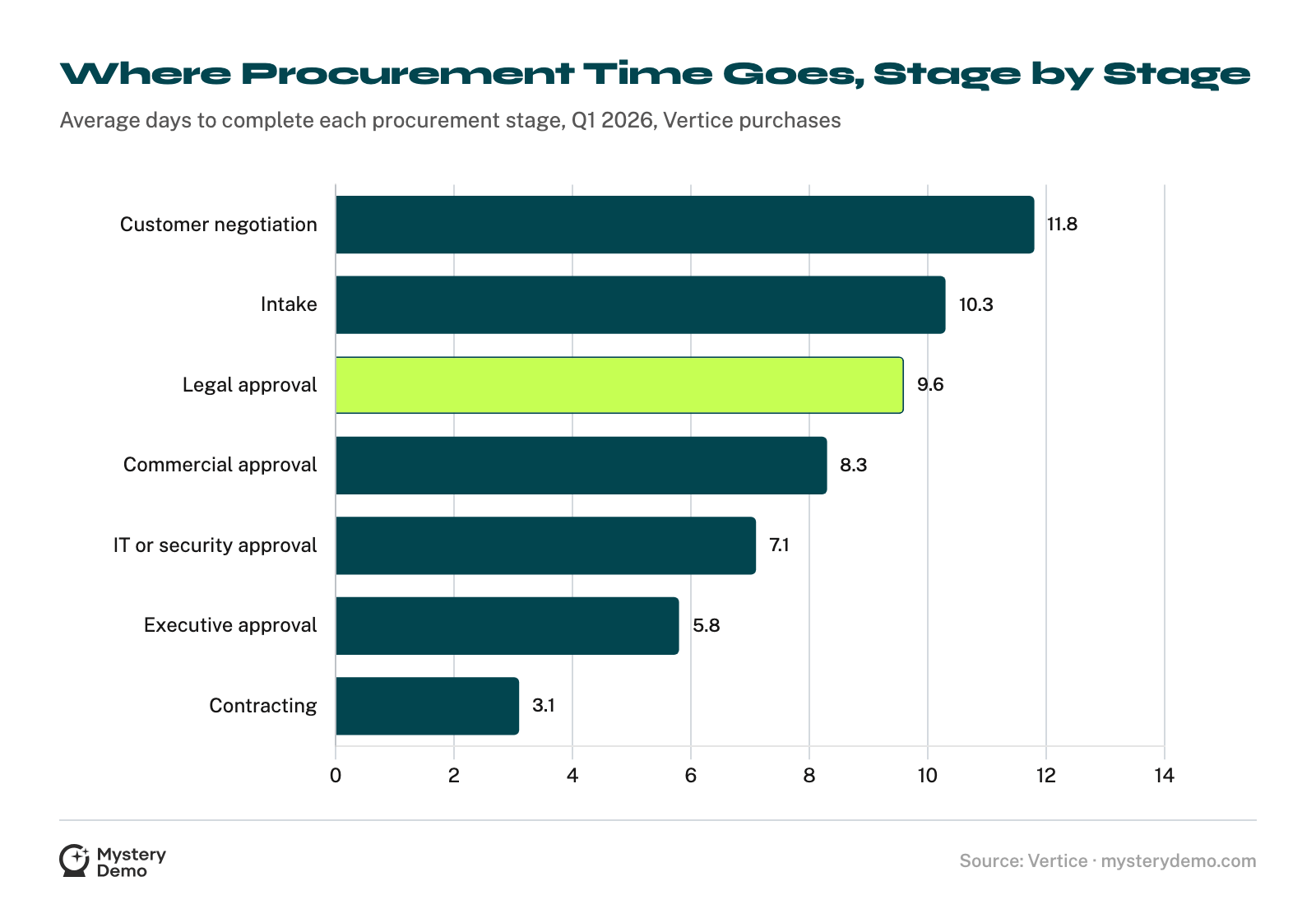
Below those two sat the approvals. Legal approval averaged 9.6 days, commercial approval 8.3 and IT or security approval 7.1, in the same data.4 Executive approval took 5.8 days, and contracting 3.1, the shortest stage.4
Averages hide the slow cases, and legal has the longest tail. Only 42% of legal tasks were done in under a day, the lowest share of any stage, and at the 80th percentile legal took 14 days.4
What is being bought matters too. HR software was the slowest category to approve, at 12.3 days, and data software the fastest, at 3.7, in Vertice’s Q2 2026 data.5 Finance software approval rose 36% in one quarter, from 8.1 to 11 days.5
Who sits at those stages was changing as well, starting with finance.
Finance Joined More Software Deals in 2026, and Reversed Some of Them
46% of buyers said finance took part in their software purchase decisions in G2’s June 2026 survey of 1,038 B2B decision-makers, up from 31% a year earlier.6 The share naming information security fell from 32% to 25%.6
Finance did not only join. 49% of buyers said their CFO had reversed an approved software purchase in the previous 12 months, according to G2.6 Among organizations with a budget for AI tokens, 54% had seen it happen, against 29% of those without one.6
Finance is one seat on a crowded buying committee. In BetterCloud’s February 2025 survey of 568 US IT professionals, 63% said SaaS buying and renewing is a group effort across IT, business users, finance, operations or procurement.7 Only 30% called their SaaS purchasing and renewal process effective.7
Few of those committees have tools that show them the spend. 35% monitored SaaS usage in a SaaS management platform, and 12% in a SaaS spend management tool, BetterCloud found.7 Only 6% had an IT-approved catalog of SaaS apps, and 28% were building one.7
Finance is the seat that grew. The seat buyers say the deal waits on longest is security.
Security Review Waits on the Vendor’s Own Answers
IT security review was the biggest delay between choosing a vendor and completing the purchase, named by 39% of buyers in G2’s 2026 survey.6 Budget approval came next, at 32%.6 Among enterprise buyers, half named IT security review as their top delay after selecting a vendor.6
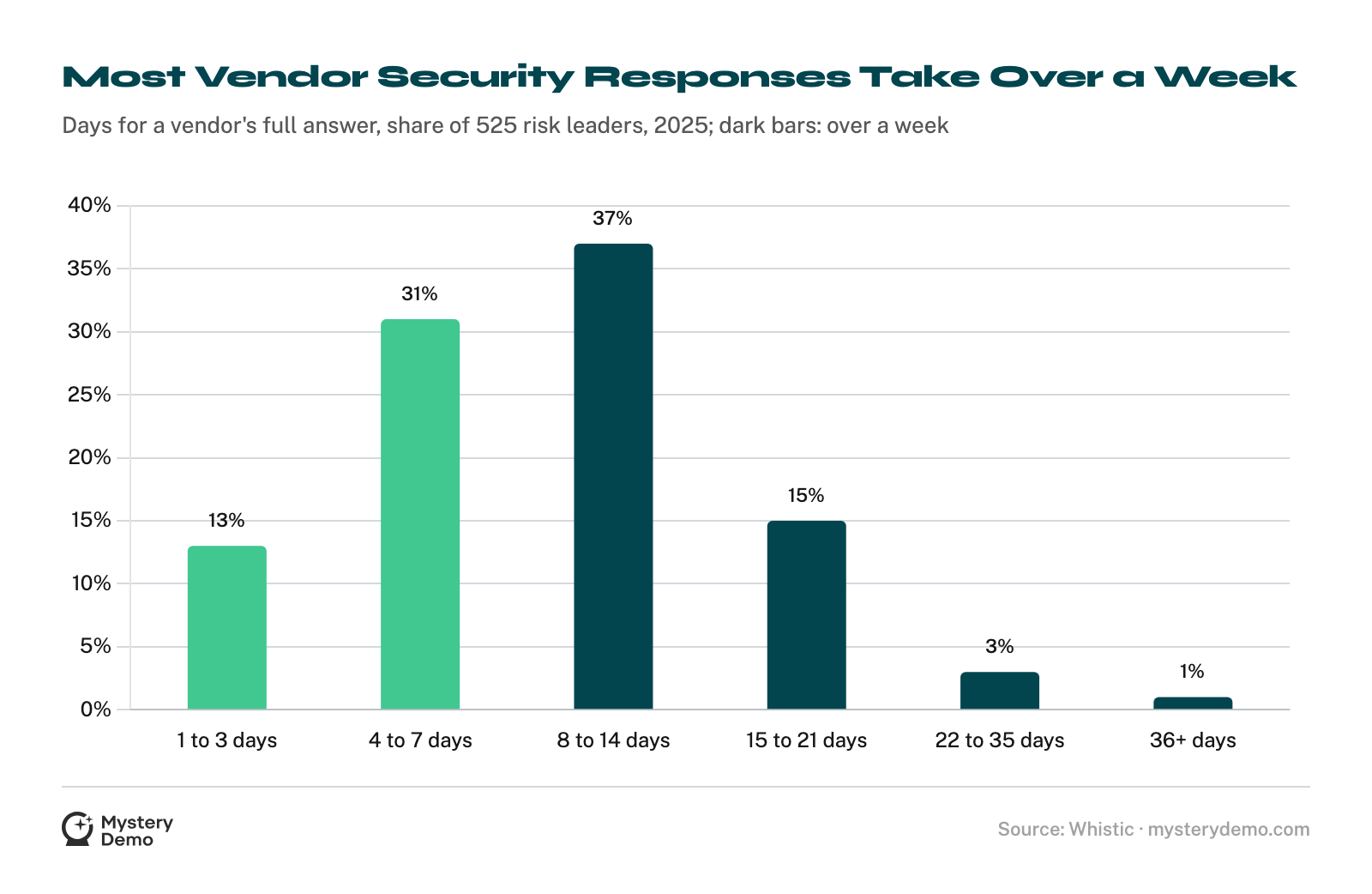
That review waits on the seller’s answers. In Whistic’s 2025 survey of 525 risk and information security leaders, the average vendor took about 12 days to answer an assessment request in full.8 87% of companies waited longer than four days for that answer, an increase Whistic puts at 13% over 2024.8
56% waited more than a week, and the most common wait was eight to fourteen days, in the same survey.8
The first answer is rarely the last one. 84% of initial assessments needed follow-up from the vendor, Whistic found.8 The teams asking spent 37.4 hours a week on vendor assessments on average, up almost 14 hours from the year before.8
Vanta saw the same load in a wider sample. In its July 2025 survey of 2,500 business and IT leaders in the US, UK and Australia, organizations spent 9 working weeks a year on vendor security reviews, up from 7.9
The proof a reviewer asks for is not a given. Among vendors in Vertice’s 2026 dataset, only 61.3% of AI vendors held SOC 2, and security vendors held it at 65.4%.10 Monitoring vendors in the same data were 99.9% certified.10
Gathering that proof now shapes the whole purchase. Evaluation was the longest buying stage for 40% of buyers in G2’s 2026 survey, up from 36%.6 G2 ties the shift to the work of gathering proof and managing security reviews.6
Security’s sign-off opens the next queue. In most companies, Vertice notes, legal will not look at the contract until security gives the green light.3
Legal and the Purchase Order Run on Their Own Clocks
Standard contracts, the NDAs and MSAs a deal runs on, move at very different speeds. In SpotDraft’s 2025 survey of in-house legal leaders, only 9% of legal teams finished a standard contract in one day, and 13% took more than 30 days.11 The largest group, 27%, took four to five days.11
Much of that work still runs through inboxes. 49% of legal teams still managed contracts in email and Word, SpotDraft found.11
Ironclad’s 2025 benchmark of its customers’ contracts shows legal in most deals. 76% of contracts had direct legal involvement, and 60% were on the other party’s paper.12 The average contract took 42 days from creation to signature.12
The purchase order comes last, and it is measured in hours. The median time from purchase request to approved PO was 55 hours in 2025, in Procurify’s benchmark of more than $30 billion of its customers’ spend.13 That was up from 51 hours in 2024 and down from 59 in 2023.14
Some industries take far longer. Technology, media and telecom companies averaged 90 hours from request to PO, the slowest industry in Procurify’s data.13 More spend now runs through a PO at all: purchase orders covered 76.9% of spend in 2025, up from 71.8% in 2023.14
These clocks overlap, and each was measured on a different population, so they do not add up to one total. Side by side, they show where the weeks go.
| Clock | What it measures | Figure | Measured by |
|---|---|---|---|
| Whole procurement cycle, $100,000+ | Request to signed contract | 93 days, Q2 20261 | Vertice, its customers’ purchases |
| Legal approval stage | Legal’s step inside that cycle | 9.6 days on average4 | Vertice, Q1 2026 |
| Vendor security response | Assessment request to the vendor’s full answer | About 12 days8 | Whistic, 525 risk leaders |
| Contract execution | Contract created to signed | 42 days on average12 | Ironclad, its customers’ contracts |
| Request to PO | Purchase request to approved PO | 55 hours, median, 202513 | Procurify, its customers’ spend |
| Payment terms | Invoice to payment due | 50 days15 | Atradius, US electronics and ICT suppliers |
A signed contract and an approved PO still leave one more clock: the days until payment is due.
Payment Terms Add a Wait After the Signature
Atradius publishes no software-only cut, and its closest sector is electronics and ICT. US electronics and ICT suppliers gave customers 50 days from invoice to pay, on average, in Atradius’s 2025 survey.15 Across all the US sectors it surveyed, average payment terms were 45 days.15
Most of that sector sells on credit. 54% of its B2B sales were made on credit, Atradius found.15 44% of those invoices were overdue, and 6% were written off as bad debt.15
Customers stretch the wait on purpose. Nearly half of US businesses were delaying payments to their own suppliers to protect cash, in the same survey.15
Payment terms are one of the things procurement negotiates. The bigger one is the price.
Procurement Expects About a Third Off the List Price
Buyers negotiating through Vertice paid 33.8% below list price on average in 2026, almost unchanged from 34% the period before.16 The size of a SaaS discount depends on what is being bought.
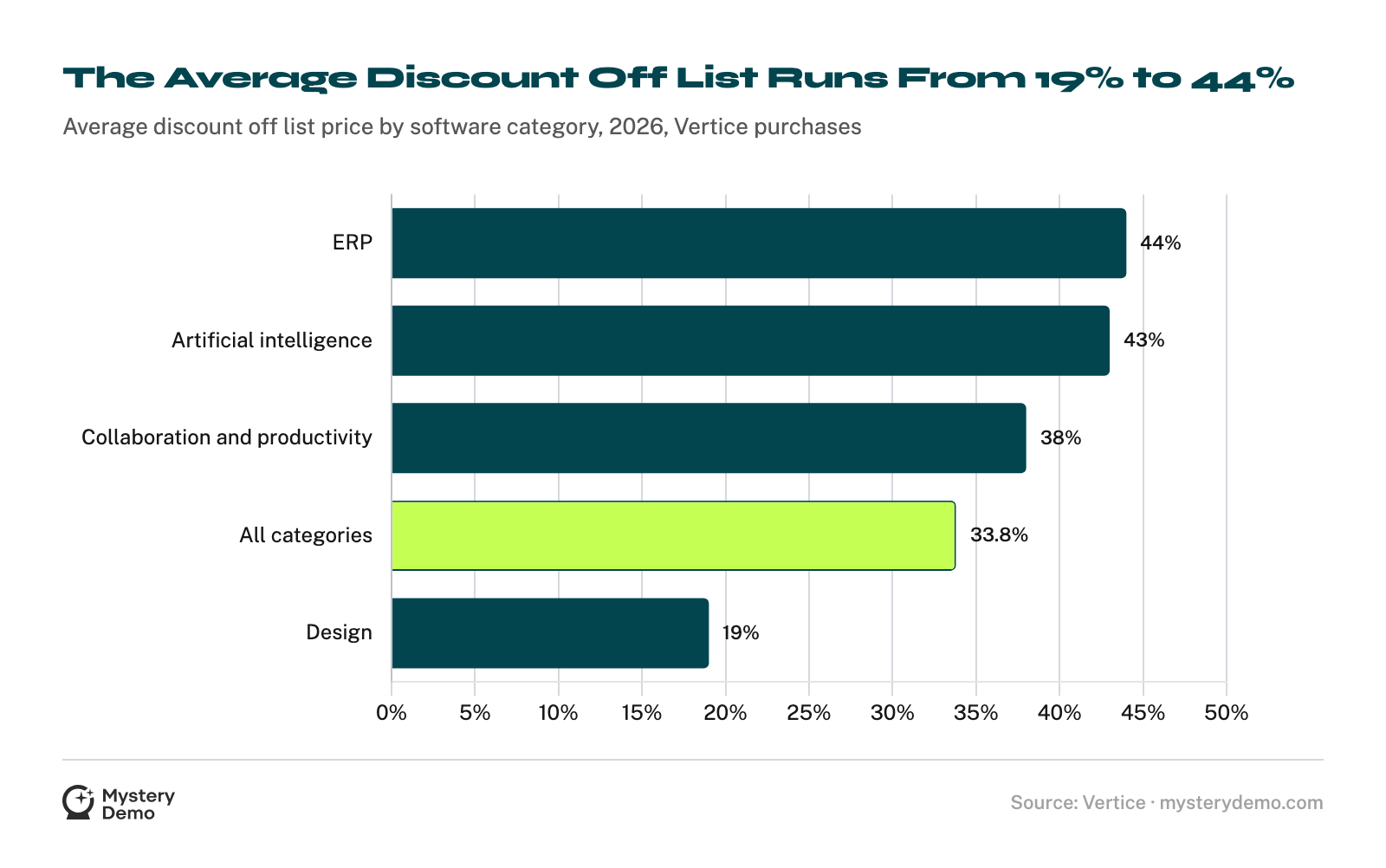
ERP carried the largest average discount, at 44%, with AI software close behind at 43%, in Vertice’s 2026 data.16 Design software carried the smallest, at 19%.16 Collaboration and productivity tools moved the most, from 28% to 38%.16
Two buyers can pay very different prices for comparable software. The worst-negotiated price was 2.14 times the best across Vertice’s Q2 2026 data.17 In ERP the ratio reached 3.04, the widest of any category.17
Timing is one of the levers in a SaaS pricing negotiation. Renewals negotiated 120 days or more before expiry saved 23.3% more than those left to the final month, in Vertice’s 2026 data.18
An auto-renewal clause removes that deadline unless someone is watching the date. The average share of contracts with an auto-renewal clause rose from 60.6% to 72.3% in one quarter of Vertice’s data, and 96.1% of CRM contracts now carry one.19 40% of organizations still tracked renewal dates by hand, BetterCloud found.7
Prices are moving while the clock runs. Vertice’s SaaS inflation rate reached 16.4% in June 2026, the highest monthly figure it had recorded.20
Buyers now negotiate term length as well as price. 70% of buyers said AI’s pace is pushing them to shorter contracts in G2’s 2026 survey, and 29% wanted terms under 12 months.6 49% said a current vendor had offered them a variable-cost option in place of a seat license.6
Every figure on this page describes many companies at once. Your rival is one company.
.png)
What the Averages Cannot Tell You About One Rival
Your buyer’s procurement team will set your price and terms beside your rival’s. The rival’s side of that comparison is said on its sales call: the price it holds, the term it shortens, the security pack it sends before anyone asks. No survey reaches that call.
Mystery Demo puts that call on a board. Below is the pricing dimension from the Findings & Analysis page of our public example board, where the client and every competitor are invented. Each row is one rival, with its pricing model, its floor price and how openly it shared the number.
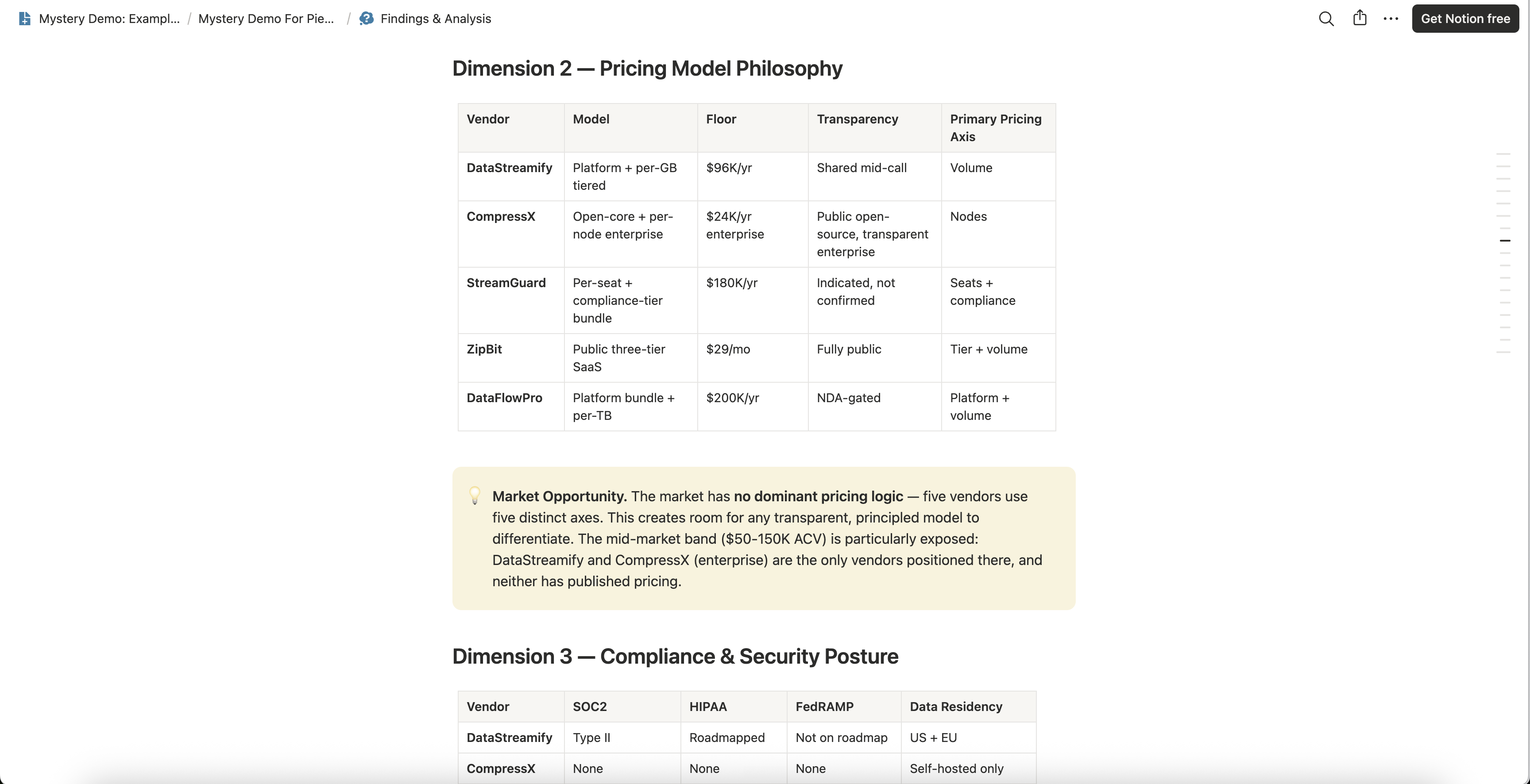
On a real project, each row comes from the calls themselves, and every number carries the timestamp of the moment it was said. That is the job of competitor pricing research: Mystery Demo books the rival’s demo as a buyer, stays through the pricing conversation, and brings back what was quoted and what was conceded. One competitor costs a flat €499 and takes one to two weeks.
Name the rival you keep losing to on terms. We will be the buyer who tells its rep procurement is involved, and bring you the recording of what it offered next.
Frequently Asked Questions
How Long Does SaaS Procurement Take?
93 days for purchases of $100,000 or more in Q2 2026, and 54 days for purchases under $10,000, in Vertice’s data.1 From request to signed contract, the average across all sizes was 72 days in Q1 2026.3
How Long Does a Vendor Security Review Take?
About 12 days for the vendor’s full answer alone, on Whistic’s 2025 average, and 56% of companies waited more than a week.8 84% of first assessments then needed follow-up from the vendor.8
What Slows Down a SaaS Purchase After the Vendor Is Chosen?
IT security review, named by 39% of buyers in G2’s 2026 survey, then budget approval at 32%.6
How Long Does It Take to Get a Purchase Order?
55 hours from request to approved PO, at the median, in Procurify’s 2025 data.13
What Payment Terms Do B2B Software Buyers Get?
50 days from invoice, on average, from US electronics and ICT suppliers in Atradius’s 2025 survey.15 The average across US sectors was 45 days.15
How Much Discount Does Procurement Get on SaaS?
33.8% off list price on average for buyers negotiating through Vertice in 2026, with ERP at 44% and design software at 19%.16
References
- Vertice: Procurement Cycle Time by Contract Value (2026)
- SaaS Capital: What Is the Average Deal Size for Private SaaS Companies? (2026)
- Vertice: Procurement Cycle Time (2026)
- Vertice: Procurement Process Stage Completion Times (2026)
- Vertice: Procurement Approval Times by Function (2026)
- G2: 2026 Buyer Behavior Report
- BetterCloud: State of SaaS 2025
- Whistic: Third-Party Risk Management 2025 Impact Report
- Vanta: The State of Trust Report (2025)
- Vertice: Supplier Compliance Rates (2026)
- SpotDraft: The 2025 Contracting Efficiency Benchmarking Report
- Ironclad: 2025 Contracting Benchmark Report
- Procurify: How to Improve Purchase Order Cycle Time (2026)
- Procurify: 2026 Procurement Benchmarks: Key KPIs for Smarter Spend Control
- Atradius: Payment Practices Barometer: Survey Results for the US 2025
- Vertice: Average Discount From List Price (2026)
- Vertice: SaaS Benchmark Prices Deviation (2026)
- Vertice: Renewal Savings vs. Negotiation Time (2026)
- Vertice: Contracts Containing Auto-Renewal Clauses by Category (2026)
- Vertice: SaaS Inflation Rate (2026)
.png)


