
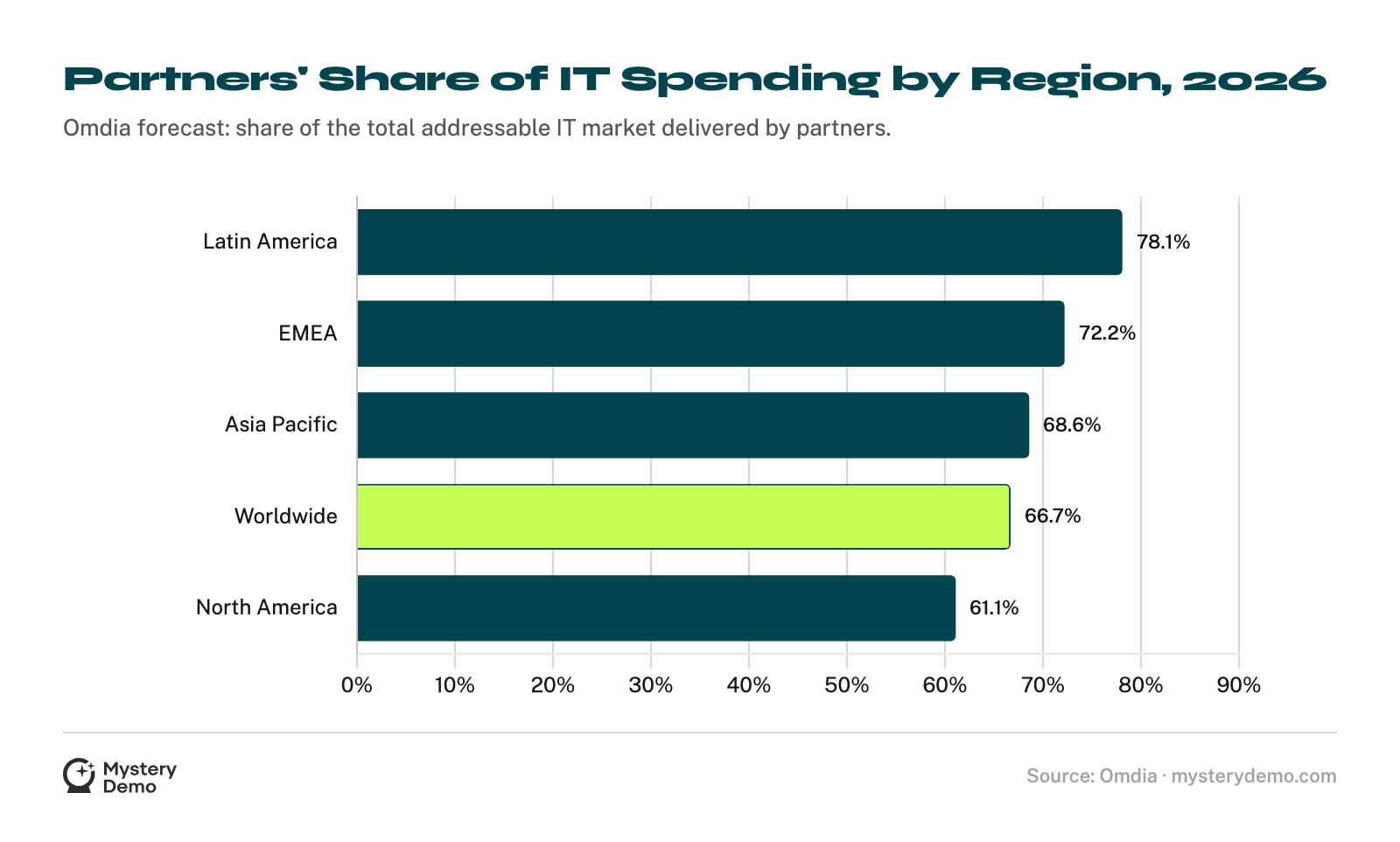
Partners are forecast to handle 66.7% of the world’s technology spending in 2026, by Omdia’s count, down from 70.1% in 2025.1 Cloud infrastructure runs the other way. Channel partners delivered just 34.7% of cloud infrastructure services worldwide in 2024.2
In the UK, the big cloud providers sell the large majority of their services directly, through their own portals or negotiated contracts.3 Both pictures hold at once, and the difference between them is the buyer. The buyer’s size, purchasing rules and need for hands-on help decide whether the same software is sold direct, through a reseller, or on a marketplace.
Mystery Demo works on the buyer’s side of that decision. Its team approaches a software company’s competitors as a believable buyer with a set size and location, and sits every sales call they offer. It records what each rep proposes, including the moment a rep hands the deal to a partner.
The figures below come from public research, each one linked to where it was published. None of them comes from those calls.
Key Takeaways
Partners Still Handle Two Thirds of Technology Spending
Omdia forecasts the worldwide IT market at $6.07 trillion in 2026, up 10.2% on the year.1 Partners are forecast to carry 66.7% of it, down from 70.1% in 2025, in what Omdia calls a decade-long decline.1
The cause is spending that never passes through a partner. Partner-delivered sales are forecast to grow 6.7% in 2026, against 18.1% for the sales vendors handle themselves, driven mainly by hyperscaler and AI infrastructure spending.1
The share swings with the buyer’s region. North America has the lowest partner share, at 61.1% in 2026, down from over 70% four years earlier.1 Latin America has the highest, at 78.1%.1
EMEA is forecast at 72.2%, down from 80.1% in 2016.1 Asia Pacific sits at 68.6%.1
Cloud infrastructure is the part of the market partners reach least. Channel partners delivered 34.7% of cloud infrastructure services worldwide in 2024, far below their share of technology spending as a whole.2
Those shares cover everything a business buys in technology, from laptops to telecom. A software company’s own books are the closer measure of what partners bring a vendor.
Software Companies Expect About a Third of 2026 Revenue From Partners
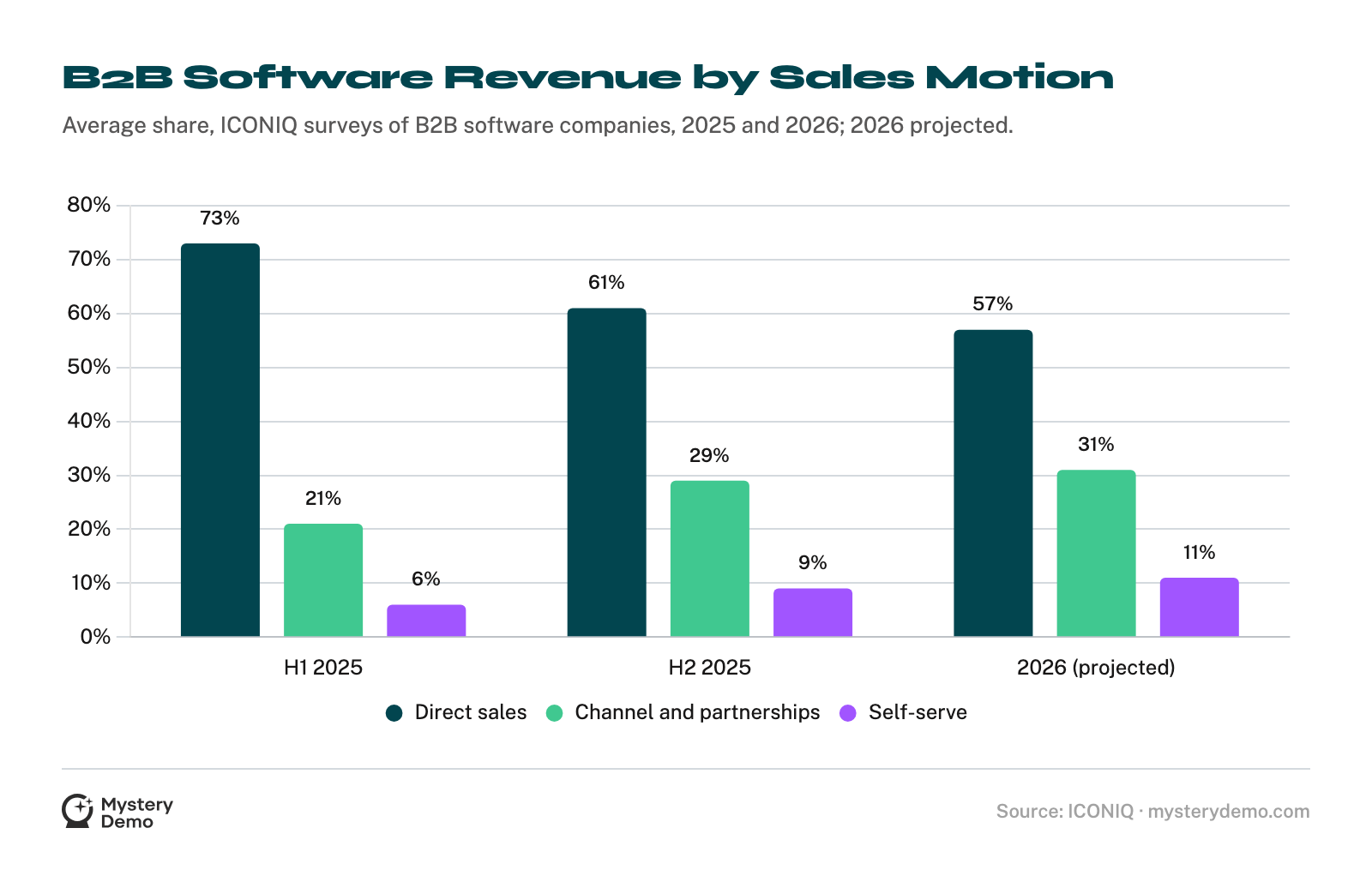
ICONIQ surveys go-to-market executives at B2B software companies with $10 million or more in revenue, most recently more than 150 of them in January 2026. Across its 2025 and 2026 surveys, channel and partnerships made up 21% of revenue in the first half of 2025, 29% in the second half, and a projected 31% in 2026.4
Direct sales fell over the same three periods, from 73% to 61% to a projected 57%.4 Self-serve rose from 6% to 9% to 11%.4
The fastest growers lean on partners less. Companies ICONIQ classes as high-growth project 27% of 2026 revenue from channel and partnerships, against 33% for the rest.4
Partners bring in a smaller share of pipeline than of revenue. Among companies under $100 million in revenue outside the high-growth group, channel and partnerships produced 19% of total pipeline and 15% of new-logo pipeline.4
A second survey counts the deals partners influence as well as the ones they bring. In a September 2025 survey of 100 senior leaders at B2B SaaS companies with $50 million or more in revenue, mid-market and enterprise companies reported 35% of the previous quarter’s new pipeline as partner-influenced or partner-sourced.5
The same survey shows why those shares are hard to compare across companies. Only 42% of the companies used multi-touch attribution.6 The rest credited the first touch (31%), the last touch (19%), or used another method or none (8%).6
Companies plan to spend more on partners anyway. 69% of the companies planned to increase investment in partnerships in the coming year, and 30% called partnerships a top strategic priority for 2026.7
Across industries, partner selling is close to universal. In Salesforce’s survey of 4,050 sales professionals in 22 countries, run in August and September 2025, 94% said their company uses partner selling, up from 86% in 2024.8 Partner selling is increasingly important to hitting revenue targets, 89% said.8
If partners touch that much revenue, the next question is which deals they touch. The clearest public answer comes from a regulator that looked at how business customers buy.
A Buyer’s Size and Needs Decide Which Route the Deal Takes
The UK Competition and Markets Authority’s July 2025 findings on cloud buying name four routes. Customers buy through competitive tenders, bilateral negotiations, a provider’s online portal or marketplace, or suppliers of professional services, including authorized resellers.3
The authority found that different buyers take different routes:
One provider’s data, published in the same report, shows how lopsided that split is. Fewer than 5% of its UK customers negotiated their contracts in 2022, and those customers produced more than 75% of its UK revenue.3
The route also decides who the buyer deals with. Resellers often negotiate prices independently and own the billing and the contract, so the vendor is no longer the buyer’s counterparty.3 Many customers mix routes, buying some workloads direct and others through partners, one provider told the authority.3
| Route | Who sets the price | Who the buyer contracts with | Who tends to use it |
|---|---|---|---|
| Online portal or standard marketplace listing | The provider’s listed price | The provider, on its standard terms | Smaller enterprises, paying as they go |
| Negotiated agreement or tender | Negotiated deal by deal | The provider, on negotiated terms | Larger, higher-spending customers and the public sector |
| Authorized reseller | Often the reseller, independently | Often the reseller, which also bills | Buyers who need technical services |
| Private offer on AWS Marketplace | A custom price from the vendor or a channel partner | The vendor or channel partner, with billing consolidated through AWS | AWS buyers who want custom pricing and terms |
The table draws on the competition authority’s appendix3 and on AWS Marketplace’s buyer page for private offers.9
So the route changes the counterparty, and a buyer who needs technical help tends to get it from the partner too. Most partner revenue now comes from exactly that kind of work.
Most of What Partners Earn Now Comes After the Sale
Reselling is the smaller part of a partner’s business today. 61.2% of partner revenue comes after procurement, from building, managing and helping customers adopt what they bought, according to Omdia research published in September 2026.10
Omdia finds partners running at least three business models, such as reselling, managed services and professional services.1 Customers work with 6.3 partners on average.1
Managed services alone are a large business. IT managed services delivered through the channel were forecast to grow about 13% in 2025, to $595 billion.11 Around 341,000 partners were expected to be delivering them by the end of that year.11
The work is concentrated at the top. Among the 1,000 largest channel partners Omdia ranks, the top 30 earn as much as the other 970 combined.12 Together the 1,000 earn $1.07 trillion a year, 63.3% of the global IT services opportunity.12
So a buyer handed to a partner gets a different seller, and that partner earns most of its money on what comes after the sale. The software companies have measured whether those deals close more often.
Partner-Sourced Deals Win Less Often Than Sales-Sourced Ones
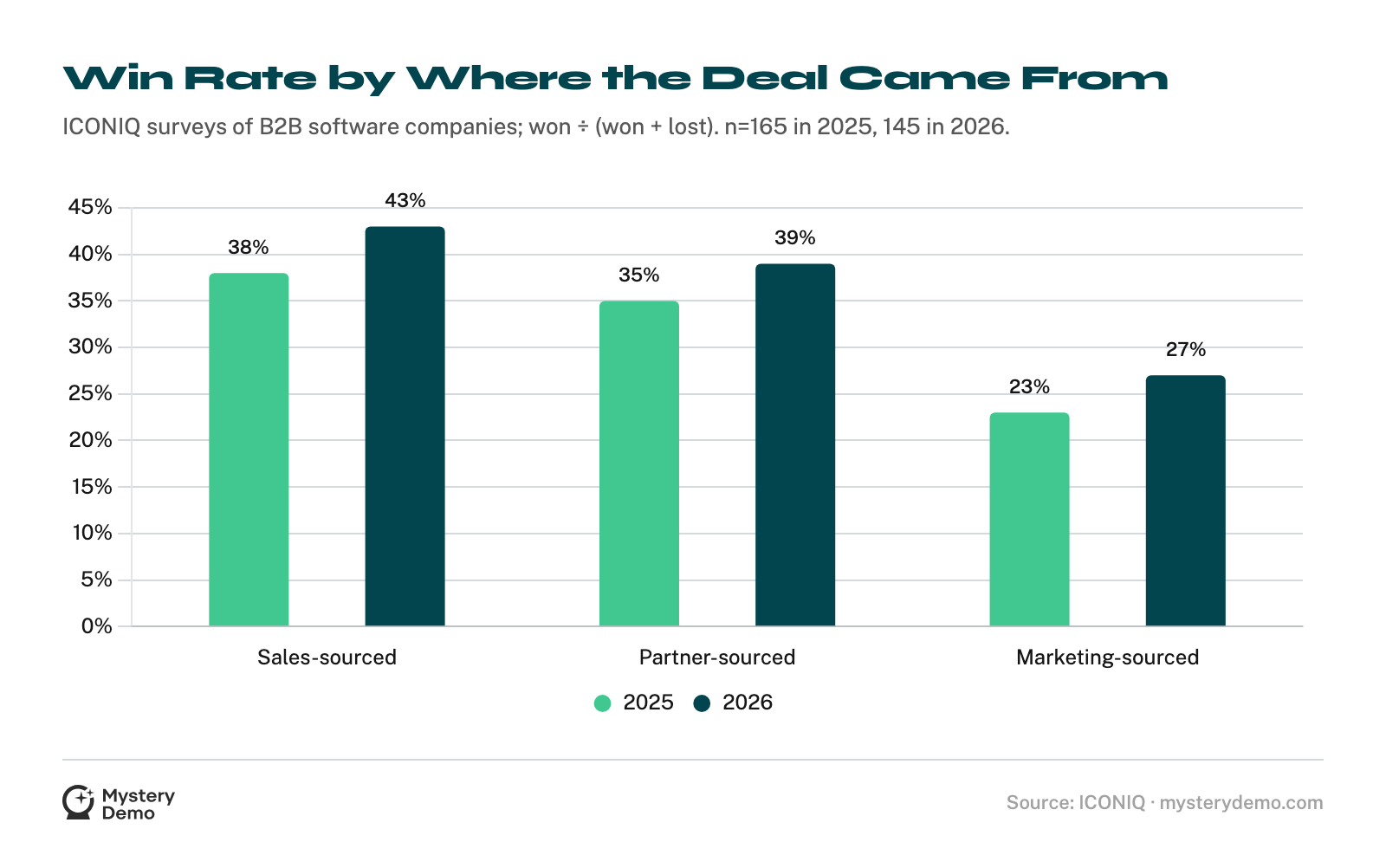
ICONIQ measured win rates by where an opportunity came from. In its 2026 survey, deals sourced by channel partners closed 39% of the time, behind sales-sourced deals at 43% and ahead of marketing-sourced deals at 27%.4
All three rose from 2025, when the rates were 38% for sales, 35% for partners and 23% for marketing.4 Deals sourced by customer success won 52% in 2026, the highest of any source.4
Senior SaaS leaders describe the gain mostly as speed. In the PartnerStack and Wynter survey, 48% said alignment with partners had shortened sales cycles, and 23% said it helped land bigger deals.6
Co-selling with the cloud providers is spreading too. Tackle, which sells marketplace software, surveyed B2B SaaS companies with cloud marketplace programs for its 2025 report and does not publish the sample size.
Those companies said co-selling with cloud partners influenced almost 22% of their net-new deals in the past year, and expected 30% next year.13 Companies selling on all three major clouds expected 39% of deals to be co-sell influenced, against 18% for those on a single cloud.13
A widely shared partner statistic, a figure on how much likelier partner deals are to close, traces back to a vendor report whose page no longer loads, so it is left out.
Partners bring deals that close at respectable rates. They also take a cut, and on the cloud marketplaces that cut is published.
Marketplace Fees Fall as the Deal Grows
AWS charges a 3% listing fee on SaaS sold through public offers in AWS Marketplace, under fees in effect since January 5, 2024.14 Its private offers cost 3% under $1 million, 2% from $1 million to under $10 million, and 1.5% at $10 million or more, with every renewal at 1.5%.14
Adding a channel partner adds to the fee. AWS puts a 0.5% uplift on channel partner private offers, so a SaaS private offer under $1 million carries 3.5%.14
Google Cloud moved to the same ladder in May 2025. It charges 3% on standard offers and on private offers under $1 million, 2% from $1 million to under $10 million, and 1.5% at $10 million or more.15 Channel shifts, migrations and native renewals also drop to 1.5%.15
Microsoft charges a 3% standard store service fee on Microsoft Marketplace transactions.16 Private offer renewals can qualify for half that fee.16
| Deal | AWS Marketplace | Google Cloud Marketplace | Microsoft Marketplace |
|---|---|---|---|
| Standard SaaS listing | 3% | 3% | 3% |
| Private offer under $1 million | 3% | 3% | 3% |
| Private offer, $1 million to under $10 million | 2% | 2% | 3% |
| Private offer, $10 million or more | 1.5% | 1.5% | 3% |
| Renewal | 1.5% | 1.5% (native renewals) | Half the standard fee, for qualifying private offer renewals |
The rates come from AWS’s seller documentation,14 Google Cloud’s revenue share schedule15 and Microsoft’s publisher documentation.16
A reseller’s margin is harder to pin down. Margin bands for resellers and referral partners circulate widely on vendor blogs. None of the ones we traced led back to a published study, so the marketplace fees are the only partner cut with a document behind it.
The fees fall as deals grow, which rewards vendors for pushing large contracts through the marketplaces. Buyers have their own reasons to go there, and the money moving through them is growing fast.
Cloud Marketplaces Are Growing Fast, and Partners Are Moving In
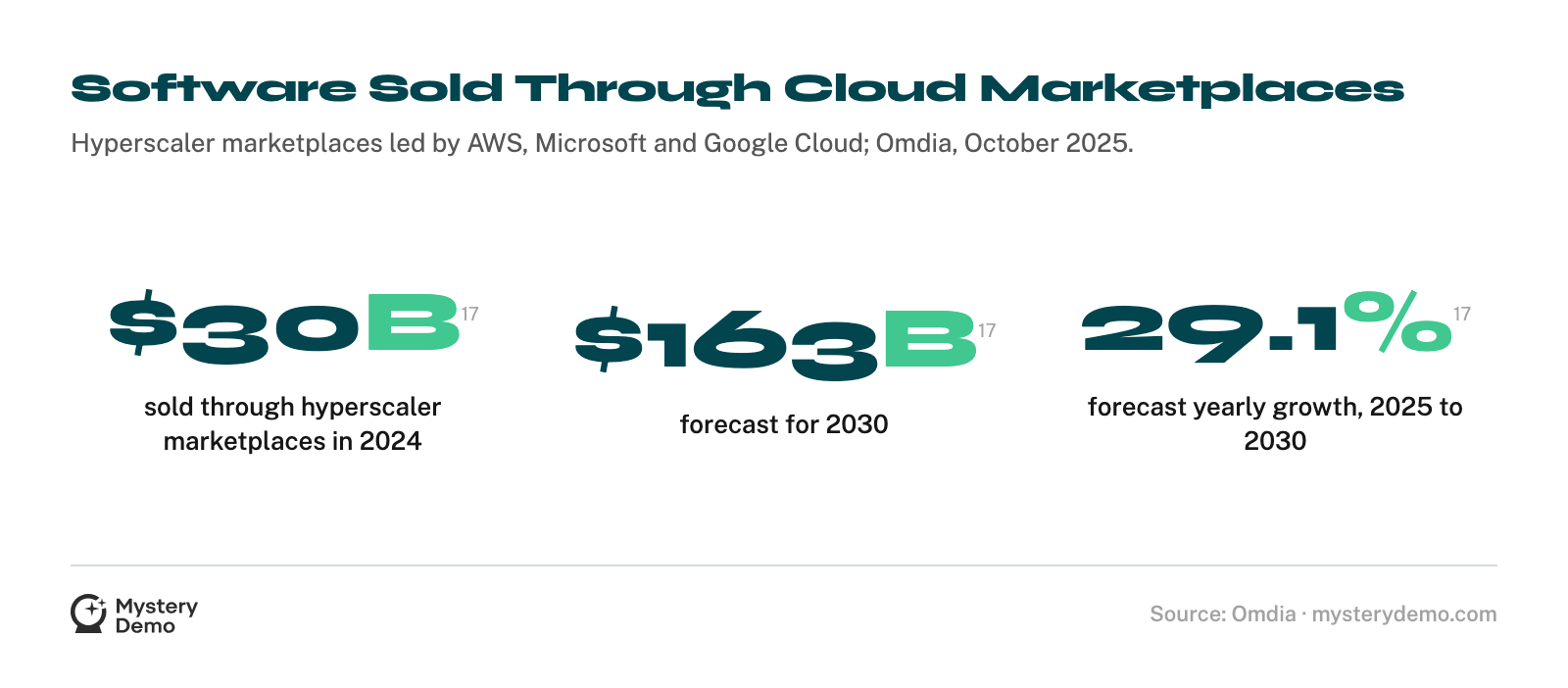
Enterprise software sold through hyperscaler cloud marketplaces, led by AWS, Microsoft and Google Cloud, is forecast to grow from $30 billion in 2024 to $163 billion by 2030, according to Omdia.17 That is a compound annual growth rate of 29.1% from 2025 to 2030.17
Cloud commitments feed the growth. Omdia estimates close to $470 billion in multi-year cloud commitments across the three providers, part of which buyers can spend on third-party software in the marketplaces.17 Nearly $30 billion of new commitments were added in the second quarter of 2025 alone.17
Three categories are forecast to account for 63% of marketplace spending in 2025: infrastructure software at $10.5 billion, DevOps at $9.1 billion and business applications at $9.1 billion.17
Partners are not being cut out of it. At least 50% of hyperscaler marketplace transactions are expected to flow through channel partners by 2027.18 By 2030, Omdia expects partners to facilitate nearly 60% of them.17
The software companies see the same shift in their own deals. Companies in Tackle’s survey said 27% of their marketplace transactions involved a channel partner over the past year, and expected 37% over the next.13 They also expected marketplaces to grow from 20% to 32% of their revenue on average.13
74% of the companies said access to customers’ committed cloud spend was a significant benefit.13 Getting attention from the cloud providers’ own sellers was the bottleneck, and only 8% called it not at all challenging.13
None of this makes marketplaces the main route yet. In the UK, the competition authority found that marketplace sales are only a small share of revenue for most cloud providers.3 So why do the buyers who use marketplaces choose them?
Marketplace Buyers Say They Chose the Route to Buy Faster
In a survey of 419 IT decision-makers at small and midsize businesses and public sector organizations that use AWS Marketplace, run by Forrester Consulting for AWS, 67% named faster procurement as a reason they started.19 Shorter time before purchase came second at 58%, and cost savings third at 52%.19
After adoption, 72% reported faster procurement and 65% reported cost savings.19 Respondents also reported spending 33% less time on finding solutions.19
Public sector buyers ranked cost first. Among the 40 public sector respondents, 65% named cost savings, 63% faster procurement and 50% shorter prepurchase time.19
The time saved continues after the purchase. Among 165 respondents who reported shorter post-purchase work, monthly hours spent deploying and using purchased software fell from 71.3 to 55.5, a 22.2% drop.19 Time spent renewing and returning for the next purchase fell the most, from 17.8 hours to 9.7, down 45.5%.19
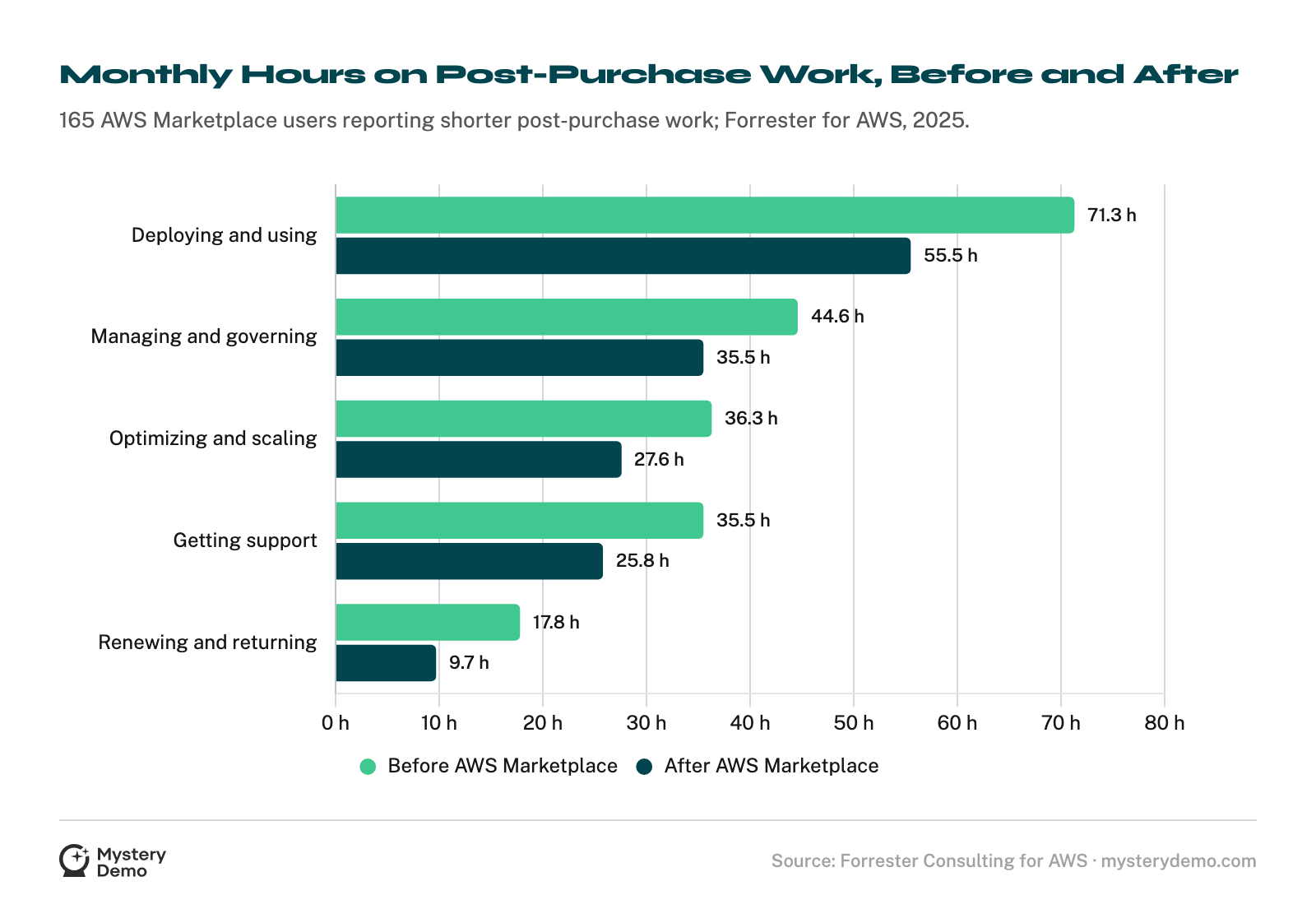
Forrester’s respondents all use one marketplace, and the survey was commissioned by the company that runs it. Their answers explain why those users chose it, and say nothing about how many buyers do.
All of these figures describe a market. None of them shows the one meeting where a rep decides how to sell to you.
.png)

The Route a Rival Gives Your Buyer Is Only Said on the Call
Your own market will not match the averages. Does your closest rival sell to a buyer of your size, in the region you are entering, with its own team or through a partner? And what does that partner quote once it owns the deal?
Mystery Demo finds out by being that buyer. Its team builds a buying company with the size and location you need to test, approaches each rival through its normal front door, and records every call, email and quote that follows.
Below is a page from our public example board, where the client and every competitor are invented. On a real project, each column fills from the calls, covering how long each rival says it takes to reach first value, who does the implementation, and what support continues afterward.
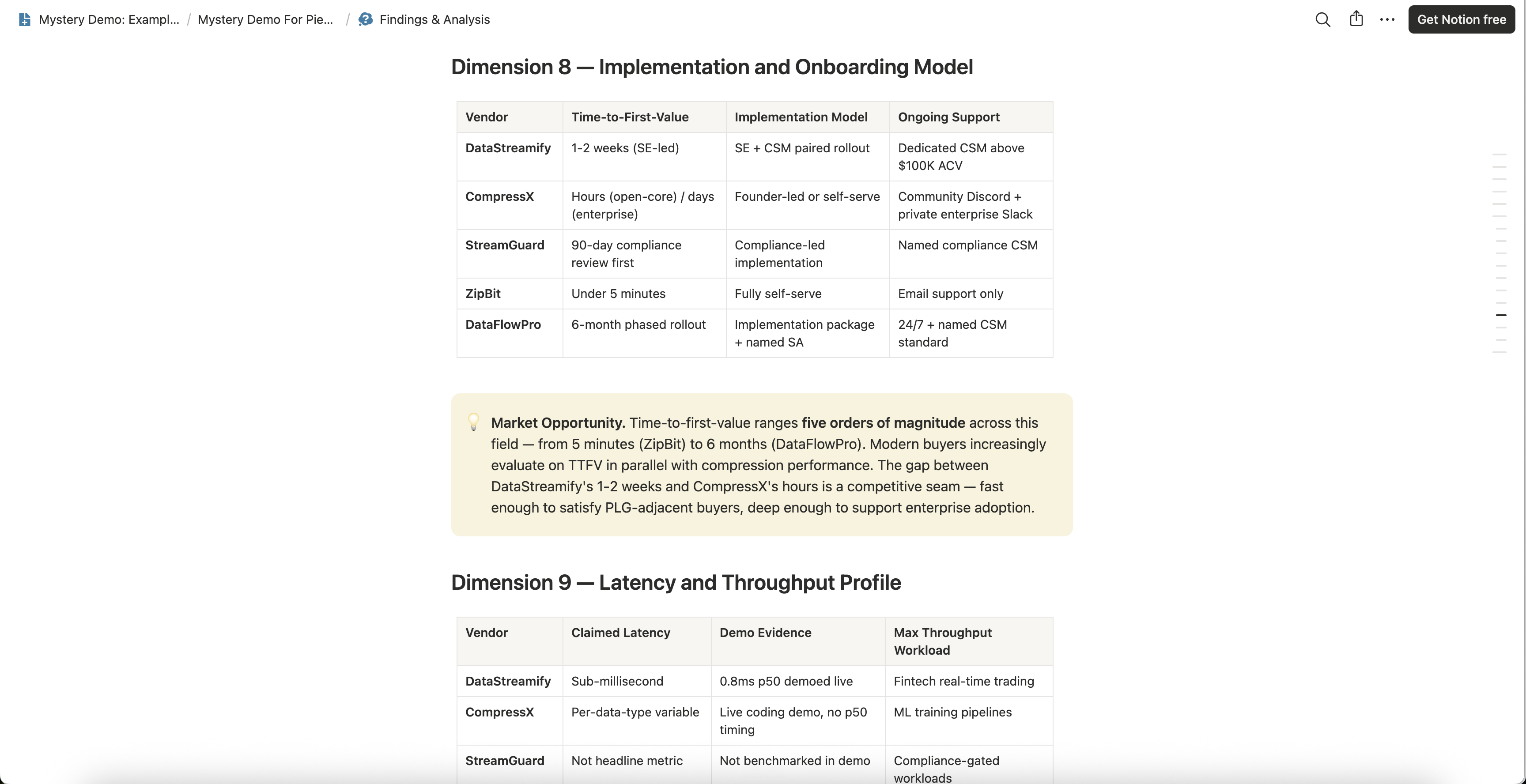
Our SaaS market entry research builds that view for every serious player in the market you are entering. It costs a flat €499 per competitor with everything included, and a full landscape takes four to eight weeks.
Tell us the region and the buyer size you are planning around, and the rival you expect to meet there. Start with a short intro call, and we will approach that rival as the buyer and bring back which route it chose, who quoted, and the recording.
Frequently Asked Questions
What Percentage of IT Spending Goes Through Channel Partners?
66.7% in 2026, by Omdia’s forecast, down from 70.1% in 2025.1
How Much SaaS Revenue Comes From Channel Partners?
31% is projected for 2026, the average across the B2B software companies in ICONIQ’s survey, up from 21% in the first half of 2025.4
Do Partner-Sourced Deals Close More Often?
They won 39% of the time in 2026 in ICONIQ’s survey, against 43% for sales-sourced deals and 27% for marketing-sourced deals.4
What Fee Do Cloud Marketplaces Charge Software Vendors?
3% on a standard SaaS listing at AWS, falling to 1.5% on private offers of $10 million or more.14 Google Cloud runs the same ladder.15
How Big Will Cloud Marketplaces Get?
$163 billion by 2030, Omdia forecasts, up from $30 billion in 2024.17
Why Do Companies Buy Software Through a Cloud Marketplace?
67% cited faster procurement in a survey of AWS Marketplace buyers commissioned by AWS.19
Which Region Relies on Channel Partners the Most?
Latin America, at 78.1% of IT spending in 2026, by Omdia’s forecast.1 North America relies on partners least, at 61.1%.1
References
- Omdia: How will changing IT spending trends impact global channel chiefs? (2026)
- Omdia: Channel partner investment in cloud hyperscalers: a strategic pivot point (2025)
- UK Competition and Markets Authority: Appendix A: Demand for cloud services and how customers purchase cloud services (2025)
- ICONIQ: The State of Go-to-Market in 2026 (2026)
- PartnerStack: Mid-market and enterprise companies report 35% of pipeline is partner-influenced or sourced (2025)
- PartnerStack and Wynter: The State of Partnerships in GTM 2026 (2025)
- PartnerStack: Original Data From PartnerStack and Wynter Reveals the State of Partnerships in GTM 2026 (2025)
- Salesforce: State of Sales, Seventh Edition (2025)
- Amazon Web Services: AWS Marketplace Procurement (2026)
- Omdia: Partners as Lifecycle Orchestrators: Why 61.2% of Revenue Comes After Procurement (2026)
- Omdia: MSP trends and predictions 2025: executive summary (2025)
- Omdia: The Omdia Global Partner 1000 (2025)
- Tackle: The 2025 State of Cloud GTM Report (2025)
- Amazon Web Services: Understanding listing fees for AWS Marketplace sellers (2024)
- Google Cloud: Google Cloud Marketplace simplifies deals and improves economics (2025)
- Microsoft: Microsoft Marketplace transact capabilities (2026)
- Omdia: Hyperscaler cloud marketplace sales to hit $163 billion by 2030 (2025)
- Omdia: Now and Next for Hyperscaler Marketplaces (2025)
- Forrester Consulting, commissioned by AWS: The Total Economic Impact of AWS Marketplace (2025)
.png)


