
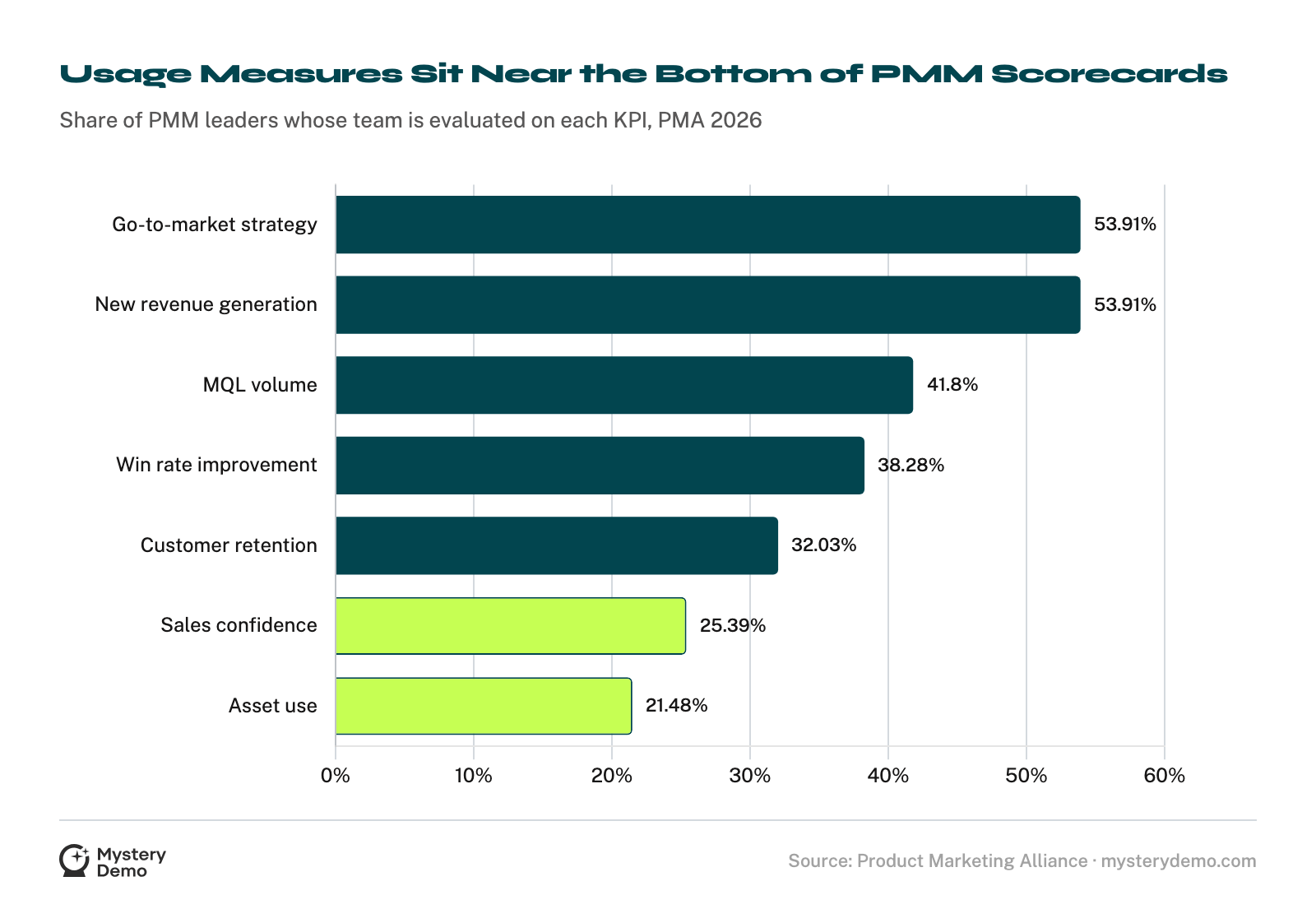
91% of product marketers count positioning and messaging among their duties, the most common task in Product Marketing Alliance’s 2025 survey of the role.1 Yet when PMA asked PMM leaders in 2026 what their teams are judged on, only 25.39% named sales confidence,2 one of the two measures PMA itself describes as checking whether the work gets used.
So product marketing writes the message, and is seldom scored on what happens to it once a rep starts talking. The public numbers stop at that point, for every company, rivals included.
Mystery Demo goes past it. Mystery Demo books competitors’ real sales demos, sits each call as the buyer, and hands back the recordings and a board of what every rep said. A team gets to hear its rivals’ positioning the way their buyers hear it.
Every number below comes from public research, with its population and year inside the sentence and the study linked in References. Together they cover what product marketing owns, how many people do it, what they spend, how many launches they carry, and how their work gets checked.
Key Takeaways
Positioning Tops the Product Marketing Job List
In PMA’s 2025 State of Product Marketing survey, positioning and messaging is a duty for 91% of product marketers.1 Managing product launches follows at 80.9%,1 then customer and market research at 69.7%.1
Two duties tie further down. Competitive intelligence is on the list for 65.2%,1 and so is managing the website and digital touchpoints, also at 65.2%.1
The edges of the job are moving. Customer onboarding reached 37.5% after nearly doubling since 2024,1 product roadmap planning sits at 28.1%,1 and content marketing slipped slightly, to 48.3%.1
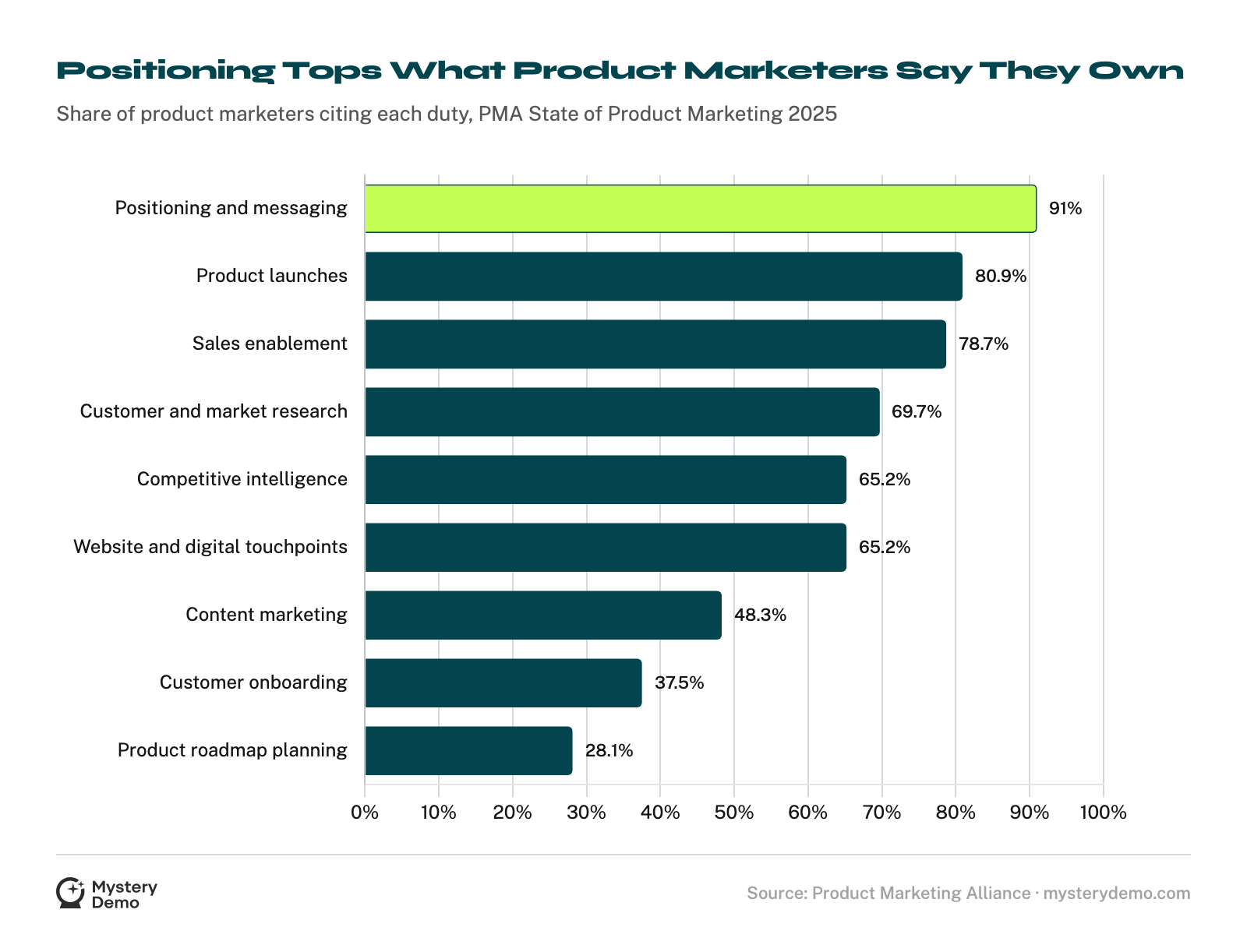
Sales enablement has become a core duty for 78.7% of product marketers in 2025, up from 66.9% in 2023.3 On paper, that puts product marketing right next to the sales conversation.
A list this long is a staffing question before it is a strategy question. And the teams carrying it are small.
Most Product Marketing Teams Have Five People or Fewer
Around 74% of PMM teams have five or fewer people, in the State of Product Marketing data PMA summarized in April 2026.4 In the same data, 70% of PMM leaders manage no direct reports at all.4
PMA’s 2025 report cut it finer. 44.3% of PMM teams were just one or two people,3 and only 11.5% had more than 10.3 The 2024 edition used a wider bracket and found 80% of product marketers working in teams of one to five.5
Against product management, the clearest benchmark is McKinsey’s 2024 analysis of the top 100 software companies by revenue. The fastest-growing quartile averaged about one PMM for every 1.6 product managers,6 a 25 to 30 percent higher PMM-to-PM ratio than the slowest-growing quartile.6 In PMA’s 2024 survey, 20% of product marketers worked at one PMM to three product managers.5
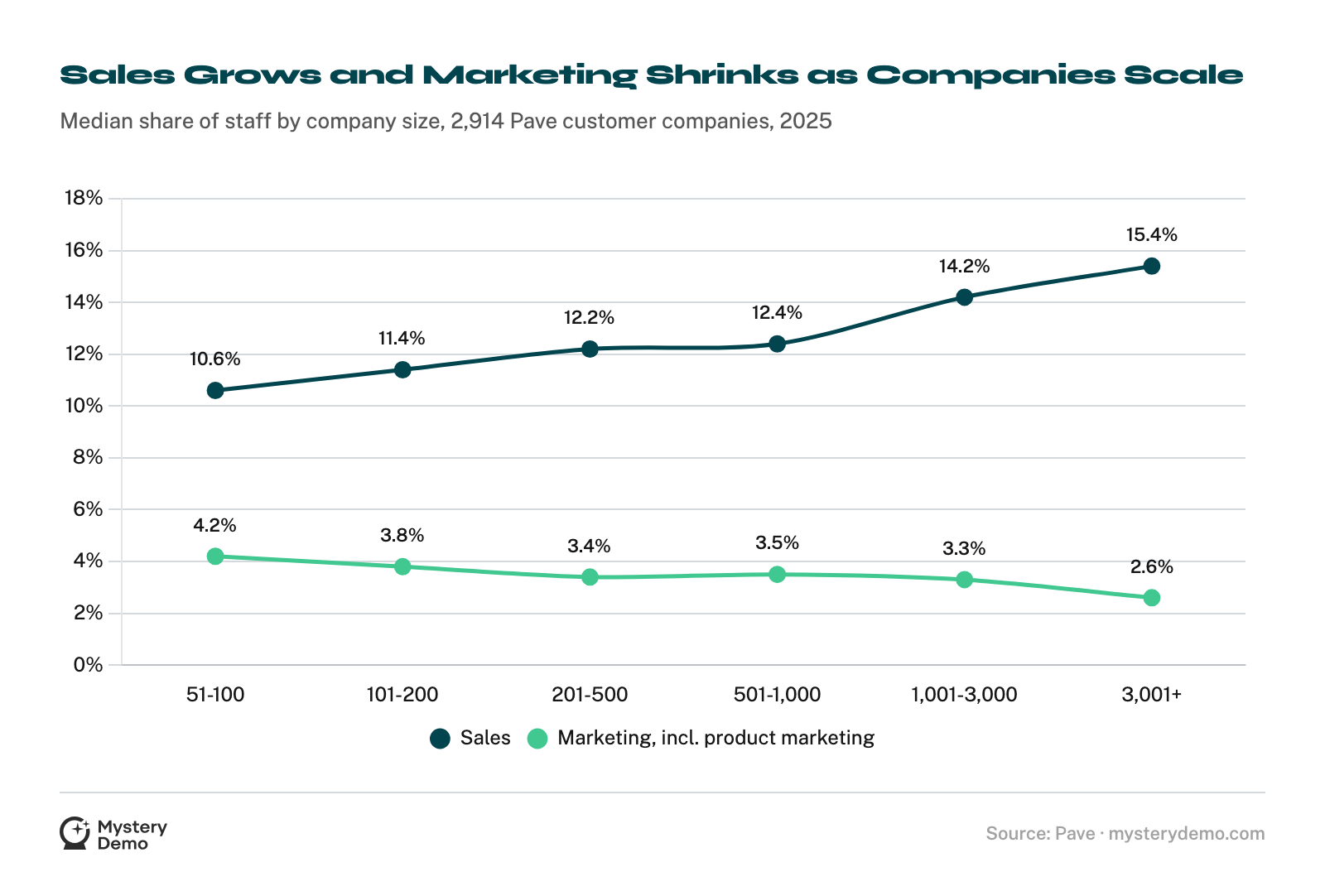
We found no open study that publishes a ratio of product marketers to sales reps. The nearest public figure is share of headcount, from Pave’s 2025 look at 2,914 of its customer companies with more than 50 employees, where product marketing counts inside marketing.
At the median company with 51 to 100 employees, 4.2% of staff work in marketing and 10.6% in sales.7 At 3,001 employees and up, marketing’s median share falls to 2.6% while sales rises to 15.4%.7 From the smallest bracket to the largest, sales grows as a share of staff while marketing, where product marketing sits, shrinks.
Budgets are thin too. 33.2% of product marketers reported no dedicated budget in 2025,3 after 35.6% said they lacked one in 2024.5 In the 2025 survey, 30.7% saw their budget rise from 2024,3 and 18% saw cuts.3
Small teams and thin budgets would matter less if launches were rare. For many teams, they are not.
Fewer Than Half of GTM Teams Have a Clear Launch Process
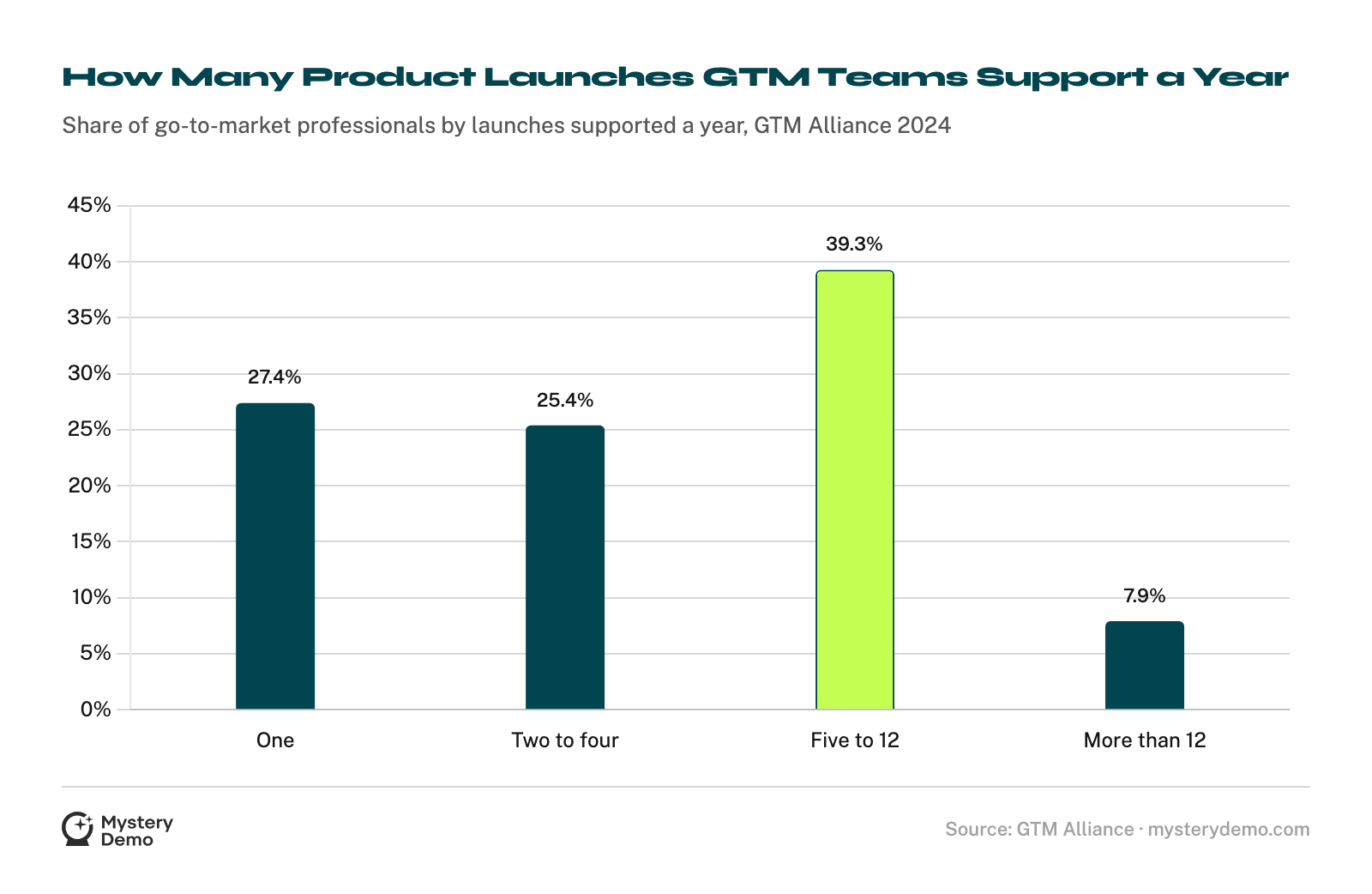
GTM Alliance’s State of GTM 2024 survey asked go-to-market professionals how many product launches they support a year. 27.4% support a single launch,8 25.4% support two to four,8 39.3% support five to 12,8 and 7.9% support more than 12.8
45.1% have a clearly laid-out launch process,8 and another 41.2% say they only “sort of” have one.8 Planning is just as uneven. 41.2% always build a GTM plan for a launch,8 while 7.8% never do.8
Asked to rate their launch process, 55.3% put it between 6 and 8 out of 10.8 Most still expect launches to move revenue, with 90.2% rating the revenue impact at 5 or higher out of 10.8
Every launch hands reps new claims to repeat. The next question is who checks those claims once they leave the building.
About a Third of Marketers Check Their Message With Sales
Start with whether there is a written message to check. In HubSpot’s 2026 State of Marketing survey of marketers worldwide, B2B and B2C together, 51.6% say they have a clear, documented value proposition.9 38% say theirs isn’t documented,9 and another 10% report competing or missing value propositions.9
We found no open study that measures how often B2B companies formally refresh their product positioning. The nearest public figure covers brand campaigns. Every quarter, 40.4% of marketing teams test, measure, and adjust their brand awareness campaigns,10 and 45.38% review and refine them once a year.10
The same report lists how those teams check whether the message lands. 61% run brand perception surveys,10 56% watch for engagement changes,10 36% gather sales team feedback on how prospects react,10 and 34% run A/B positioning tests.10
Sales feedback comes third of those four checks, behind surveys and engagement data. Product marketing’s own scorecards show the same order from inside the function.
Few PMM Teams Are Scored on Whether Sales Uses Their Work
In PMA’s 2025 State of Product Marketing data, summarized in April 2026, PMM teams named the functions they work with most closely. Product came first at 93%,4 marketing at 84%,4 and sales at 81%,4 with engineering last at 14%.4
Working closely does not make the function heard. 68% of PMM teams are invited to leadership meetings,4 and 55% of PMM leaders say other teams don’t fully understand what their function does.4
How the work gets scored tells a similar story. PMA’s 2026 report asked PMM leaders what their teams are evaluated against, and they named 16 different metrics.2 Go-to-market strategy and new revenue generation led, at 53.91% each,2 and MQL volume was still on 41.80% of scorecards.2
Win rate improvement came in at 38.28%,2 and customer retention at 32.03%.2 Lower down sit the two measures PMA says show whether the work gets used: sales confidence at 25.39%2 and asset use at 21.48%.2 Neither is on even a third of scorecards.
13.28% of PMM teams have no defined KPIs at all.2 In PMA’s 2024 survey, 88.1% of product marketers said they track role-specific KPIs,5 so the gap is less about having metrics than about which ones. For a function that writes what sales says, the scorecard rarely asks whether sales says it.
The message shows the strain as well. In Forrester’s 2023 B2B Brand and Communications Survey, 44% of marketing leaders said their messaging fails to address the needs of all audiences,11 and 37% said different messages from across the organization confuse buyers.11 40% said they struggle to make brand messages relevant to buyers.11
None of these surveys sat in on a sales call, and the call is where a message either survives or changes.
.png)

Every Figure Here Stops at the Door of the Sales Call
The numbers above describe product marketing from the inside, from what it owns to how it gets scored. None of them says what a rival’s rep leads with when a buyer is on the call, which competitor that rep names as the alternative, or how the rep frames the category out loud.
The gap you have with your own reps is the gap you have with every rival’s reps, except that a rival’s positioning is public and its rep’s version of it is not. Hearing that version is the job of a competitor messaging comparison: Mystery Demo books the rival’s demo through its normal front door, sits the call as a buyer with a real evaluation, and records the pitch as the rep delivers it.
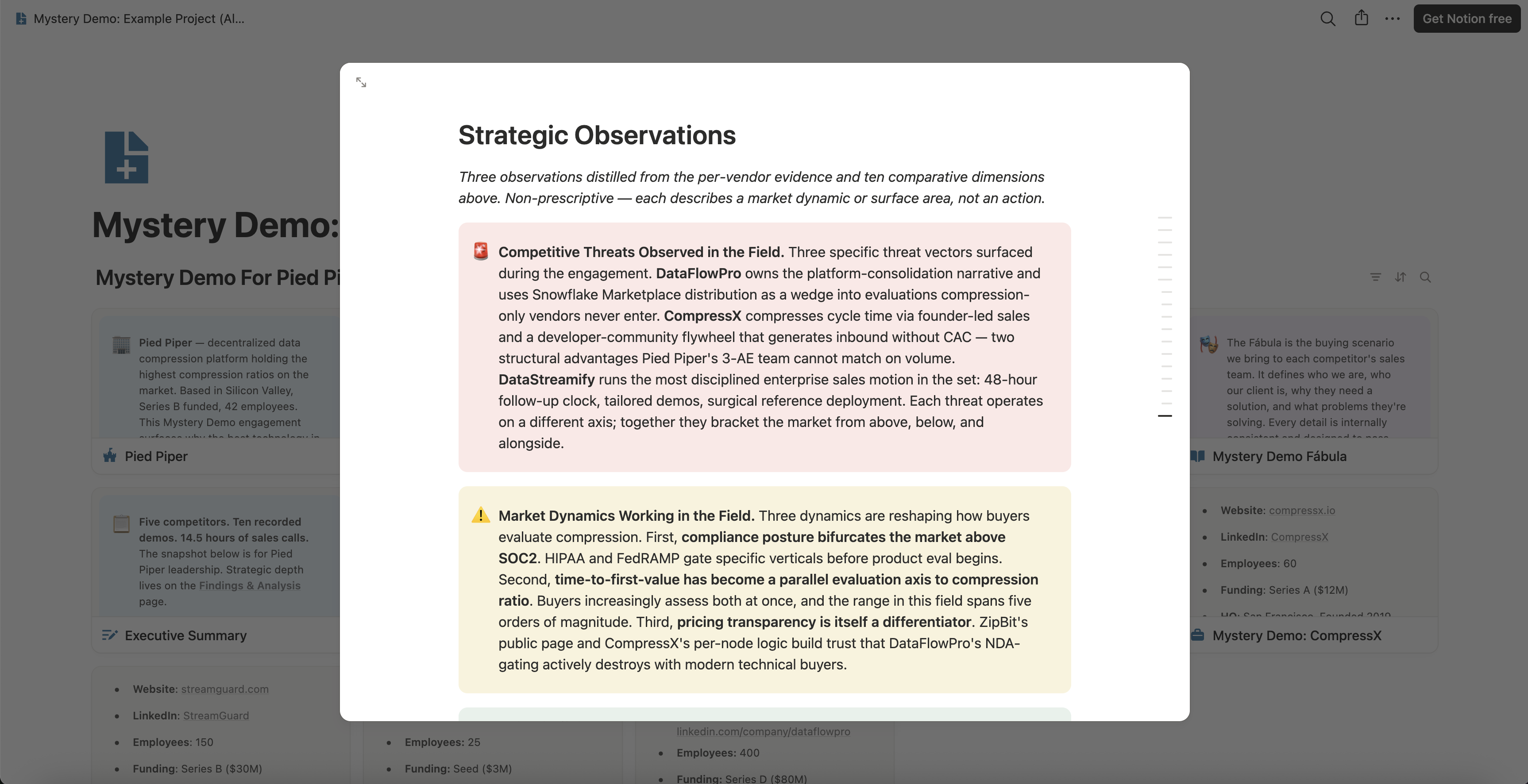
Below is the Strategic Observations page from our public example board, where the company and every competitor on it are invented. On a real project, the board is built from the recordings of the demos we sat for that client, and each observation names the story a competitor leads with in the room.
Your positioning team can see every rival’s homepage and none of their sales calls. Name the rival, and we will sit its demo as the buyer, then bring back the recording, first ten minutes included, for a flat €499 per competitor in one to two weeks. Start with a short call about which rival to hear first.
Frequently Asked Questions
How Big Is a Typical Product Marketing Team?
Five people or fewer for around 74% of teams, in the State of Product Marketing data PMA summarized in April 2026.4 Only 11.5% of teams in PMA’s 2025 report had more than 10 people.3
What Does Product Marketing Own?
Positioning and messaging, for 91% of product marketers in PMA’s 2025 survey.1 Managing launches, sales enablement, and market research follow.
How Many Product Marketers Should There Be per Product Manager?
About one PMM for every 1.6 product managers at the fastest-growing of the top 100 software companies, in McKinsey’s 2024 analysis.6 We found no open study that publishes a ratio of product marketers to sales reps.
How Many Product Launches Do Go-to-Market Teams Support Each Year?
Five to 12 launches for 39.3% of go-to-market professionals in GTM Alliance’s 2024 survey.8 A single annual launch is the next most common answer.
How Is Product Marketing Measured?
53.91% of PMM leaders name go-to-market strategy, and as many name new revenue generation, in PMA’s 2026 report.2 Sales confidence and asset use, the measures of whether sales uses the work, sit further down the list.
How Often Do Companies Refresh Their Positioning?
40.4% of marketing teams adjust brand campaigns quarterly, the nearest public figure, in HubSpot’s 2026 survey of B2B and B2C marketers.10 We found no open study that measures how often B2B companies formally refresh their product positioning.
Do Product Marketing Teams Have Their Own Budget?
33.2% of product marketers had no dedicated budget in PMA’s 2025 survey.3 In the 2024 survey, 35.6% said the same.5
References
- Product Marketing Alliance: What is product marketing? (2026)
- Product Marketing Alliance: How PMM leaders get measured, and why most of them are tracking the wrong things (2026)
- Product Marketing Alliance: How far has PMM come in the last 6 years? (2025)
- Product Marketing Alliance: How product marketing leaders are shaping company strategy in 2026 (2026)
- Product Marketing Alliance: State of Product Marketing Report 2024 (2024)
- McKinsey & Company: The growing importance of software product marketing managers (2024)
- Pave: Team Size Benchmarks for Sales & Marketing (2025)
- GTM Alliance: Do you need an established Go-to-Market process to succeed in 2025? (2024)
- HubSpot: Q1 marketing plays that'll start your year strong, according to State of Marketing data (2026)
- HubSpot: Why Loop Marketing matters in 2026, according to our State of Marketing report (2026)
- Forrester: B2B Messaging Is Fractured, But It Doesn't Have To Be (2023)
.png)


