
A rival’s real price is kept in one place, and it is not the pricing page. The page shows a starting number, or the words “Contact sales” where the price for a bigger deal should be. The price a buyer is offered gets said out loud by a rep, to someone the rep believes is buying.
Competitor pricing research is the work of finding out what a rival charges a buyer like yours. It covers more than the headline number:
Most methods for finding those things return the price a rival prints, or a price somebody else paid. The price its rep quotes to a buyer like yours is only said on a sales call, and Mystery Demo takes that call for software companies. Its team books each competitor’s sales demo as a genuine buyer and hands back every number the rep named, recorded and set beside the published price.
“Pricing research” also names three surveys, and each one asks your own buyers about price. Van Westendorp’s price sensitivity meter asks which prices feel too cheap or too expensive, Gabor-Granger asks whether they would buy at a given price, and conjoint analysis asks them to choose between packages. The answers help you set your own price, and they say nothing about what a rival quotes.
What Each Pricing Research Method Can Prove
A rival has three prices, and every method finds one of them. The printed price is what the rival publishes, and the reported price is what somebody says they paid in their own deal. The quoted price is what a rep tells a buyer during a live deal, set for that one buyer.
| Method | The price it finds | What it proves | Where it stops |
|---|---|---|---|
| The rival’s pricing page, its old versions in the Wayback Machine, and the review sites that repeat it | Printed | The list price and packaging the rival chooses to show, and when they changed | “Contact sales” on the tier that matters, and a final cost the review sites say is negotiated with the seller; enough on its own only for a rival with no sales team |
| Cloud marketplace listings | Printed | The public offer and its terms | Private offers, which are negotiated one buyer at a time and differ from the public one |
| Price databases and buying platforms | Reported | What the platform’s own buyers signed, pooled together | Buyers who came through that platform, at their seats and term, not yours |
| Public buying records | Reported | What a government buyer agreed to pay, and for how long | Public-sector deals, often one figure for licenses, setup and support together |
| Your own buyers and lost deals | Reported | The number a buyer says a rival offered | Told from memory, by someone negotiating with you |
| The rival’s customers and former staff | Reported | What one company paid, or how the price list worked | What they are free to share, since standard contracts can make pricing confidential |
| Your own team asking for a quote | Quoted | A real quote, if one comes | Given to a buyer the rep may recognize as a competitor |
| A mystery demo | Quoted | What a rep quotes a believable buyer fitted to the rival’s customers, what moves it, and what is gated | One buyer’s quote on one day, until the calls that follow confirm it |
Six of the eight methods find a printed or a reported price: a number from before any deal, or from somebody else’s. The reported prices look like the closest substitute, since somebody really paid them. They still miss your price, for reasons that sit inside each source.
Why the Price Someone Else Paid Is Not Your Price
A reported price was set in somebody else’s deal, for their seats, their term and their timing. Each source then bends it in its own way:
The desk sources still earn their place: a range, a price history and a rough floor, all before anyone books a call. Start with the desk steps for finding SaaS competitor pricing, which cost nothing but time.
None of them can show the price set for your buyer.

That price does not exist until a rival’s rep meets a buyer like yours, so no desk source can hold it.
The Quote Only Comes Out on a Sales Call
A rep prices the buyer in front of them. Say the rep asks for your headcount before showing a single screen: the answer has just set your tier. Your region, the tool you use today and how soon you need to decide can move the number the same way, and that arithmetic rarely reaches a pricing page.
Your own team can ask for that quote, but the request arrives with your company’s name on it. A recognized competitor gets the generic tour, and the price on that tour is the printed one.
The quote you need comes from a buyer the rival believes. Before Mystery Demo books anything, it writes that buyer as a buying scenario, the fábula, built around the deal you price against. Every rival hears the same need and gets the same questions, and six details are fitted to each one so it meets the kind of customer it sells to:
The evaluation is genuine, because the software really is being assessed for a company that needs it: yours. The only invented detail is the company the rep is told about. Mystery shopping a competitor’s demo is legal, and this one crosses no line: nobody real is impersonated, nothing is signed, and nothing is bought.
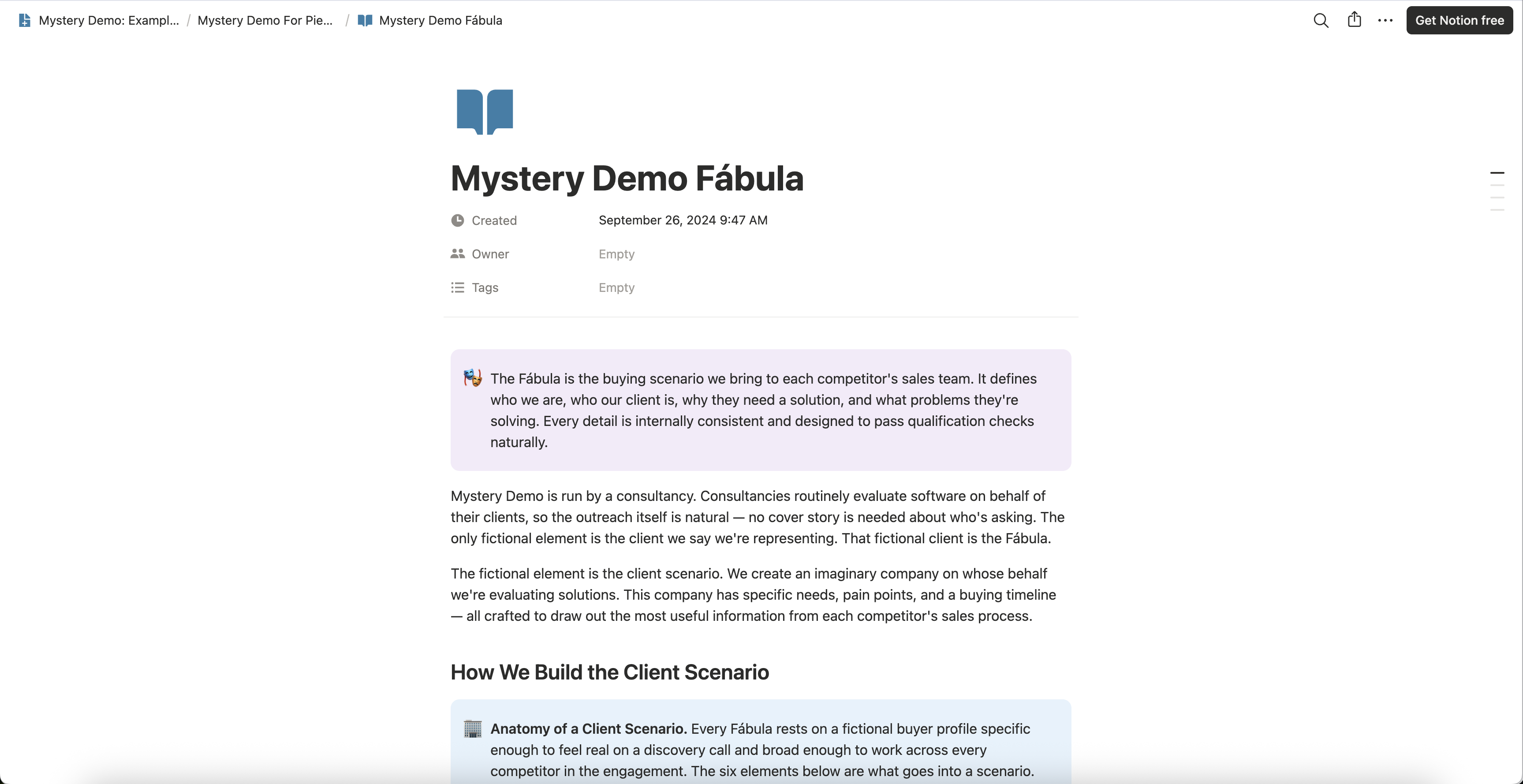
Every project hands over a board, a shared Notion workspace with a page for each part of the work. Below is the fábula page from our example board, an invented project with an invented client and invented competitors. On a real project, the same page holds the scenario written for that client’s rivals, and how it was adjusted for each one.
The people running the calls matter as much as the scenario. They are operators who have sold B2B software themselves, so they know which question moves a rep off the script, such as what happens to the price with more seats or a two-year term. The scenario and the operators then carry a project through five stages, from the first question to the last recording.
How a Competitor Pricing Project Runs
Each stage fills one page of the board, which is yours to keep:
| Stage | What happens | Where it lands on the board |
|---|---|---|
| Kickoff | You name the competitors and the deal you price against, and we agree the pricing questions: tiers, gated upgrades, discount thresholds, contract terms and how often you pay. You also show us your product, so our questions sound like a buyer’s | Research Objectives |
| The buying scenario | A believable buyer written for each rival’s customers, with its region set where that changes the price list | The fábula page |
| Outreach | Each rival approached through its own front door, with a pitch fitted to what it leads with | Each competitor’s page |
| The calls | Discovery, the demo, the pricing conversation and the follow-up, all recorded, with every email and document the rival sends kept | Each competitor’s page and the Database |
| Synthesis | Transcripts cleaned, every quoted number set beside the rival’s live pricing page so the gap is on record, and the analysis written | Findings & Analysis and the Executive Summary |


The first project usually picks itself: it is the rival whose number your team is least sure of. Scoping its calls takes one intro conversation about that rival and your deal.
Its quote, and every other rival’s, ends up in one comparison.
Every Quoted Number Sits Beside the Published One
Findings & Analysis is the page of the board where the rivals are compared one dimension at a time, and pricing is one of those dimensions. On a real project, every number in that comparison carries three things:
Below is the pricing dimension from the same invented example board. Its figures are invented, and its columns are what a real project fills in: each rival’s pricing model, its lowest price, what the price grows with, and how openly each rival gave its price.
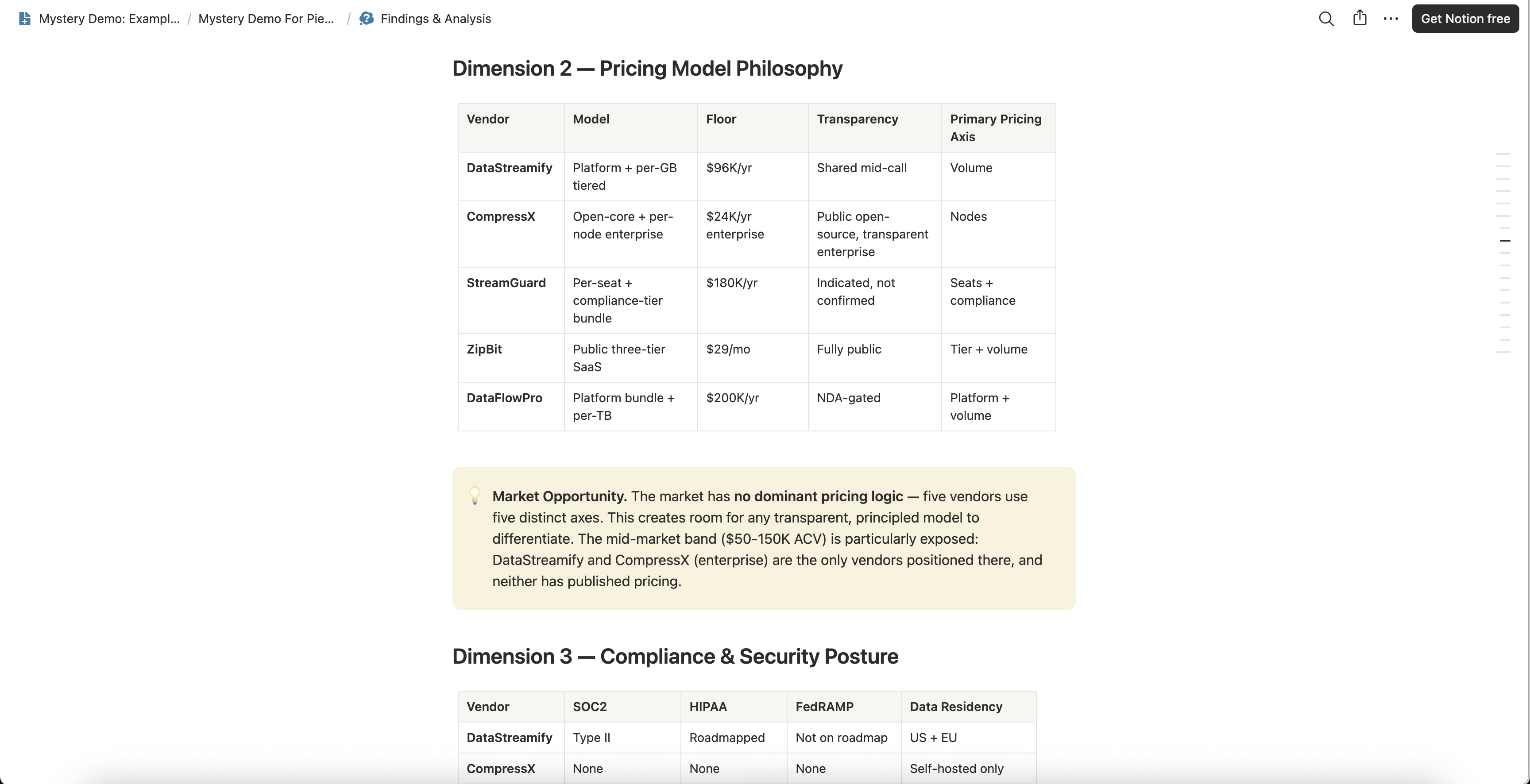
That comparison is the core of SaaS competitor pricing research. A pricing committee can decide from it, and a rep who hears “they’re cheaper” in a live deal can check the claim against what the rival quoted a buyer like theirs.
A quote is still one buyer’s evidence. One call shows what one rep offered one buyer on one day, and the number becomes the rival’s price for buyers like yours when it holds through that rival’s later calls, from the demo to the written follow-up. It is also an offer, not a signed price: we sign nothing and buy nothing, so the board stops at what the rival offered.
Start With the Rival Whose Price You Are Guessing
Before any call, write down two things: the deal you price against, with its seats, term, tier and region, and the rival whose number your team keeps guessing. A kickoff starts from those two lines.
Mystery Demo charges a flat €499 per competitor, with everything included: the buying scenario, every call, the recordings, the transcripts, the analysis and the board. One rival takes one to two weeks, and a full landscape takes four to eight, because the calls run in parallel.
Your next pricing review will put a number beside each rival’s name, and most of those numbers will be printed or reported. The one that matters most can be a quote instead, said by that rival’s own rep to a buyer like yours, with the recording ready to play in the room. An intro conversation with us is where we pick that rival and write its buyer.


