
Yes. Mystery shopping a competitor’s sales demo is legal.
Reps behave differently when they believe a deal is real, which is why we sit in competitors’ demos as a genuine buyer on your behalf instead of reading their website and guessing.
The evaluation is real. Real SaaS operators assess real software, nobody is impersonated, and the only fact withheld is who asked us to look.
We never sign an NDA. We never pay for the product. No contract is broken and nothing is obtained by fraud, which is what the word legal rests on.
That is the answer. What companies pay for is the part underneath it: what a rival says, quotes, and shows once they believe the deal is real.
Mystery Shopping Was a Profession Long Before SaaS Existed
Retail, hospitality, and financial services have measured their own service this way since long before software had a category, and the research industry defines it in almost clinical terms.
The professional guideline describes the use of individuals trained to experience and measure a customer service process by acting as potential customers, then reporting back in a detailed and objective way.
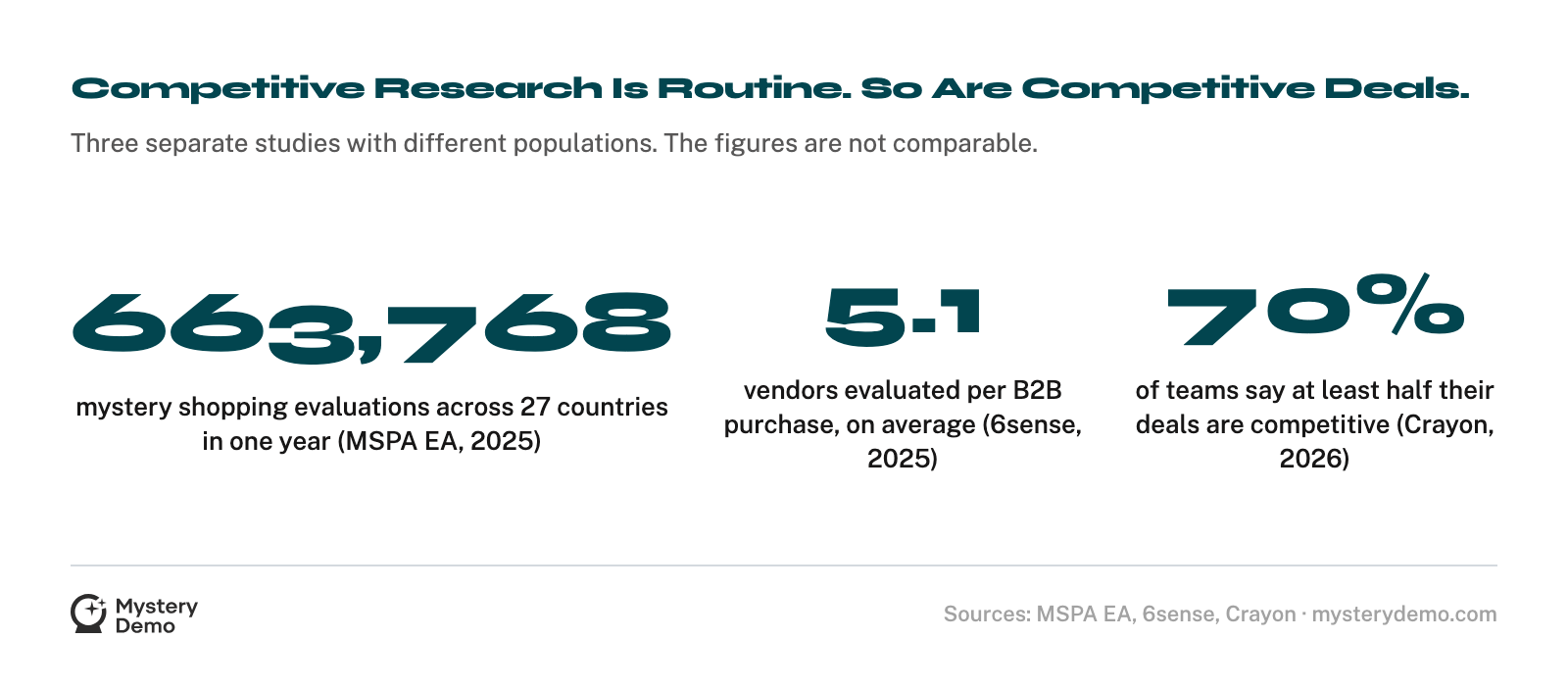
The guideline was written for shop floors. Applying it to enterprise software changes which industry is being measured, not whether the method is a recognized one.
Two Red Lines Do All the Legal Work
The boundaries are short enough to hold in your head, which is the point of having them.
We never sign an NDA. An NDA is the mechanism by which a vendor converts a conversation into a contract, and a contract is the only thing in this picture capable of being breached. We do not enter one.
We never pay for the product. Buying a license means accepting terms about who may use the software and for what. We do not buy, so there is nothing to accept and nothing to violate.
What is left is an ordinary sales process: a form, a call, questions, a demo, a quote, a follow-up sequence. All of it started by a buyer who is genuinely evaluating the category.
Nothing About the Process Looks Unusual From Their Side
The question a cautious founder asks next is whether the vendor works it out afterward.
They do not, and the reason is dull. An operator books a demo, asks informed questions, evaluates the product, and follows up like a buyer whose calendar was already full before this vendor showed up. There is no odd moment for anyone to notice.
We also close the loop properly. We reply to the emails, answer the follow-up, and let the thread end the way sales threads end, after several increasingly hopeful nudges. Nothing about the sequence is unusual enough to prompt a second look.
Your name never reaches them. The vendor sees a buyer evaluation, and who asked for it stays out of the conversation.
The ethical line sits in the same place as the legal one. Professional codes in this field prohibit misrepresenting the qualifications, experience, or skills you hold, and the operators on these calls hold the ones they claim.
Recorded Demos Become Evidence You Can Go Back To
A summary of a sales call is one person’s memory of it, compressed on the way out. The recording keeps the call as it happened, and four things survive in it that a summary loses:
Timestamped transcripts make all of it searchable in seconds, which matters more than it sounds like it should. A colleague who doubts a finding can go and check it, and that tends to end the argument faster than arguing does.
Desk Research Runs Out Exactly Where the Deal Starts
By the time a company calls us, it has usually exhausted the respectable desk research: the website, the review grids, the lost-deal notes, and the confidence that comes from studying material a rival wrote about itself.

Booking those calls yourself does not solve it either, for reasons the category explainer goes through: your domain is on their CRM, and a rep who cannot place you still qualifies hard.
.png)

Per-Vendor Pages Keep Every Claim Attached to Its Source
What comes back is a structured Notion intelligence board, and every page on it opens on the minute of the recording that produced it.
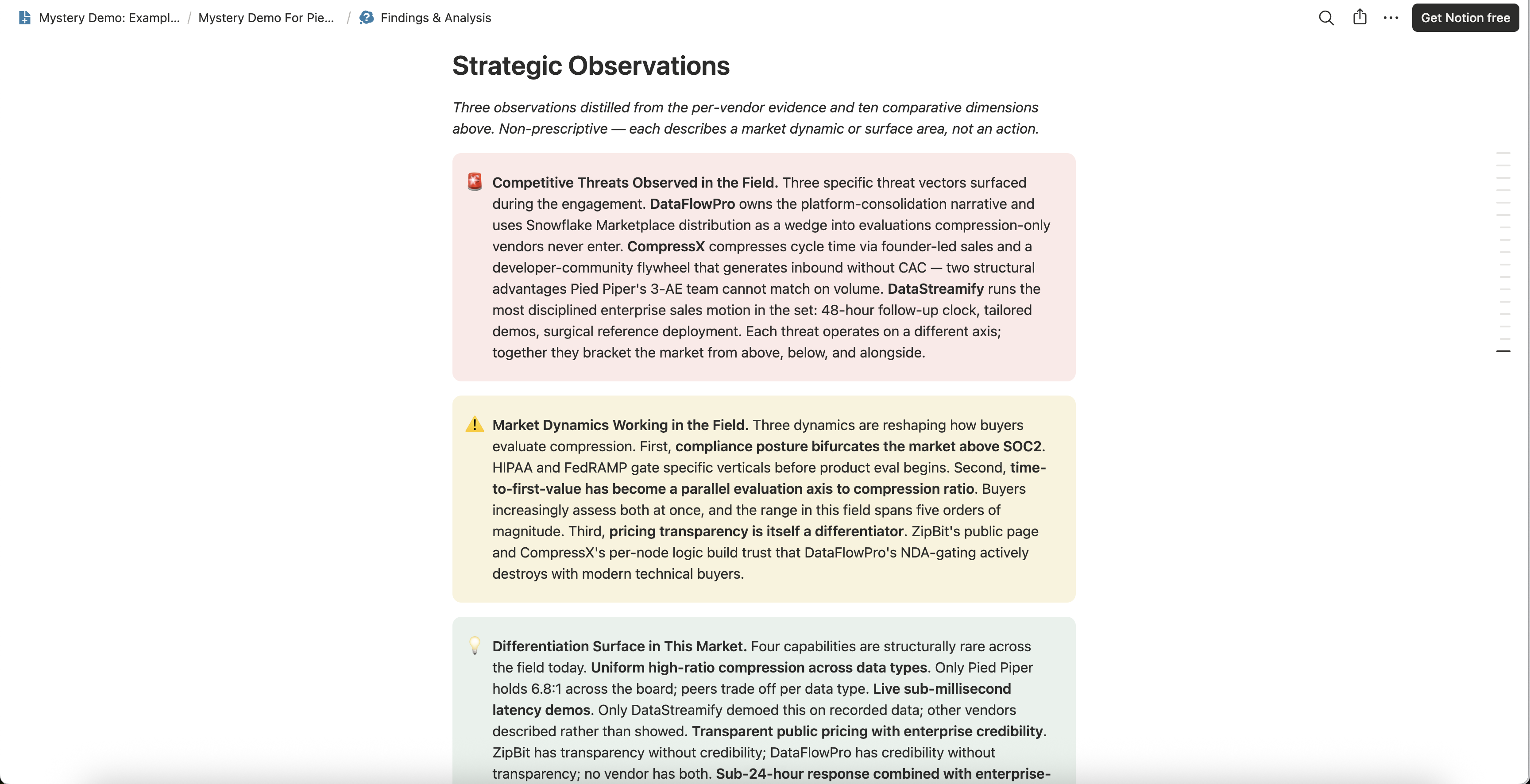
Matrices put five sales stories under the same light. The Executive Summary gives leaders the readout, and the Findings and Analysis page explains what the calls were doing.
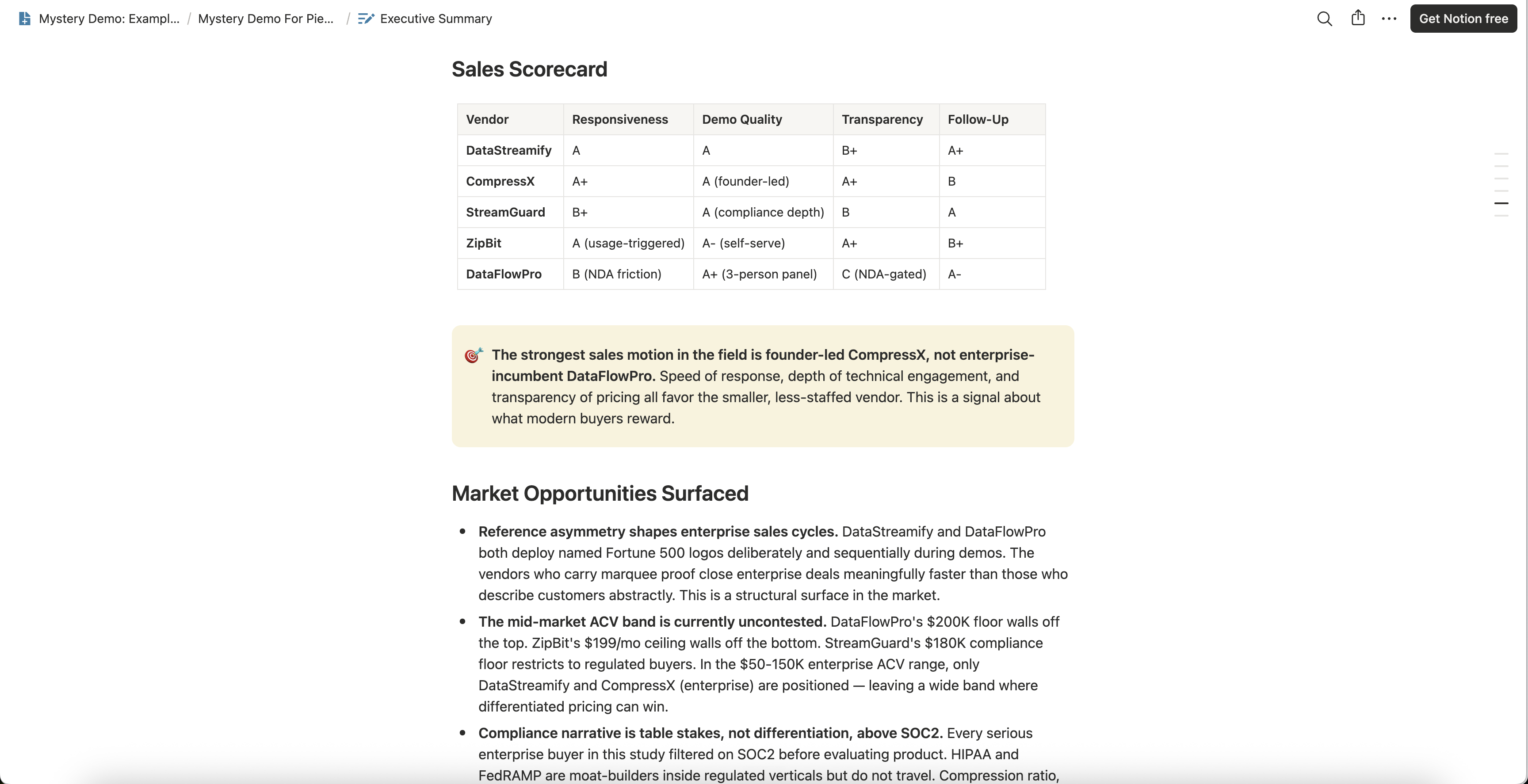
Four People Read the Same Board for Four Different Reasons
That is the practical argument for keeping every claim attached to its source, because the board gets opened by people looking for different things.
| Who opens it | What they go to first |
|---|---|
| Founder | The Executive Summary and the cross-vendor observations |
| Product leader | What was demonstrated live rather than described, and the roadmap language around it |
| Marketing leader | The pitch: order of emphasis, the proof each vendor reached for, the words they use for the category |
| Sales leader | Objection handling and follow-up cadence, which is what their reps meet in a live deal next Tuesday |
The recordings stay underneath all of it, so any of those four can check the read against the moment it came from.
What that produces is a review of how each competitor runs its sales process that a sales leader can defend line by line, rather than a slide nobody can source.
All of it runs on a fixed fee. 499 euros per competitor covers the fábula, the meetings, the recordings, the transcripts, and the analysis, with five competitors at 2,495 and ten at 4,990. A single competitor takes one to two weeks, a full landscape four to eight.
If the recordings themselves are the part you are unsure about, recording a sales demo has its own short answer and it is worth reading before a legal review asks.
Which name on your shortlist could nobody in the building describe in a sentence? That is usually the one worth doing first, and a short call is enough to scope it.
.png)


