
Nobody has ever hired us because they wanted a video file. They hire us because of what the video file makes checkable six weeks later, in a room where somebody disagrees.
Recording the call is the easy part, and it is lawful: no NDA is signed, no product is bought, and the operator on the call is a real person evaluating real software.
The reason companies pay for it is narrower. A sales call is the one place where a rival’s working price, their product as it demos rather than as it is described, and their answer to a hard question all show up together, in front of a buyer they are taking seriously.
We book those calls on your behalf, sit them as genuine buyers, and record what happens. Then we turn the recordings into something a colleague can check.
Record It, Because the Alternative Is Somebody’s Memory
The version of a sales call that survives without a recording is a set of notes, written by someone who was also trying to keep the conversation going.
Notes capture whatever struck the note-taker. They lose the sequence, the hesitation, the exact figure, and the question that produced the answer.
A recording keeps all of it, and does something notes cannot. It stays available to people who were never on the call.
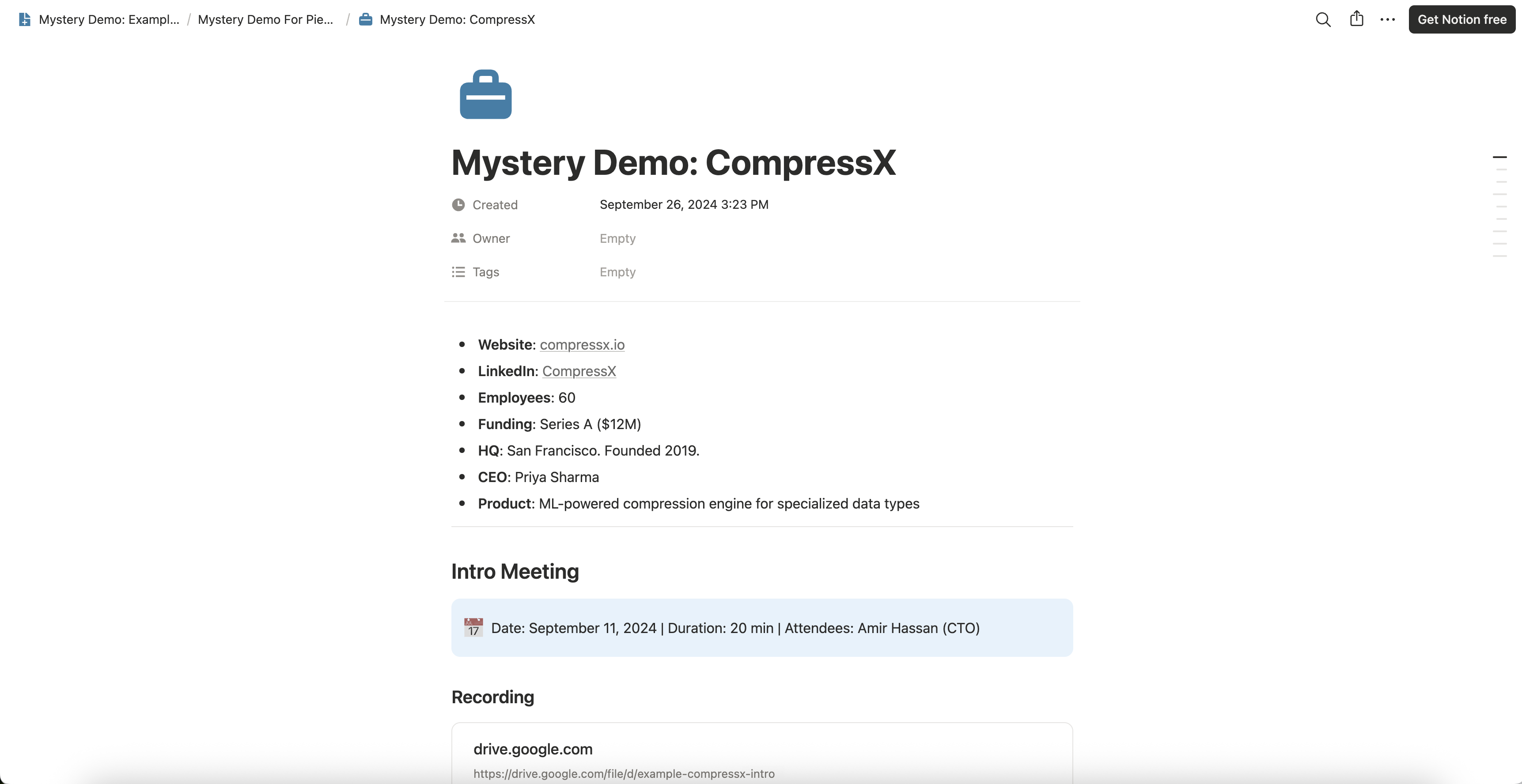
That is what a recorded session looks like once it is on the board: the call, its transcript, and the minute you jumped to, all in one row.
Your pricing lead, your head of product, and your VP of sales can each read the same thirty minutes for three different reasons, months apart, without any of them having to trust a summary.
A Thin Story Gets a Thin Demo
There is a version of this that produces a useless file. Somebody books a demo with a thin story, cannot answer a qualifying question, and gets ten minutes and a follow-up email.
That recording is thirty megabytes of nothing.
So the operator is a real SaaS professional evaluating real software, working from a fábula: a truthful company profile, a believable use case, a buyer persona, and commercial details that hold together.
Reps respond to that the way they respond to any serious buyer. They qualify properly, they dig, they bring in a solutions engineer, and they show the product instead of the deck.
What ends up on the recording is the process the rep ran for a buyer they took seriously, which is evidence. Everything you would otherwise be working from is extrapolation.
Read the Whole Session Before You Trust One Line
A single line from a demo is easy to misread once it has been separated from the question that made the rep say it.
A price said out loud in minute forty means one thing on its own. With the discovery questions from minute six beside it, you can see what the rep had learned before putting a number on anything.
.png)

Weeks later the team is arguing about what that number was attached to. The recording settles it in about forty seconds, which is the least glamorous reason to keep one and easily the most common.
The call is the evidence. The correspondence shows what they were willing to put in writing afterwards.
The proposal that follows, the deck they send unprompted, the second call they offer without being asked: each one adjusts the read of what happened on the first call.
Every Claim Sits Ten Seconds From Its Source
Recordings are only worth having if you can get back into them, which is what the database on the board is for.
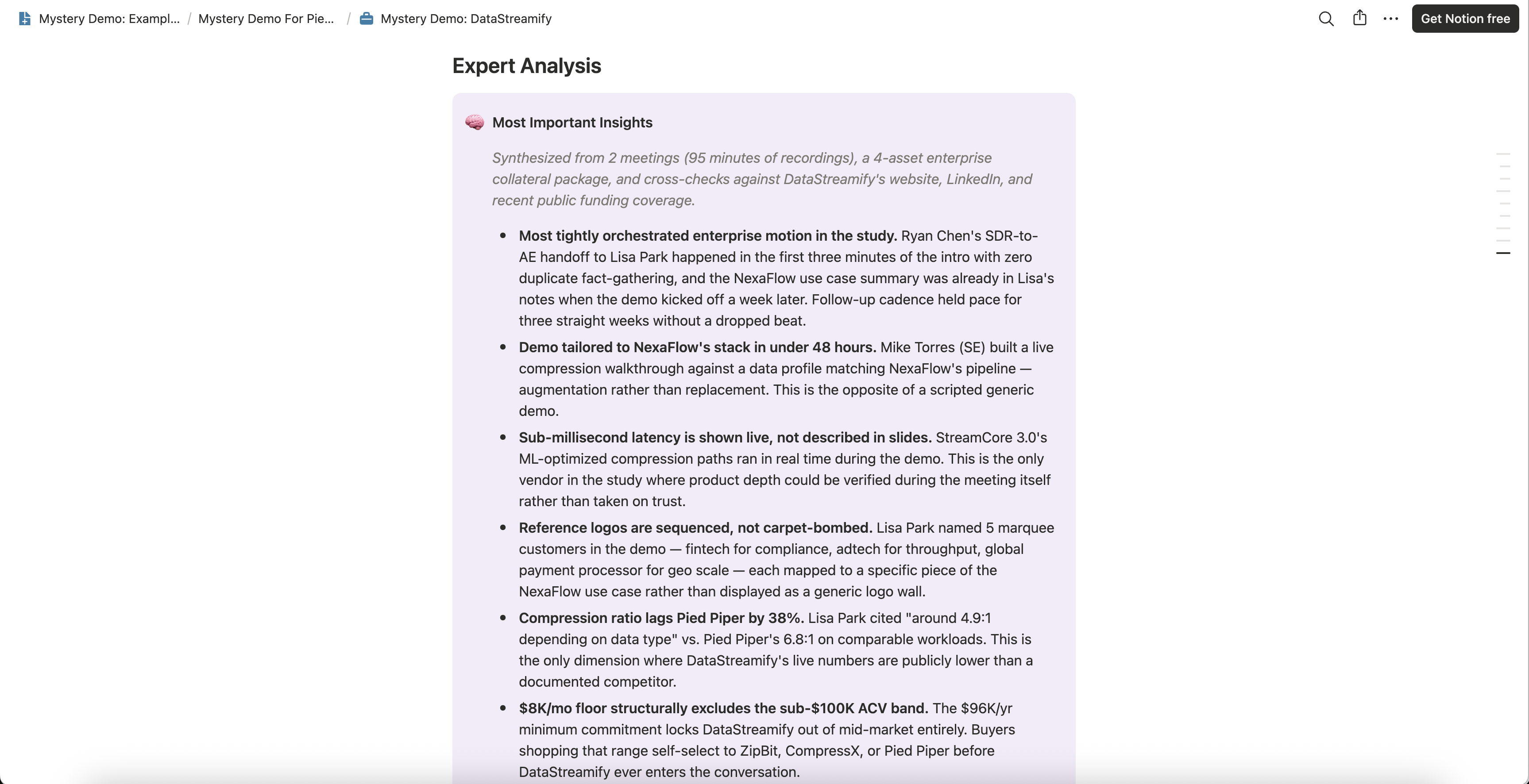
The structure is dull, and it is what makes the analysis checkable. Every conclusion has a route back to the moment that produced it.
A colleague who doubts a finding can go and check it, which tends to end the discussion faster than arguing about it does.
The recordings are handed over with the board. They belong to the partner.
A search box finds the word. Whether the rep ran the workflow on screen or talked around it is written on the vendor page by the person who watched.
The per-vendor pages are where somebody who sat the call writes down what they think it meant, keeping what was demonstrated separate from what was merely asserted.
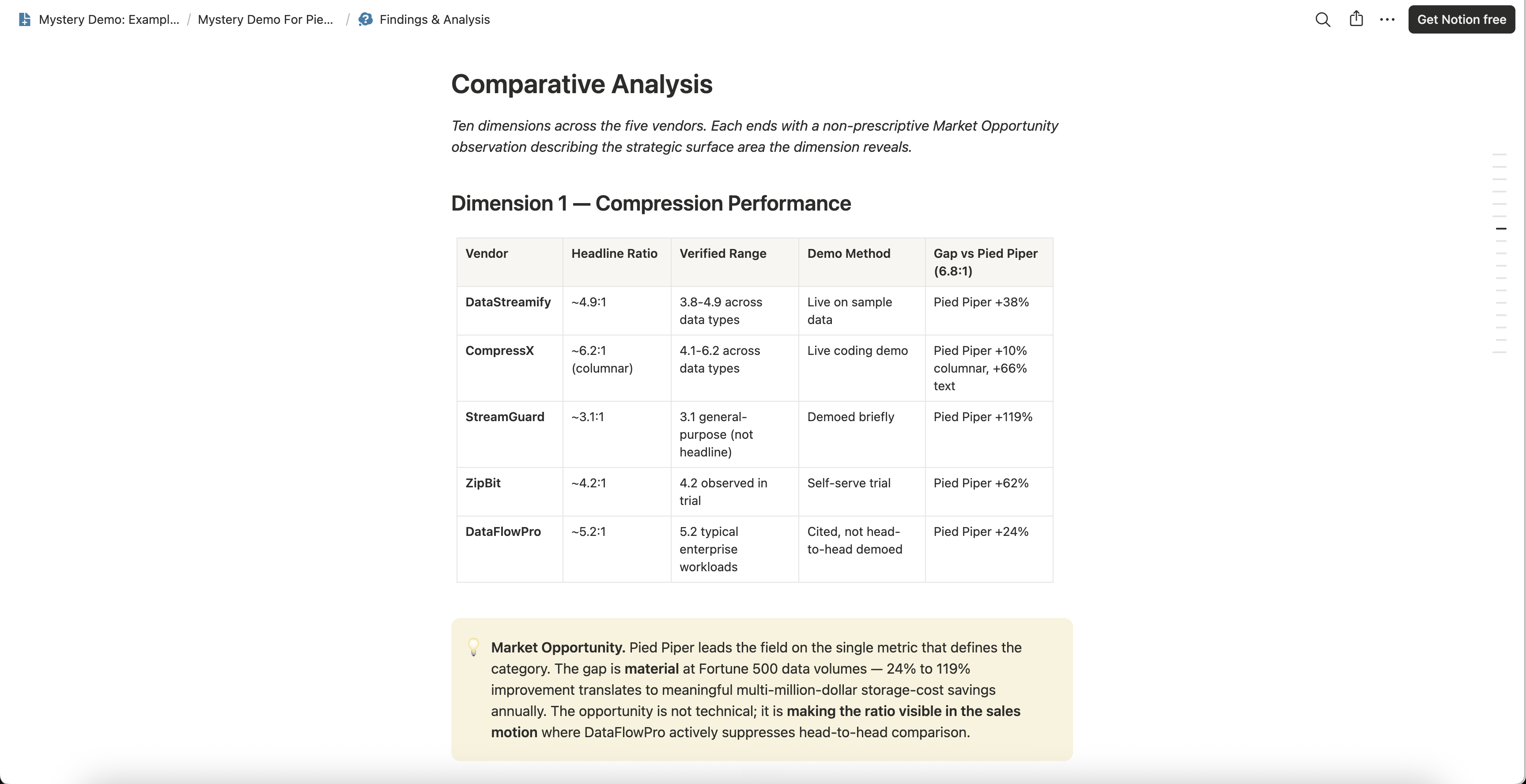
Comparison matrices then put the same questions to every vendor, keeping three grades of evidence in separate boxes:
Side-by-side research gets less flattering once those stop sharing a cell. Every row in the database points at one vendor, one meeting, and one timestamp, so finding a claim takes a search rather than an afternoon.
Once the evidence is organized that way it stops being a research project and starts being battlecards where every line cites the moment it came from.
What a Project Costs, and How Long It Takes
All of it runs on a fixed fee: 499 euros per competitor, covering the fábula, the meetings, the recordings, the transcripts, and the analysis. One competitor takes one to two weeks, a full landscape of ten to fifteen takes four to eight.
If the legality of the wider method is the part you still want argued properly, the case for mystery shopping a competitor’s demo is set out on its own.
If you already know which competitor you would want watched, that is enough to price the work on a scoping call. If you do not, the shortlist usually names itself once somebody asks which rival nobody in the building can describe.
.png)


