
Your rep is mid-call, and the buyer has just said a competitor’s name. The battlecard opens. From here, everything depends on what is written in it.
Most cards are written from the competitor’s website, plus whatever the last lost deal left behind in the CRM. The buyer, meanwhile, sat that competitor’s demo last week. They have heard the pitch, watched the product, and been quoted a number your card has never seen.
Mystery Demo exists for exactly that gap. We go through your competitors’ sales processes as a real buyer, sit their demos, and bring back the recordings, the transcripts, the email threads, and the read on what they mean.
Great battlecards are built from what a competitor says while selling, not from what they publish. That one sentence decides everything else: the intelligence a card needs, the way we collect it, and the job each piece does on the card.
The Intelligence a Battlecard Runs On
Strip any battlecard down to what wins deals, and three kinds of knowledge are doing all the work.
None of that is published anywhere. A website carries the version of the pitch written for everyone, and your reps are losing to the version built for one buyer.
The spoken pitch is chosen in the room. A rep opens with whatever discovery surfaced about the buyer in front of them, names the rivals that buyer already mentioned, and moves the price when the objection arrives. The same vendor runs two different pitches in the same week, and neither one is the homepage.
So the intelligence a great card needs lives in exactly one place: inside the competitor’s own sales conversations. Somebody has to go through them as a buyer, and that is the job we do.
What Mystery Demo Is, and How a Project Runs
Mystery Demo is mystery shopping for B2B SaaS. You name the competitors, we go through their funnels as a genuine evaluator, and everything they said on the way comes back to you.
A project runs in five stages:
We never impersonate a real person, and we never lie about our own background. A firm that evaluates software for the companies it works with is an ordinary thing for a vendor to hear from, and the only invented element in the fábula is the client we say we are representing.
A competitor costs a flat 499 euros, everything included. Scenario, booking, every meeting, recording, transcript, analysis, delivery. There is no second invoice.
One competitor takes one to two weeks. A full landscape of six to fifteen takes four to eight, because the funnels run in parallel rather than in a queue.
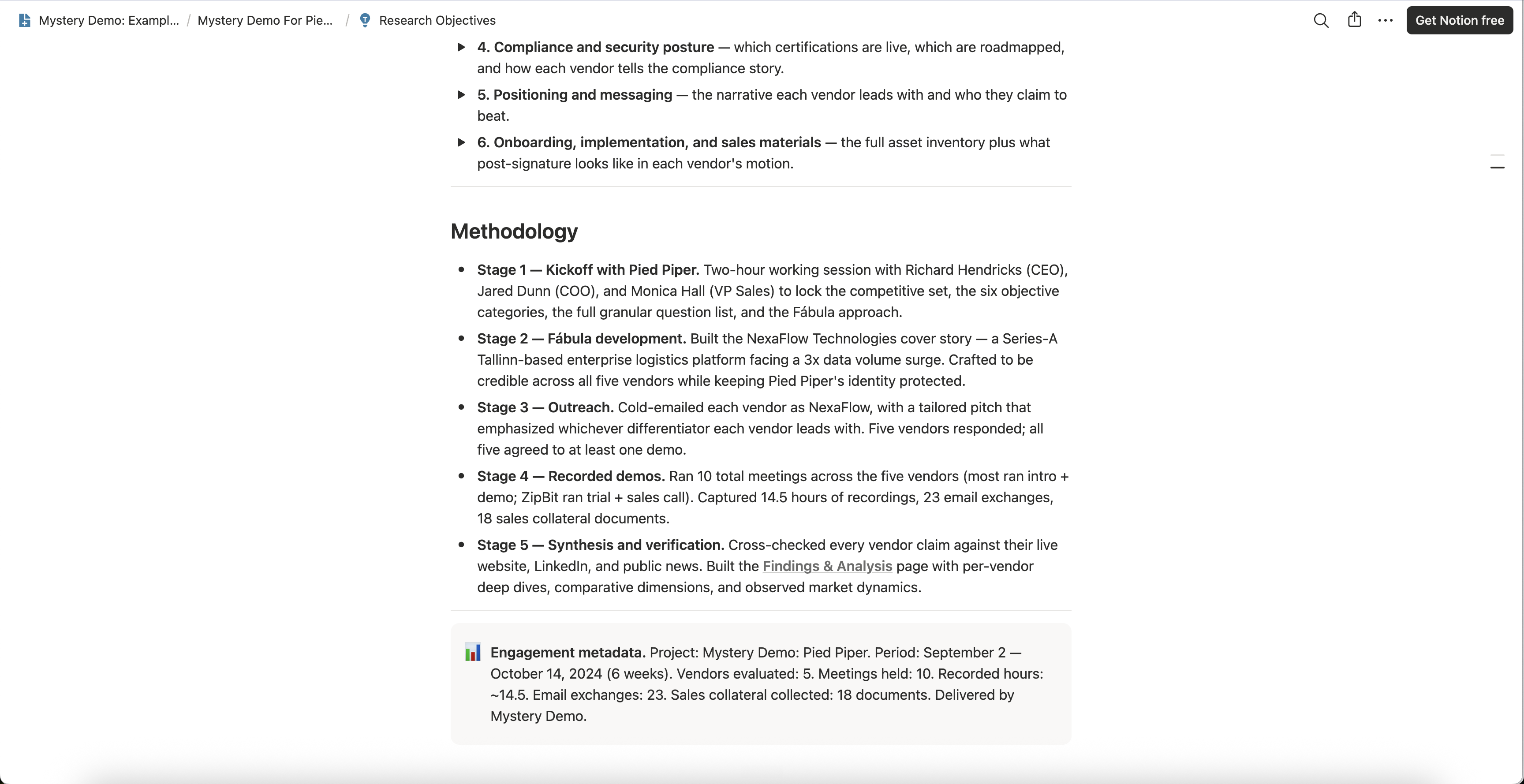
Below is the methodology page from our public example board, where the client and every vendor on it are invented. Every engagement gets its own version of this page, written from your competitive set at kickoff.
The Information We Collect, in Detail
What comes back is a Notion board, and each competitor gets a page of their own.
The raw layer on that page is everything the vendor produced while selling to us:
On top of the raw layer sits the read, and this is the part your card is built from.
How they sell, and what they could show. The order they run the motion in, what they qualified on, and what they did when the answers were not the ones they wanted. Every capability gets marked as shown live or merely described, because a feature demonstrated under a question the rep did not control is a different fact from a slide.
How they price, and how they position. The verbatim pricing quote, the model underneath it, and what moved the number. The category they claim, who they name as the alternative, and the subject that never comes up.
Where they are strong, and where they are not. Both, honestly, because a card that only lists weaknesses gets a rep laughed at in the first meeting it matters.
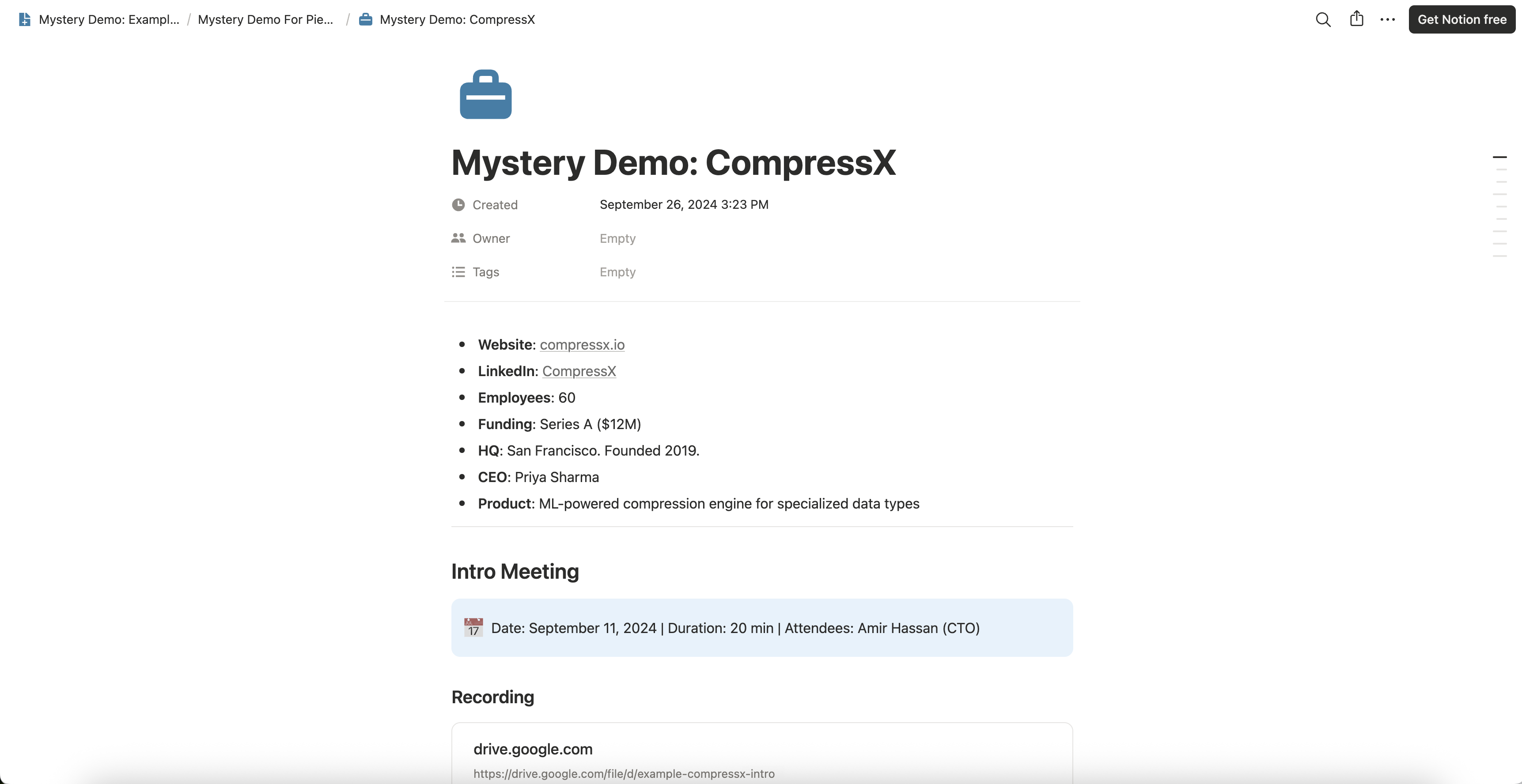
Here is one competitor’s page from the example board, holding the meetings, the transcripts, and the analysis in one place:
Across the whole set, the same evidence is cut the other way: a pricing matrix, a feature matrix separating shipped from asserted, a sales scorecard grading every vendor’s motion, and a page naming where each competitor wins. Underneath it all sits a Database page where every claim resolves to a recording, a transcript, or a document somebody can open.
That is the raw material. The battlecard is what it turns into.
A Structure for the Battlecard
One card per competitor, seven sections, and one rule that keeps it honest: nothing goes on the card unless it traces to something the competitor said or showed. That is the same bar an evidence grade in competitive research sets for everything else we hand over.
| Card section | What it answers for the rep | What fills it from the board |
|---|---|---|
| How they pitch | The story the buyer heard before you got a word in | The discovery and demo recordings, and the read on how they sell |
| What they really charge | The number this buyer is being quoted, not the tier list | The verbatim pricing quotes, and the minute the number moved |
| What they can show | Which capabilities run live on a screen and which live on a slide | The demo recording, at the moment they showed it or moved past it |
| How they come at you | The comparison their rep makes when your name comes up | The transcript passages where your name or category was raised |
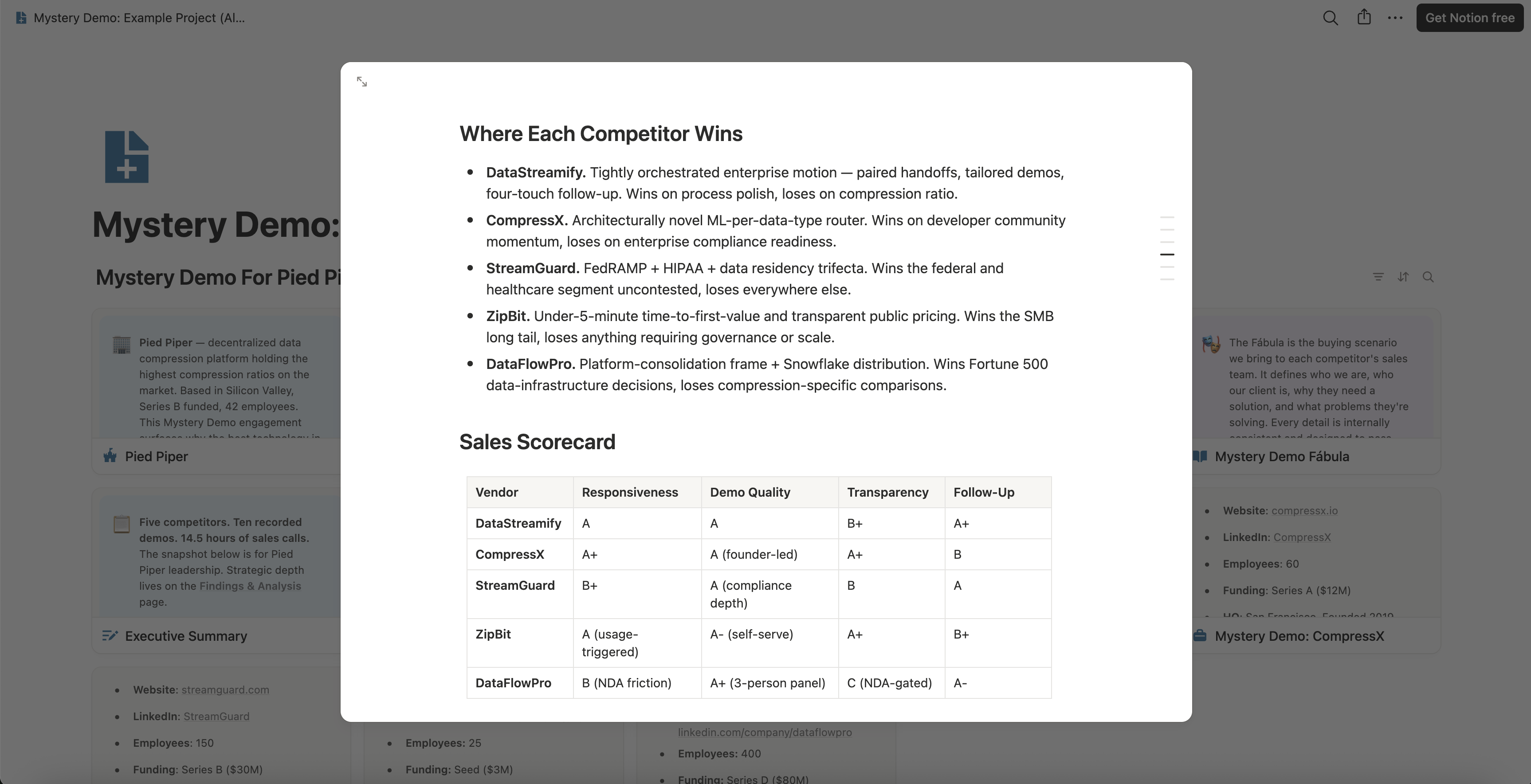
| Where they genuinely win | The deals to stop fighting for | The where-each-competitor-wins page and the sales scorecard |
| Questions that pull them off script | What your buyer should ask in the rival’s next demo | The moments their rep retreated to a case study or a roadmap date |
| The receipts | Where every line above came from, and when | The Database page: recording, timestamp, thread, file |
The seventh section is what makes the other six safe to say out loud. A line with a recording behind it can be checked by the rep who says it, by the manager who signs off the card, and by whoever inherits it next quarter.
How to Use Each Piece, Section by Section
.png)

The card gets used in the room, so the guidance below is written for the room.
How they pitch. Open it in discovery, the moment the buyer names them. You already know the story that buyer heard, so ask which part of it landed instead of guessing at all of it.
What they really charge. Save it for the finalist round. “They came in lower” stops being a number to beat once you know their quoted floor and the objection that moved it, and becomes a position to test.
What they can show. Use it when the buyer says the rival showed the same thing. You know what that demo showed, the step it skipped, and the data it used, so run the same job live and let the difference speak.
How they come at you. Use it before the attack lands, not after. Say the true half of their line yourself, early, because a concession the buyer hears from you first takes the sting out of hearing it from them.
Where they genuinely win. Use it at qualification. Some deals belong to their motion, and knowing which ones saves your team a quarter spent proving it the expensive way.
Here is the page that section is lifted from, one win-and-loss line per vendor, written from the calls rather than from anyone’s impression of them:
Questions that pull them off script. Hand these to your champion before the rival’s next demo. The questions that made their rep retreat to a case study or a roadmap date will do it again, in front of your buyer this time.
The receipts. Use them the moment the card is doubted, because that moment decides whether it keeps getting opened. The rep checks the minute in the recording instead of asking around, and the argument is over.
A Card Expires When Their Motion Changes
Not when their website does. The week a competitor’s reps start opening on security instead of speed, or quietly drop one of the things competitors almost never do in a demo, no page changes anywhere. Those are the changes that cost you deals.

That is why partners re-run projects one to three years later. The second board shows what moved, and the card gets rewritten from evidence instead of drifting on memory.
So tell us which competitor keeps showing up in your losses, and we will go through their entire sales process as the buyer they most want to win. What you get back is the seven sections above already filled in, every line with its receipt: battlecard research built on recorded demos, end to end. Put one competitor on our calendar and watch what your reps do with a card they can check.
.png)


