
Open your competitive matrix and look down any column. If every rival has a green tick on nearly every row, you already know why sales stopped opening it. A grid where everyone has everything cannot tell a rep what to say when a buyer names a rival.
The ticks are not lies. Each one was copied from a rival’s website, and a website can only tell you that a feature exists. When a buyer asks that rival’s rep to show the feature, one of these happens:
Your reps need to know which of those happened, and a tick cannot tell them.
Mystery Demo finds that out. It takes your rivals’ sales demos as a genuine buyer, asks each rep to show the rows on your matrix, and records what happens. Those recordings fill a matrix your reps can use in a live deal, with one mark per cell for what the rival’s rep showed when asked.
A Website Can Only Tell You a Feature Exists
A tick still records something true. A rival’s website, docs, release notes and pricing page can tell you whether a feature exists and which plan carries it, and a free trial lets you click it yourself. That is worth recording, and a good matrix keeps it.
The guide Google ranks first for “competitor matrix” this month builds one the same way. It takes the product row from each rival’s website, the price from its pricing page and the ratings from review sites. It stops there, because no page can tell you what happens when a buyer asks to see the feature.
Here are four rows, as the website puts each one and as a buyer asks about it on the call:
| The row | What the website tick says | What the buyer asks on the call |
|---|---|---|
| Two-way accounting sync | Integrates with your accounting system | “Can you change an invoice here and show it update in our books?” |
| Custom approvals | Build any approval flow | “Can you set up our three-step sign-off while we watch?” |
| Single sign-on | Enterprise-grade SSO | “Which plan is that on, and can you add a new user without IT?” |
| Usage reporting | Real-time dashboards | “Can you show us a report by team, not a sample screen?” |
Each of those questions puts the rival’s rep to the same choice: show it, or say something instead. Each answer tells your rep something different.
A review site tells you how customers felt after they signed, and a tracking tool tells you a page changed. Neither was there when the buyer said “show me.”
That moment only happens on the rival’s sales call, and nobody from your side is on it.
Mystery Demo Takes Your Rows Into the Demo
Mystery Demo gets onto that call, and the work starts from your matrix. At kickoff, your rows become the project’s research objectives. You also show us your own product, so our questions sound like a real buyer’s.
Then we write one buying scenario, covering the kind of company that is evaluating, its size, the tools it uses now and its deadline. The scenario is adjusted to each rival’s ideal customer, so every rep meets a buyer worth a real demo. The evaluation is real, because we are evaluating that software on your behalf, and nobody is impersonated.
Here is the road one row travels, from your grid to a cell:
The rows stay the same for every rival, even where the scenario is adjusted to fit one. That is what lets you read across a row and compare.
Your own team could book these demos. The rival’s rep would see your email domain and give you the polished tour, or no demo at all.
Our buyer arrives as a company the rival wants to win, so it gets the real one, with the discovery questions, the deep dive and the follow-up. The people asking are operators who have sold B2B software themselves, so they know which question takes a rep off the slide and into the product.
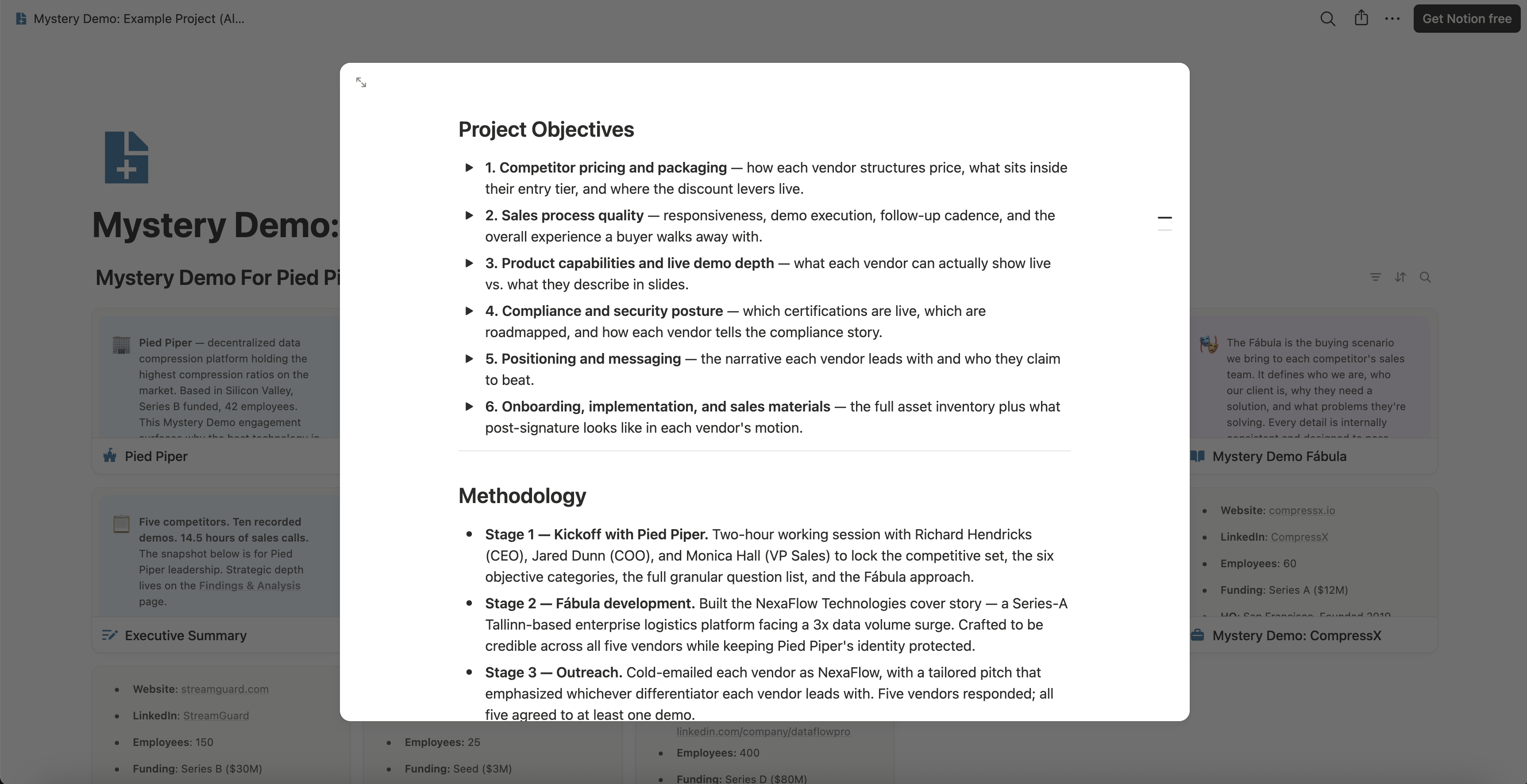
Here is where it starts on our public example board, where the client and every competitor are invented. A real project’s board is built from that client’s own calls. Its Research Objectives page lists six objectives, and one of them is product capabilities and live demo depth: what each vendor can show working on screen.
A product comparison of one rival costs a flat €499, everything included, and its board is ready in one to two weeks. A set of six to fifteen rivals takes four to eight weeks, not months, because their demos run at the same time.
If your matrix has rows nobody on the sales floor trusts, send them to us with the rivals your reps meet most. We will take each rival’s demo as the buyer and come back with a mark in every cell.
Every Mark Comes Back With Its Recording
The calls land on one Notion board. Each rival gets its own page with the recordings, the transcripts, the emails and our analysis of how it sells. The Database holds every recording in the project, so any moment can be played back.
The matrix itself lives on the Findings & Analysis page, where the rivals are compared one dimension at a time. The invented client on the example board sells data compression. Its first dimension puts the compression rate each vendor advertises beside the range its demo proved, and says how the demo showed it.
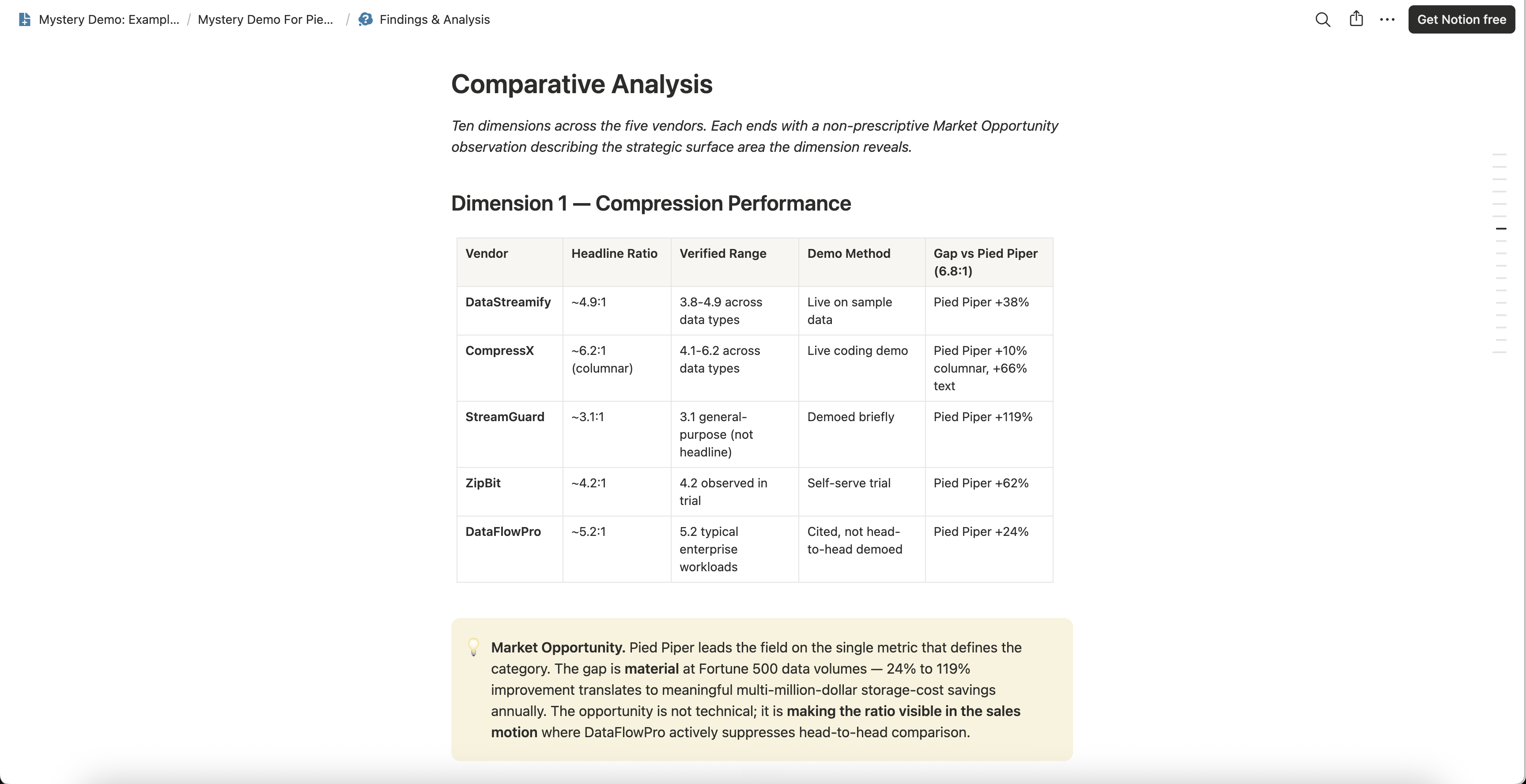
Swap compression rates for your own rows, and that column is a feature matrix with its proof attached. On a real project, each cell in it leads back to a call and a minute in the Database.

A board holds all of that. A rep in the middle of a deal needs one page, built from it.
The Competitive Matrix, Part by Part
The matrix has six parts. Each answers something a buyer says to your rep about a rival, and each is filled from a named page of the board, so nothing goes in a cell without a call behind it.
| Part | What it answers on a live call | What fills it |
|---|---|---|
| The columns | “How do you compare to Rival A?” | Your rivals, chosen on the Research Companies page |
| The rows | “Can you do what we need?” | The questions your deals turn on, set as Research Objectives |
| The scenario line | “Would that hold for a company our size?” | The buying scenario on the Mystery Demo Fábula page |
| The mark in each cell | “They told us they have that too.” | Each rival’s own page, from the recordings |
| The minute behind the mark | “Are you sure that’s what they said?” | The Database, where the recording plays |
| The finished grid | “So where are they weaker?” | Findings & Analysis, rivals compared row by row |
Here is one filled in, for a different invented category: dental practice software. The rivals are lettered, and every mark on it is invented to show the shape. On a real project, every mark comes from a recorded call.
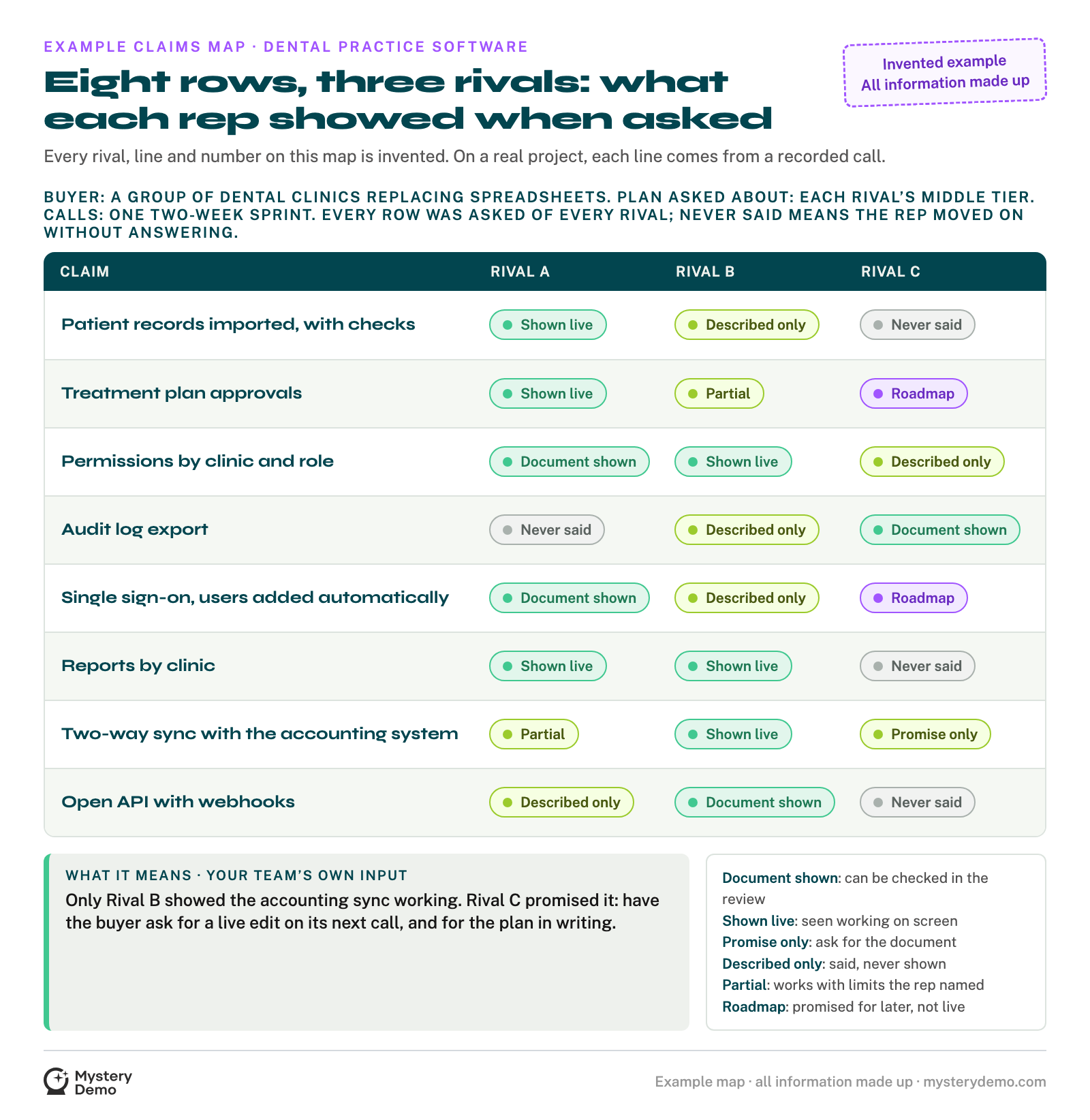
Read the line under the grid first. It says who the buyer was, which plan was asked about, and when the calls ran.
Then read across one row. On the first row, where your old grid has three ticks, one rival opened the feature, one described it and one never answered.
The table says where each part comes from. It does not tell a rep what to do with it when a buyer says a rival’s name.
How a Rep Uses Each Part on a Call
Your team chooses the rows and the columns, and the calls fill the marks. Here is what goes into each part, and how a rep uses it.
The rows. Take them from the questions buyers asked in deals you lost or nearly lost, and from the features sales hears buyers ask about every week. Cut any row the team could not act on in a deal, and keep the list short enough to read on a call.
The columns. The rivals sales meets most often. A rival nobody meets is a column nobody reads.
The scenario line. This one line keeps every mark in its place. A mark holds for that buyer, on that plan, on that date, so a rep selling to a much larger company reads it as a lead to check.
The mark. One per cell, saying what the rival’s rep did when the buyer asked to see the row:
A blank cell means the row was never asked, which is different from Never said.
The mark also says nothing about which plan carries the feature. That comes from the rival’s documents and trial, and it goes in a note under the cell. Sources differ in strength too, and an evidence grade ranks them.
The minute. Every mark points to the call and the minute it happened. A rep plays that minute before the buyer’s next call, because the rival rep’s exact words matter as much as the mark.
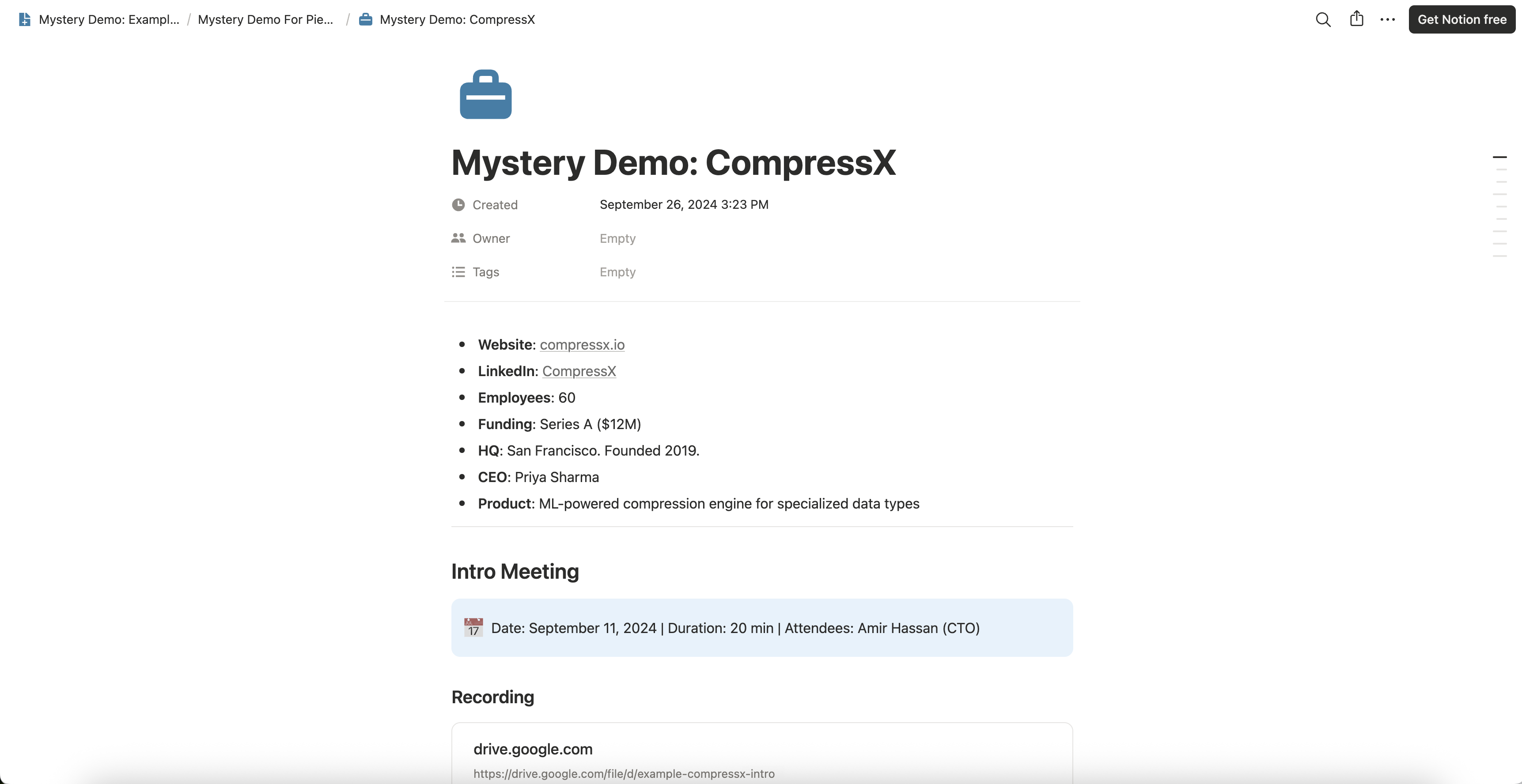
On the example board, each rival’s own page opens with the facts about the company, then the meeting and its date, then the recording itself. That is where a mark comes from, and where your rep goes to hear it.
Here is one cell from the invented example grid, followed all the way through. The row is two-way sync with the accounting system, and Rival C’s mark is Promise only.
That suggestion costs your rep nothing. If Rival C shows the sync working, the buyer has learned something true. If it cannot, the buyer remembers who told them to ask.
.png)

All of that is true on the day of the call. Rivals keep shipping after it.
When a Rival Changes, Ask the Row Again
A mark is a record of one day, so the matrix needs a rule for when a row gets asked again. Any of these is a reason:
A trigger is a reason to look again, not proof the old mark is wrong. Partners re-run a project one to three years later, or sooner when a rival moves, and the new board shows which marks changed.
Once the marks are in, test them. Hand sales the old grid of ticks and the new one with marks before a week of calls, and watch which one they quote from.
Name the rival your reps least like hearing about, and the rows where they lose to it. We will take that rival’s demos as the buyer and fill each of those cells with what its rep showed.
.png)


