
A competitor’s free trial will teach your team its product. It will not tell you what that rival charges a company your size, or what its rep says about the plans above the one you are trying. In a sales-led deal, those answers come from a rep, on a call.
If your team studies rivals through their trials, the work has two halves. The trial shows you the product, and the sales process shows you the deal. Which one you need depends on your question, and it is worth deciding before anyone spends the time.
Mystery Demo takes the sales route for you. Its team requests your rival’s demo as a credible buyer, asks the questions a deal turns on, and brings back the recordings, with an analysis of what the rep said, showed and quoted. Here is what each route reaches:
| What you want to know | Your team in the rival’s trial | Mystery Demo in the rival’s sales process |
|---|---|---|
| The product, hands-on | Setup, the core workflow and the trial plan’s limits | What the rep shows on screen, without hands-on time |
| Onboarding emails | Every email a new user gets, in order | None of these; the sales follow-up a buyer gets instead |
| How the rival sells | Only if the trial brings a salesperson to you | Every call, from the first questions to the follow-up, recorded |
| The quote for a deal like yours | Not from the product itself | Said by the rep, along with what moves it |
| What the higher plans add | What the upgrade prompts and the pricing page say | What the rep says and shows about them |
| Who the rival thinks you are | Your company, from the sign-up | A credible buyer fitted to that rival |
| Cost and time | Free, plus your team’s hours for as long as the trial runs | €499 per competitor, everything included, in one to two weeks |
The trial owns the first two rows, and they are worth having.
What a Free Trial Shows Your Team
For many rivals, the trial is one form away. In a survey of 200 software products by ChartMogul and ProductLed, run in January 2026, 57% had a free trial as the main way new customers came in.
Inside a trial, your team meets the product the way a self-serve user does:
That last item is easy to underrate. One founder who tried eight rivals’ trials as competitor research described one of them on Reddit: “A 7-day trial with no card needed. They emailed me about a free website check that came with it, then sent only one polite email after the trial ended.”
A trial also has edges, and they are worth knowing before anyone signs up:
A trial can also bring a salesperson to you. In the same survey, 80% of the free-trial products had people step in for enterprise users. That person can answer what the product cannot, though by then they know whose trial it is.
The Questions Only a Rep Answers
A sales-led deal turns on questions no product screen answers:
A pricing page and a trial show the offer a rival makes to everyone. A sales call shows the offer it makes to one buyer, shaped by what that buyer said about team size and deadline.

Your team can reach a rep too, by requesting the demo or by answering the salesperson a trial brings. A founder on X named the catch with signing up yourself: “their team knows exactly who you are.”
A rep who recognizes a competitor has every reason to keep the call short and the price vague. The answers worth having are the ones given to a buyer the rep believes.
How a Mystery Demo Runs
Mystery Demo is that buyer. Before anything is booked, its team writes a buying scenario fitted to what the rival sells: a believable company, a real reason to evaluate software, and a date it has to decide by. The demo is then requested through the rival’s normal front door, the way any serious prospect asks for one.
From there the evaluation runs like any other, and every step is recorded:
The evaluation itself is real, and the only invented part is which company it is for. Nobody real is impersonated, and taking a rival’s demo this way is legal.
Below is the method page from our public example board. The client, its rivals and every detail on it are invented, and a real project’s board is built from that client’s own calls.
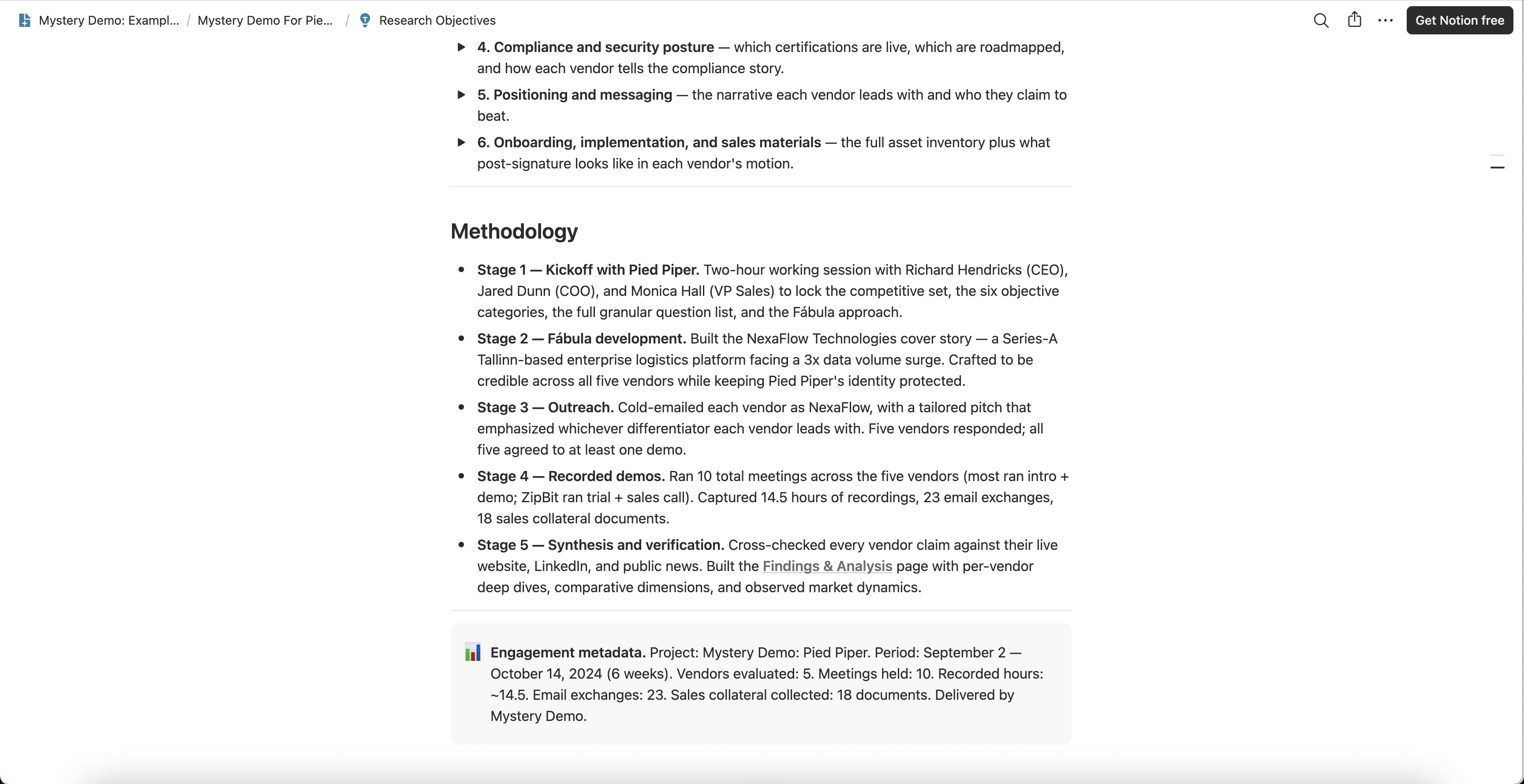
Stage four is the part a trial does not reach on its own: the recorded demos with each rival, and every email and piece of sales collateral kept beside them. Then all of it has to become something your team can use.
What Your Team Gets Back
The calls come back as a board, a shared Notion workspace your team keeps. Each rival gets a page with its recordings, transcripts, emails and collateral, and our analysis of what its rep said, showed and quoted.
Each page is one rep talking to one buyer. Every rival meets the same core buyer story, so the pages can be read side by side.
For a product team, the most useful layer is the product comparison. Every capability a rep showed or claimed gets one of three ratings:
Each rating is our reading of the calls: what the rep showed working, against what the rep only described. Every claim is also checked against the rival’s website and public news. The ratings reach the higher plans your trial did not open, and lining rivals up this way is the core of a competitor product comparison.
Here is the expert analysis on one rival’s page of the same invented board. It opens by naming its sources: the meetings and their recordings, the sales collateral, and checks against the rival’s public record.
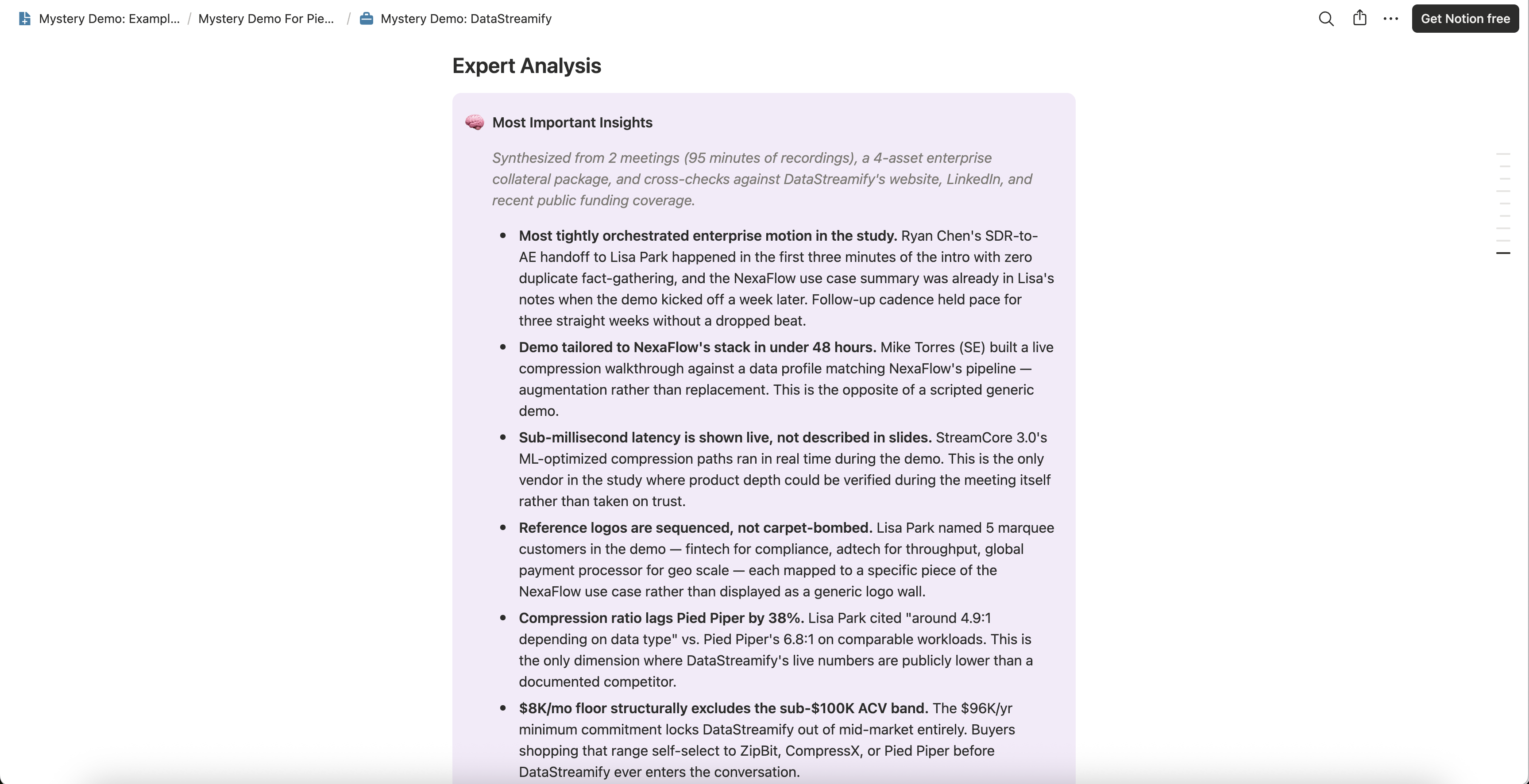
On a real board, this is where you read how a rival’s sales team handles a buyer and what it asks a buyer to commit to, two things no trial screen shows. Answers like these are worth having because of who asked for them:
The price is a flat €499 per competitor with nothing added, and one rival takes one to two weeks from kickoff to a finished page. If your team knows a rival’s trial inside out and still cannot say what it would charge you, tell us which rival that is. We will go through its sales process as the buyer and bring back what its rep quotes, on the recording.
How to Choose Between a Trial and a Sales Call
Choose by the question in front of you:
A trial shows you the product a self-serve user gets. The deal your sales team fights over is described out loud, by a rep, to someone the rep believes might buy.
So keep the trial for the product. For the deal, send us the rival and the question its trial left open, and we will put that question to its rep as the buyer.


