
Most technology buyers read user reviews during a purchase. In TrustRadius’s January 2026 survey of 1,862 people involved in a software or hardware purchase, 74% of buyers consulted user reviews as part of their buying process, most of them on a software review site.1 Yet user reviews came fourth on the same survey’s chart of the most influential resources, at 53%, behind a free trial, a product demo and the buyer’s own experience, all ways of seeing the product work first-hand.1
For a sales team, a marketer or a writer who needs a number, the figures below cover how many buyers read reviews and where, how much reviews weigh, when in a purchase they count, and how review sites compare with AI chatbots on the shortlist. Every one comes from a published survey run by a company that operates a software review site.
Mystery Demo takes the sales demos of a software company’s competitors as a genuine buyer and brings back what each rep said, showed and quoted. A review records what a customer lived through after buying. A demo is where a vendor tells the next buyer what the product will do and what it will cost, before any contract.
Key Takeaways
Most Buyers Read Reviews on a Review Site, Not on Yours
For a sales team, most buyers will read reviews during a purchase, and more of them on a review site than on your website. 74% of buyers consulted user reviews as part of their buying process in TrustRadius’s January 2026 survey, and most of them found those reviews on a software review site.1 TrustRadius runs a review site, and the 1,862 people who answered had been involved in a software or hardware purchase in the past year.
Buyers are moving their review reading away from the vendor. On TrustRadius’s chart of where buyers read user reviews, a software review site rose from 58% in 2025 to 63% in 2026,1 while the vendor’s own site fell from 46% to 42%.1 Search results pages rose from 36% to 39%1 and video reviews from 22% to 25%,1 so the vendor’s site was the only place on the chart that fell.

On the review sites themselves, buyers use more than the reviews. Self-service information such as demos or pricing led narrowly, at 19%, ahead of the review content itself at 18%, with reviewers they could relate to and feature-specific scores both at 17%.1 The same survey also asked how much reviews count against a trial, a demo or a buyer’s own experience.
Buyers Weigh What They Try Above What They Read
For a sales team, buyers rate the trial and the demo as more influential than the reviews.
TrustRadius asked its buyers which resources they consulted and, separately, which most influenced them, and published the top five for each question. It does not say whether the influence shares count every buyer or only those who used each resource, so read each column on its own.
| Resource, TrustRadius 2026 | Consulted | Most influential |
|---|---|---|
| A free trial or account | 36%1 | 77%1 |
| Product demos | 47%1 | 73%1 |
| Their own prior experience | 53%1 | 72%1 |
| User reviews | 45%1 | 53%1 |
| The vendor’s website | 42%1 | not in the top five |
| Asking a friend or peer | not in the top five | 49%1 |
All three resources ahead of reviews on influence let buyers see the product work first-hand. The 45% who consulted user reviews comes from a different chart in the same report than the 74% who consulted them, and TrustRadius does not explain the gap. Quote each with its own chart.
On a separate question, why they finally bought, 24% said customer reviews gave them the confidence to buy, the same share as in 2025,1 while the best price for their needs led at 64%.1 The share who said the demo impressed them rose from 13% to 18%.1

None of these questions says when in a purchase reviews do their work. G2 asked about each stage.
More Buyers Turn to Review Sites Later in the Journey
For a sales team, more buyers say review sites influence them late in a purchase than at the start.
G2, which runs a software review marketplace, surveyed 1,076 B2B decision-makers in March 2026. The share who said review sites influenced them rose from 40% at discovery to 44% at consideration and at decision, and to 47% at the stage G2 calls retention.2 AI chatbots rose too, from 48% to 57%,2 part of a wider shift in how B2B buyers use AI to choose software.

The decision begins with a shortlist, and the same survey measured review sites there against everything else.
Review Sites Share the Top of the Shortlist With AI Chatbots
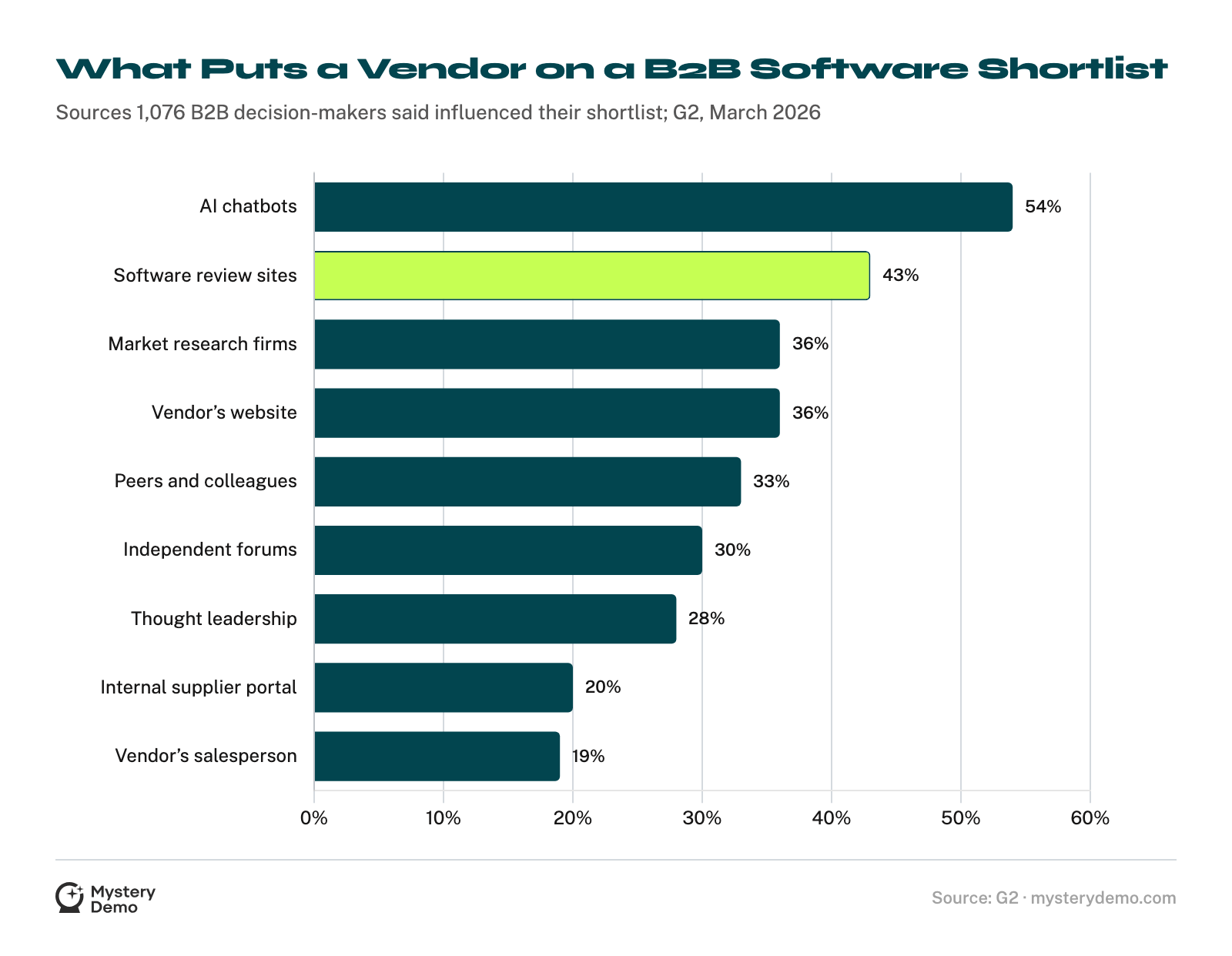
For a sales team, the vendor’s salesperson sits at the bottom of what puts a product on a buyer’s shortlist, and review sites sit near the top. In G2’s March 2026 survey, 43% of the decision-makers said software review sites influenced which vendors made their shortlist, second only to AI chatbots at 54%.2 The vendor’s own website influenced 36%,2 peers and colleagues 33%,2 and the vendor’s salesperson 19%, last of the nine sources.2
G2’s next survey reversed the top two. In June 2026, among 1,038 decision-makers, review sites led at 38%, just ahead of AI chatbots at 37%, the first time review sites had passed chatbots in G2’s research.3 G2 does not explain the reversal, so neither survey settles which source leads.
Capterra, a review site that G2 now lists in its own ecosystem, asked 3,385 software buyers in 11 countries in August 2025 to name up to four sources that most influenced their research. Among buyers with neither an unexpected implementation disruption nor purchase regret, 43% named software review or comparison sites, against 35% of buyers who had both.4
| Survey and question | Review sites | Generative AI |
|---|---|---|
| G2, March 2026, 1,076 decision-makers: what influenced the shortlist | 43%2 | 54%2 |
| G2, June 2026, 1,038 decision-makers: what shaped the shortlist | 38%3 | 37%3 |
| Capterra, August 2025, 1,147 buyers with neither disruption nor regret: up to four most influential research sources | 43%4 | 32%4 |
| Capterra, August 2025, 1,368 buyers with both disruption and regret: up to four most influential research sources | 35%4 | 42%4 |
Generative AI ran the other way among Capterra’s buyers, at 32% against 42%.4 Neither group put review sites first, since industry experts led for the buyers with neither problem, at 52%, and generative AI for the buyers with both.4 Capterra’s split shows which sources each group leaned on, not what made a purchase work.
Review sites and chatbots also meet inside an AI answer, when a chatbot cites a review site.
A Review-Site Citation Is What Buyers Trust Most in an AI Answer
For a sales team, a review site cited in an AI answer about your product is the citation buyers find most convincing.
Asked what would increase their confidence in an AI chatbot’s answer, 45% of the B2B software buyers in G2’s March 2026 survey named a citation from a review site, the top answer.2 Among those who called themselves daily chatbot users, the share was 50%.2 That measures what buyers find convincing, not how chatbots use reviews.
Sometimes a chatbot leaves out a brand a buyer knows, or gets it wrong. The most common response among the same buyers is to look for peer feedback to vet the recommendation, at 24%, just ahead of asking the AI why it left the brand out, at 22%.2 Peer feedback is the second opinion buyers reach for most often, if only just.
Reviews Are Where Buyers Check a Claim
Read together, these surveys point to one job for reviews. Buyers read them widely, mostly away from the vendor’s site, and more of them name review sites as an influence later in the journey. Reviews work as a check on someone else’s claim:
The resources buyers rated most influential, by their own account, were the ones that show the product working: the trial, the demo and their own experience.

What No Review Tells You About a Rival
Transparent pricing is the change technology buyers most want in the tech buying process, named by 59% of TrustRadius’s 2026 buyers.1 A review rarely carries the price a rival quotes today, or how it sells now, because each reviewer bought on their own deal and at their own time.
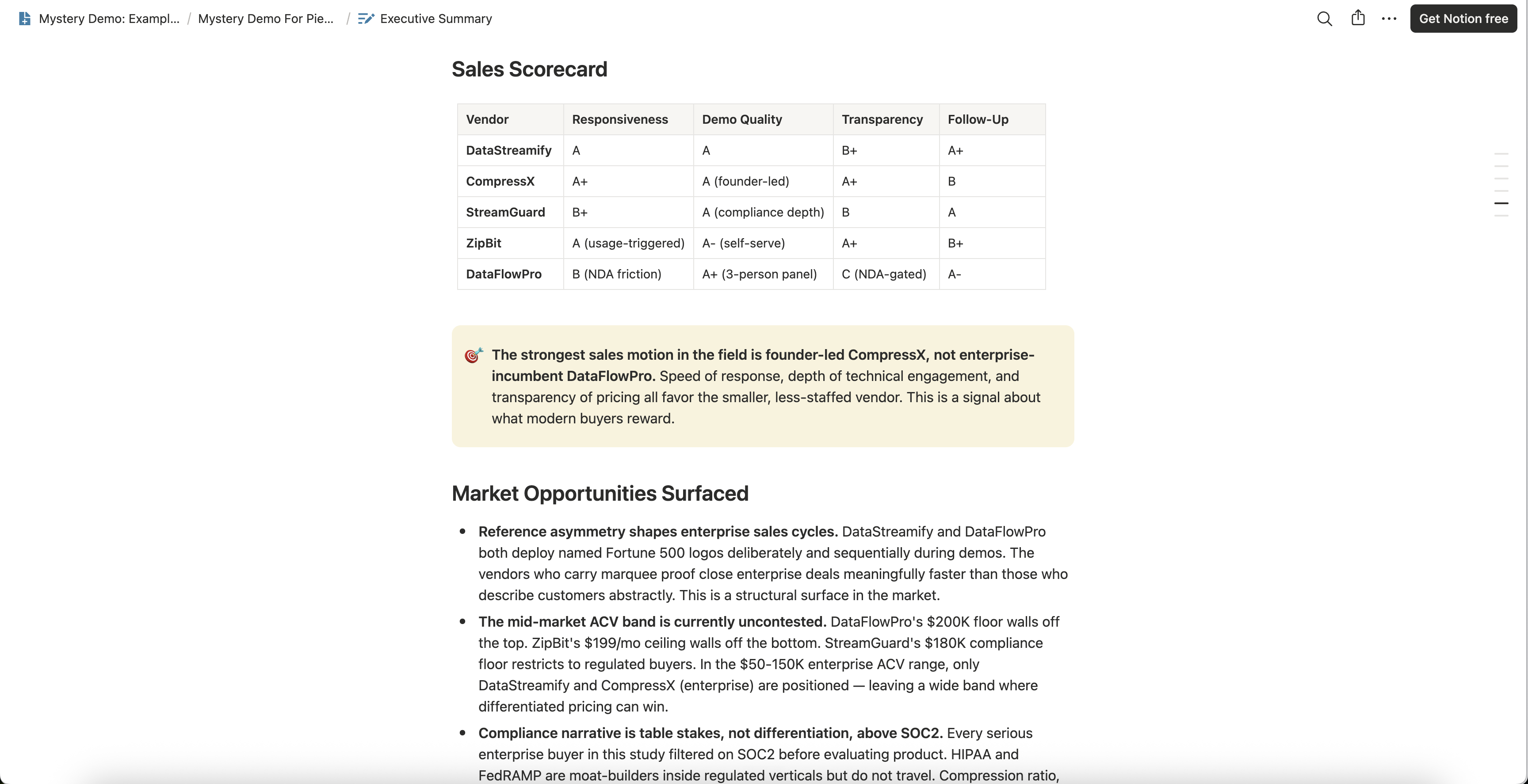
Mystery Demo gets those answers the way a buyer does, taking a competitor’s sales process from the first call to the written quote and putting every call on a shared board for the client. The page below is the sales scorecard from our public example board, where the client and all five competitors are invented. It grades each competitor’s sales process on responsiveness, demo quality, transparency and follow-up, and on a real project every grade comes from recorded calls with that competitor.
For a team mapping a whole market, SaaS market entry research runs the same process on every serious player in it, at a flat €499 per competitor, with a full landscape done in four to eight weeks. A good place to start is the rival whose reviews your buyers quote back to your reps. Over a short first conversation, we agree which rival that is, then we take its sales process as the buyer and bring back what it said and quoted.
Frequently Asked Questions
What Percentage of B2B Buyers Read Online Reviews?
74% of technology buyers consulted user reviews as part of their buying process in TrustRadius’s January 2026 survey of 1,862 people involved in a software or hardware purchase.1
Where Do B2B Software Buyers Read Reviews?
63% is the software review site’s share on TrustRadius’s 2026 chart of where buyers read reviews, up from 58% in 2025.1 The vendor’s own site fell from 46% to 42%.1
How Much Do Reviews Influence B2B Software Purchases?
53% is the user-review share on TrustRadius’s 2026 chart of the most influential resources, fourth behind a free trial, a product demo and the buyer’s own experience.1 On a separate question, 24% said customer reviews gave them the confidence to buy.1
When Do Reviews Matter Most in the Buying Journey?
47% of the decision-makers in G2’s March 2026 survey said review sites influenced them at the stage G2 calls retention, against 40% at discovery.2
Do Review Sites or AI Chatbots Influence the Shortlist More?
54% of G2’s March 2026 respondents named AI chatbots as a shortlist influence, against 43% for review sites.2 In G2’s June 2026 survey, review sites led, 38% to 37%.3
Do Buyers Trust AI Answers That Cite Reviews?
45% of B2B software buyers in G2’s March 2026 survey named a review-site citation the most confidence-inspiring signal in an AI answer.2


