
When you run a SaaS company whose competitors keep their prices off their websites, keeping yours off feels safe. Nobody in the comparison shows a number, and your reps keep their room to price each deal.
That safety ends once buyers build their shortlist before they talk to anyone. A buyer who cannot find your price can leave you off the list, and an AI assistant asked what you cost may answer with somebody else’s number.
If your buyers shortlist through AI answers and review sites, put a starting price on your website and keep the rest for the quote:
Then set that starting price against what your rivals quote on their sales calls, not against the pricing pages they publish. A rival with no price on its website still names one, to each buyer, on a call nobody from your side hears.
Mystery Demo books competitors’ sales demos as a genuine buyer and brings back what each rep quoted, what the quote included and the terms attached, laid out on one board beside the recordings. Your starting price will be compared with that quote.
In a January 2025 survey of 2,058 technology buyers by TrustRadius, a software review site, 49% of software buyers said the number one thing they would change is the lack of transparent pricing. The advice holds wherever price varies by seats, integrations or services, because the quote absorbs the variation. It weakens for products sold only through formal procurement, where buyers ask a fixed list of vendors for quotes instead of building their own shortlist.
A Starting Price Tells a Buyer Whether to Call
A price on your website does its work before anyone at your company knows the buyer exists. One buyer in a Reddit thread on gated pricing put the cost of hiding it plainly: “I’m often asked to research prices, so if you’re completely hidden you may not make my shortlist.”
Your website can answer that buyer in four ways. Here is what each one does, in our judgment, to the buyer, to an AI answer and to your first sales call.
| What you publish | What it does to buyers | What it may do to AI answers | What it does to your first sales call |
|---|---|---|---|
| A full price list | A buyer can shortlist you without talking to anyone | Answers have your own numbers to quote | The call starts past price, with less room to price the deal |
| A starting price | A buyer can check the budget before calling | Answers have your floor to quote, beside any outside estimate | The call is about scope, and the quote is still yours |
| A price range | It works for a budget check, if the range is honest | An answer may quote either end | The call starts with where in the range the buyer lands |
| No price | Some buyers leave, and others assume you are expensive | Answers are left with review sites and old listings | You keep the number, and lose the buyers who never call |
The AI column rests on a warning from a firm that sells AI-search optimization. When a pricing page says “book a demo to find out,” it writes, the assistant “pulls numbers from review sites and old listings instead,” and that estimate is what the buyer sees first. It is a seller’s warning rather than a measured effect, and a published price only gives the assistant your own number to find.
The buyer column has one test behind it, which a former head of branding at a SaaS company described on Reddit. It set a page with transparent pricing against a page telling visitors to contact the company, and counted the demos each one booked. The pricing page won, in one company’s one test.
None of that settles it for a company whose price changes with every deal. That company has a real case for showing no number, and the case deserves its best form.
A Quote Still Belongs Where Price Varies
The case against publishing has two halves, and sellers on Reddit make both well:
The deal half is right where price really does vary by deal. A full price list for software priced by integrations and services would mislead, and the quote should stay with the sales team.
But a starting price is not a price list: it tells a buyer whether a call is worth their time, and the quote stays custom. One buyer in that gated-pricing thread called hiding the price “fine as long as you give them a starting point.” One SaaS seller in another thread published even the basic enterprise tier, so the middle tier would look cheaper beside it.
Hiding your price does not cure the undercut, because a rival can quote under a number it heard from the buyer as easily as one it read on your website. Your defense is knowing what its lower quote leaves out. What should your starting price include, then, and where should it sit, against offers you have never seen?
Set Your Starting Price Against What Rivals Quote
A pricing page, printed or blank, shows what a rival chooses to show everyone. The sales call shows what it quotes a buyer like yours, what the quote includes and what it trades for a signature. One buyer on Reddit put it from the other side: a “book a demo” wall means the price “is whatever the rep decides I look like I can afford.”
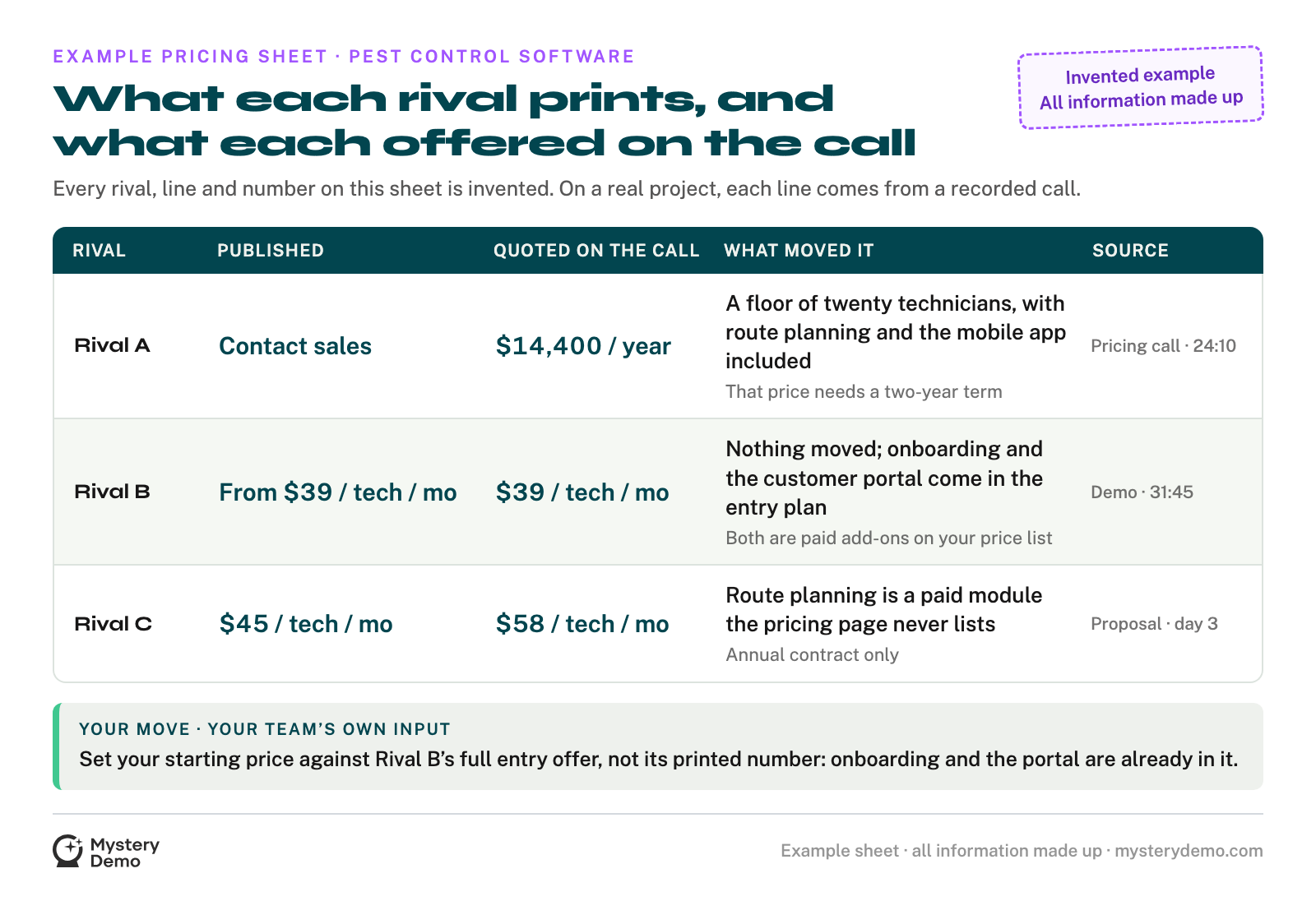
A quote and a starting price are not the same thing, so compare what each one covers before you compare the numbers. If a rival’s entry offer includes something yours charges extra for, your starting price either includes it too or says plainly that it does not. A lower quote with less inside it then looks like what it is.
Mystery Demo gets those offers by asking for them as the buyer. The team books each rival’s demo through its normal front door, with a buying scenario fitted to what that rival sells, and stays through discovery, the demo and the pricing conversation. From each rival it brings back:
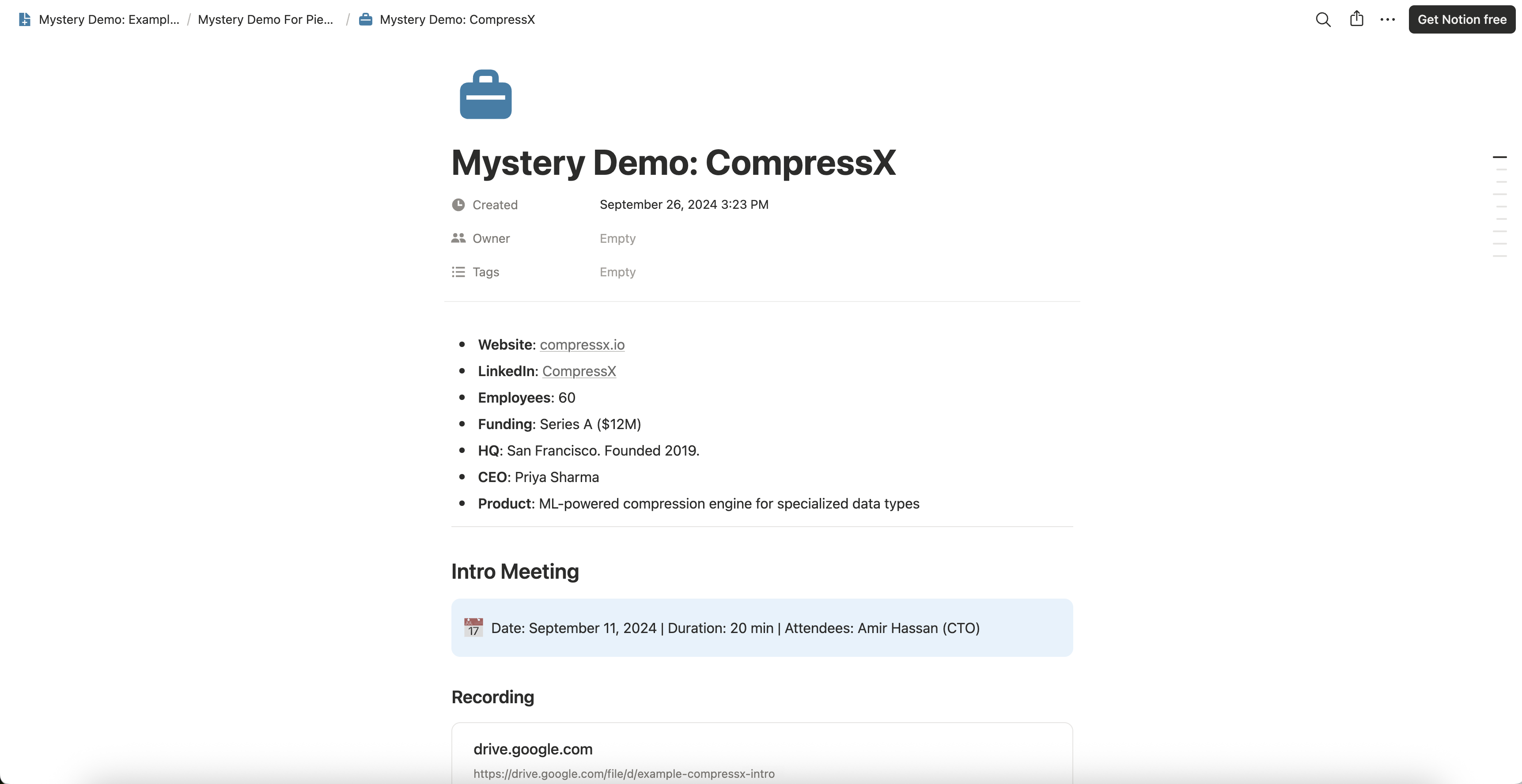
All of it lands on a Notion board shared with the client, with a page for each rival holding its recordings, transcripts, emails and analysis. Below is the top of one rival’s page on Mystery Demo’s public example board, where the company and every rival are invented, and a real board is built from the calls Mystery Demo takes for that client. For pricing, the line that matters is the last one, the recording, where every quoted number on the board can be played back.
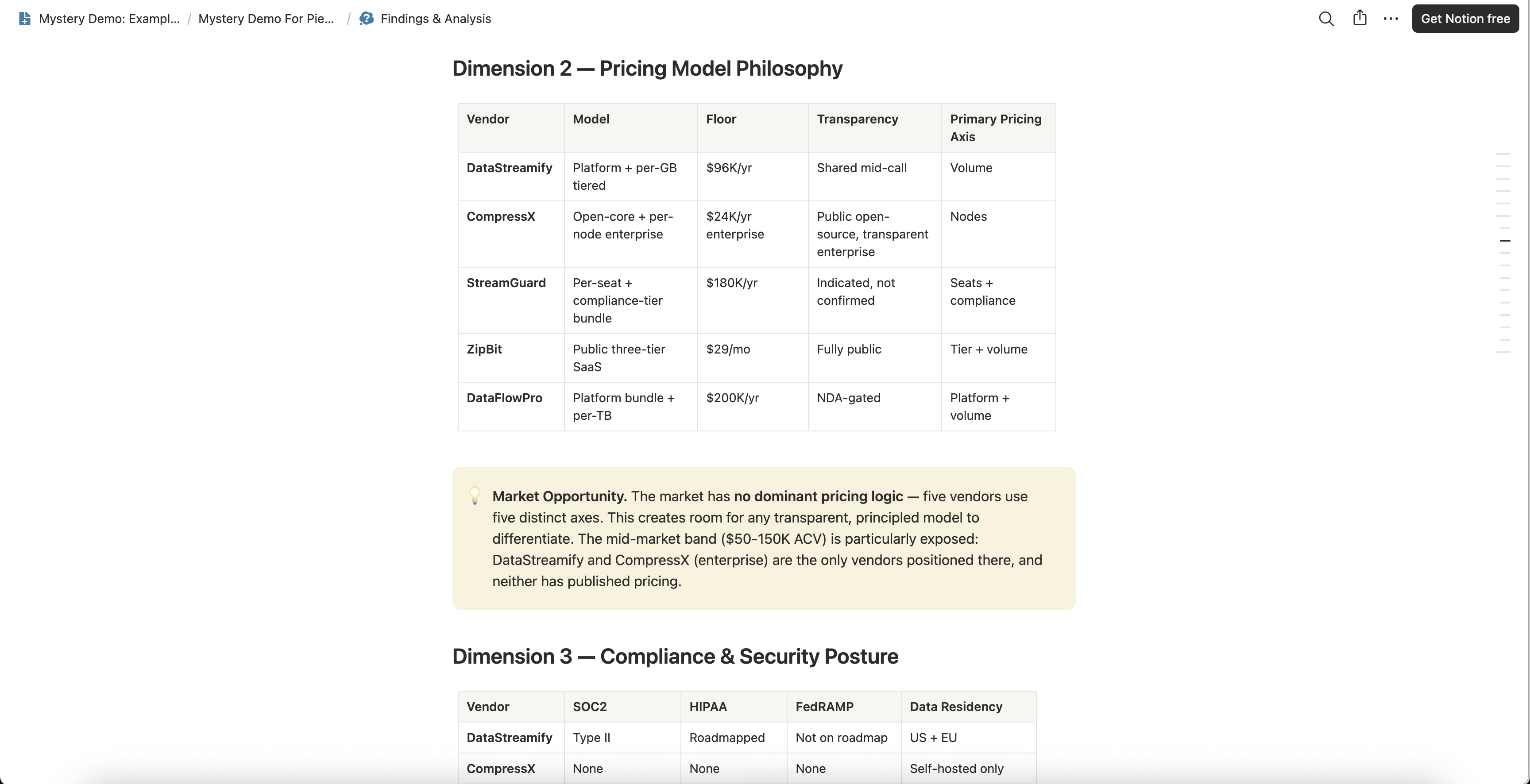
The page a pricing decision needs is Findings & Analysis, where the board compares the rivals topic by topic. Its pricing table puts the rivals side by side on model, entry price, how openly each gave its price and what the price grows with, every cell taken from the calls. The figures on this example are invented, so read it for the columns your own comparison would hold.
Set beside your own pricing, that table becomes a sheet like the one below, with each rival’s published price next to the offer its rep made. The rivals and figures on it are invented, to show the shape. The same sheet answers a rep whose buyer says a rival is cheaper, because it shows what the cheaper quote leaves out.


If your own team books those calls, it gets recognized or gets the generic tour. A believable buyer fitted to each rival gets the real questions and the real price, and operators who have sold software know how far to push a rep on it. Every finding comes back as a recording with a timestamp, and one rep’s quote stays one rep’s quote until a second rep gives the same buyer the same number.
SaaS competitor pricing research costs a flat €499 per competitor, everything included, and one competitor takes one to two weeks. Name the rivals whose prices you cannot see on a short intro call, and we will bring back what each one quotes and includes for a buyer like yours.
Your Starting Price Should Answer Your Rivals’ Quotes
If your buyers shortlist through AI answers and reviews, publish a starting price and keep the quote for what varies by deal. Then decide what that starting price includes from what your rivals quote on their calls.
Start with your two closest rivals, and give each one two columns:
If that second column is empty, or filled from what a lost prospect remembered, tell us which two rivals to start with. We will take their pricing calls as the buyer and bring back each quote and everything that came with it, on recordings you can play.


