
Ask a B2B SaaS company what its product costs and the most likely answer is a button that says “Contact Sales.”
Hidden pricing is the default in this market, the published number is the minority case, and among the fast-growing companies analysts track most closely, the trend has run toward more secrecy, not less.
That wall is where our work begins: on your behalf, we go through the form as a real buyer and come back with the number that was never on the page.
We collected the most relevant, independently verified SaaS pricing transparency statistics we could source: how much of the market hides its pricing, how that splits by segment, which way the trend is moving, and what a buyer does when the price is missing.
Every figure below is footnoted to its original source.
If you only keep a handful of these pricing transparency benchmarks, keep these:
Most of the Market Won’t Show You a Price
The headline question, what share of SaaS publishes a price, has a clear answer at the market level, and it is not flattering.
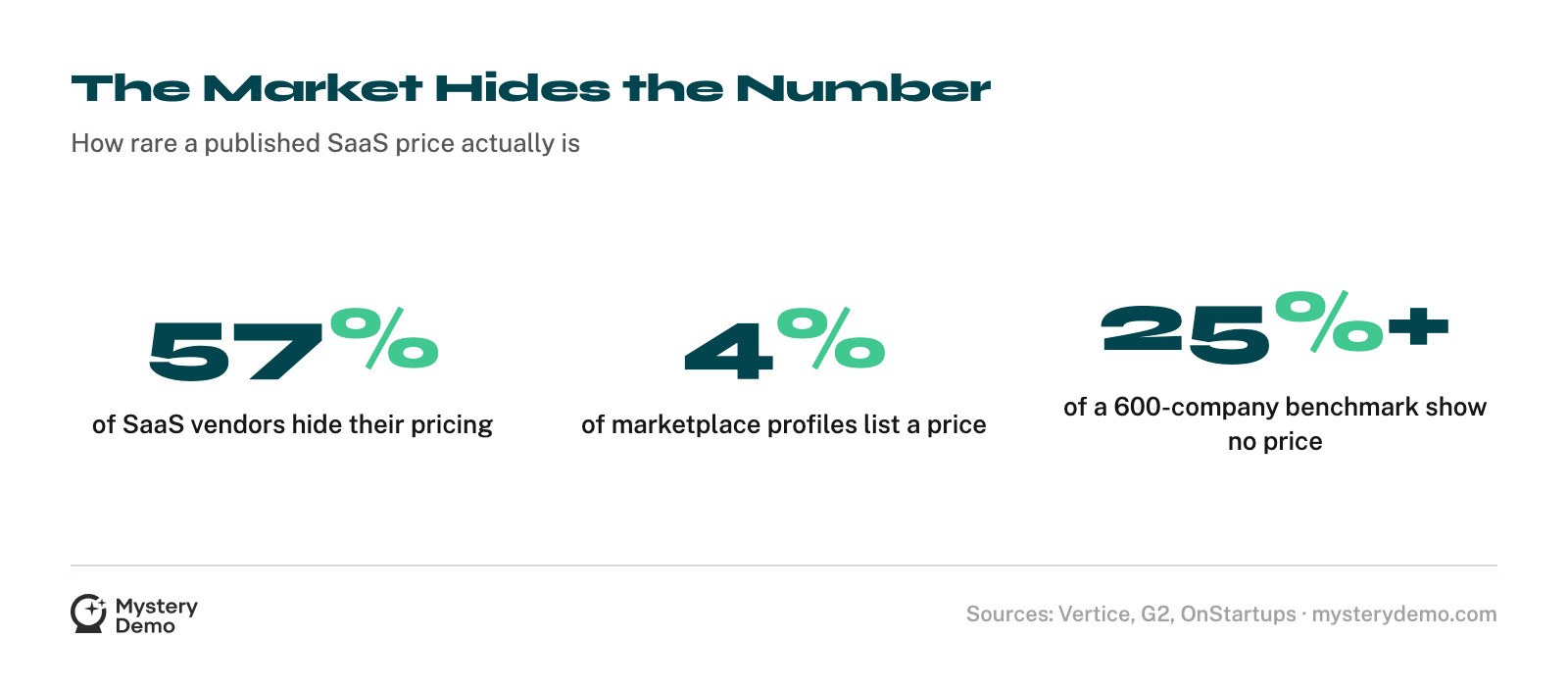
The three figures look inconsistent until you notice what each one counts. The 57% and the 4% measure broad vendor universes that include the enterprise-heavy companies most likely to gate a price, while the 600-company benchmark skews toward smaller self-serve SaaS.
The honest read is a rule rather than a single percentage: the bigger and more enterprise a vendor’s book, the less likely a price appears. A real published number is the minority behavior.
Transparency Depends on Who You Sell To
The aggregate hides a sharp pattern. Whether a company shows a price is mostly a function of who is on the other side of the deal.
Young self-serve SaaS and the biggest incumbents solve for opposite problems, which is the whole gap in miniature. Startups publish a price to convert a buyer who will never take a call, and the biggest companies hide it because their deals are large, negotiated, and custom.
The most revealing cut is the middle: the $10M to $100M ARR band, the exact stage where companies start chasing enterprise, is where pricing pages quietly go dark.
Transparency erodes with ambition, not with age. The moment a vendor decides to move up-market, the number comes off the page.
The Trend Went Backward, Not Forward
It would be reasonable to assume that, with buyers demanding it, the market has been drifting toward transparency. The same firm tracking the same companies found the opposite.
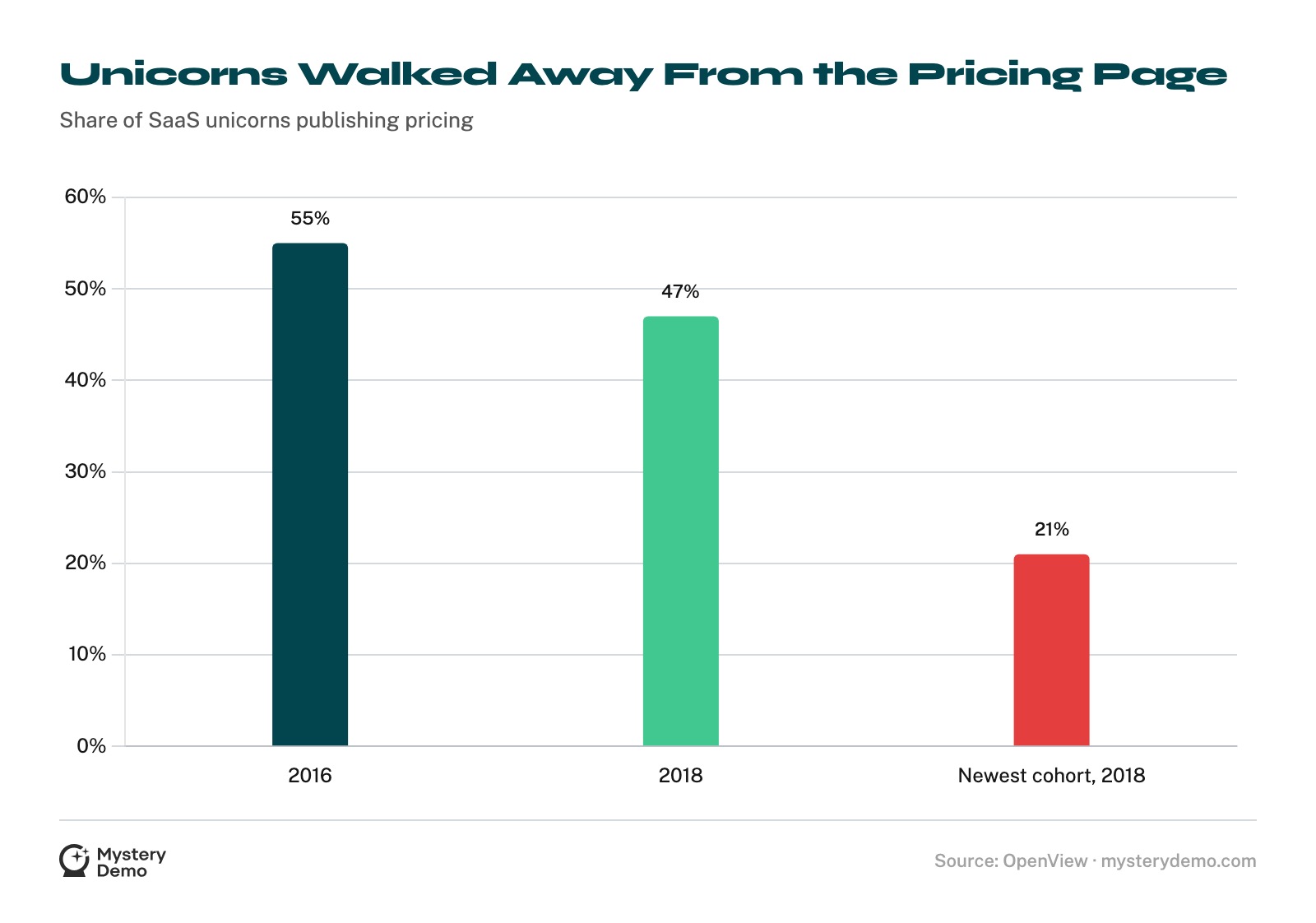

This is the finding that should unsettle anyone who treats “more transparency” as an inevitability. Between 2016 and 2018 the direction of travel was toward the sales call, not away from it.
Margin explains it: a hidden price preserves room to negotiate, segment, and raise, and the companies leading the retreat were the youngest and fastest-growing.
Buyers Want the Number You’re Hiding
Buyers were not ambiguous about what they want fixed. When asked, pricing sits at the top of the list.
In a survey of 2,058 technology buyers, transparent pricing was the number-one change they wanted from vendors, cited by 45%, ahead of every other friction point7.
A separate survey of more than 18,000 business buyers found nearly 90% had a purchase stall in 2023, and the analyst’s prescription was to offer price transparency up front8.
Two independent surveys, one of two thousand buyers and one of eighteen thousand, land on the same instruction: show the price earlier.
The 45% figure is striking because of the competition it beat. Buyers could have asked for faster demos, better support, or simpler contracts, and instead the single most requested fix was the one most vendors refuse.
The Forrester read adds the stakes, tying the up-front price to whether a stalled deal moves at all. The gap between what buyers ask for and what the market provides is the widest in pricing.
.png)
Showing the Price Changes Buyer Behavior
Vendors hide the price on the theory that a number scares buyers off; the click and pageview data measures the opposite effect directly.
Listings that added pricing saw a 21% average increase in time on page, a 15x increase in page views, and a 3x increase in CTA clicks7.
Buyers also go hunting for the missing number. Searches for product pricing information rose 15% year over year on one review platform, even as general traffic fell7.
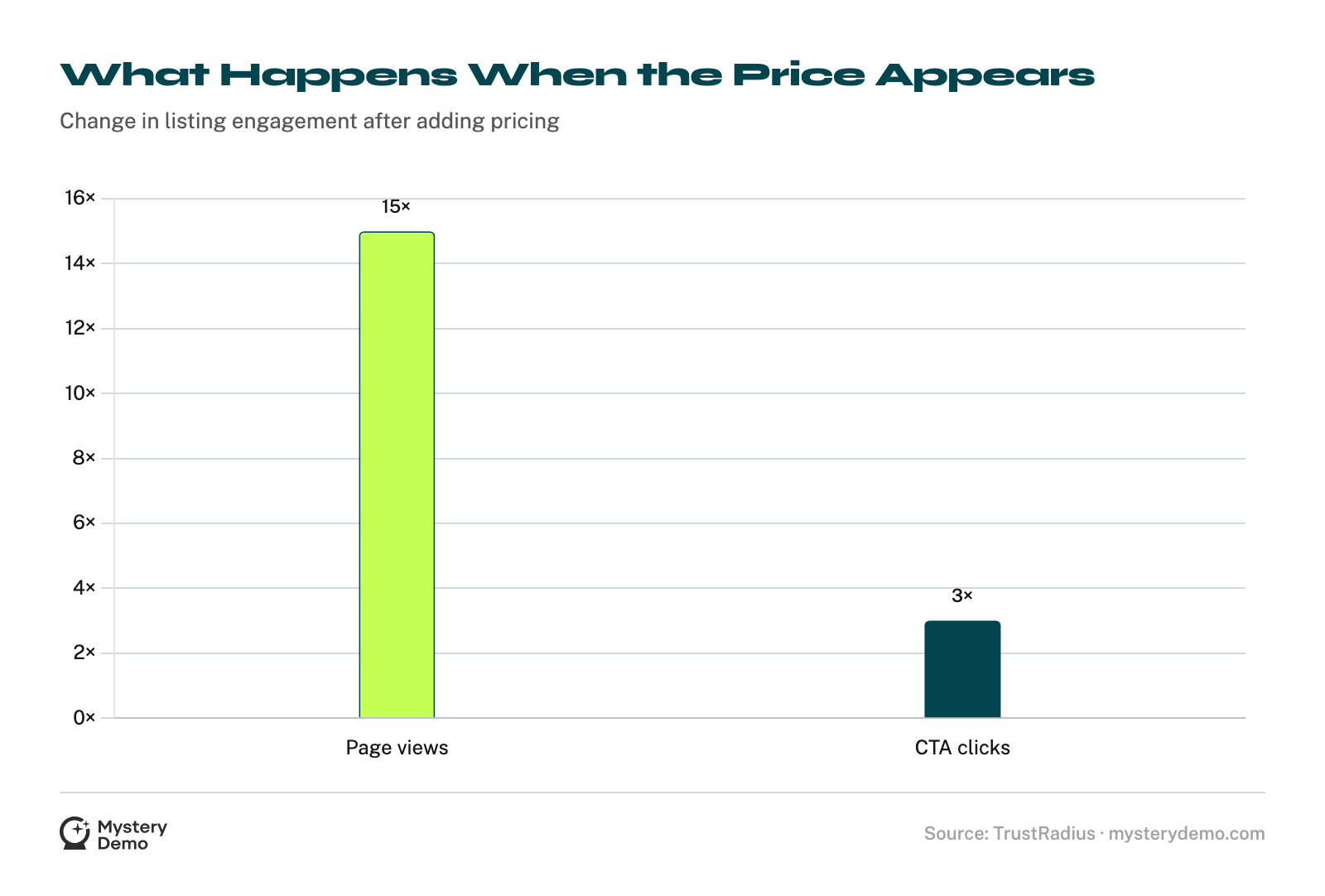
These are observed behaviors, not survey opinions, which is what makes them hard to wave away. Revealing a price tripled the share of buyers who clicked to act, and the rising search for pricing data shows the demand does not disappear when the number does.
Hide the price and the buyer leaves to find it somewhere you do not control, a review site, a community thread, or a competitor who did publish, handing the next move to someone else.
What none of this tells you is what your specific competitors put behind their own “contact us” wall, or how that number changes depending on who is asking. That only exists on a real call.
We take that call as a real buyer and bring back the starting price, the segmentation, and the discount they reveal only once someone is in the room. For the structured version, our SaaS competitor pricing research turns each hidden page into a real number you can plan against.
If a rival’s pricing page ends in a form, the price still exists. It just gets said out loud instead of published. We’ll go through the form as a real buyer and bring the number back.
Frequently Asked Questions
What share of SaaS companies hide their pricing?
A majority. Across a 16,000-vendor dataset, 57% of SaaS vendors hide their pricing from public view1.
How many SaaS products publish an actual price?
Very few. On the largest B2B software marketplace, only 4% of product profiles list an explicit price2.
Do most enterprise SaaS companies show pricing?
No. 80% of the 250 biggest SaaS companies had no pricing page at all, the opposite of self-serve startups4.
Are startups more transparent about pricing than big SaaS?
About twice as likely. 39% of trending startups published their pricing, while only about 20% of the 250 largest even had a pricing page4.
Even when SaaS shows pricing, is the top tier public?
Usually not. Among companies that publish, 59% list at least one package as “Contact Us,” almost always the enterprise tier4.
Which SaaS companies are most likely to hide pricing?
Enterprise-focused ones. Nearly half of HR software companies hide pricing, and the $10M to $100M ARR band moving up-market is the most private3.
What percentage of SaaS companies have no pricing page on their website?
More than a quarter overall. In a 600-plus company benchmark, over 25% do not feature pricing on their site, with the share much higher among enterprise vendors3.
Is SaaS pricing getting more transparent over time?
No, it reversed. Among private unicorns, the share publishing pricing fell from 55% to 47%, and no company that had hidden pricing moved toward transparency6.
Were newer SaaS companies more or less transparent?
Less. Only 21% of newer unicorns published pricing, and just 33% across all 66 studied, making the youngest the most secretive6.
When did the SaaS transparency wave peak?
Around the mid-2010s. In 2016, more than half of unicorns published pricing versus a quarter of public companies, with most having started within the prior five years, before the reversal5.
What do B2B tech buyers want most from vendors?
Transparent pricing. It was the number-one requested change, named by 45% of 2,058 technology buyers, ahead of every other friction point7.
Do buyers expect up-front pricing?
Increasingly. In a survey of more than 18,000 buyers, nearly 90% had a purchase stall in 2023, and Forrester’s prescription for moving deals was to offer price transparency up front8.
What happens to engagement when a vendor shows pricing?
It jumps. Listings that added pricing saw a 15x increase in page views and a 3x increase in CTA clicks, plus 21% more time on page7.
What happens when a vendor hides its price?
Buyers go looking elsewhere. Searches for product pricing information rose 15% year over year on one review platform, even as general traffic declined7.
Why do SaaS companies hide pricing if buyers want it shown?
To protect margin and flexibility. A hidden price preserves room to segment, negotiate, and raise, which is why transparency drops exactly as companies move up-market3.
How do you find a competitor’s real price behind “contact us”?
By going through the funnel as a real buyer. The starting price, segmentation, and discount behind a hidden page only surface on a live call, which is what we capture for you.
References
- Vertice: 2023 SaaS Inflation Index (2023)
- G2: Is B2B Software Pricing Transparency Broken (2025)
- ChartMogul: The B2B SaaS Pricing Masterclass, Lessons From 600-Plus SaaS Companies (2020)
- OnStartups: A Study of 386 SaaS Startup Pricing Pages (2016)
- OpenView: SaaS Pricing Best Practices From 90 Companies (2016)
- OpenView: Why SaaS Companies Are Moving Away From Pricing Transparency (2018)
- TrustRadius: Bridging the Trust Gap, B2B Tech Buying in the Age of AI (2025)
- Forrester: 2023 Global B2B Buyers Journey Survey (2023)
.png)


