
Scoping calls converge on two questions, and everything else is a version of one of them: what exactly am I buying, and is any of it going to come back on me?
The second half has the shorter answer, so it goes first.
No NDA, and Nothing Bought
It is legal, and the boundaries are two lines long.
We never sign an NDA, because an NDA is what turns a conversation into a contract, and a contract is the only thing here capable of being breached. We never pay for the product, so there are no license terms to accept or violate.
What is left is an ordinary sales process, run by real operators evaluating real software. The only fact withheld is who asked us to look, and the full legal and ethical case is argued properly in its own piece.
Why the Vendor Never Works It Out
This is the question every cautious founder asks second, and the honest answer is dull. There is nothing unusual for anyone to notice.
An operator books a demo, asks informed questions, evaluates the product, and follows up like a buyer whose calendar was already full before this vendor appeared. Then the thread ends the way sales threads end, after several increasingly hopeful nudges.
What holds it together is the fábula: a truthful company profile and a real buying scenario, with a use case, a persona, and commercial details that fit each other. Nobody invents a person. The story is about which problem we are shopping for, not about who we are.
Your name never reaches them either. The vendor sees a buyer evaluation, and who commissioned it stays out of the conversation entirely.
.png)
You find out what that was worth when you set it beside four others and the same question comes back with four different answers. The pattern is never inside one call. It is in what the calls disagree about.
Send Someone Who Buys This Software for a Living
Providers in this category are blunt about the failure mode: the whole thing collapses when the person asking cannot hold a technical B2B sales conversation. A thin story gets a thin demo, and a thin demo records nothing worth having.
So we only do software. The people on these calls evaluate SaaS for a living, which is why the questions that open a call up arrive early, while the rep is still deciding how serious the buyer is.
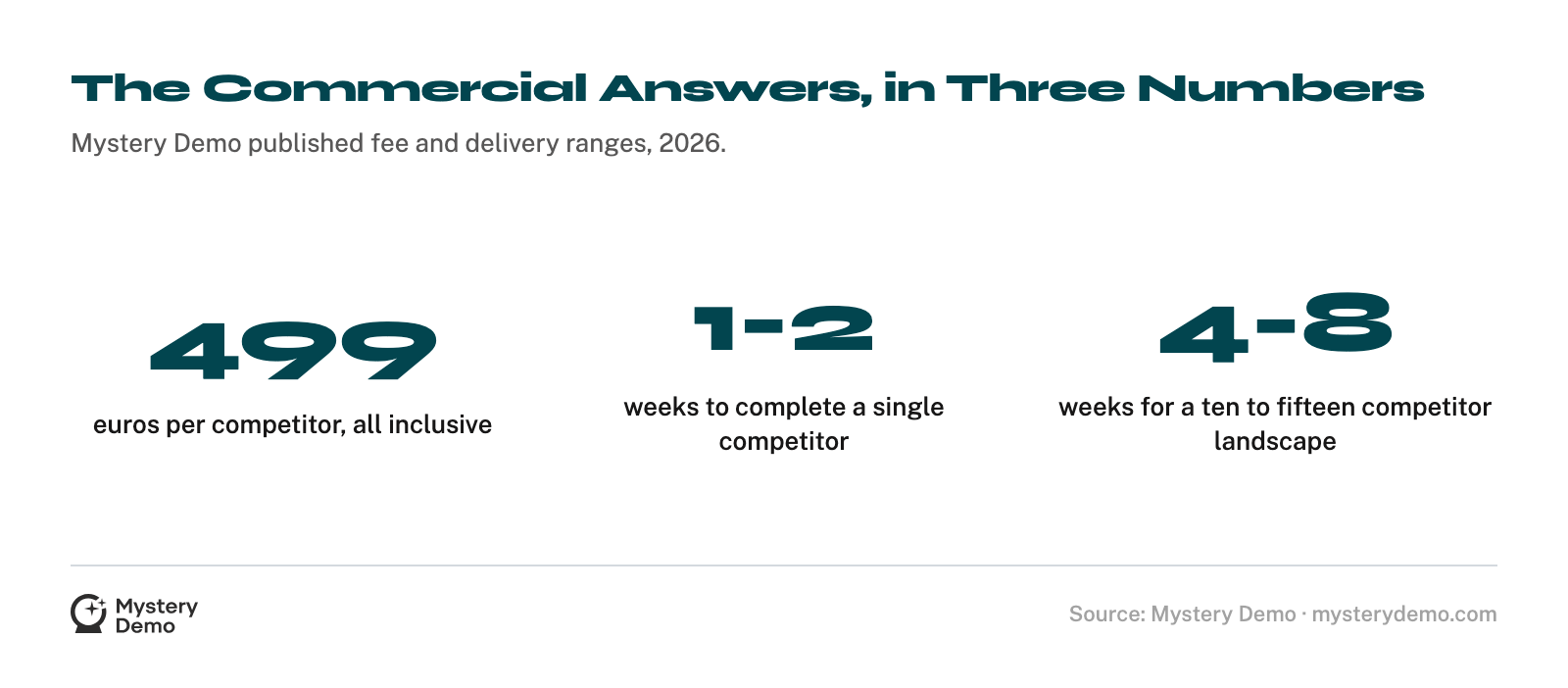
Those are the whole commercial terms. The tenth competitor costs the same as the first because it is the same work: the same fábula, the same demo, the same analysis. Five run to 2,495 and ten to 4,990.
What you bring is small. A kickoff to agree the objectives and the competitor list, the questions you want settled, and a live demo of your own product, so we understand your positioning well enough to ask the right comparative questions on somebody else’s call.
After that it runs without you until the board starts filling.
One competitor takes one to two weeks. A landscape of ten to fifteen takes four to eight, because the demos run in parallel and each vendor page lands as it finishes.
You are not asked to approve a fábula, sit a call, or chase a vendor. The only thing we come back for mid-project is a question we could not answer from the kickoff.
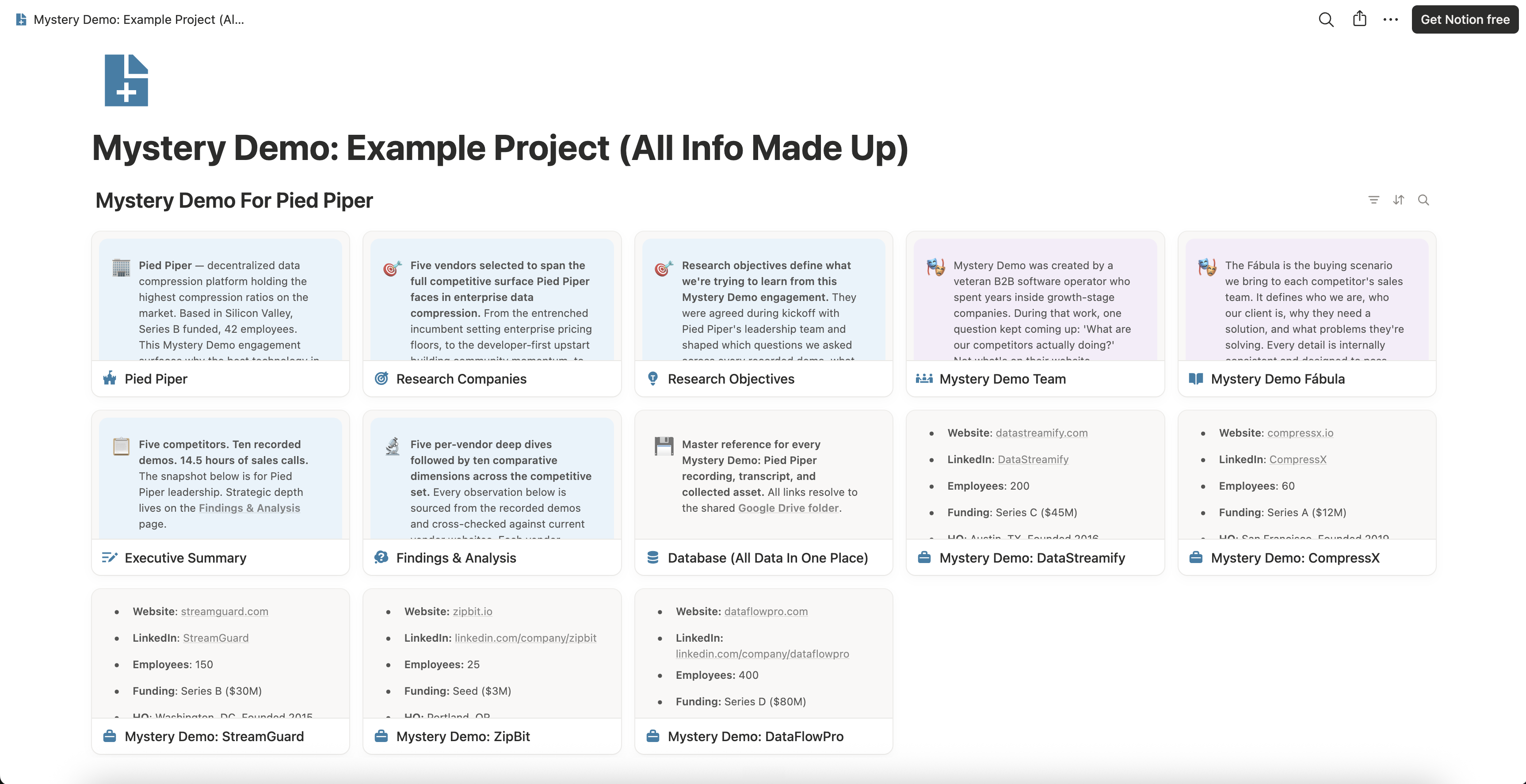
That is the database you are handed at the end: every recording, transcript, screenshot, pricing document, and follow-up email, filed by competitor.
We Close Every Thread We Open
We never go dark on the companies we meet. Every thread closes the way a real evaluation closes, which is what makes a second pass a year later possible at all rather than starting from nothing.
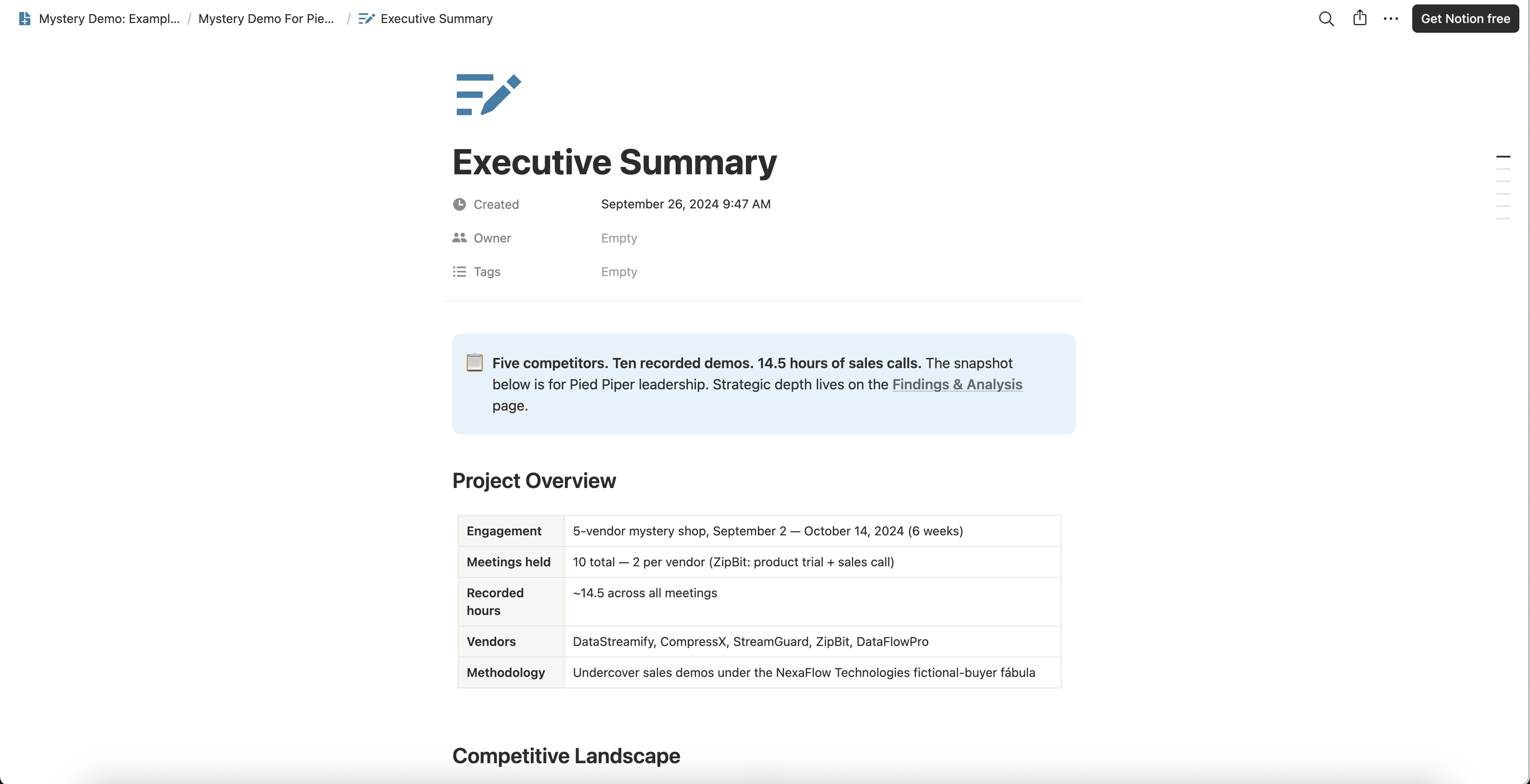
That is also the argument for running a set rather than a single evaluation. One vendor page tells you about one company, and the matrices are where five of them turn into a read on the whole landscape built on primary sources rather than on marketing copy.
If the method itself is new to you, what mystery shopping for B2B SaaS involves covers the ground underneath all of this in more detail.
Write down the three questions your public research cannot answer. Send us that list and we will run the demos that answer it, in your competitors’ own words, on the record.
.png)


