
You can see how each of your reps is doing overall. You cannot see which competitor each one is weakest against. One rep may have no answer to a rival’s price, while another has never heard what a second rival tells buyers about you.
The competitive content meant to close those gaps often goes unused. When Wynter asked 101 product marketers at mid-market and enterprise B2B SaaS companies in April 2026, 37% said their sales teams mostly ignore that content or freestyle.
A short check shows those gaps, and once you hold the right answers, an enablement lead can run it in one team meeting. Mystery Demo gets those right answers by booking your competitors’ real sales demos as a buyer and bringing back what each competitor’s rep quoted, pitched, and said about you. The check is a grid, with your reps down the side and your competitors across the top, and in every cell a rep answers four questions in a sentence each:
The first three are graded against what the competitor said on its recorded calls, and the counter against the reply your team agreed. Grading that way also teaches the right answers, in the same hour.
Why You Can’t See What Each Rep Knows
A battlecard shows what your team was given, not what a rep can say when a buyer brings up a competitor halfway through a call. Some of what the buyer heard was never on the card at all, because the competitor never put it in writing.
One product marketer said as much in a Reddit thread on competitive research: reps “get beaten by whatever the competitor says about us in the room,” and none of it was ever public. Of the three answers that come from a competitor, its website gives you part of two at best, in the form it wants every buyer to see:
The quoted number, the pitch against you, and the planted question are said only on a sales call, to someone the competitor believes is buying. A useful check makes reps say their own answers, one competitor at a time. Grading it takes the right answers, and those come only from the competitor’s own calls.
Where the Right Answers Come From
Mystery Demo gets those answers by going through each competitor’s sales process the way a buyer would. Each project starts with a kickoff, where the answers you want to test become the questions every call must answer: the price and its terms, what the competitor leads with, and what it says about you.
Before anything is booked, the team writes a buying scenario fitted to each competitor: a believable company of the size and stack that competitor sells to, with a real reason to evaluate software. Then it books through each competitor’s normal front door and takes the calls as that buyer, from discovery and the demo to the deep dive, the pricing conversation, and the follow-up. Every call is recorded.
If your own team booked these calls, the rep would spot the email domain, or give the tour every rival gets. These answers are worth grading against because of how the calls are run:
Below is the Research Objectives page of our public example board, where the client and every competitor are invented. A real project’s board is built from that client’s own calls. The lower half of the page lists the five stages of the method, from the first meeting to the analysis, and every answer on your key goes through all five.
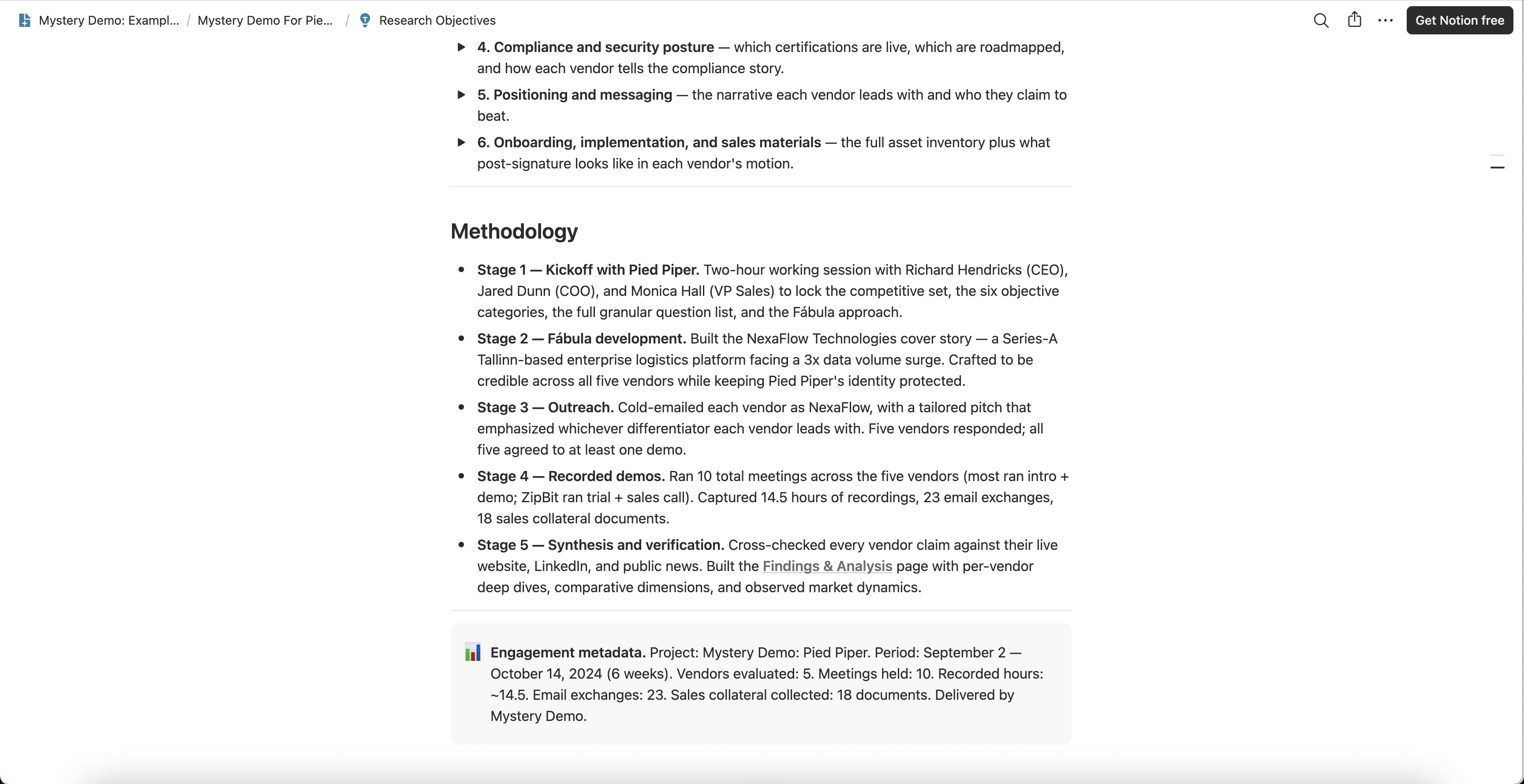
Everything lands on a board in Notion, a shared workspace with one page per competitor: its recordings, transcripts, and emails, and the analysis of what its reps said. Those pages feed battlecards where every line links to the recorded moment, and the same recorded lines become the right answers on your key. A Findings & Analysis page then sets the competitors side by side, one topic at a time, and price is one of the topics.
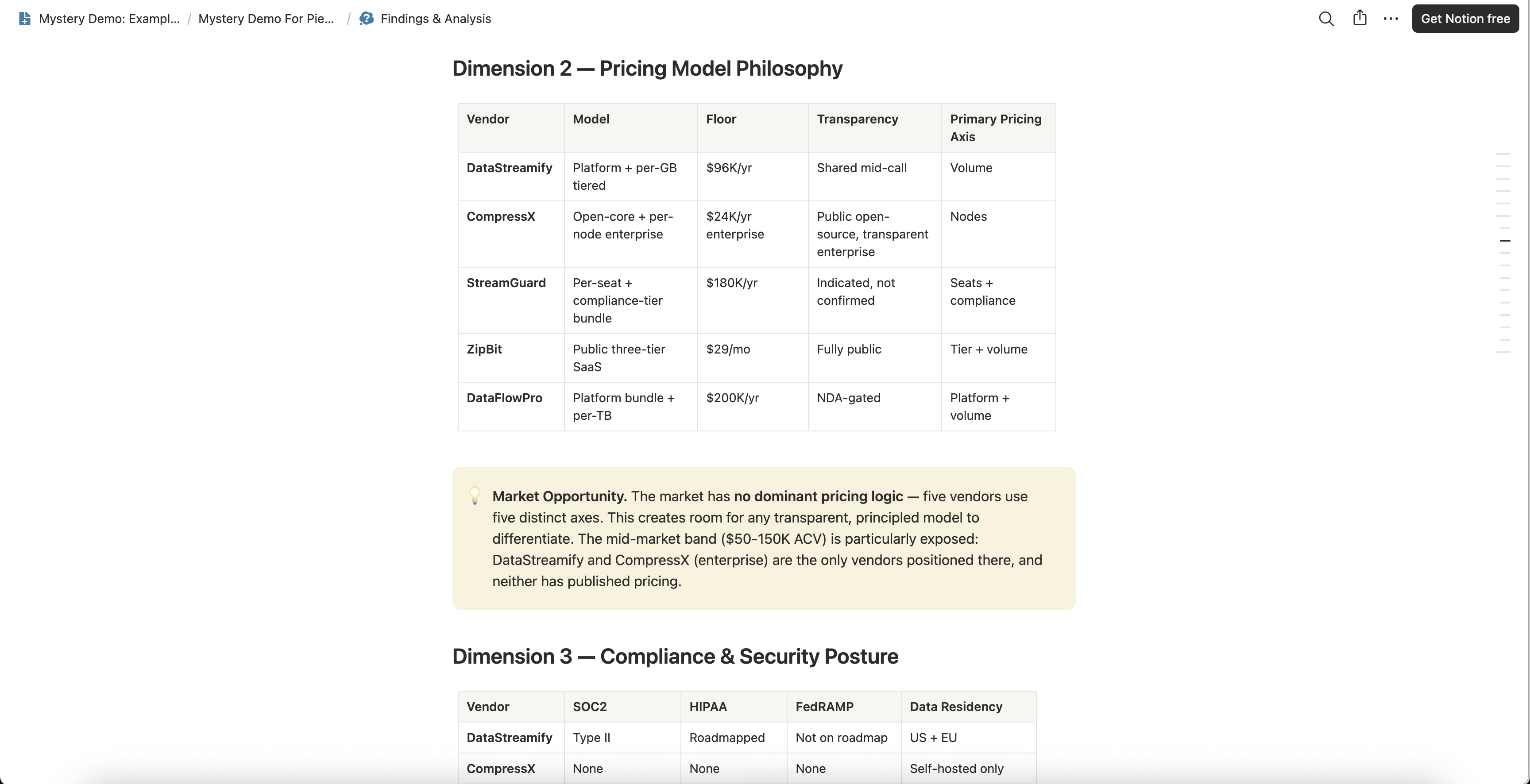
That table is where the price answer on your key comes from. Its Transparency column records whether each competitor published its price or only said it on a call. On a real project, each row holds the price its rep quoted a buyer like yours, with the call it was quoted on, beside whatever the competitor publishes.
If the competitors across the top of your grid have no key yet, an intro conversation with the Mystery Demo team is where that starts. One competitor takes one to two weeks at a flat €499, everything included, and its key comes back with every answer tied to the minute of its call.
Four Answers Each Rep Owes for Every Competitor
Every cell of the grid holds four answers of one sentence each, and every one is something a buyer will test the rep on.
| The answer | What the buyer asks the rep | Where the right answer comes from |
|---|---|---|
| The real price | “They quoted us less. Why are you more expensive?” | The pricing comparison on the board, and the recorded call where the price was quoted |
| The pitch | “They showed us something you don’t have.” | The board’s analysis of that competitor, with the recordings behind each point |
| The trap | A question about your weak spot that the competitor told the buyer to ask, such as “How long does your setup really take?” | The recordings, and only where the competitor’s rep was heard planting it |
| The counter | “So why should we pick you?” | Your team’s agreed answer: your own input, not something a call supplies |
The real price. Write the number this competitor quotes a company like the buyer’s, with the conditions it came with, as the pricing comparison and the recorded call give them. When a buyer says the competitor is cheaper, the rep knows what the lower number depends on, such as the contract length, the seat count, or a signing deadline.

The pitch. Write what this competitor leads with when it knows the buyer is also looking at you, so a rep can raise that claim before the buyer does, in the rep’s own framing. On the board, the answer comes from the competitor’s section of Findings & Analysis, like the invented one below: the headline claim in its table and the How They Sell list under it.
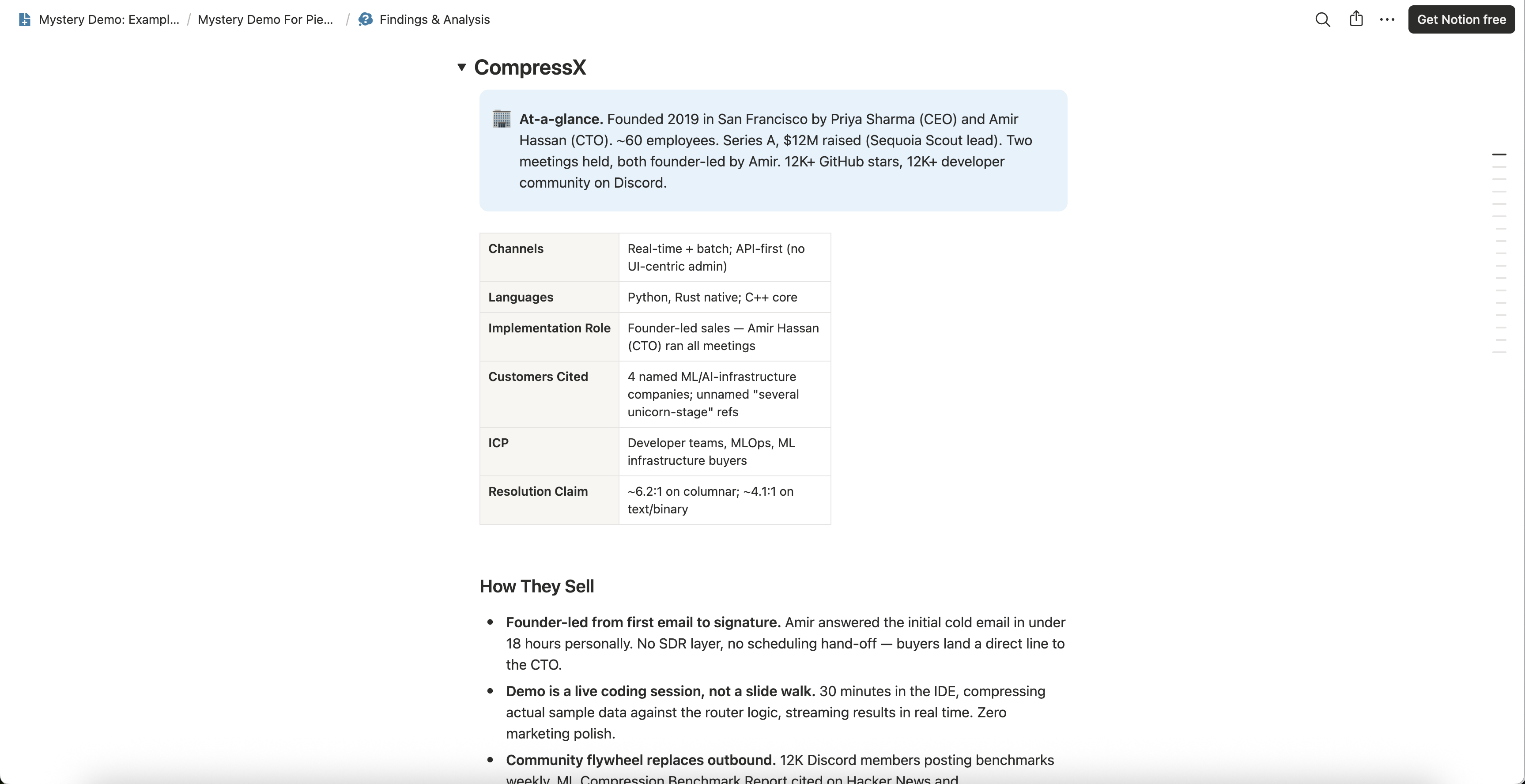
The trap. Write the question this competitor plants with buyers to ask you, picked because your answer to it is weak, so a rep can answer it before the buyer asks. It comes only from a recording of the competitor’s rep planting it, and without one the key says “no key” and nobody is scored on it.
The counter. Write your team’s answer to the pitch and the trap, agreed by enablement and product marketing before the check and written against what the competitor says, since no call can supply it. A rep whose answer is “We have more features” or “Our customer support is better” is, in the words of one product marketer on LinkedIn, “losing credibility in real time.”
How to Run the Check in One Team Meeting
Four answers a competitor, from every rep, sounds like a lot to collect, so collect them the day before. Every rep writes their sentences for each competitor alone, without opening a battlecard, and about ten minutes covers three competitors. Score those first answers before anyone hears the key, so the grid shows what each rep knew walking in.
| Score | What the answer looks like |
|---|---|
| 2 | It matches the key, conditions included |
| 1 | It is partly right: the right number without its conditions, or the right point with the details off |
| 0 | It is wrong or blank, or it gives the list price as the quote |
| No key | No call showed it, so nobody is scored on it |
Write each rep’s score for a competitor as points earned out of points available, such as 5 of 8, so a gap in the key never counts against anyone. Read across a rep’s row to find the competitor they are weakest against, and down a column to find the answer the whole team misses. A competitor with fewer than two answers in its key can stay on the grid, but don’t rank reps on it yet.
Below is the grid filled in for an invented team of five reps and three invented competitors, with every score made up to show the shape.
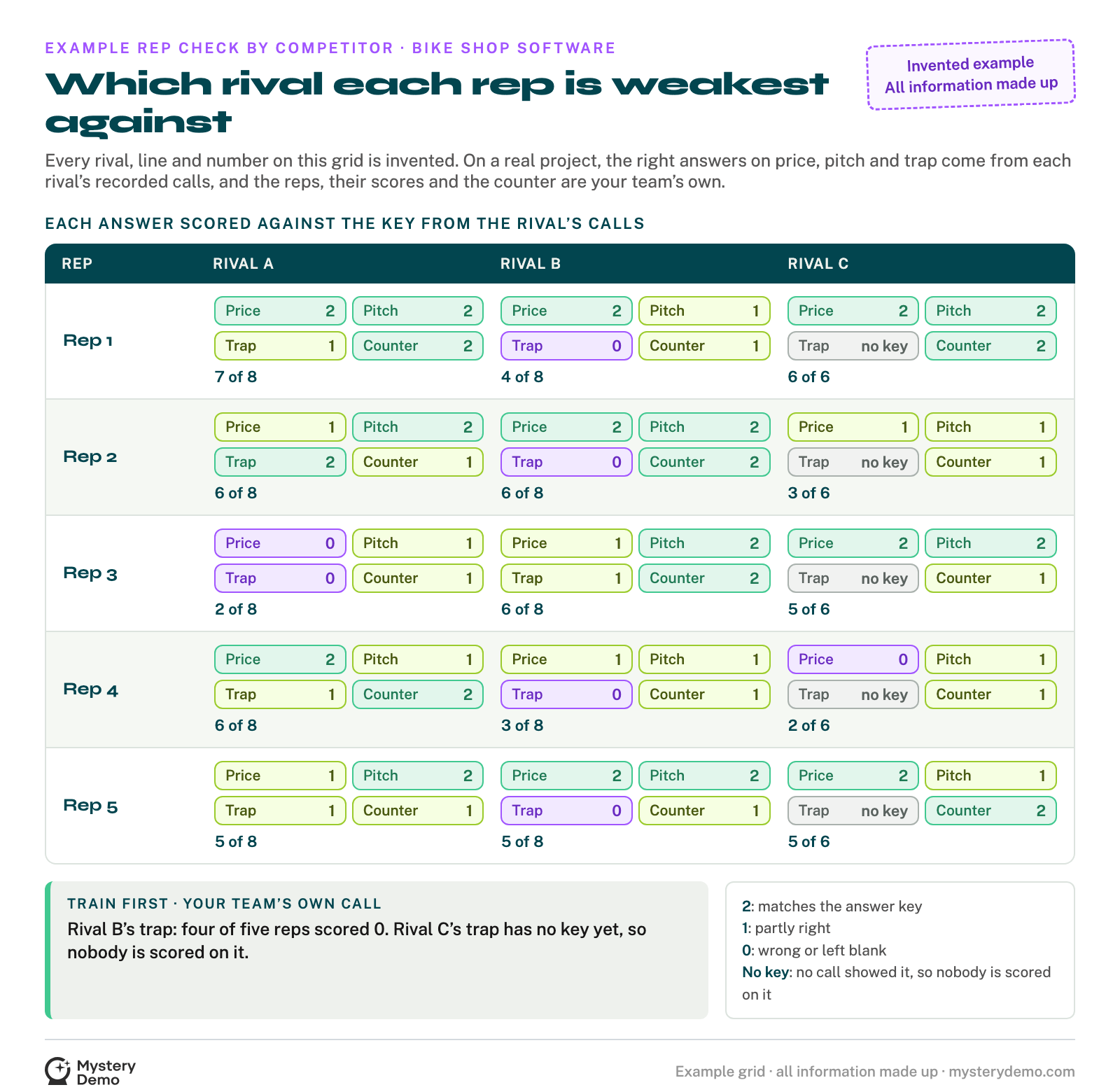
Keep the meeting itself to 30 to 45 minutes, on the weakest answers only. Take each one in turn:
The check doubles as training here, because every wrong answer is corrected with the competitor’s own words, in the form the buyer heard them. With more than about ten reps or four competitors, split the meeting by team or by competitor, so every meeting still ends with each weak answer said out loud. If the check runs at a sales kickoff instead, the one-hour kickoff session on competitors builds it into the day.
A grid scored this quarter describes this quarter’s competitors. When one of them changes what it says, the key goes out of date before the reps do.
Keep the Answer Key Current
Run the check again every quarter, and let the key change only on evidence.
| When | What changes |
|---|---|
| Every quarter | Every rep writes fresh answers before anyone sees the key, and the grid is scored again |
| A rep hears something new in a live deal | That answer is marked as reported, and the key changes once a recorded call or a written quote confirms it |
| A new competitor turns up in deals | It gets a column, marked “no key” until its calls are recorded |
One product marketer on Reddit tags every competitor item as a signal, likely, or confirmed, and “only confirmed goes into battlecards.” An answer key deserves the same rule, because a rep graded against a rumor learns the rumor. Recording one competitor again takes one to two weeks.
The written check shows what reps know when they are asked. Mystery Demo can also hear what they say when a real buyer brings up a competitor, by running the same buyer scenario on your own team, unannounced, in the same week or two as the competitors’ calls. Your rep’s answer then sits beside the competitor’s on the same questions, for a better sales process and never for discipline.
You only see which competitor each rep is weakest against when you grade them against what that competitor says, and grading that way is the training too. Copying the grid is free. Filling its key takes a buyer on each competitor’s calls, which is the part Mystery Demo does, and a short intro conversation is enough to agree which competitors go first.


