
A SaaS data room is full of sales numbers, and not one of them shows a sale happening. The pipeline, the bookings, and the pricing book are all records of what the sales team produced. In the management presentation you meet the founder, usually the best salesperson the company has ever had.
After the deal, the company has to keep selling to strangers who fill in its demo form, and the founder will not be on every call. To see how that goes, be the stranger, at the target and at the two rivals it meets most often in deals.
Mystery Demo does this before you sign. It books demos with the target and its closest competitors as a real buyer, asks the questions an acquisition depends on, records every call, and hands you a board your investment committee can read. Investors and private equity firms bring us in for exactly this, on companies they plan to buy and on companies already in their portfolios.
If you have a SaaS target in diligence, here is why the buyer’s chair beats the data room, how a project runs, what comes back, and what your own desk work adds.
What the Buyer’s Chair Shows That the Data Room Can’t
Three reasons make a mystery demo the best way to judge how a target sells.
1. The sales motion only shows to a buyer. Every figure in the data room is the result of moments nobody writes down. Software Equity Group’s due diligence checklist names what the sales part of diligence covers: the pipeline, sales compensation, pricing books, average selling price, and historical sales productivity.
Here is each step behind those records, as the data room shows it and as a buyer on the other end sees it:
| Step of the sale | In the data room | From the buyer’s chair |
|---|---|---|
| First reply | Lead-to-meeting conversion in the CRM | How long a stranger waited, and who answered |
| Discovery | The stage definitions in the sales playbook | Which questions the rep asked, and whether the demo used the answers |
| The product | A feature list and a roadmap deck | What was shown working, and what was promised for later |
| Price | The pricing book and the average selling price | The first number, the first concession, and who had to approve it |
| The incumbent | A win-loss tab | What the rep said when the buyer named the tool they use today |
| Follow-up | The playbook’s follow-up steps | What arrived after the call, how fast, and whether it fit the buyer |
| The founder | An org chart with a sales team on it | Whether the founder had to join to move the deal |
The left column tells you the motion produced results. The right column shows how it produced them, and whether a rep can do it without the founder in the room.
2. You can’t run it as yourself. The target knows your deal team by name, and a demo request from the acquirer goes straight to the founder or the CEO. You get the best version of the pitch, from the one person whose absence you are trying to test.
The rivals read an investor’s email domain just as quickly, and give the investor tour instead of the buyer one. Mystery Demo arrives as a believable buyer, so each company runs the motion it runs for everyone else.
Investors already set this bar for themselves. Bessemer Venture Partners writes that by $10 million in ARR, investors want to see “reps hitting quota consistently and independently.” It describes an early sales playbook as what lets salespeople “migrate sales responsibility from the CEO.”
You can read that playbook in the data room. Whether a rep can run it on a buyer they have never met only shows on a call.
3. The rivals are half the answer. A target grows by winning the deals where buyers compare it with two or three other vendors. If a rival answers a demo request the same day and the target takes three days, you will see the cost in the pipeline months later, without the reason.
The same buyer, put through all three sales processes, is the only fair way to compare them. Every vendor meets the same buyer, with the same budget and the same deadline.
So the question becomes how to put one credible buyer through three sales processes at once, with none of the companies knowing who asked.
How Mystery Demo Runs It, and What Comes Back
The deal question comes first. At kickoff, your investment thesis becomes the list of questions every call has to answer. Can the target’s reps sell without the founder, and how does it sell next to the rivals it meets?
Then the companies. We choose them with you: the target and its two closest rivals, each profiled before any call is booked.
Then the buyer. We build one believable buyer with a real reason to evaluate software, fitted to the customers the target sells to. Its needs, its budget, and its deadline stay the same at all three companies.
The evaluation is real, because we are evaluating software on your behalf. The only thing no company learns is who asked us to look.
The target is shopped the same way a company mystery shops its own sales team: unannounced, through the front door, in the same sprint as its rivals. Nobody at the target is told, so you see the motion a stranger gets.
Then the calls. They run the way they would for any serious buyer: discovery, the demo, a technical deep dive, the pricing conversation, and every follow-up email. The people asking the questions have sold B2B software themselves, so they know which question pulls a rep off the script.
Every call is recorded, and every claim a rep makes is checked against the company’s website, LinkedIn, and public news. Each company gets its own page on the board. Below is one from our public example board, where the client and every company on it are invented.
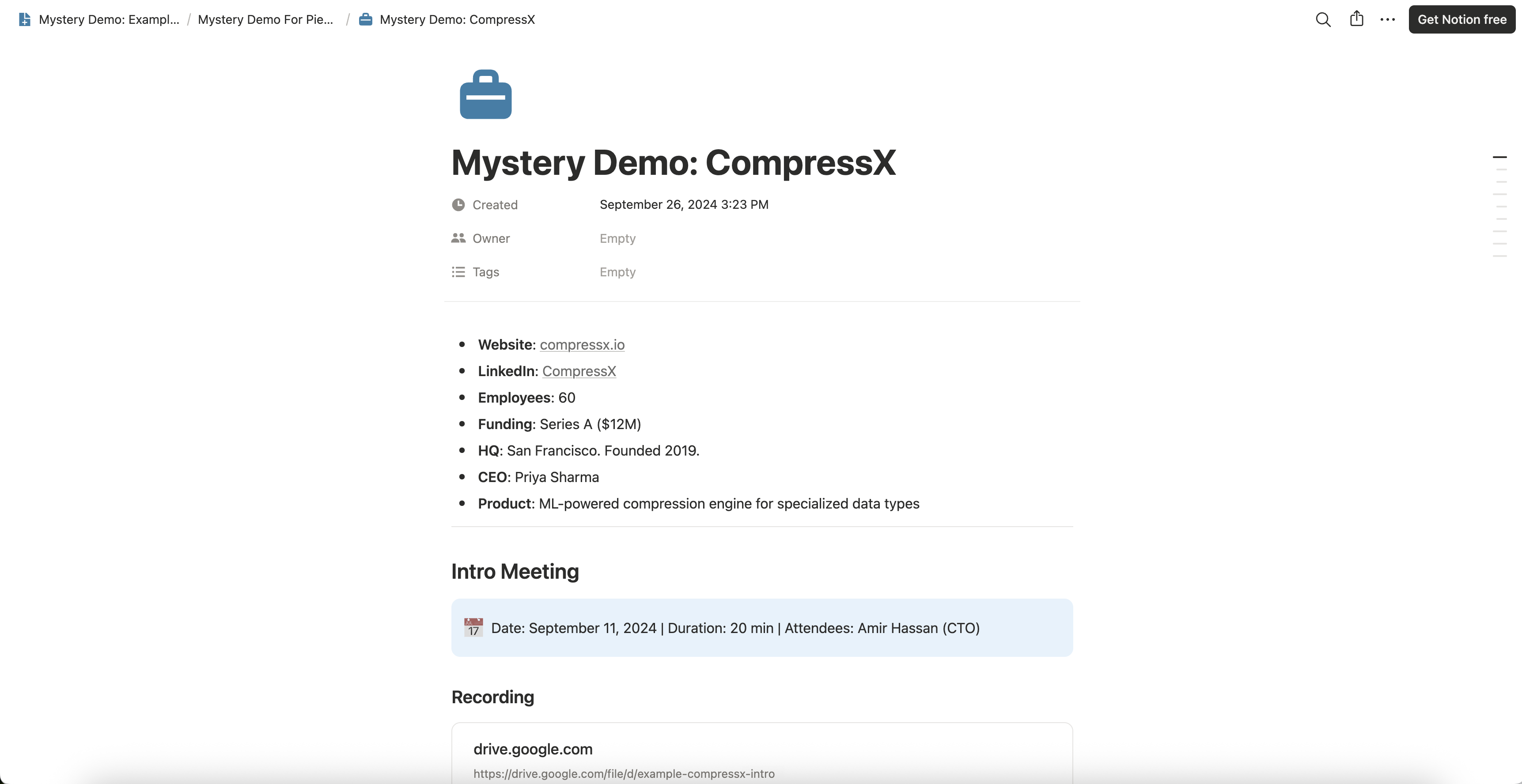
Every meeting is logged with its date, its length, and who joined from the vendor’s side. On a target’s page, that line is where a founder’s name appears, and the recording shows why they came.
The questions we carry into the target’s calls are built to make those moments visible, and you agree them with us at kickoff. The sheet below is an invented example, with Vendor A standing in for the target and every answer made up to show the shape.
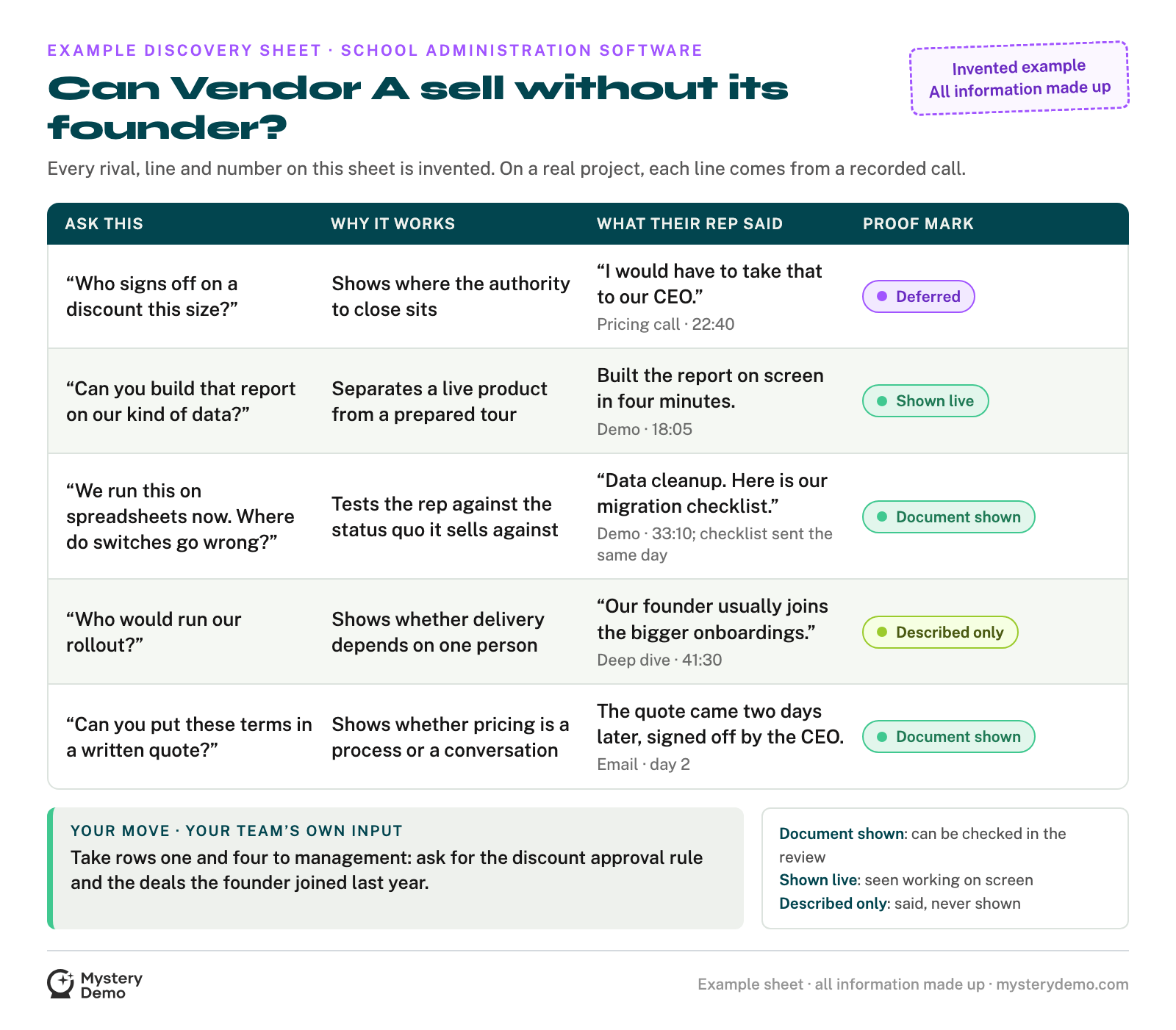
The discount question earns its place at the top. The data room may hold the approval rule, but only the call shows whether a rep can use it without the founder.
.png)

What comes back is one board. Each company’s page holds its recordings, transcripts, emails, and collateral, and the Executive Summary sets the three companies side by side.
Its sales scorecard grades every motion on the same steps: how fast each company answered, how good the demo was, how straight the rep was about price, and how the follow-up went.
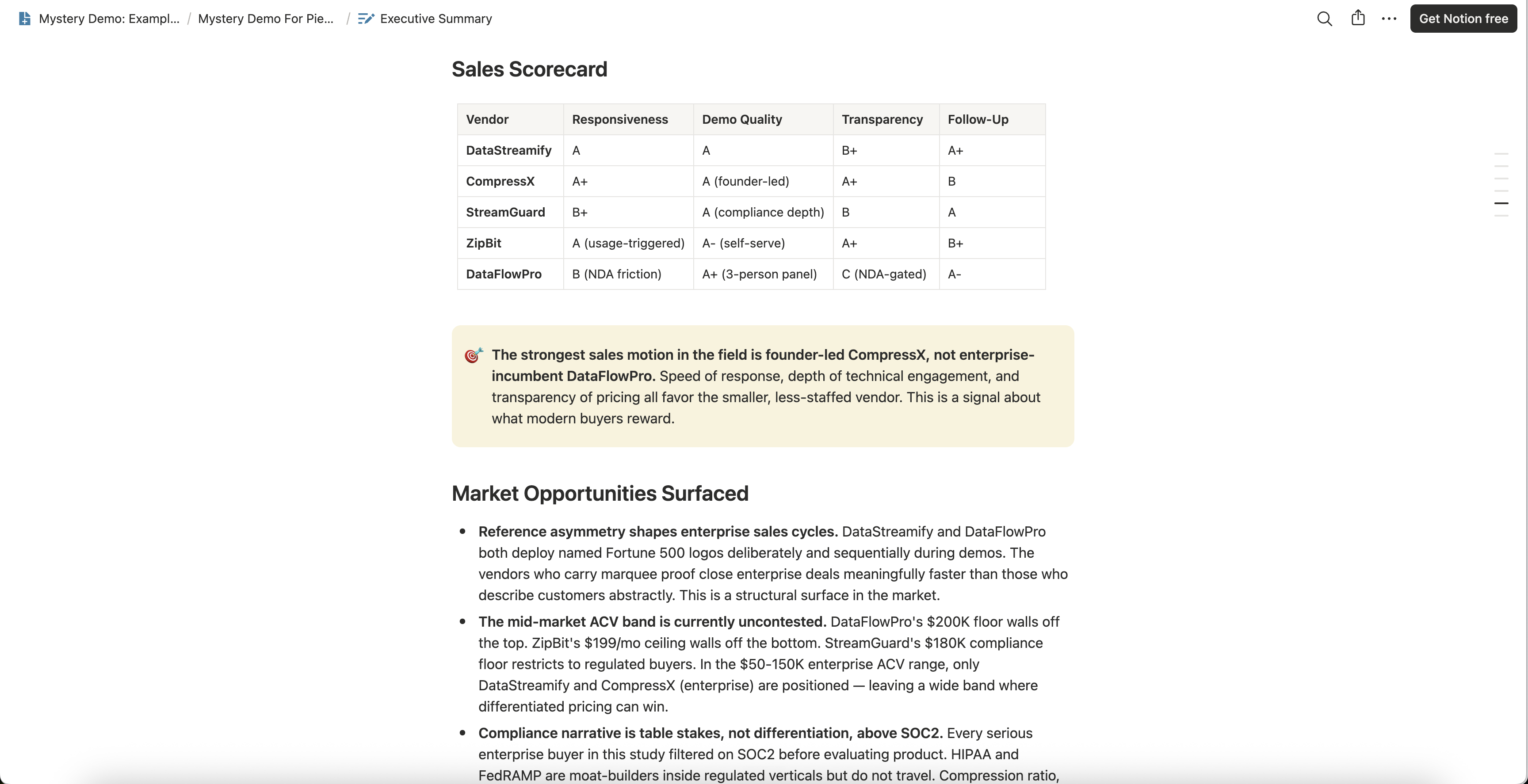
Next to the grades, the scorecard carries a note on how each company’s motion is run, including whether it still leans on a founder. On a real board, that note is written from the calls, and every line of it points to the recording behind it.
One project shows how the target sold to one buyer, this month. A founder who steps in once may be answering this buyer’s one unusual question. A founder who steps in at every stage is part of how the company sells, and either way you now know what to ask management.
Mystery Demo charges a flat €499 per company, everything included, and the target counts as one company. Each company takes one to two weeks, and the calls run in parallel.
When the thesis rests on a whole category rather than three companies, the same work runs across every serious player as SaaS market entry research, usually in four to eight weeks.
If a target is in diligence on your desk right now, tell us which company it is and who it loses deals to. We will go through all three sales processes as the buyer.
Four Checks to Run From Your Desk Alongside the Calls
Your own diligence still earns its place, and it tells you what to listen for on the calls. Each check helps, and each one has a limit you can name.
1. Read the sales records in the data room. Pipeline, bookings, pricing books, average selling price, and productivity by rep show you what the motion produced. They don’t show how any one deal was won, or whether a rep or the founder won it.
2. Ask management for the playbook and a few call recordings. Ask for the discount approval rule too, and for the deals the founder joined last year. You get the motion as the company describes it, from calls the company chose for you.
3. Call customers and lost prospects. PwC, for one, lists “voice of the customer through phone interviews” among the key tools of its commercial diligence teams. Customers tell you why they bought, about a sale that is months or years old, often from a list the seller picked.
4. Read the public footprint. The website, the pricing page, and the reviews show what the target wants buyers to believe, and they stop at the demo form. Its sales job posts tell you a little more: whether it hires reps to carry the sale, or the founder still carries it.
Take the Board Into the Investment Committee
The board turns into questions for the seller. Every time the founder had to step in on a call becomes a precise one:
Every place a rival out-sold the target becomes a question for your financial model. Flippa’s guide to buying a SaaS business counts low founder dependency among the things that make ownership “easier and safer.” The calls show you how much of it the target has before the price is agreed.
If the target is still a name on a list, start before the data room opens. If you are already in diligence, start this week, because each company takes one to two weeks.
Every desk check is yours to run. Name the target and its two closest rivals, and we will be the buyer at all three and bring back the recordings behind every question.
.png)


