
Ask a buyer why they chose a rival, and the first answer is often price. User Intuition, a win-loss interview platform, went back through 6,400 lost deals from its own clients’ interviews. Price came up first in 62.3% of them, and after patient follow-up questions the vendor’s analysts classed it as the main reason in 18.1%.
That is a vendor’s own sample, and every answer in it is a memory of a decision already made. Still, the gap shows what a good interview does: it gets past the first answer. An interview never gives you a record of the rival’s pitch, only the buyer’s memory of it, because nobody from your side was on that call.
Mystery Demo books your rivals’ sales demos as a credible buyer, one built to resemble the deals you keep losing. It cannot replay your lost deal. It hands back what the rival does with a comparable one: the recordings, and an analysis of what each rep said, showed and put in writing.
The win-loss analysis template below keeps the buyer’s memory and the rival’s recorded pitch apart. It has three records: one for the deal, one for what a rival said in a comparable demo, and one for the hypothesis that connects them. The deal record is yours to fill this week, and the second record is the one that needs a buyer on the rival’s calls.
The Template Keeps the Deal, the Rival and the Link Apart
Most win-loss templates have one competitor column, filled from the buyer’s memory or the rep’s notes. This one gives the rival a record of its own, with its own date. A third record holds what you think connects the two, and it stays labeled as a guess until a test confirms it.
On a Mystery Demo project, each field in the middle record lives on a page of the board, named in parentheses in the last column.
| Record | Field | The question it answers | Where it comes from |
|---|---|---|---|
| Deal | Seller account | What does our rep say happened? | Your CRM: the loss code and the rep’s own words |
| Deal | Buyer account | What mattered to the buyer, once you got past the first answer? | Your buyer interview |
| Deal | Buyer claim | What does the buyer say the rival said, showed or promised? | Your buyer interview, marked unchecked |
| Deal | Unknown | What do we still not know about this deal? | Your team |
| Observation | Scenario | Which buyer did the rival meet, and how close is it to this deal? | The buyer we built, fitted to that rival (the Fábula page) |
| Observation | Said or shown | What did the rival’s rep say, show or put in writing? | The recording, with the call and the minute (the rival’s own page) |
| Observation | Proof mark | Was it shown live, sent as a document, or only described? | The rep’s claims checked one by one (the rival’s own page) |
| Observation | Limits | How far is this run from the lost deal? | The run’s scenario and date set beside your deal (the Fábula page) |
| Observation | Cross-read | Do the other rivals do the same? | Every rival on the same question (Findings & Analysis) |
| Link | Hypothesis | What might connect the run to the loss? | Your team, labeled as an inference |
| Link | Unknown | What would break the hypothesis? | Your team |
| Link | Next test | What would confirm it or kill it? | Your team, at an action level set by the ladder below |
| Link | If confirmed | What changes if the test holds? | Your team |
The deal record and the link record are yours, and nothing on the board pretends to fill them. The middle record is the one your team cannot fill from its own systems, because nobody on your side hears the rival sell.
Start with the deal record. It is the one you can fill this week, and filling it well changes what you look for in the other two.
Fill the Deal Record Before You Look at Any Rival
Take an invented deal to see how the record fills. Deal D-0412 is a mid-market evaluation your team lost in March, and the rep coded it “lost on price.”
Seller account. Copy the rep’s code and words, unedited and dated. On its own, a loss reason logged by the rep who just lost is one of the classic competitor analysis mistakes.
Kept beside the buyer’s account, it shows where the two disagree, and they disagree often. Clozd, a win-loss research firm, reports that buyer and seller reasons for a lost deal match only 15% of the time.
Buyer account. Interview the buyer and ask past the first answer: what the second meeting with the other vendor looked like, who needed convincing, what each vendor put in writing, and whether anything your team assumed about them was wrong. In D-0412, price came up first, and ten minutes later the real worry was a long, vague implementation.
Buyer claim. Write down what the buyer says the rival said, and mark it unchecked. In D-0412, the buyer said the other vendor “put a go-live date in the contract.” That is a claim about the rival, made from memory, and it is not yet a fact about the rival.
Unknown. Nobody knows what else the winning contract held, or whether the date came with a penalty, so give those unknowns a field of their own. Written down, an unknown becomes the next interview question instead of a gap someone fills with a guess.
Fill all four fields, and one thing is still missing: what the rival’s rep said and showed to a buyer like this one. The buyer claim is the closest you get, and it is a memory.
No Buyer Interview Can Fill the Observation Record
A rival’s pitch is said to one buyer, on one call. Your reps never take that call, and the rival is not going to send you the recording.
Mystery Demo fills the observation record by being that buyer. When the scenario comes from your losses, a run works like this.
On our public example board, where the client and every competitor are invented, each rival gets a page like the one below. A real project’s board is built from that client’s own calls. The page opens with the competitor’s basics, then the intro meeting with its date, its length and who attended, then the link to the recording.
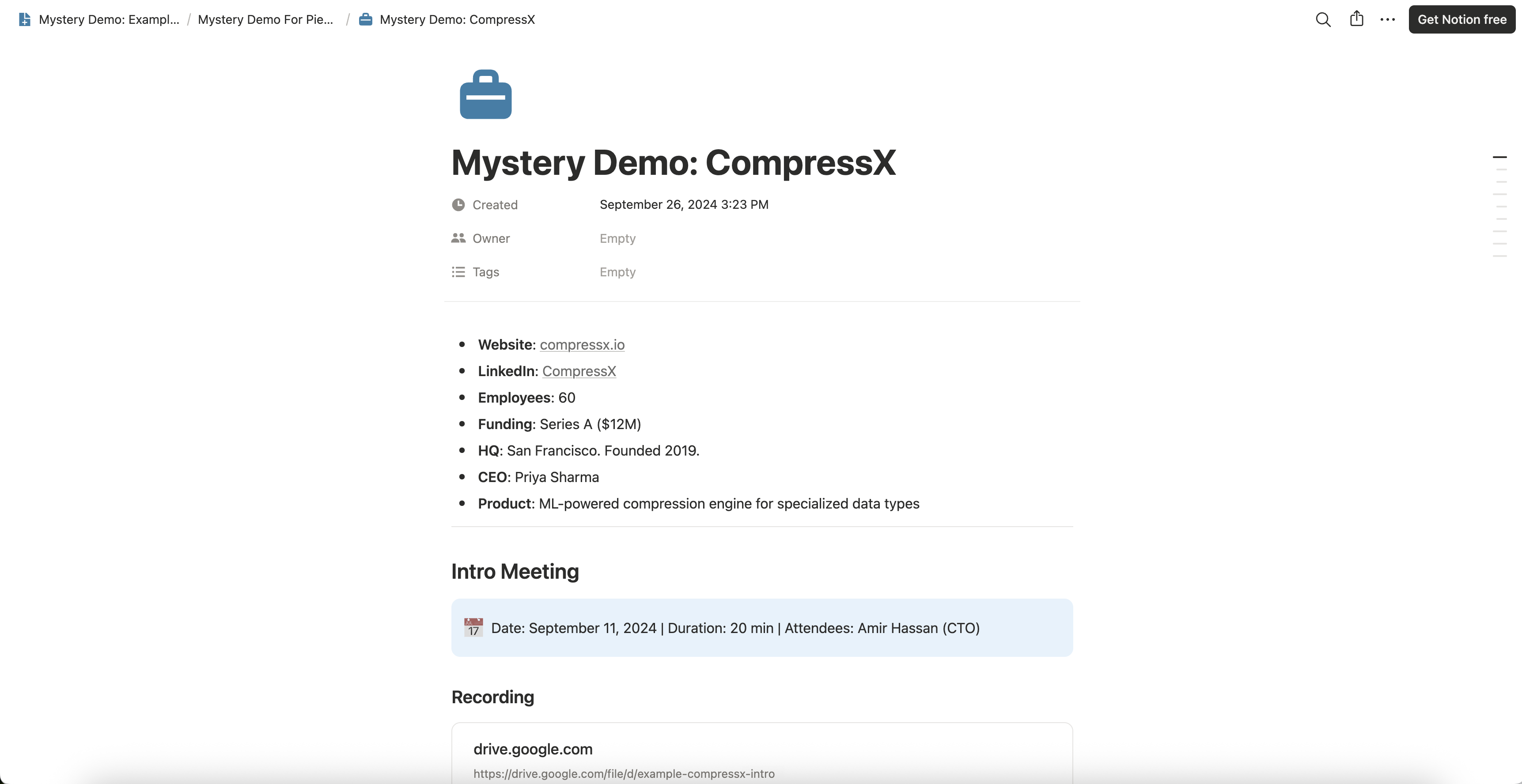
For the template, that page is where the observation record’s call and minute come from, and the recording behind it can be played back at any minute.
The run does not recover the pitch the rival gave in D-0412. It records what the same rival says to a comparable buyer, on a known date, months after your loss. That is why the template keeps it in a record of its own, with its limits written beside it.
.png)

With the deal record and the run both filled, the two can be read side by side.
Deal D-0412 and Run R-03, Side by Side
Here is the template for D-0412, filled. The deal, the rival and every line on it are invented to show the shape, and the image says so in its own frame. On a real project, the observation record comes from recorded calls.
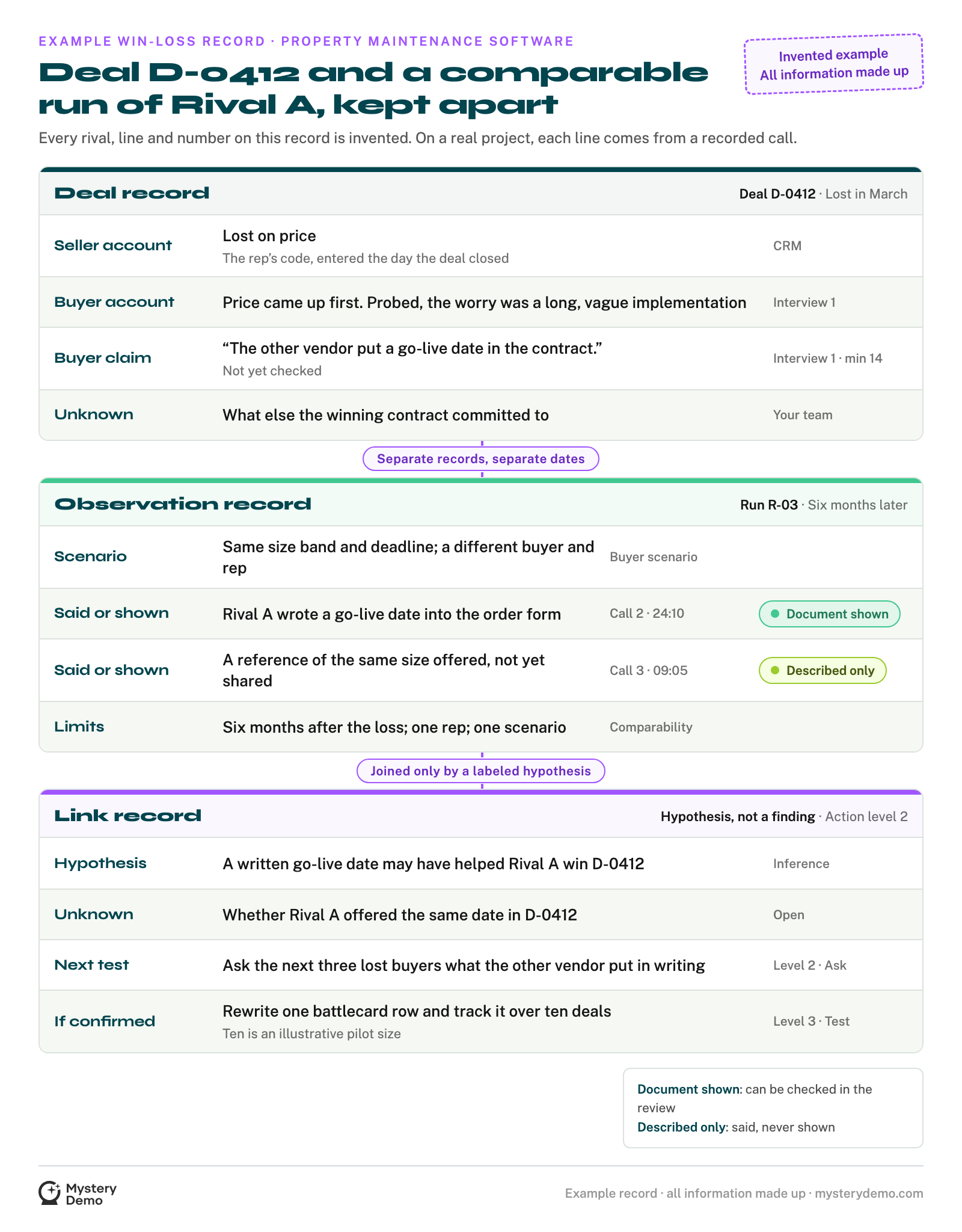
That last line is the point of the template. Without it, a recording from September slowly turns into a fact about a deal lost in March.
One run is one buyer’s evidence, so R-03 says what Rival A did once. A second run with a different rep would show whether it is a habit. The cross-read field asks a different question: do the other rivals do the same?
On the board, that answer is on Findings & Analysis, where every rival is compared one dimension at a time. Below is the implementation and onboarding dimension of the example board, every vendor in it invented: time to first value, the implementation model and the support that follows, side by side.
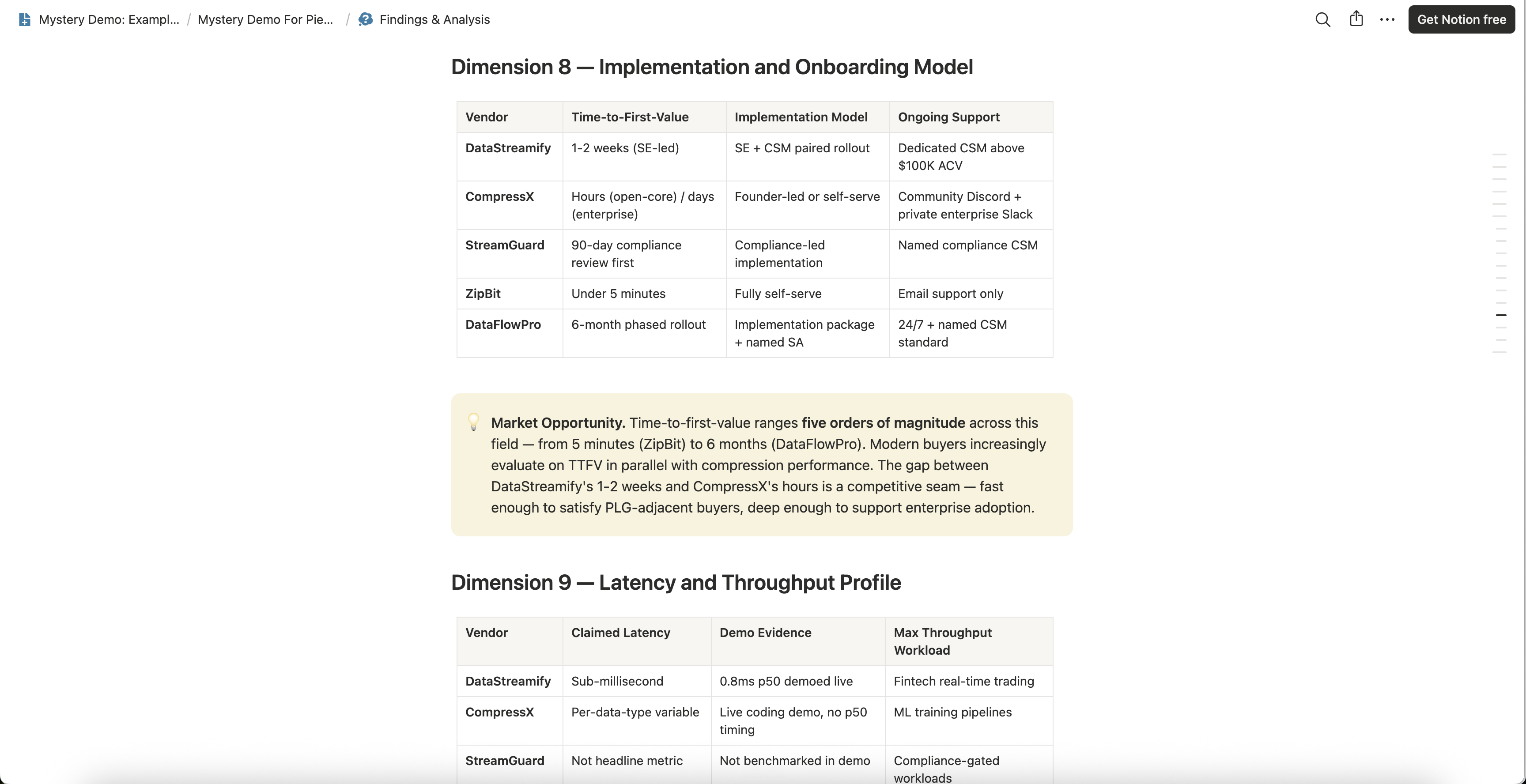
For D-0412, this is the page that would show whether a written go-live date sets Rival A apart or is what every rival offers. The same page sets what each rep claimed against what the demo showed, which you can see starting at the bottom of the capture. A SaaS competitor product comparison is built on that shown-versus-claimed layer, and it is where the proof marks on your template come from.
If one rival shows up in your loss codes more than the rest, walk us through the deal type you keep losing. We will build the buyer from it and take that rival’s calls, so the empty record on your template has a dated recording behind it.
The record still cannot tell you what to change. A hypothesis about a lost deal needs a rule for how far it may move you.
Let the Evidence Decide How Far You Move
There are two easy mistakes to make with a recording like R-03: ignore it because it is not the original deal, or rewrite a price because of it. The action level, set on each next test, is the rule between them. It decides how far the evidence may move you, in four steps.
Level 1: Log. Every observation goes on the record, dated, even when nothing else happens. One run is enough for this level.
Level 2: Ask. The hypothesis becomes a question in your next buyer interviews. For D-0412, ask the next three lost buyers what the other vendor committed to in writing.
Level 3: Test. If buyers confirm it, rewrite one row of a battlecard built from real demos and track it across a fixed set of competitive deals. Ten is a reasonable pilot to start with, not a proven threshold.
Level 4: Change. A change to price, terms or roadmap needs several buyers of that type saying the same thing, plus the observation behind it. Its size should match the strength of that evidence.
Two cautions keep the ladder honest. A recorded promise proves the promise was made, not that the rival delivers on it. A demo the rep put off until later does not prove the feature is missing, only that it is worth asking the buyer about.
Every level above the first leans on an observation that is still current. Rivals do not hold still long enough for that to last.
When the Rival Changes Its Pitch, Run the Scenario Again
The observation record carries a date because rivals change their pitch, their packaging and their price. A go-live date written into an order form in September can be gone by the next quarter, and the deal record will not tell you.
Keep old observations on the record, dated, and add each new run beside them. When two runs disagree, the scenario and rep fields tell you whether the rival changed or only the rep did.
A rerun needs the same believable buyer, months later, and your own reps cannot be that buyer: the rival would recognize them before the first call. Mystery Demo can, and a run brings four things.
This week, fill the deal record for your last three losses to one rival. Where two or three of them carry the same claim about that rival, you have found the scenario worth running.
Send us that rival and that deal type, and we will run the scenario as the buyer and hand back the observation record, dated, recorded and ready to test.
.png)


