
A rep quotes you a setup fee that is not on the pricing page.
You now know one thing and you cannot tell which thing it is. Either that vendor charges a setup fee, or the whole category does and nobody publishes it.
The first is worth knowing before your next deal against them. The second is worth knowing before you set your own price. Same sentence in the transcript, two different projects behind it.
Mystery Demo runs both of the projects behind that sentence. We are SaaS operators who book and sit your competitors’ demos as genuine buyers on your behalf, then hand back the recordings, the transcripts, the email threads and our read on what they mean, on one Notion board.
A deep evaluation of one competitor is the narrow version. A competitive landscape review is the wide one: the same evaluation walked through every funnel in your field, at once, for the same flat 499 euros a competitor.
Telling those two apart before you brief anyone, including us, is what this page is for.
It Is One Study of Several Vendors, Not a Folder of Profiles
Start with what the words mean, because the second project gets sold under a lot of names.
A landscape review runs one evaluation across every company in the set and reads them together. The output is a comparison. A single-competitor project gives you a profile.
Much of what is sold under the landscape name is desk research: websites, funding data, review-site grids, feature tables. It answers real questions about who exists and who claims to serve whom. It cannot reach anything a vendor decides in conversation.

So the definition is not in dispute. What nobody writes down is where the evidence comes from, and whether the comparison holds at all.
The Comparison Only Holds If the Buyer Stays the Same
Send six different buyers at six vendors and you get six anecdotes with a shared cover page.
Each vendor heard something different from its buyer:
When the answers differ, nobody can tell whether the vendor differed or the question did.
Hold the buyer steady and that problem mostly disappears. One company profile, one use case, one set of questions, walked through every funnel in the set. That control is what turns several studies into one review.
On our side that constant has a name. The fábula is a believable company and buying situation, rooted in truth, and it is what we carry into every one of those conversations. Nobody is impersonated, and the only invented part is which client the evaluation is for.
The core story stays the same from the first vendor to the last, and only the emphasis changes to fit each one. Which buyer you send decides which findings exist:
So scoping the buyer is part of scoping the field. If the price column is going to mean anything, every price in it has to have been quoted to the same company.
Below is the methodology page from Mystery Demo’s public example board, where every company is invented; a real project’s board is built from its own calls. It shows the five stages every project runs, with the fábula built in stage two.
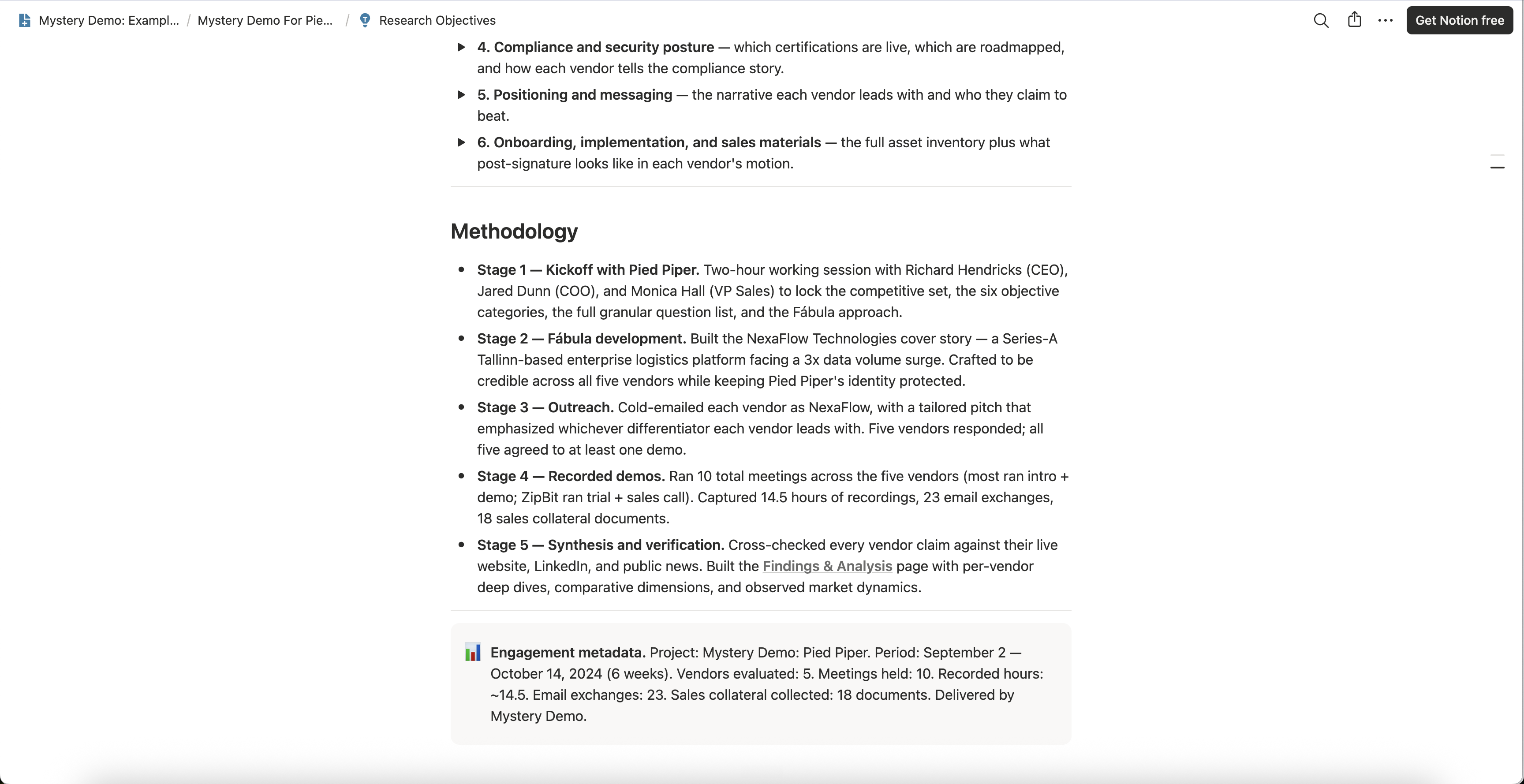
Constant buyer, comparable answers. So what shows up in them?
The Whole Field Is What Gives You a Baseline
At one vendor, a behavior is a habit. Across most of the field, it starts to look like the category’s rule.
Nothing about the observation changes. The denominator does. That is what most clients come for:
There is a harder version of the same idea, and it is the one worth paying for.
You already know which rival you lose to most often. What you do not know is whether you lose to them because they are genuinely better at beating you, or just because they are everywhere.
Those two need completely different responses. Telling them apart means measuring one vendor against the rest of the field, which means having the rest of the field. The benchmark is the field.
One caution, and it is the strongest argument against everything above. Vendors in a category often learn from each other, so a pattern across five vendors can be one idea wearing five logos. When something repeats, ask where it came from before you treat it as a rule.
The Key Findings page below is the field-level layer of the same invented board. Two of its four findings place one company against the rest of the set, and the other two describe the set itself.
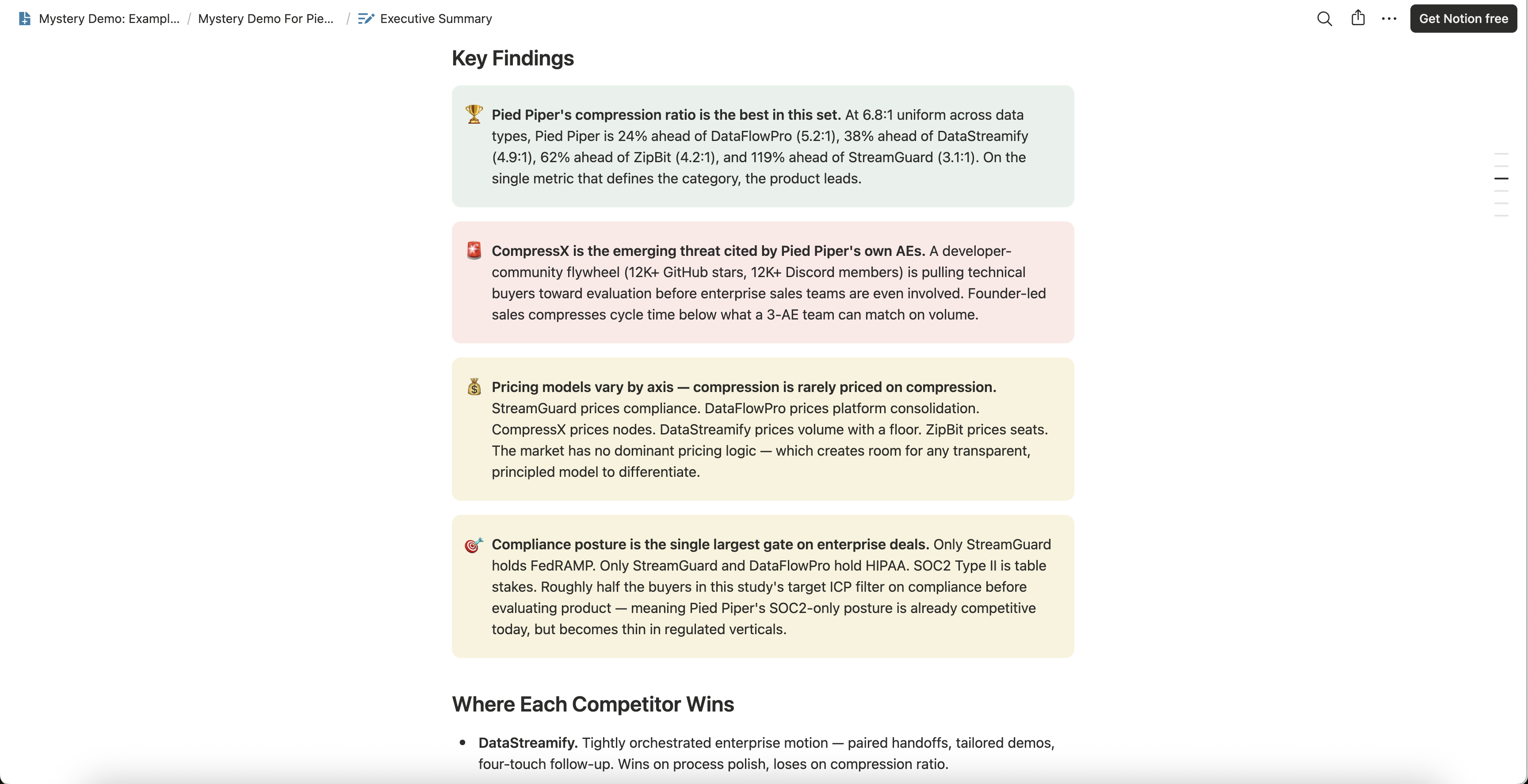
Focus Is What You Trade For It
Width does not cost you meetings. Every competitor in a landscape gets the full evaluation, every meeting included, for the same flat fee.
What it costs is focus. A single-rival project writes its whole question list around one competitor, so every follow-up chases how that rival wins, and that is what reaches these moments:
A landscape asks every rival the same questions so that the answers compare, and it trades that single-rival focus for the comparison.
So go deep on one rival when you can name them, you meet them in the same shape of deal over and over, and your question is how they win it. In that situation a fifth vendor is a distraction and a third meeting is the answer.
That work has its own page: competitor sales tactics research walks one vendor’s whole cycle, booking through follow-up, and scores the motion step by step.
A per-vendor page from the same invented board sits below: company facts, then the meetings with their dates and durations, then the recording. A landscape review builds one of these for every vendor in the set.
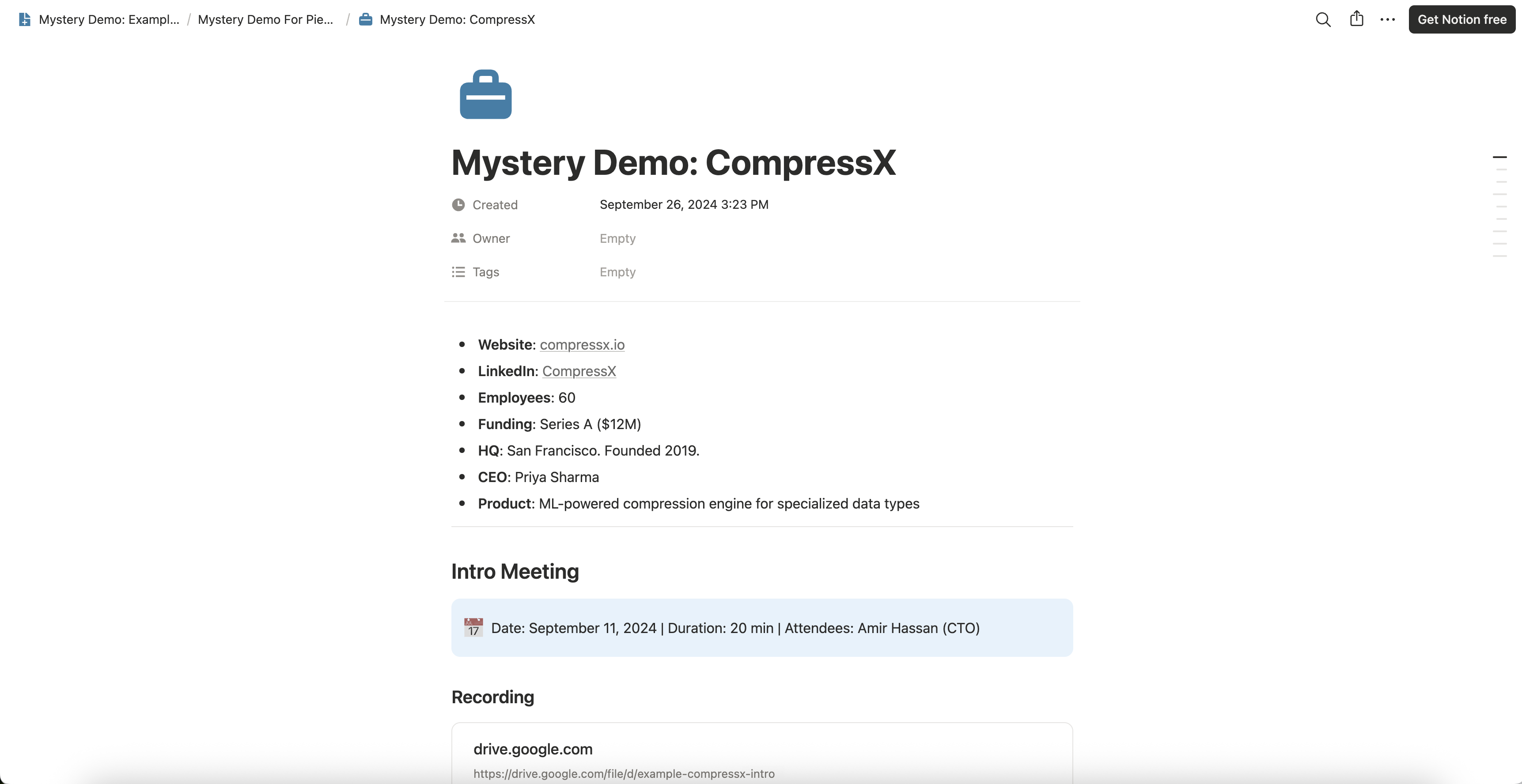
Two projects, two questions. If you have settled on the field, the only thing left is how wide.
How Wide, and What Widening Costs
Money scales with the count and nothing else. Ours is 499 euros per competitor, everything included, and the published ladder holds that number at every width: five competitors are 2,495 euros, ten are 4,990, with no volume break anywhere.
The calendar does not behave that way. One competitor runs one to two weeks, and a landscape of six to fifteen runs four to eight, because the funnels run in parallel.
A wider project takes longer, but not in proportion. It is mostly a busier one.
Whether the fee is worth paying at all is a separate argument, worked through in the case for and against the fee. This page is about what to multiply it by.
Start with what buyers do. TrustRadius surveyed 1,862 technology buyers in January 2026 and found 83 percent had shortlisted three products or fewer.
That is a per-deal number, and it is why these projects get scoped too narrowly: your competitor set is not one deal. Different opportunities surface different rivals, and the combined set across a year of deals is usually larger than any single shortlist.
The field has no natural edge either. Somebody draws the frame, and if you are commissioning the work, that somebody is you.
The one exception to keeping the set tight is rarity, and it is only arithmetic. If the behavior you are hunting shows up at one vendor in ten, a set of four will usually miss it. Width is set by how rare the thing you are looking for is, not by how many companies are in the market.
.png)

So the scope you can defend out loud is this. Wide enough that a repeat means something, weighted toward the vendors who turn up in your own deals, and wider than that only when you are hunting something rare on purpose.
If you already have that list, put it in front of us on a short intro call and we will tell you how wide we would go and why.
Which One You Need, and When to Buy Neither
The choice is easier from the question than from the budget.
| The question you are holding | What answers it | Why |
|---|---|---|
| Is this normal for the category, or is it just them? | The field | One evaluation has no denominator. |
| How does the rival we keep meeting win the deals we lose? | One rival, in depth | The answer is in the third meeting, not the fifth vendor. |
| Where can we credibly claim to be different? | The field | A differentiation claim is a claim about a distribution. |
| What do they say about us when our name comes up? | One rival, in depth | It shows up most clearly when the scenario names you. |
| Which of these competitors should we worry about? | The field | You cannot spot the outlier without the middle. |
| Why do deals we should have won go quiet? | Neither, yet | Many of them are lost to no decision, not to a rival. |
That last row is the honest answer more often than we would like. If your pipeline dies when a buyer who liked you stops replying, competitor research of any width is not your first purchase. A landscape review cannot tell you why a buyer who liked you went quiet.
Read your own closed-lost notes first. If most of them say no decision, spend the money there and come back to us later.
When it is the field you need, the first conversation is about the frame, not the names. We would rather spend that call arguing about which vendors belong in the set, which buyer the scenario should describe, and how wide it has to get before a repeat means anything.
Book the scoping call, and Mystery Demo will build the scenario, sit every funnel in the set, and hand back one board you can compare across.
.png)


