
One competitor takes one to two weeks. A full landscape of about six to fifteen competitors takes four to eight. Those are the timelines for a Mystery Demo project.
Mystery Demo takes the buyer’s seat in your competitors’ sales demos, records every call, and hands back the evidence on a Notion board, with a page for each competitor. The practice is called mystery shopping for B2B SaaS. If you are scoping one, there is probably a date it has to beat: a launch, a pricing review, a board meeting.
The range is wide, and the research is almost never what stretches it. Fifteen competitors do not take fifteen times as long as one. A handful of calendars decide where your project lands, most of them your competitors’ and one of them yours.
Kickoff Fixes the Count, and the Count Picks Your Range
Every project opens with a kickoff call. In it we agree which competitors are in the set, what you need to learn about them, and the questions every rep will be asked. You also walk us through your own product, so that on every call we can ask what a buyer who knows the category would ask.
The number of competitors you settle on picks your range. A single rival is a project of one to two weeks. A landscape of six to fifteen takes four to eight, well short of fifteen single projects laid end to end.
The page below comes from Mystery Demo’s public example board, where the client and every competitor are invented. A real project’s board is built from its own calls.
The Research Companies page lists each competitor in the set and why it is there. The column worth a look counts meetings, because the number of calls can differ from one competitor to the next.
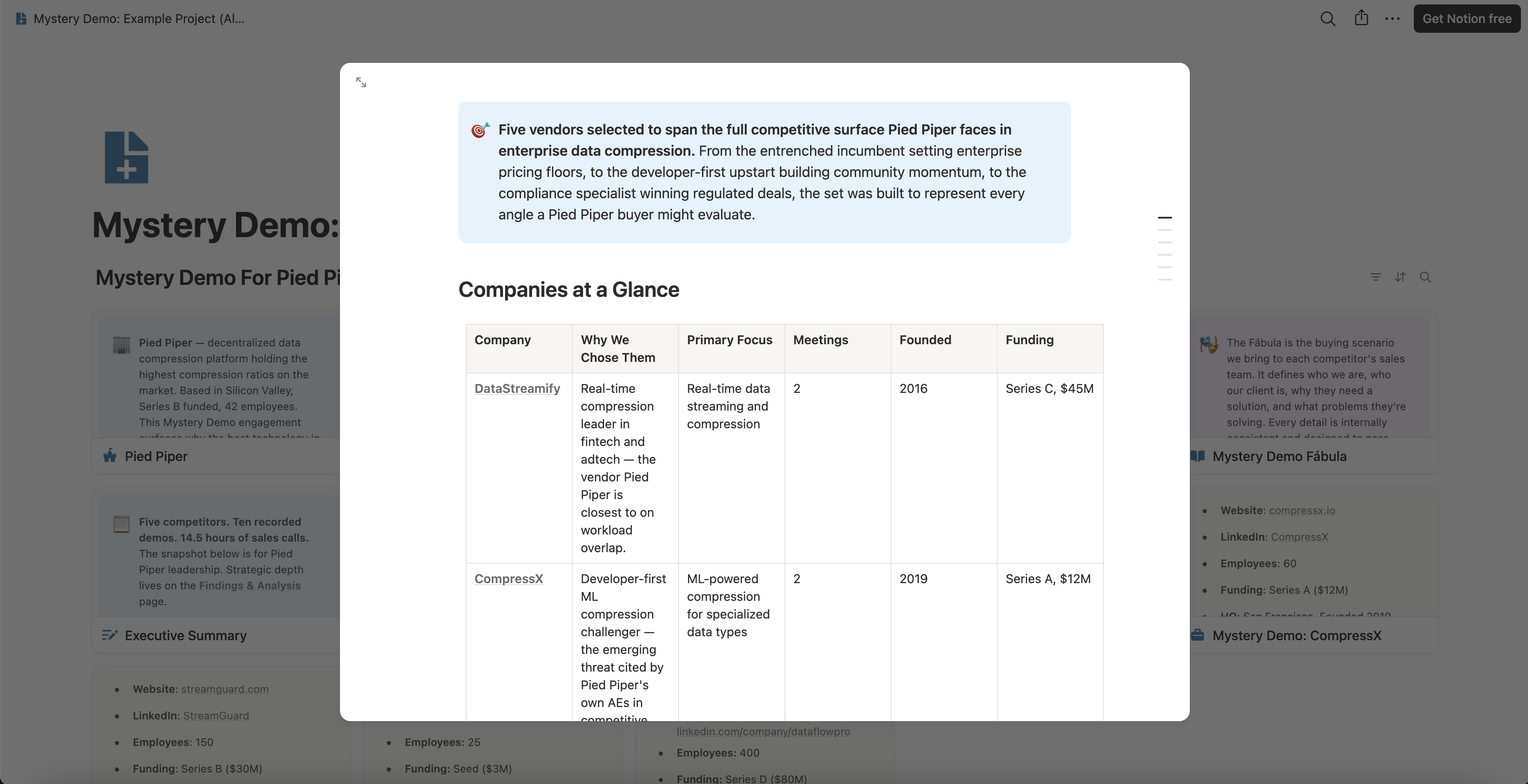
Your part of kickoff is to arrive with the names and the decision they serve. When both come from you, kickoff settles them in one call, and when they do not, the first week goes on working them out.
If you cannot name either one yet, you may not be ready to buy this, and the fix is homework rather than a longer project.
Once the set is fixed, one more thing is written before any competitor hears from us: the buyer each of them is going to meet.
Every Competitor Meets a Buyer It Takes Seriously
We call that buyer the fábula: the buying scenario we bring to each competitor’s sales team. It describes a believable company with a real reason to look at software now, fitted to the kind of customer each competitor sells to best. Nobody real is impersonated, and the one thing a rep never learns is who asked us to look.
One part of the scenario matters to your calendar more than the rest. The buyer comes with a decision date of its own. It is set tight enough that a rep treats the evaluation as live, and loose enough that a second or third meeting makes sense.
Then each competitor is approached through its normal front door, with a pitch fitted to whatever that competitor leads with. A team that shops its own rivals gets recognized, or gets the generic tour. The generic tour rarely reaches the meeting where a price gets said.
Our operators have sold B2B software themselves. They know which question gets a rep off the script, and how to get the next meeting booked.
When the last request goes out, the project stops running on our calendar.
Once the Requests Go Out, Your Competitors Hold the Calendar
From here, the date belongs to sales teams that have no idea they are on your schedule. Four things move it, and none of them is research:
.png)

A review of competitors’ websites can be done in an afternoon, because a website never makes you wait for a reply. It also never quotes the price a rep would, shows which of its listed features the product does not have yet, or tells you what gets said about you when your name comes up. Those things only happen on the calls, and the calls run on your competitors’ calendars.
A competitor that wants a second or third meeting costs you calendar time and nothing else. Every meeting is inside the flat 499 euros per competitor, so there is no second invoice when a rep asks to bring in an engineer.
In a landscape, fifteen of these clocks run at once, which is less of a problem than it sounds.
Fifteen Competitors Run Side by Side, So the Slowest One Sets the Date
Each competitor in a competitive landscape review is its own track. Its request goes out, its calls get booked, its analysis gets written, and none of that waits for the competitor next to it. The project finishes when its slowest competitor does, not after every competitor’s time added together.
That is why fifteen competitors take four to eight weeks, not fifteen times two. It is also why the board fills up while the project is still running, with each competitor’s analysis landing on its own page as soon as its calls are done.
A competitor’s page holds the recordings, the cleaned transcripts, every email and piece of collateral it sent, and our analysis of what it showed and claimed, with every point traced to the recording it came from. Across the set, those pages become a feature-by-feature comparison of what each competitor really ships, set against what its website says it does.
Not every competitor has a sales team to wait for. The page below, from the same invented board, belongs to a product-led competitor with no intro call at all, so its evaluation ran through its own self-serve trial.
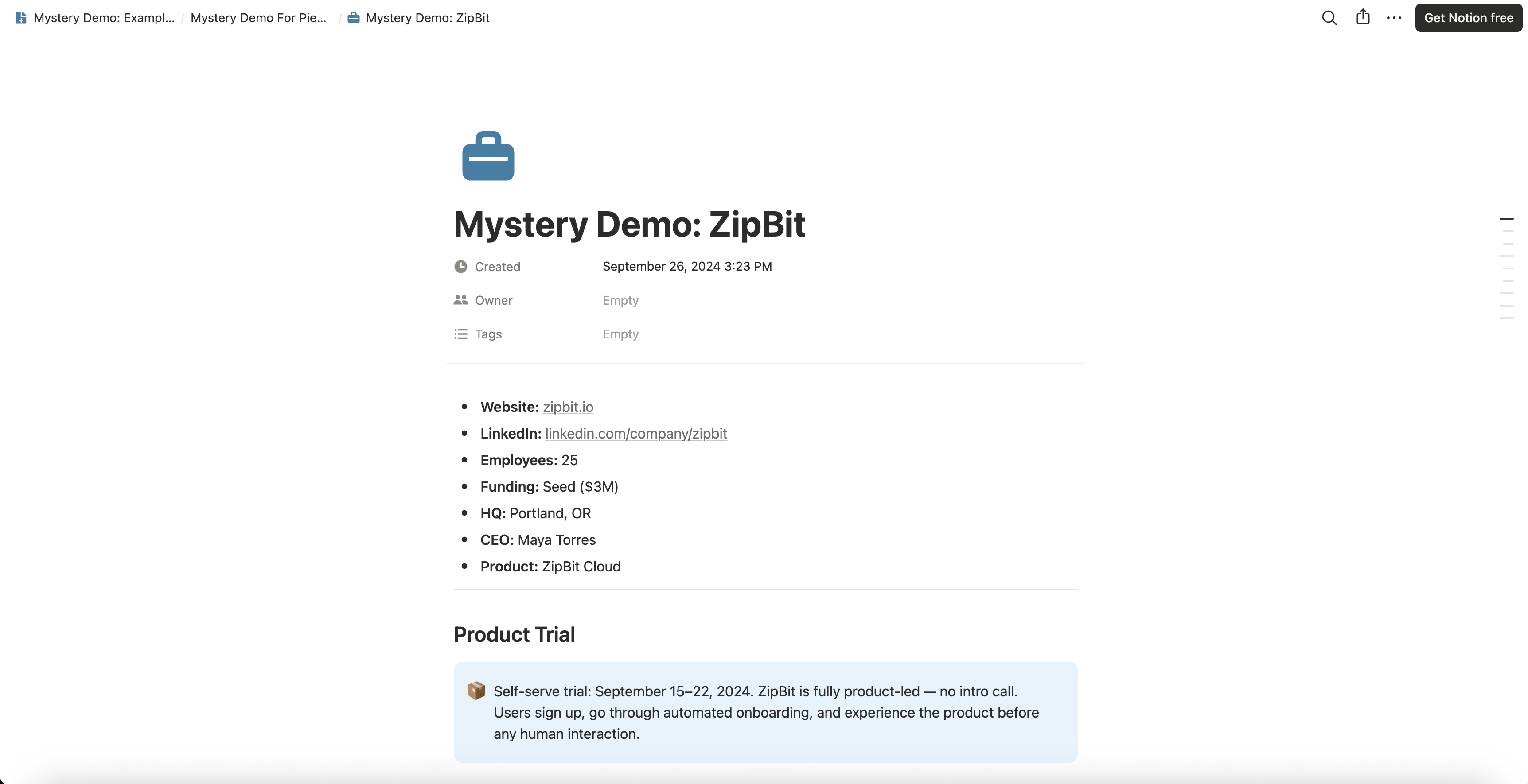
An evaluation like that never waits on a rep. Its clock starts when the trial does, and the page logs the trial where the recordings would be.
If your decision needs the whole field, bring us the list and we will start every competitor on it at once.
When the last competitor finishes, we write the two comparison pages. Findings & Analysis sets the competitors side by side one dimension at a time, and the Executive Summary gives the verdict to whoever has to decide. Laid out stage by stage, with the calendar each stage runs on, the whole project looks like this:
| Stage | What happens | Where it lands on the board | Whose calendar |
|---|---|---|---|
| Kickoff | The competitors, the objectives and the questions are fixed, and you show us your product | Client Profile, Research Objectives, Research Companies | Yours and ours |
| The buying scenario | A believable buyer is written and fitted to each competitor | Mystery Demo Fábula | Ours |
| Outreach | Each competitor is approached through its own front door | Every email, on that competitor’s page | Theirs |
| The calls | Discovery, demo, technical deep dive, pricing and follow-up, all recorded | Each competitor’s page and the Database | Theirs |
| Analysis | Transcripts cleaned, claims checked, each competitor written up as it finishes | Each competitor’s analysis, then Findings & Analysis | Ours |
| The verdict | The competitors compared and the verdict written | Executive Summary | Ours |
| Your review | Your team reads the board and makes the decision | Executive Summary, in your meeting | Yours |
You appear in two rows. Kickoff is one call, fixed before anything starts. The review is the other, and it is the one that slips.
The Step That Slips Is the Review on Your Own Calendar
A board can be finished and then sit unread for weeks. Nothing in the research is late when that happens. The meeting that was supposed to use the board never made it into anyone’s calendar.
That is the step that slips, and it is the only one in the table that runs entirely on your side.
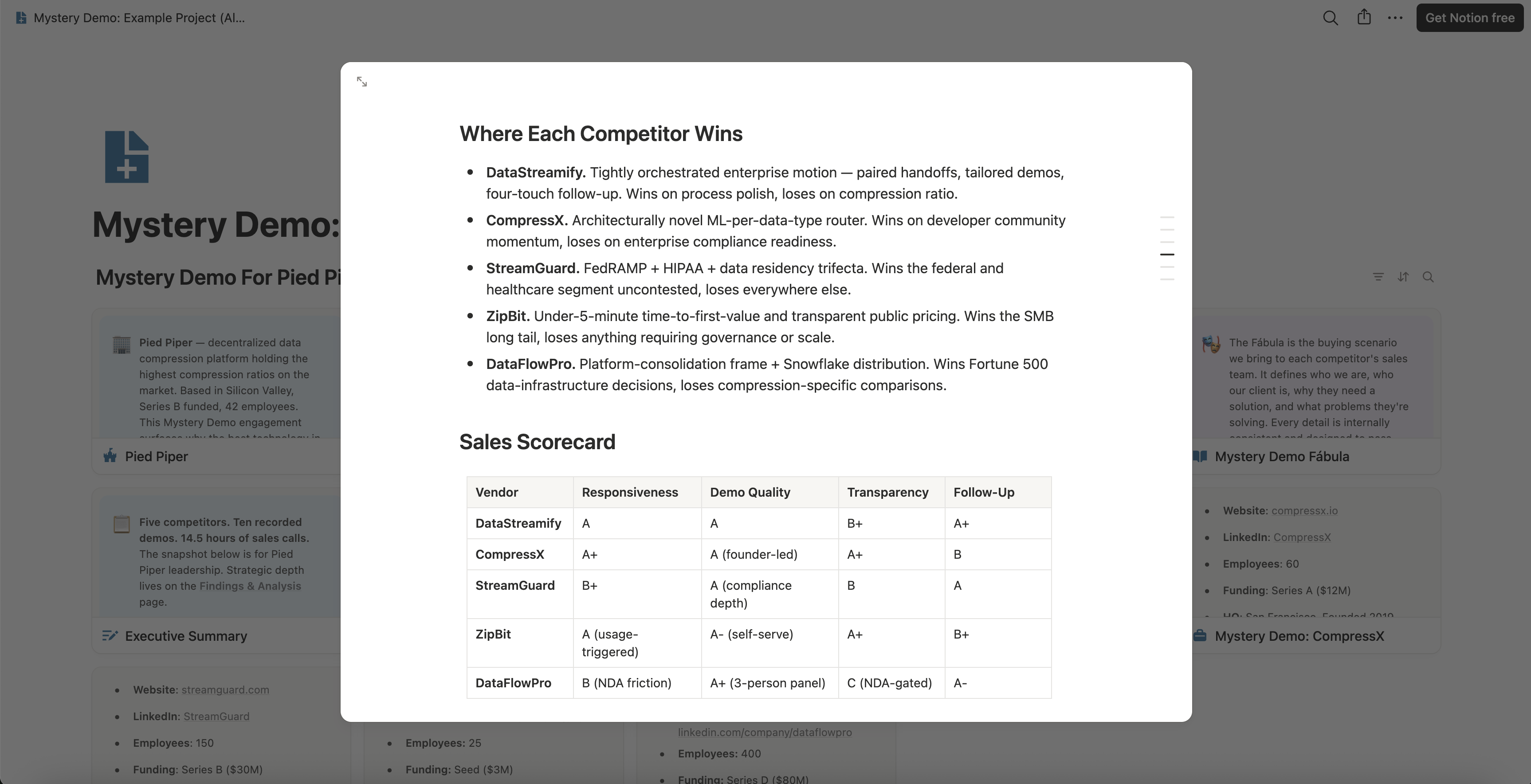
The review starts from the Executive Summary, the page written for whoever owns the decision. Below is part of it from the invented example board: where each competitor wins and where it loses, and a sales scorecard grading each one’s reps. The scorecard’s first column grades responsiveness, so the same waits that set your calendar become a finding about how each competitor sells.
Four habits keep the review on schedule:
Do those four, and the only question left is when to start. You can work it out backwards from your own date.
Count Back From the Date Your Decision Is Due
Start from the meeting where the decision gets made, and put your review a few days before it. Count back two weeks from the review for one competitor, or eight for a full landscape, and you have the latest day kickoff can happen.
If that day has already passed, start with the competitor the decision cannot do without. One competitor takes one to two weeks, and the rest of the set can follow on its own schedule.
The fee does not move with the calendar. It is a flat 499 euros per competitor with everything included, so a landscape of ten costs 4,990 euros whether it lands in four weeks or eight.
Tell us the date your decision is due and the competitors it turns on. On a short call we will work out with you whether the board can land before that date, and then we go and sit the demos.
.png)


