
TrustRadius asked 1,862 B2B technology buyers how they bought software last year, and 83 percent of them shortlisted three products or fewer.
That number is why this page exists. Your competitive set is not your category. It is the two or three names that sit beside yours on a buyer’s shortlist, and naming those companies is the first thing a competitor demo project needs from you.
Mystery Demo runs those projects: it books your competitors’ sales demos, sits every call as a genuine buyer, records what the rep says and shows, and hands you the evidence on a Notion board. It costs a flat 499 euros per competitor, and it is not for every company.
Three kinds of company should not commission this work: one that cannot name its competitors, one that cannot say what it wants to learn, and one that wants the software itself tested. The first two are not ready yet, and both can be. The third wants a different service.
If You Cannot Name the Competitors, Start There and Not Here
We can build the list, and it is a perfectly good piece of work. It is still better when the names come from you.
The reason is not effort. A competitor list is a claim about who you lose to, and a claim you did not make yourself is one you can disown later. When the findings land and one of them stings, a list we wrote becomes the thing under discussion, and the project turns into an argument about scope instead of an argument about price, product, or pitch.
A real competitor is a name that shows up on a buyer’s shortlist beside yours. With three names or fewer on most shortlists, that set is small and specific, and nothing like a category map.
Your own list can go wrong in both directions. Teams overcount by listing everyone with a similar landing page. They undercount by leaving out the incumbent spreadsheet, the internal build, and the option of doing nothing for another year, which belong in your thinking even though nobody can sit their demo.
Once the names exist, the work starts before any demo is booked. The page below is from Mystery Demo’s public example board, where every company is invented; a real project’s board is built from its own calls. Each named competitor gets a profile and a line on why it was chosen, so the questions we carry into the call are not ones its website already answers.
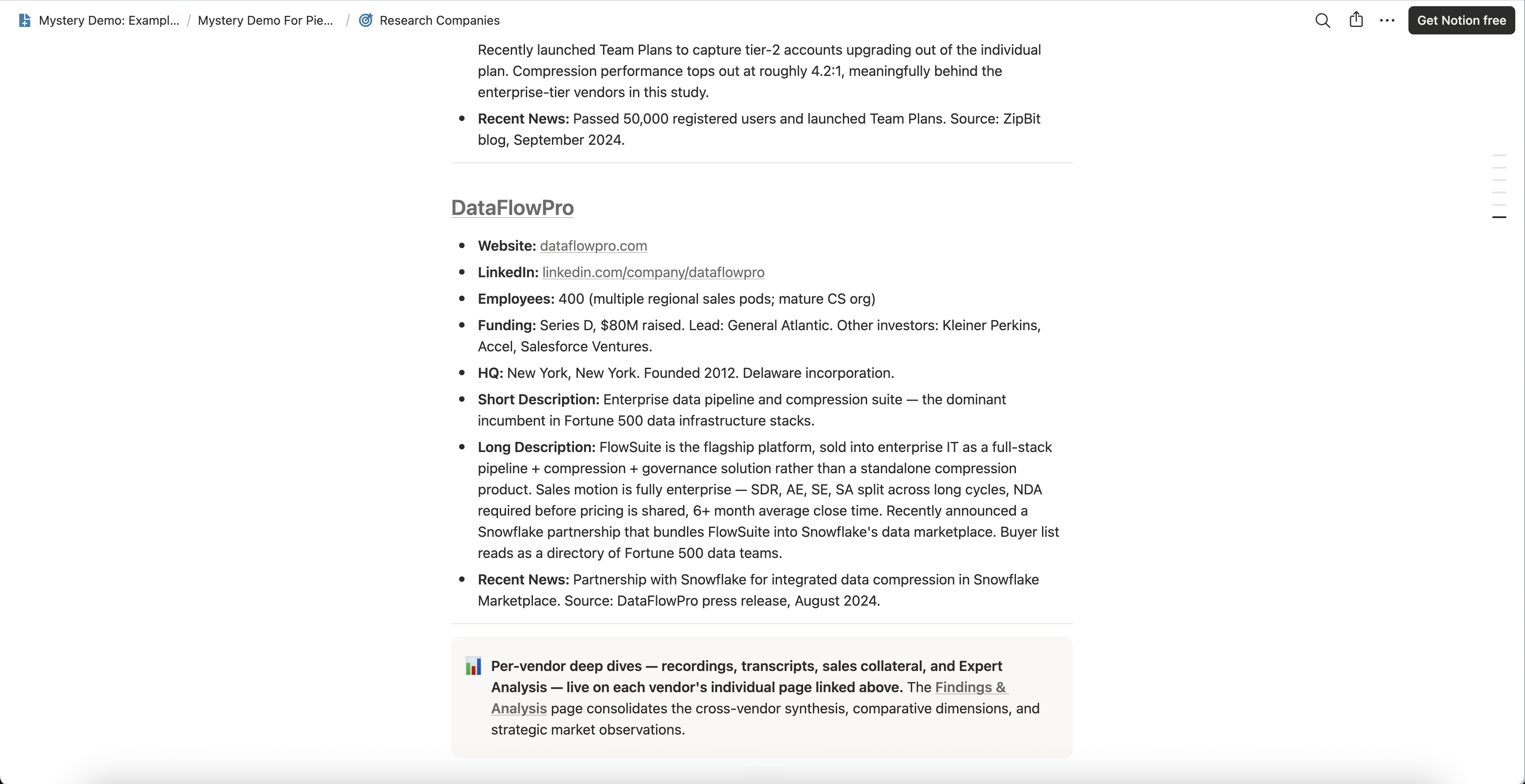
None of the competitor-specific work can begin from a category. It begins from a list.
If you do not have one, the work to build it is yours to do, and it rarely takes more than an afternoon:
If the same two or three names keep appearing, that is your set. If nothing repeats, the list needs more work before a project can be scoped.
If You Cannot Say What You Want to Learn, You Get Coverage Instead of Answers
A list of names is half of what a project starts from. The other half is the part people arrive without.
Every project opens with a kickoff that settles the competitors, the objectives, and the specific questions we will ask. We can help shape the questions, but the objectives have to be yours.
The calls run on that question list. A question nobody brought to kickoff rarely gets asked later, because by then the rep is running their own agenda. An objective missing at kickoff is a conversation that never happens.
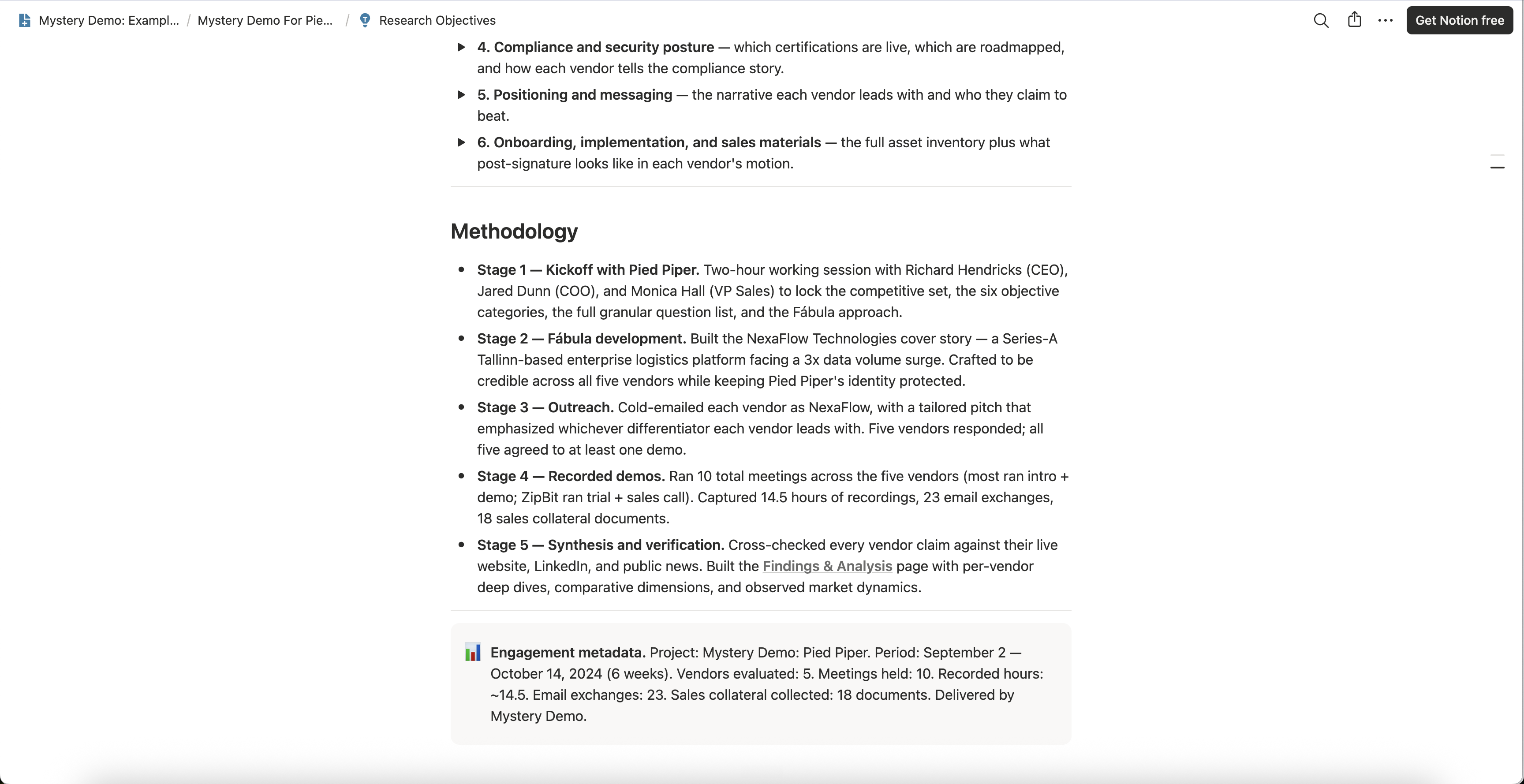
The objectives page above follows the five stages every project runs: kickoff, the buying scenario, outreach, the recorded demos, and the analysis. Operators who have sold B2B software sit the calls, working from a buying scenario fitted to each competitor, and every finding on the board points back to the recorded moment it came from.
What changes between projects is the question list, and the question list is where a project is won or lost before anything is booked.
A wish and an objective read almost the same on a kickoff call. “Understand their pricing” is a wish. “Find out their floor on a 200-seat deal, the conditions that ride on it, and how long the quote stays good” is an objective, because it names something specific enough to change what you do next.
.png)

None of this is an argument about whether the fee is worth paying, which is a separate question with its own page: the return case for competitor mystery shopping weighs the cost against the decision it settles. The question here comes earlier. A decision has to exist before anything can be weighed against it.
So the homework is short, and it is not research. Write down the decisions you face this quarter that turn on something you do not know about a competitor.
One clear decision is enough to start a brief, and kickoff turns it into the questions. If you have the names and that decision, and the answer lives in what their sales teams say, show, or quote, set up a short intro call and we will scope the demos with you.
If You Want the Software Tested, That Is Someone Else’s Job
The first two are questions of readiness. This one is not, and it is the only one of the three that no amount of preparation changes.
We sit the demos, ask the agreed questions and the follow-ups they lead to, keep everything the vendor sends afterwards, and write the analysis. We do not test the product. We are inside their sales process as a buyer, never inside their software as a user.
What that gives you is everything that happens in front of a seller: what they demonstrated live against what they only described, what they said when we asked the awkward question, what the quote covered and what it left out, how they behaved when we named a rival. That last one is the whole subject of a competitor sales tactics review.
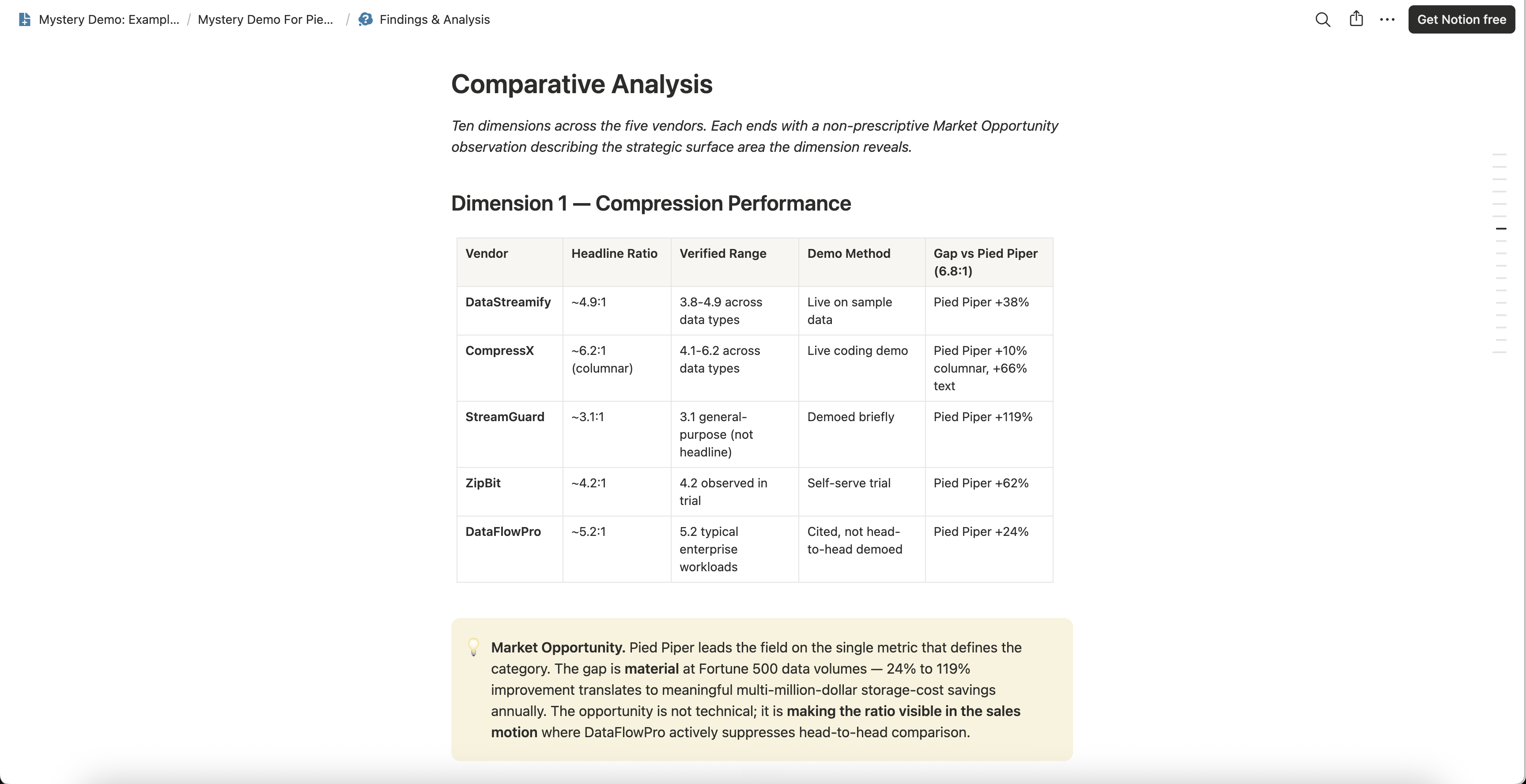
The comparison page above sets what each vendor claimed beside what it showed in the room. It is a strong instrument and it has a limit. It tells you what a vendor chose to show in a sales call, on its own data, not how the product behaves on yours.
Usually what someone means by testing the tools is a related question worth answering: is this product any good. We answer a different one: what they claim, what they will show, what they charge, and where those three disagree.
How the product behaves on your data, whether the integration still holds in week six, and whether your team finds it usable come from a paid pilot, a trial your own people run against a scorecard, or a firm that runs hands-on bake-offs. Asking us for it would get you a careful version of the wrong thing.
Two of These Are Timing. The Third Is Not.
The first two are homework, and homework gets done. A company that could not name its competitors in March walks in with a list in May.
A company that could not say what it wanted to learn often finds out the next time it loses a deal it expected to win. Neither is a permanent no, and neither is a criticism.
| If you | Where that leaves you | What to do instead |
|---|---|---|
| Cannot name your competitors | Not ready yet | Write down who took your last twenty lost deals |
| Cannot say what you want to learn | Not ready yet | Name the decision a competitor’s answer would change |
| Want the software itself tested | Asking for a different service | Run a paid pilot or a trial against your own scorecard |
The third does not move. Nothing about a longer project or a bigger budget turns demo research into product testing, because the constraint is not the depth of the work. It is where the work happens.
Which makes the honest test one you can run before you contact anybody. Name the competitors, and name what you want to learn about them. Then ask whether the answer lives in what those companies say, show, and send, or in what their software does once you own it.
If it lives in the conversation, that is our half of the work: we build the buying scenario, book and sit every demo, record them, chase the follow-ups, and hand back a Notion board with a page per competitor and our analysis of what it all means. One competitor takes one to two weeks, and a landscape of six to fifteen takes four to eight.
Your half is the list of competitors and the decision behind it. Bring both, or bring the half you have and we will pressure test it before anything gets booked.
.png)


