
Search for the best B2B SaaS mystery shopping companies and the list comes back short and mixed. Store-visit firms, gig platforms, freelancers and a few research shops all use the same two words. Far fewer can sit through a software sales call as a believable buyer.
Mystery Demo books your competitors’ sales demos, sits every call as a credible buyer, and hands you the recordings and the analysis on one board. It is one of the names on that list.
Frankly, we can vouch for exactly one company in this category, because it is ours and we know what it does. Below, we compare every kind of provider by what its people bring back from a sales call. We do not name the others, but the seven questions at the end work on all of them, including us.
One Label Covers Very Different Work
Mystery shopping started in shops, and most of the industry still lives there. Retail chains, restaurants, hotels and banks have checked their own service this way for decades, and the firms that serve them are built for it.
Software is a different errand. A SaaS company wants to hear what a rival tells a buyer: the price it quotes, what its demo shows, what its rep says about you. The person on the call decides how much of that you hear.
A software rep spends the first call qualifying you, before showing a single screen, and your answers set the course of everything after:
A buyer who stumbles on those questions often still gets a demo. It is the standard tour with the list price, the version anyone could have read on the website.
So ask any provider who they put on that call, and whether that person can keep answering once the rep starts asking.
What Each Kind of Provider Does Well, and Where It Stops
Every option below is good at something real. Here they are by what their people can bring back from a software sales call.
Retail and customer-experience firms. They recruit certified shoppers, build scorecards with you, and can visit a rival’s stores every day with data back within hours. They describe their programs for stores, restaurants, hotels, car dealers and banks, the places this kind of shopping was built for.
Task platforms. They post your job to a network of gig workers and cover a lot of ground fast: retail audits, mystery shops and property inspections, in many places at once. A gig is one contact, though, and a software evaluation runs across several calls and the emails between them.
Freelancers. A marketplace can find you someone for a set scope, price and timeline, often within a few days. Its own advice is to check their credentials yourself, so you also decide, before any call, whether they can pass as a software buyer.
Your own team. Nobody knows your product better, so nobody knows better what to ask. You are also the easiest buyer for a rival to recognize.
A product manager who has booked rivals’ demos told a product management forum it was uncomfortable but “found out a lot of good info”. The first reply asked: “do you sign up as yourself?”
The few firms that sell this to software companies. There are only a handful, and we respect them. Their own pages describe their people as trained analysts or as professionals recruited for each project.
Software is one of several sectors those firms serve, beside financial services, industry, healthcare and consumer brands.
Prospects who evaluated those firms before coming to us told us they are not run by sales professionals, and they have no background in B2B SaaS.
Line the options up and each one is missing one of two things: people from SaaS go-to-market, or a buyer the rival does not recognize. Mystery Demo was built to have both.
Why We Vouch for Mystery Demo
The sales call is where a rival quotes its price, shows what its product does live, makes promises and talks about you. A website says what the rival wants buyers to believe, and a review site says what customers felt long after the contract. The call is the primary source, and you only hear it from the buyer’s chair.
Mystery Demo is run by B2B SaaS professionals who have sold software themselves. We have spent more than a decade in marketing and go-to-market, including at some of the largest software companies in the world. We have used hundreds of software tools, and we only do mystery demos for software companies.
That background gets a buyer through the first call. When a rep asks what the buyer runs today, we name the tools that company would really use and say why it wants to switch. When the deep dive turns technical, we follow it and ask the question that takes the rep off the script.
.png)

We have sat hundreds of live competitor demos across SaaS and finished dozens of projects, so we hear which answers are rehearsed. Still, one call is one rep talking to one buyer on one day. When a second call with a second rep repeats the price or the line about you, it starts to look like how that company sells, not one rep’s habit.
Here is how a project runs, so you can judge the method for yourself.
How a Mystery Demo Project Runs, Stage by Stage
Every Mystery Demo project runs the same five stages, from the first meeting to the board:
The evaluation is genuine, and nobody real is ever impersonated. The people on the call are who they say they are, and the only invented part is the company they are evaluating for.
Below is the Research Objectives page from Mystery Demo’s public example board, where the client and every competitor are invented. A real project’s board is built from that client’s own calls, and this page lays out the five stages in the order they run.
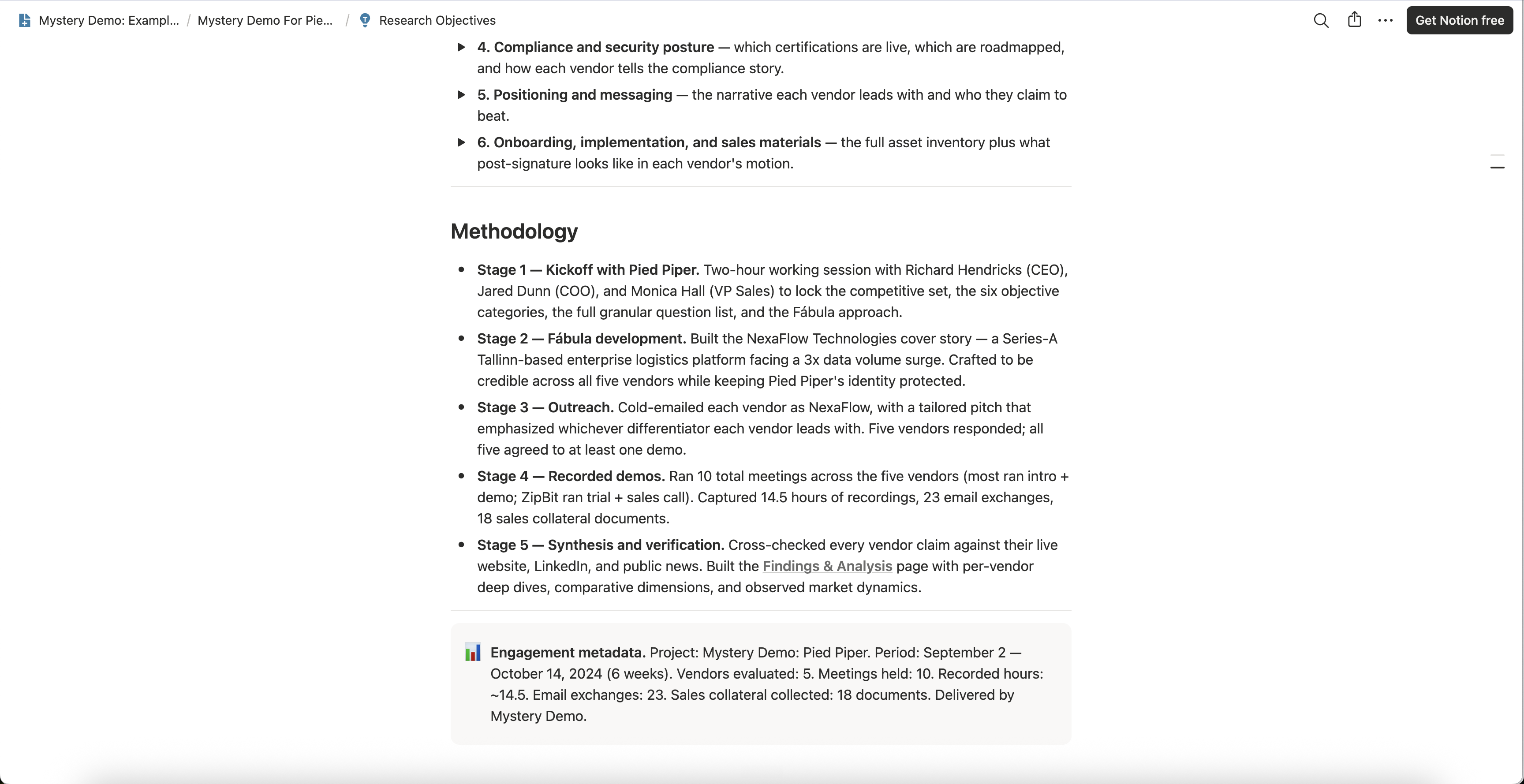
The last stage matters more than it looks. A feature shown live, a rep’s promise and a line on the website are different kinds of evidence. An evidence grade is the label that keeps them apart.
Those calls bring back a good deal more than a folder of videos.
What You Get: Analysis, With Every Recording Underneath
Every project ends in one shared Notion board. It holds your profile and objectives, the competitors and why each was chosen, the fábula, a page per competitor, a database, the findings and analysis, and an executive summary.
The Database is the raw material: every recording, transcript, email and document, organized by competitor. On its own it would be days of listening. On the board it is the bottom layer, kept so every finding can be played back.
This is the Database page on the same invented board, the reference that every other page links back to.
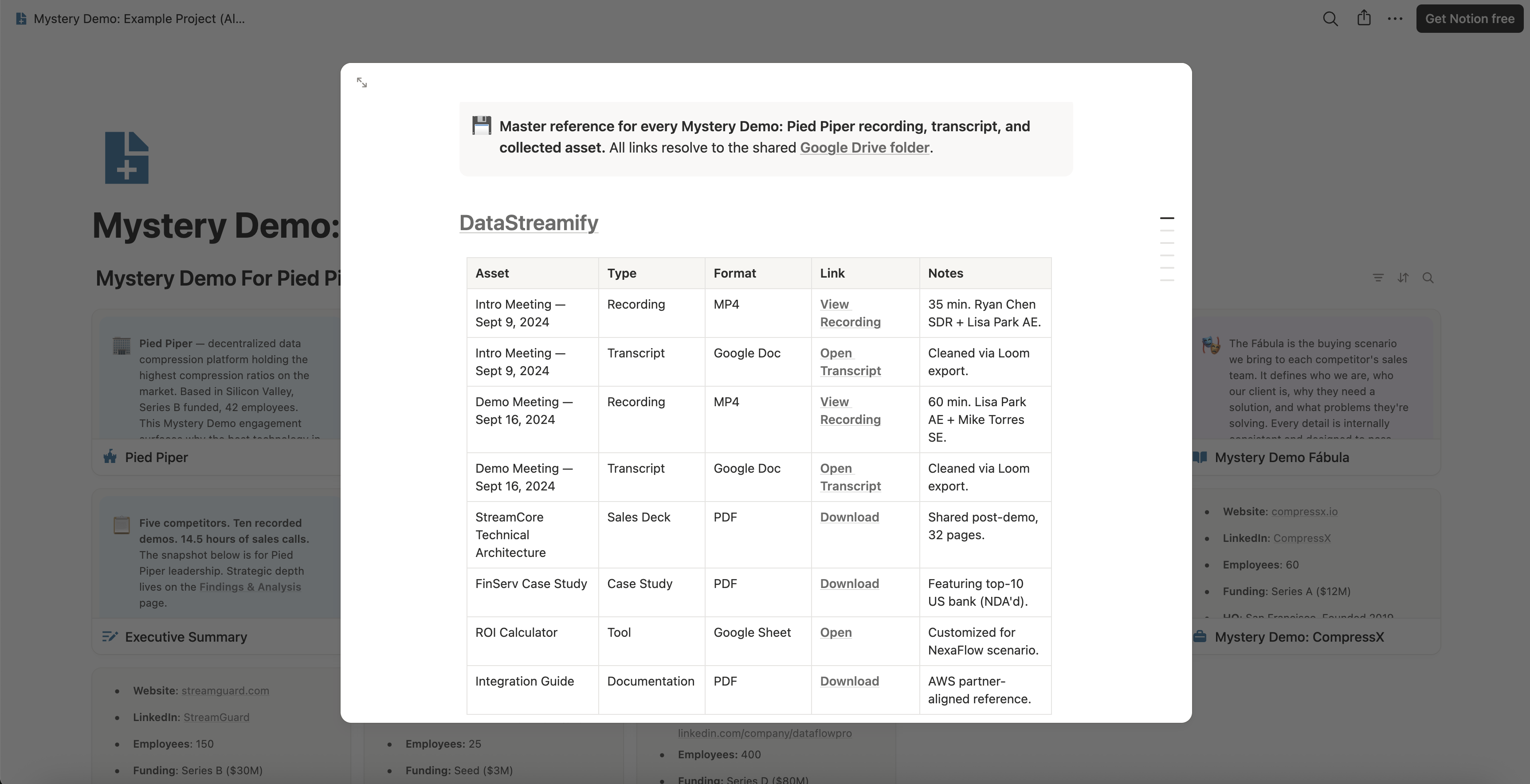
On top of it sits the analysis, written by the people who sat the calls. Each competitor’s page opens with what mattered most and names what it was built from: the meetings, the minutes of recording, the collateral the rep sent, and the checks against the public record.
Here is the top of one competitor’s Expert Analysis on the invented board. The sourcing line comes first, and the insights below it set what the demo proved beside what the vendor claims.
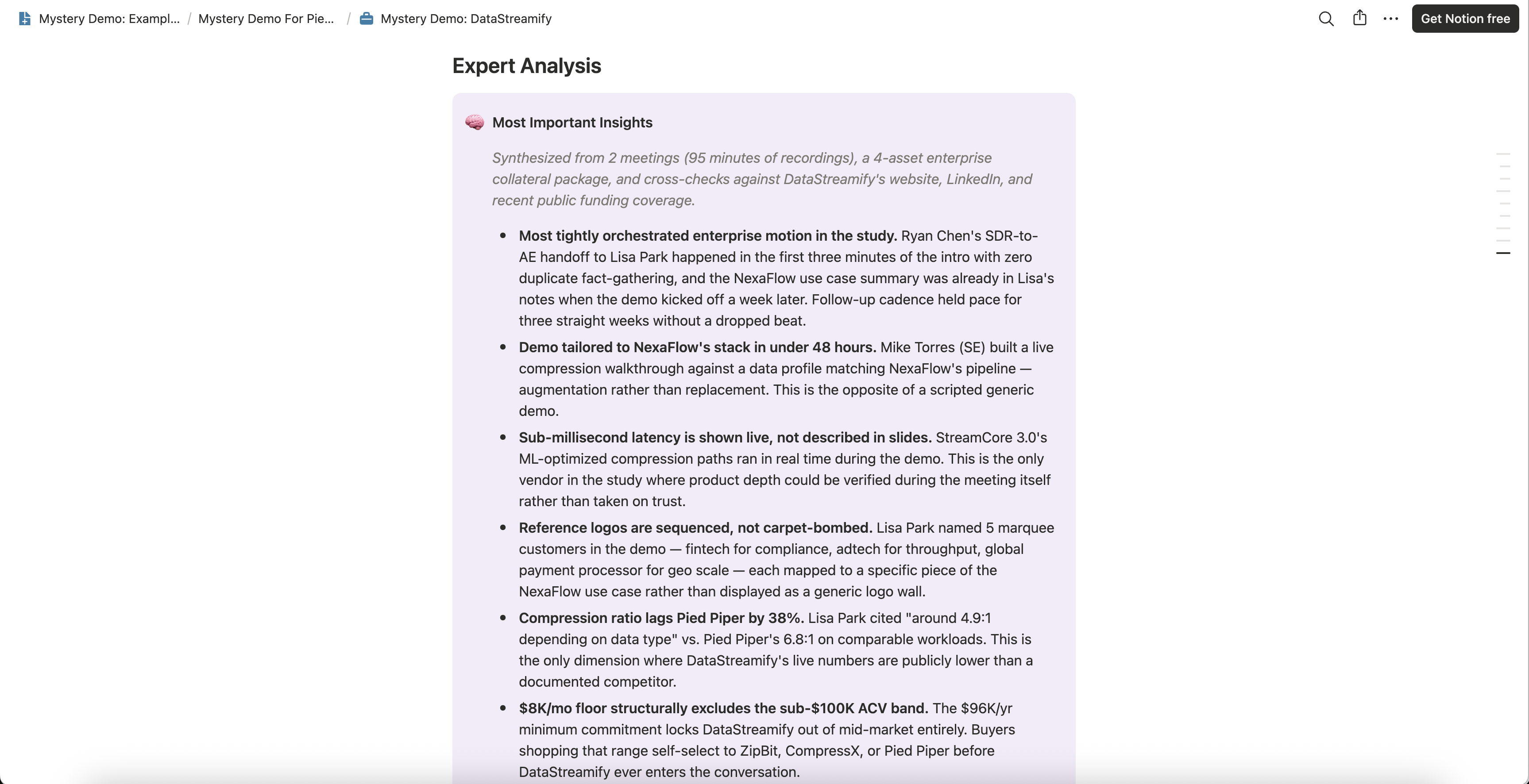
For a product question, the comparison runs feature by feature. Each feature is marked shipped, partial, or a stub that is present in name but not yet working, judged by what the demo showed rather than what the site claims. That layer is our competitor product comparison work, and every mark on it leads back to a minute of a call.
Each competitor costs a flat €499 with everything included: the buyer, every call, the recordings, the transcripts, the analysis and the board. One competitor takes one to two weeks, and a landscape of six to fifteen takes four to eight, because the demos run side by side.
If one competitor keeps coming up in your lost deals, start there. Tell us its name on an intro call, and we will write a buyer for its sales team and sit every call it offers.
Put every option on the same terms, and the differences are easy to read.
Every Option on the Same Terms
Here is each kind of provider in one table: what its people bring back from a software sales call, what they cannot see, and what it costs in money and time.
| Option | What it brings back | What it cannot see | Cost and time |
|---|---|---|---|
| Retail and CX firm | Scored visits, at scale and fast | A software evaluation that runs across several calls | Priced as a program; store data within hours |
| Task platform | Many single contacts, quickly | Anything past the first contact | Priced per gig; fast and wide |
| Freelancer | Whatever your brief asks for | Whether their answers hold up under a rep’s questions, until the call | A set scope and price; hired within days |
| Your own team | The tour a rival gives whoever you appear to be | The real sales motion, once the rep recognizes you | Your team’s hours on every call and email, plus the exposure |
| Firm that sells this to software companies | A first-hand account of a rival’s sales process | The follow-up questions only a SaaS operator thinks to ask | Quoted per project after a discovery call |
| Mystery Demo | What each rival quotes, shows, promises and says about you, to a buyer it believes, with the analysis on top | Anything not said or shown on the calls, such as an internal roadmap | €499 per competitor, everything included; one to two weeks each, four to eight for a landscape |
Read down the second column and every option brings back something real. Read down the third, and most rows miss the same thing from different sides: a buyer the rival believes, who can stay through every call and knows what to ask next.
Our own row has real limits too. If a rival never says it on a call or shows it in a demo, we cannot hand it to you. And one competitor takes one to two weeks, where a store visit comes back within hours.
Whichever row you choose, the decision comes down to a few questions you can ask any provider on your first call with them.
Seven Questions to Ask Any Provider, Including Us
Ask these of anyone you consider. Here are our answers, so you have something to compare against.
The first two answers matter most. A buyer the rep does not believe gets a shorter evaluation, and no analysis can add back what the rep never said.
The quickest test is to put those seven questions to us yourself. Ask them on an intro call, name the competitor you most need to hear from, and we will sit its sales process as the buyer.
.png)


