
Buyers picture the back-and-forth before the first signature as the negotiation that sets their spend. The number that sticks gets set at the renewal.
It arrives quietly, on a schedule the contract set in the vendor’s favor, and most buyers let it pass without a word. The negotiating power sits with the buyer. The discipline to use it usually does not.
We track that clock from inside the deal itself, on your behalf: when a rep first reaches for a concession, which levers move them, and how the number bends as a quarter runs out of days.
We collected the most relevant, independently verified SaaS pricing negotiation statistics we could source on how often list price gets negotiated, what the negotiation is worth, and where the timing and terms tilt the table. Every figure below is footnoted to its original source.
If you only keep a handful of these price negotiation benchmarks, keep these:
The Real Negotiation Is the Renewal, Not the First Deal
New-logo deals get the attention and the war stories. The money is somewhere quieter.
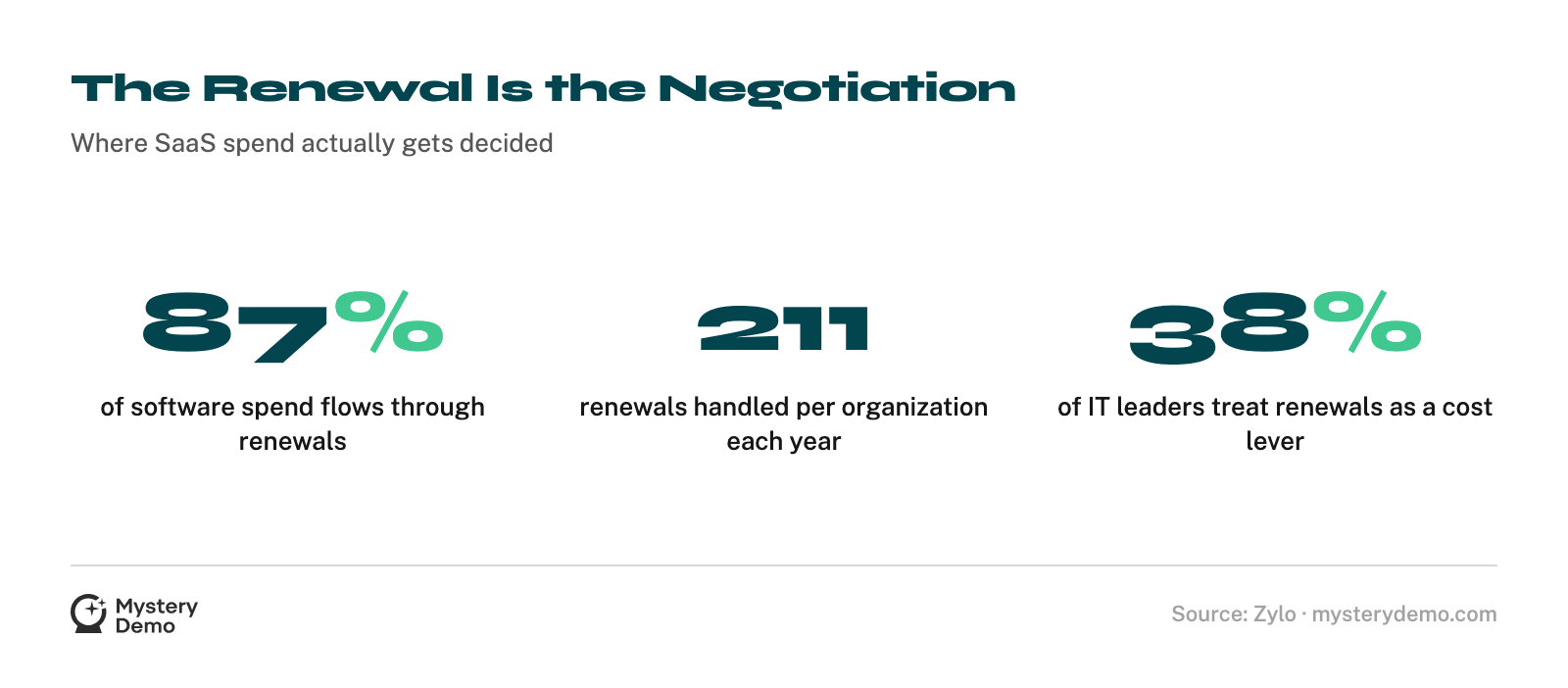
Nearly nine of every ten software dollars flow through a renewal, those renewals land at the rate of one a day, and a clear majority of buyers do not treat them as a chance to cut costs.
The first-purchase haggle everyone remembers is the small money. The renewal, repeated 211 times a year and carrying 87% of the spend, is where the real number gets set, and most buyers leave it on autopilot.
Most Buyers Don’t Negotiate, and It Shows
Negotiating power and negotiating behavior are not the same thing, and the split has a price.
All three numbers describe the same un-negotiated renewal. The 17% is what organizations capture when they run the renewal through a managed process, and the most common complaint, the price hike, is the exact thing that conversation is for.
The 30% who miss the alert entirely are the purest version of the problem: they forfeit the negotiation, auto-renewed at a higher number before anyone on their side noticed the date.
The constraint is discipline, not power. The buyer holds the upper hand at renewal and, most of the time, nobody shows up to use it.

The Contract Is Built to Renew Without You
None of this is an accident. The standard SaaS contract is engineered so that doing nothing favors the vendor.
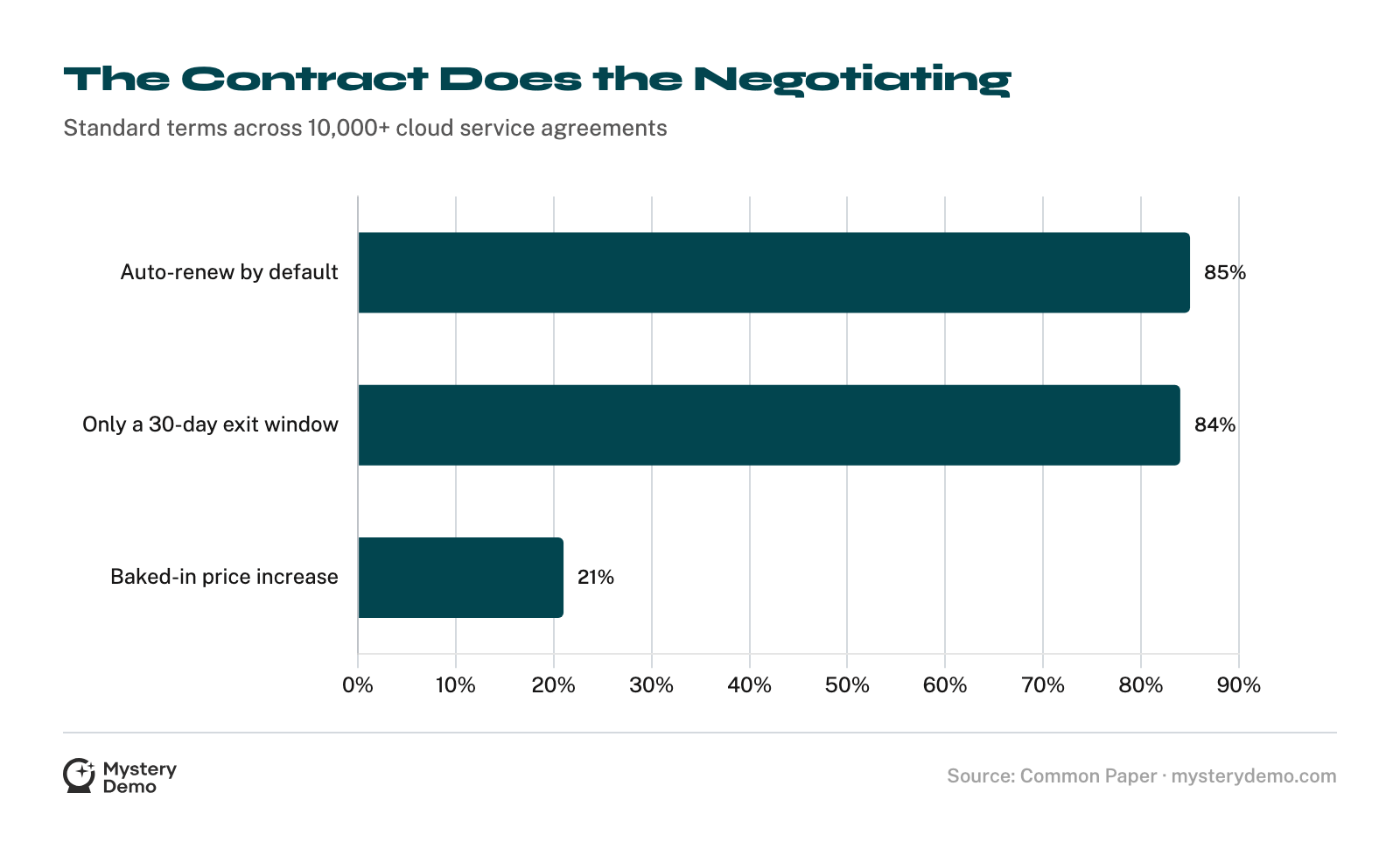
Line up the mechanics and the un-negotiated renewal reads as design rather than buyer laziness. The deal renews on its own, a fifth of agreements raise the price by clause rather than by conversation, and the only off-ramp is a 30-day window most buyers are not watching.
The vendor does not have to win the renewal negotiation, they only have to run out the clock, and the contract is written to help them do exactly that.
Timing Is a Lever: The Quarter-End Clock
When a buyer does engage, the calendar quietly changes who has the upper hand. Reps carry quotas, and quotas have deadlines.
Rep-initiated discount discussions rise by nearly a third in the last month of each quarter versus the first two5.
Procurement activity concentrates into the year-end window, where one buying platform is already negotiating more than 40% of its customers’ year-end spend6.
Few negotiation tactics carry hard conversation data; this one does. The seller, not the buyer, brings up the discount a third more often as the quota clock runs down, which reframes timing from folklore into a lever.
A buyer who can hold a decision into the closing month of a vendor’s quarter is negotiating against a different, more flexible version of the same rep. The concentration of spend into year-end shows buyers are starting to act on it.
.png)

Multi-Year Is a Lever Buyers Keep Putting Down
Multi-year commitments have traded discount for lock-in longer than any other SaaS lever. Buyers grew skeptical of the trade, then partly reversed themselves.
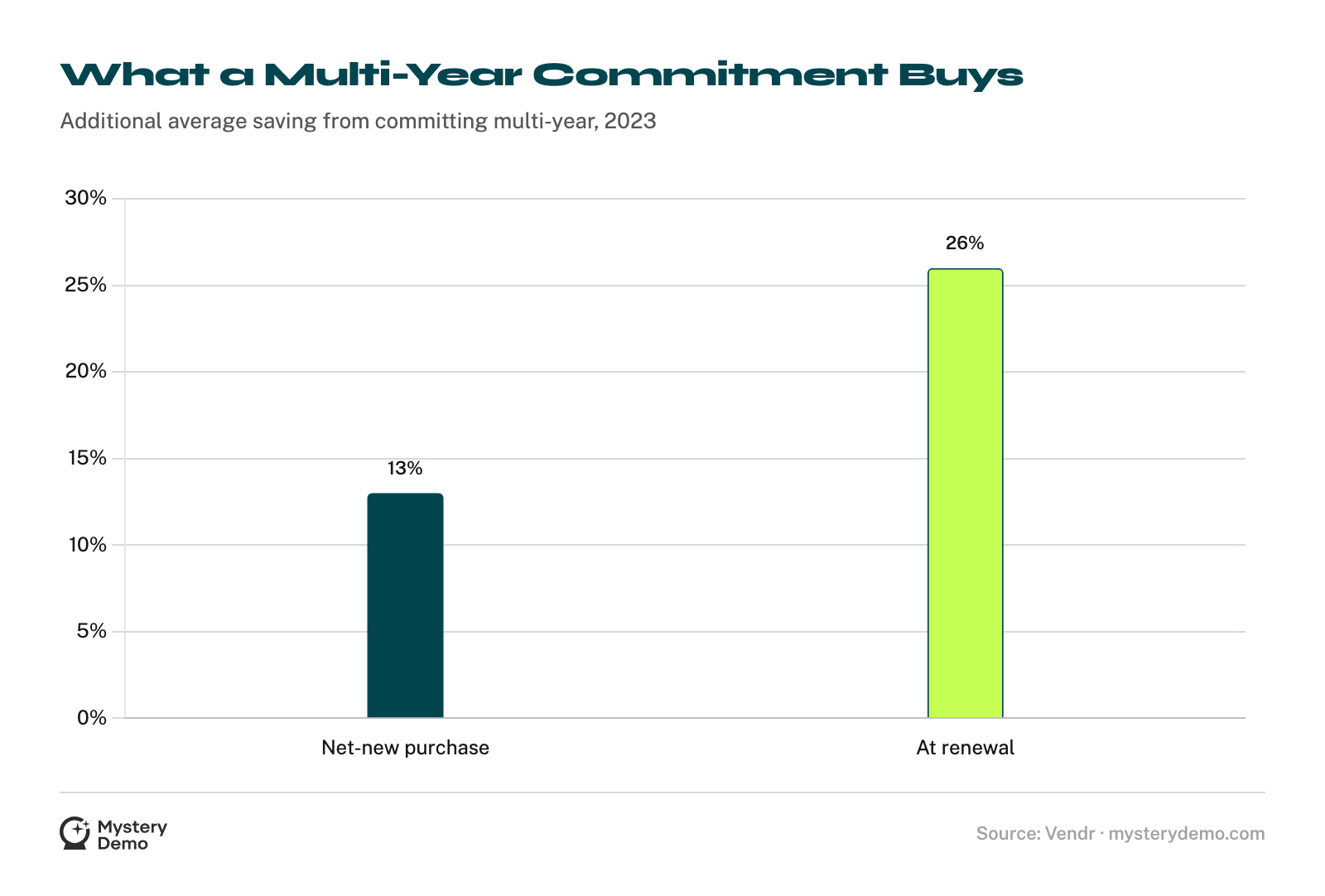
What buyers value at a given moment shows up in the multi-year lever. When budgets tightened, buyers walked away from a real concession, a 13% to 26% improvement, because being locked in felt more expensive than the discount was worth.
The recent swing back toward multi-year trades a shrinking price break for predictability, in a market where renewal increases are near-universal.
The lever still works. Whether a buyer pulls it now depends on whether they fear the price more than the commitment.
What none of these benchmarks tell you is how your specific competitors negotiate: when their reps blink, which levers move their floor, and what they quietly concede in the final week of a quarter. Those numbers only exist on live calls.
We carry their deals through pricing and renewal pressure as a real buyer and hand you the concessions they make when they think a signature is close. For the structured version, our SaaS competitor pricing research documents how each one negotiates, deal by deal.
You will never be in the room when a competitor decides what to concede to win a deal against you. Send us into their next negotiation, and we will write down every lever they pull on the way to the signature.
Frequently Asked Questions
Do SaaS buyers treat renewals as a chance to cut costs?
Most do not. Only 38% of IT leaders treat the renewal as an opportunity to reduce software costs, so the majority renew without pressing on price1.
How much can you save by negotiating a SaaS renewal?
About a sixth of the bill. Buyers who run the renewal as a managed negotiation save an average of 17%2.
Why are SaaS renewals the most important negotiation?
Because that is where the money is. Renewals account for 87% of total software spend, and the average organization handles 211 of them a year2.
How common are price increases at SaaS renewal?
Near-universal. 79% of IT leaders hit a price increase at renewal in the past 12 months2.
How many SaaS contracts renew automatically?
The large majority. 85% of cloud service agreements auto-renew unless the buyer actively opts out3.
Do SaaS contracts build in automatic price increases?
Often. 21% of contracts include an automatic fee increase at renewal, most commonly 5% to 8%, set before any negotiation3.
How long is the typical SaaS cancellation window?
Short. 84% of auto-renewal contracts require a 30-day non-renewal notice, and missing it locks in another term3.
Why do so many buyers get auto-renewed at a higher price?
They miss the date. 30% of leaders say they miss contract alerts and end up in expensive auto-renewals, the most preventable way to overpay7.
Is quarter-end a good time to negotiate SaaS pricing?
Yes. Rep-initiated discount discussions rise by nearly a third in the last month of the quarter, when quota pressure peaks5.
Does SaaS negotiation cluster around year-end?
Heavily. One buying platform reports negotiating more than 40% of its customers’ year-end spend in that window6.
What is a multi-year SaaS commitment worth as a negotiation lever?
A real but shrinking concession. It delivered an additional 13% saving on net-new purchases and 26% at renewal in 20234.
Are buyers signing more or fewer multi-year SaaS deals?
Recently more. After pulling back in 2021 to 2023, multi-year contracts rose from 23% to 38% of agreements1.
Why did buyers move away from multi-year deals?
For flexibility. Buyers became 14% less likely to sign multi-year at purchase and 28% less likely at renewal versus 2021, choosing optionality over the discount4.
What is the most common SaaS renewal frustration?
The price hike. 45% of leaders cite renewal price increases as their top frustration7.
Do buyers get surprised by costs after signing?
Most do. 77% of IT leaders experienced unexpected costs that surfaced after a contract was signed, a sign the diligence happens too late2.
Is the lack of SaaS savings a power problem or a discipline problem?
Discipline. Buyers hold the negotiating power at renewal, but only 38% treat it as a chance to cut costs, so the gap comes from process, not weakness1.
How many renewals does a company have to manage?
A lot. The average organization handles 211 SaaS renewals a year, which is why missed ones compound across the portfolio2.
How do you learn how a competitor negotiates?
By taking their deal far enough to see where they bend. Concession behavior, quarter-end flexibility, and renewal tactics only surface on a live call, which is what we capture for you, deal by deal.
References
- Zylo: 2026 SaaS Pricing Trends Driving Up Enterprise Costs (2026)
- Zylo: 175+ SaaS Statistics for 2026 (2026)
- Common Paper: Auto-Renewal Clauses in Contracts (2025)
- OnlyCFO with Vendr: Software Buying Trends and Insights (2023)
- Gong: How a Bad Quarter in Sales Starts (2017)
- Vendr: Jumpstart Your SaaS Budgeting (2024)
- Spendflo: State of SaaS Buying Survey 2026 (2026)
.png)


