
A fund, a fintech or a merchant puts three crypto providers on a shortlist, and every website on it promises some version of the same four things.
Your reps win some of those evaluations and lose others, and the losses rarely come with a reason. The likeliest reason was said out loud, on a call between the buyer and a rival’s rep. Nobody from your side heard it, so nothing on your battlecard answers it.
Mystery Demo books your rivals’ sales demos as a genuine buyer, asks for the proof behind each claim, and hands back the recording of everything the rep said, showed and sent. Here is how that works, what comes back, and the crypto battlecard built from it, row by row.
Every Crypto Rival Promises the Same Four Things
Crypto services are a fiercely competitive market, and the competitors sound alike. Whether a shortlist is for custody, payments or on-ramps, most of the providers on it lean on those same four promises.
When every rival says the same thing, the website stops helping anyone choose. The buyer chooses on what each rep says when pushed, and on what that rep can prove.
Two things about crypto raise the stakes on that choice:
So the line that wins is on no homepage. It is what each rival’s rep said when the buyer asked, and whether a document followed.
The Proof Behind a Claim Only Shows Up on a Sales Call
Everything your team can read about a rival carries the claim and leaves out the proof. Here is what each public source gives you, and what it never will.
| Where you look | What it tells you | What it leaves out |
|---|---|---|
| The rival’s website | The four promises, written for everyone | Which company holds the assets, what the policy covers, who can move funds |
| Review sites and forums | How customers felt after signing | What the rep promised before they signed |
| Press releases | A new license or partner, announced | Whether the rep sells it as live today |
| Alerts and tracking tools | That a page changed | What the rep now says about it on calls |
| The sales call | What the rep claims, shows, promises and sends | Only what the rep will not answer, and that refusal is a finding too |
On a call, a claim meets its first question. “Fully insured” meets “Can you send the policy schedule?”, and the rep sends it, promises it for later, or moves the conversation somewhere else.
Each of those three answers belongs on your battlecard, and only a buyer ever hears them. Mystery Demo exists to be that buyer.
How Mystery Demo Takes Each Rival’s Demo as a Buyer
Every project starts with your list of rivals and the questions you need answered. For a crypto service, those questions cover what the buyer’s review will cover: custody, insurance, the licensed entity, reserves and price.
From there, the work runs in five stages.
The questions are where experience shows. The people asking them are operators who have sold B2B software themselves, so they know which question pulls a rep off the script. Your own team could ask the same things, but a rival’s rep knows your email domain on sight and gives you the polished tour.
In a crypto evaluation, our questions ask for documents:
Here is the method on our public example board, where the client and every competitor are invented. A real project’s board is built from that client’s own calls. On its Research Objectives page, the fourth objective is compliance and security posture: which certifications are live, which are only on a roadmap, and how each vendor tells that story.
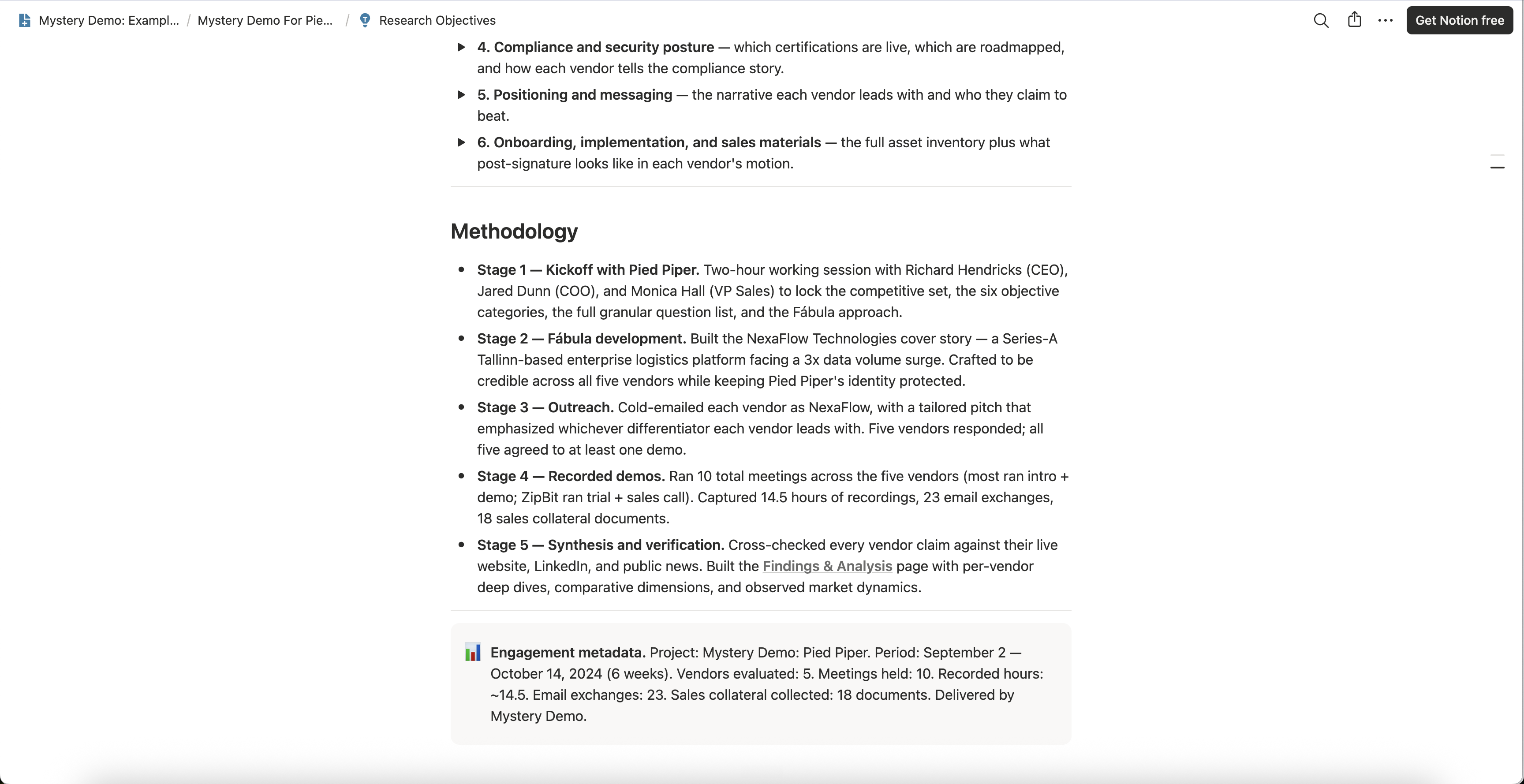
The recordings, the emails and the analysis all come back in one place.
What Lands on the Board After the Calls
That place is a Notion board, and each page holds a different cut of the same calls.
Here is the expert analysis from one competitor’s page on the example board. Its first line names what the analysis was built from: the meetings, the minutes of recording, the documents collected and the public sources checked.
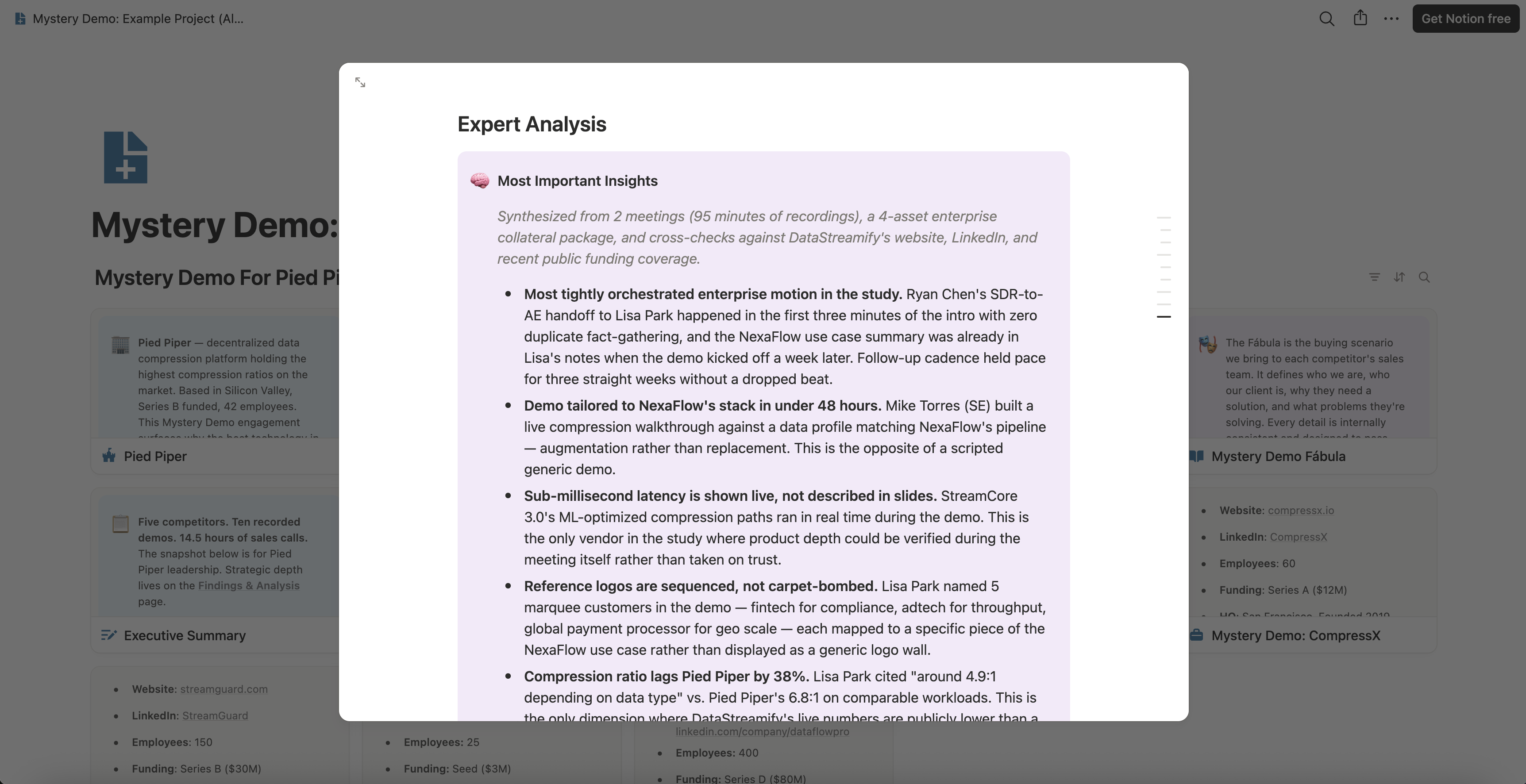
For a crypto rival, this is the page where the rep’s words on key control and insurance would sit, quoted, each with the minute it was said. Nobody has to trust a summary when the recording is one click away.
The price is a flat €499 per competitor, everything included: the scenario, every meeting, the recordings, the analysis and the board. One rival takes one to two weeks, and a full set of six to fifteen takes four to eight, because the demos run side by side.
If one crypto rival keeps turning up in deals you lose, tell us which one. We will go through its sales process as the buyer it most wants, and put everything its rep says on a board like this.
A board, though, is not something a rep opens in the middle of a call.
The Crypto Battlecard, Row by Row
A rep mid-call needs one page. That page is the battlecard, and it is what you hold at the end of competitor battlecard research.
One card per rival, eight rows. Each row answers a question a buyer asks in the room, and each one names the board page that fills it, so no line goes on the card without a call behind it.
| Row | The question it answers in the room | What fills it on the board |
|---|---|---|
| Their pitch | “What did they tell you they are?” | The rival’s own page: the expert analysis of how they sell |
| Custody and key control | “Who can move our assets?” | The rival’s own page: the rep’s answer, quoted, with the minute |
| Insurance | “What exactly is covered, and for whom?” | The rival’s page and the Database: the claim as spoken, and any policy sent after |
| License and legal entity | “Which company would we sign with?” | Findings & Analysis: the compliance and security comparison, each claim checked against the rival’s public pages |
| Reserves and audits | “Can you show me the latest report?” | The Database: the report the rep sent, or the follow-up that never came |
| Price and fees | “What did they quote you?” | Findings & Analysis: the pricing matrix, every quoted number beside the published one |
| Where they win | “Why would we pick them?” | The Executive Summary: the line on where each rival wins |
| Where they hedged | “What did they avoid answering?” | The Database: the recording, at the minute the rep moved on |
Rows two to five, from custody to reserves, are the ones a security review will test. On each of them, the card records what the rep claimed and what the rep produced when asked for proof.
One finished card looks like this. The rival, every line and every minute on it are invented to show the shape. On a real project, each line comes from a recorded call.
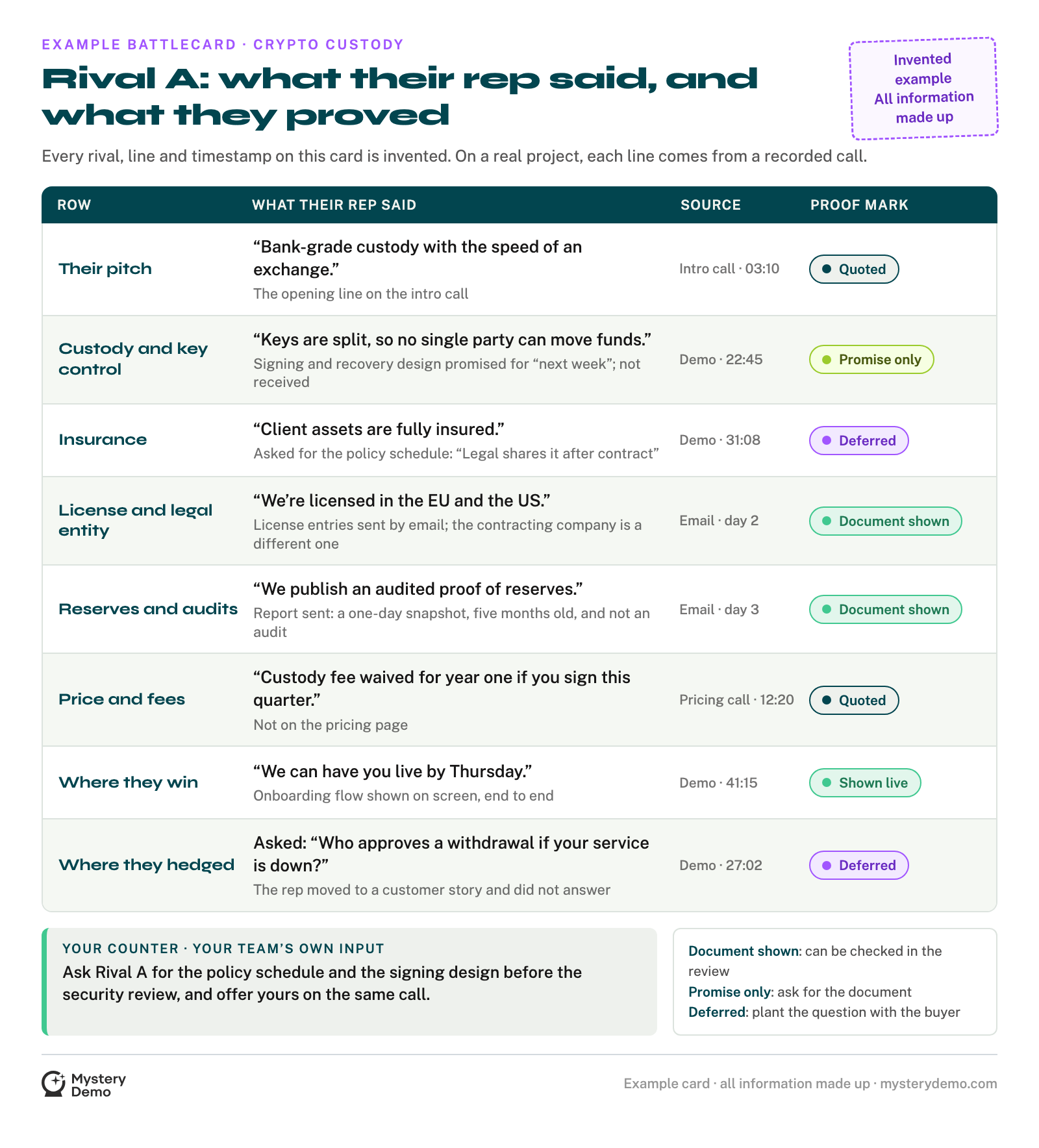
The proof marks are what a security reviewer would read first. A line with a document behind it can be checked in the review. A promise or a deferral is a question your rep can plant now, before the buyer’s reviewers ask it for you.
The table tells your rep where each row comes from. It does not tell them when to use it.
How a Rep Uses Each Row Before the Security Review Does
On a battlecard project, we fill every row for you from the calls. Whoever fills it, here is what goes in each row, and when your rep reaches for it.
Their pitch. The one sentence the rival’s rep used to describe the company, in the rep’s own words. When the buyer repeats it to you, you know which version of the rival they met, and you can ask which part of it convinced them.
Custody and key control. Their rep’s answer to “who can move our assets”, with the minute, and a mark for whether a signing and recovery design arrived afterwards. If their rep could only describe the design, your buyer’s security team already has its first question for them.
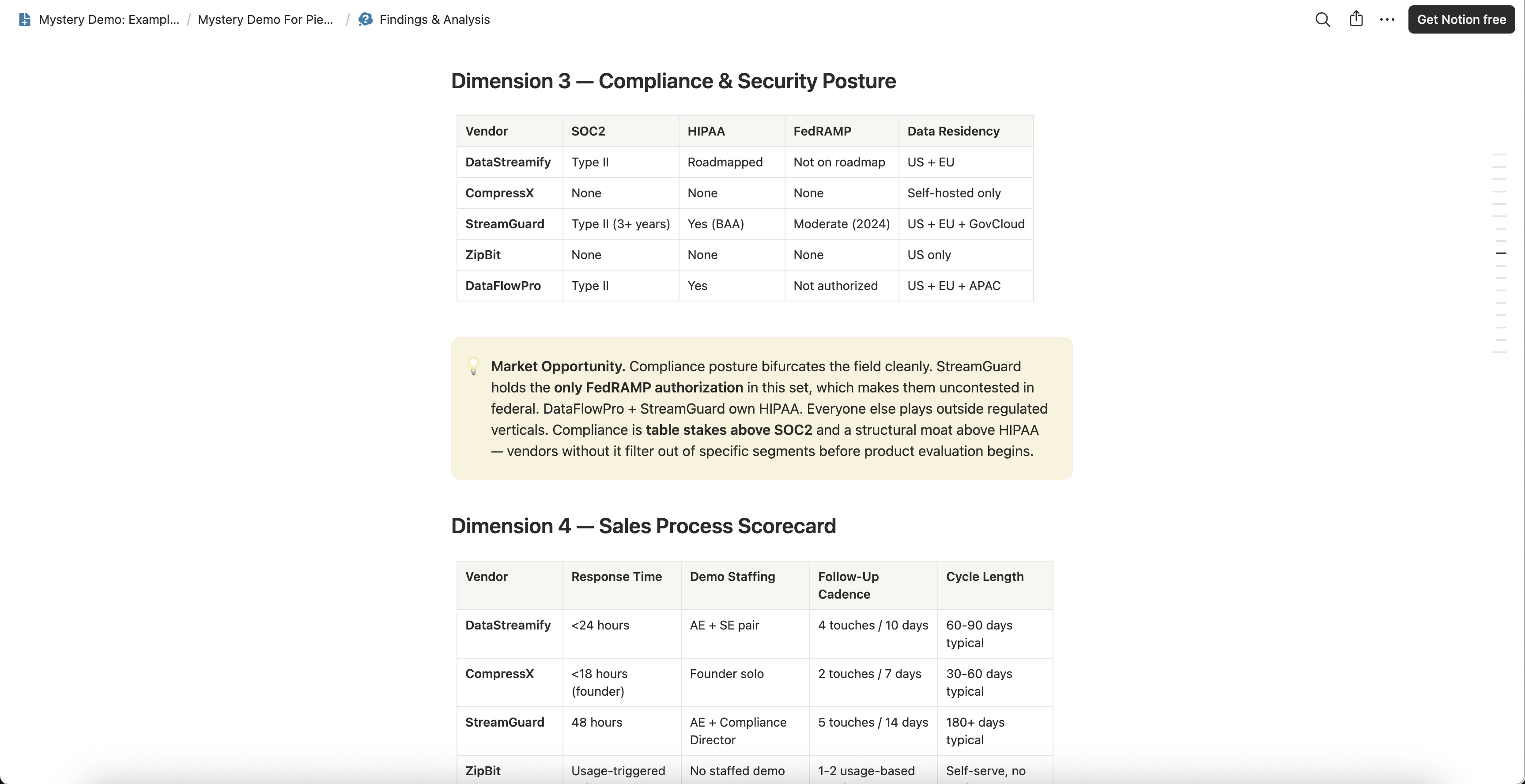
On the example board, the compliance and security comparison sets every vendor side by side on the same certifications, each one live, roadmapped or missing. For crypto rivals, the same page would compare the claims your buyers test: key control, insurance, the licensed entity and reserves.
Insurance. The claim exactly as their rep said it, then what arrived when the buyer asked for the policy. A custodian’s insurance usually does not cover every asset it holds one-for-one, so “fully insured” with no schedule behind it is the line your rep asks the buyer to check.
License and legal entity. The company their rep said would sign the contract, and the one that would hold the assets. A brand can hold a license through one company and sign through another, and the buyer’s lawyers will ask which one.
Reserves and audits. The date of the latest report their rep sent, and what it covered. A proof-of-reserves report is a snapshot of one day, and it is not an audit, so a rep who calls it one has left your team a polite correction to make.
Price and fees. The number their rep said out loud, the fees around it, and what the buyer had just asked. The quoted figure beside the published one shows your rep how far the rival has already moved for one buyer.
Where they win. Their strongest moment, the way their rep put it, written honestly. Some evaluations belong to them, and knowing which ones saves your reps three months of losing them slowly.
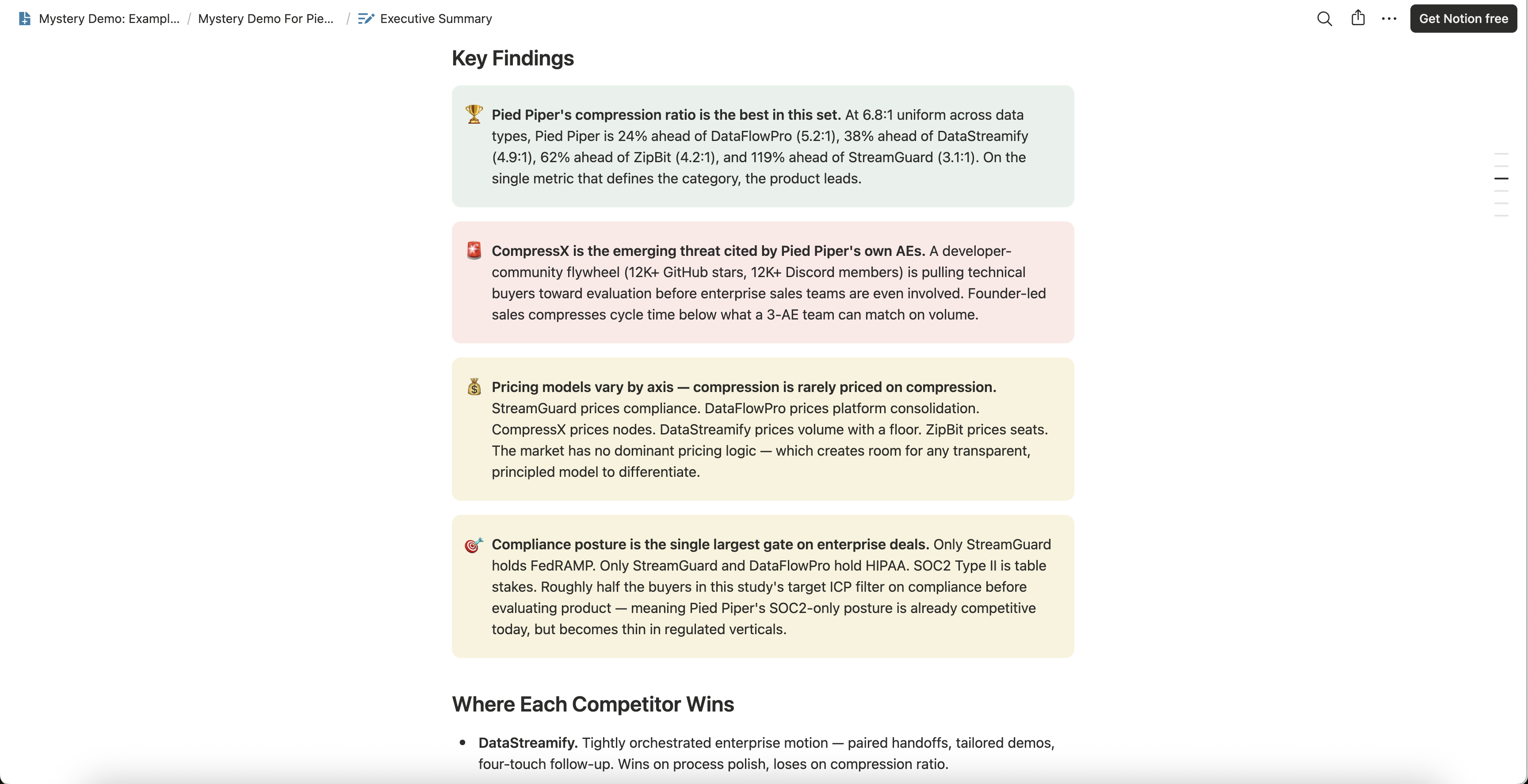
On the example board, the Executive Summary opens with its key findings, one callout each. The line on where each competitor wins sits right below them, written from what the calls showed.
Where they hedged. The question, the minute, and what their rep did instead of answering. This row is the one a buyer cannot get from anyone else, and it becomes the question your rep gives the buyer to ask on the rival’s next call.
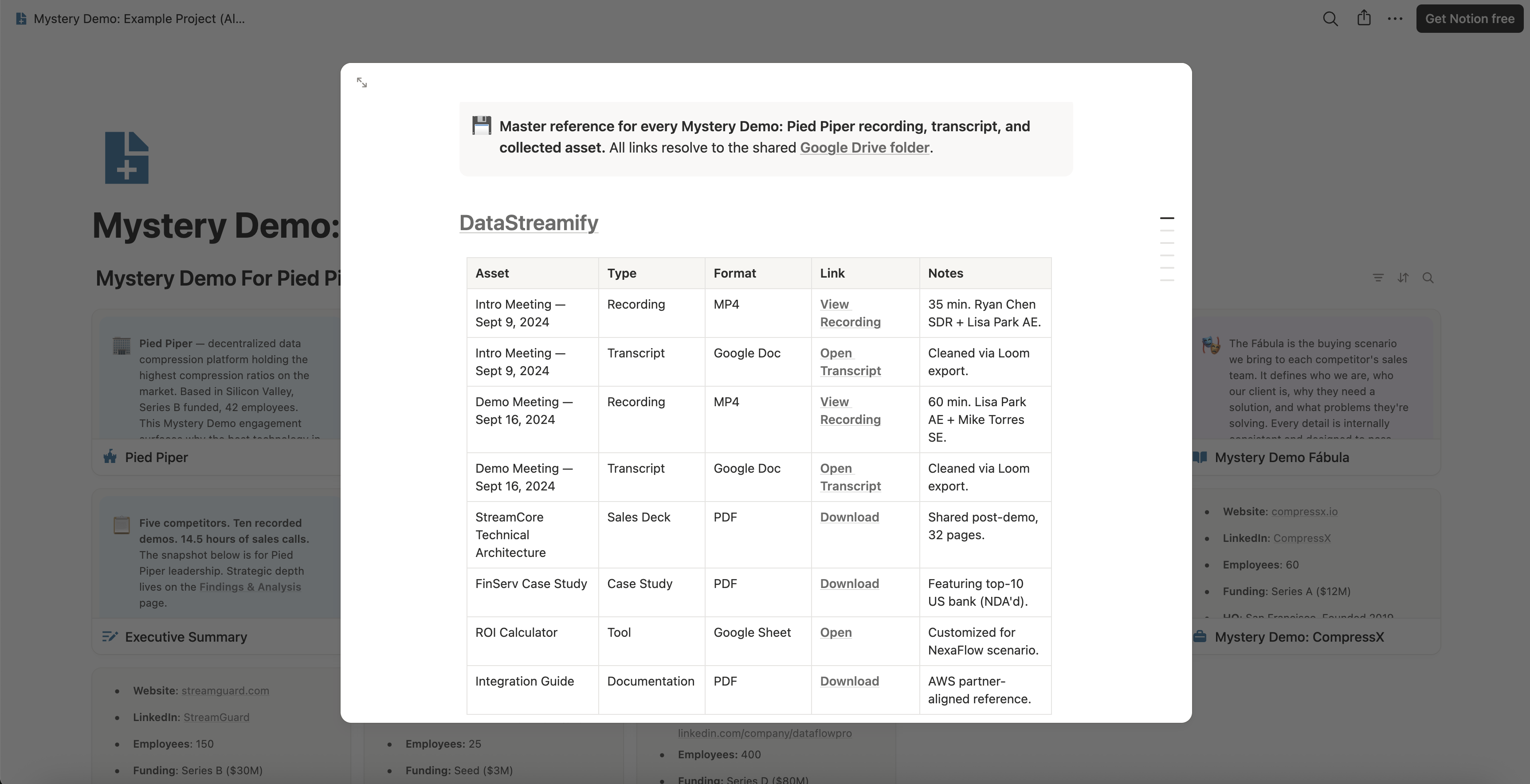
Every hedge on the card points to a recording, and the Database is where the recordings live: every meeting, transcript and document from the project, each with its link.
.png)

All of that is true on the day of the calls. Then the rivals keep moving.
A Card Goes Stale When a Rival’s Pitch Changes
A crypto rival can change its story without changing much on its homepage. Any one of these turns a row on your card wrong:
Your reps tend to learn about these from a lost deal, months late. The cure is to run the demos again when the pitch moves. Partners come back to re-run a project for exactly that, and the new board shows what changed.
When every rival promises the same four things, the deal goes to the team that knows which promises came with paper.
Name the crypto rival your reps least want to meet in a review. We will take its demos as a serious buyer, then fill every row of this card from the recordings.
.png)


