
Your CRM says most of your lost deals went on price, and you don’t believe it. You have good reason. Across more than 100,000 B2B purchase decisions, Corporate Visions found that sellers and buyers give different reasons for the same lost deal 50 to 70 percent of the time.
The closed-lost reason is one pick from a list, made by the rep who just lost. It is often wrong, or only part of the story, and you can check it deal by deal. Decide what each reason would need to be true, confirm who won, ask the buyer, and change the field so the next loss tells the truth.
Mystery Demo takes your competitors’ sales demos as a genuine buyer and brings back the recordings. That matters here, because a wrong closed-lost reason often hides a comparison the buyer made with another vendor. Your team only heard its own side of it.
Why Closed-Lost Reasons Are So Often Wrong
The field gets filled in at the worst moment, by the person closest to the loss. The rep has just lost, the dropdown wants one answer, and price is the answer nobody argues with. It says the buyer ran out of budget, not that the rep did anything wrong.
The buyer often gives the same answer first. User Intuition, a win-loss research firm, looked at 6,400 lost deals from interviews on its own platform. Buyers named price first in 62.3 percent of them, and after several rounds of follow-up questions price was the main reason in 18.1 percent.
The firm argues that price is simply the easiest answer to give: it ends the conversation and blames nobody. It also notes that price was not irrelevant in the other deals, only rarely the main reason.
People who sell far from software describe the same thing. One insurance broker, talking through accounts just won from an incumbent, said a client complained about price when the real problem was being left out of the client’s own renewal. Once that client felt ignored, price became the complaint that carried every other one.
Then there is the deal nobody won. The book The JOLT Effect rests on research into 2.5 million recorded sales conversations. In that research, 40 to 60 percent of lost deals ended with the buyer deciding nothing at all.
Some deals marked lost are not even over. Corporate Visions found that in 10 percent of them, the buyer was still deciding.
Put together, a closed-lost code goes wrong in a few predictable ways:
The User Intuition study also shows what the follow-up questions found instead. Most of the 6,400 losses came down to worries about risk: whether the product would work for the buyer, whether their champion could defend the choice, and how soon it would pay off.

None of this gets fixed by asking reps to choose more carefully from the dropdown. Each code has to be checked against the deal itself, and the check starts with deciding what would count as proof.
Step 1: Write Down What Each Reason Would Need to Be True
Before you open a single lost deal, write the rules. For each code in your dropdown, decide what evidence would support it and what would contradict it. Anything that does neither stays unknown.
Deciding all this first keeps you from reading the answer you expected into every deal.
| Code | Supported when | Contradicted when |
|---|---|---|
| Price | The buyer says the number decided it, and your recording shows a price objection that never went away | The buyer says the price was acceptable, or chose a vendor that cost them more |
| Missing feature | The buyer names the feature, and it was on their list of requirements before the demo | The buyer says the feature did not matter, or the winner lacks it too |
| Timing | The buyer names a date or an event that pushed the decision back | The buyer signed with someone else in the same window |
| Lost to a rival | The buyer confirms which rival they chose, and that they signed | The buyer bought nothing, or bought from someone else |
| No decision | The buyer kept their current setup or shelved the project | The buyer bought from another vendor during the deal |
| Relationship | The buyer names a person or a moment in your process | The buyer praises your team and names another reason that decided it |
Then give every check four possible verdicts:
Keep the rep’s original pick in its own field and never overwrite it. Their read of the deal is evidence too, and the gap between it and your verdict is the most useful thing the audit will produce.
Two rows in that table, lost to a rival and no decision, depend on facts the CRM rarely holds for certain: who won, and whether anyone did.
Step 2: Pull a Sample and Confirm Who Won
Pick about twenty recent losses, a few from each code and from the rivals that turn up most. Twenty deals will not give you a rate you can report. They will show you where your rules break, which is what a first audit is for.
For each one, start with the outcome. A deal marked “lost to Rival A” makes two claims at once: that the buyer bought, and that they bought from Rival A. Check both before you judge the reason.
Record the outcome as one of five values, with the date you checked it:
Take each value from the buyer’s own word where you can get it, or from something public, such as an announcement or a case study the winner published. The rep’s guess alone does not count.
The research on recorded calls found that about half of lost deals end with no purchase at all. If yours look like that, some of your battlecards are aimed at a competitor who never won those deals. With the outcome recorded, even when it is unknown, you can test the reason itself.
Step 3: Test Each Code Against Your Recordings and the Buyer
Start with your own recording. Play back the last two calls of each deal and note what the buyer raised, how often, and how hard.
A revenue leader at a company that closes deals every month saw what recordings catch. When the team pulled qualification fields from call recordings instead of rep reports, it found reps had claimed access to the economic buyer in deals where they had none.
Then ask the buyer, without defending the loss. One sales trainer calls this an apology follow-up. You apologize for not solving their problem and ask whether you assumed something wrong or showed them the wrong thing.
Go past the first answer. In User Intuition’s interviews, when a buyer named price first, it took about four rounds of follow-up questions to reach the real driver. Ask what the price was compared against, and what would have had to be true for them to pay it.
Write down silence as silence. If the buyer does not reply after the asks you planned, record “buyer did not respond” in its own field. Judge the code on the evidence you still have, and when that is nothing, the verdict is unknown, never a guess.
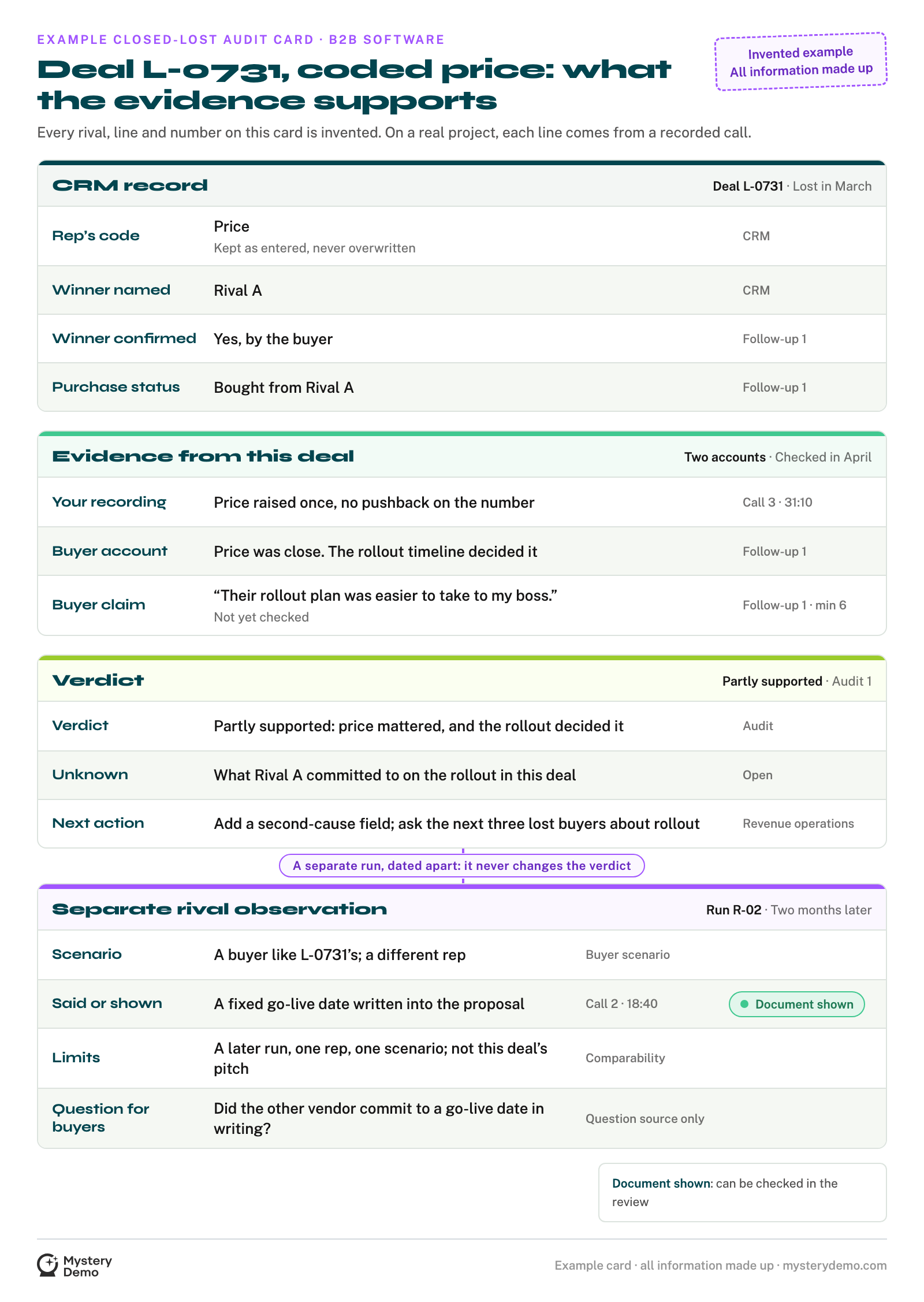
Take deal L-0731 from an illustrative sample, coded price. Your recording of the third call shows the buyer raised price once and never pushed back on the number.
In the follow-up, the buyer says the price was a close call. The deciding worry was how long the rollout would take, and the other vendor’s plan was easier to take to their boss.
The verdict is partly supported. Price mattered to the buyer, and it did not decide the deal.
That is the shape the study found at scale. Its interviews asked buyers why they chose a competitor, and the reasons that replaced price were comparisons. The firm writes that champions “chose the competitor not because it was better, but because it was easier to defend,” and quotes buyers saying “the other solution had a quicker implementation path.”
Your recording shows what you said about the rollout. The other vendor’s calls and emails about it are the part of the loss you never saw.
Step 4: Hear How the Rival Sells to a Buyer Like Yours
A closed-lost audit ends up needing your competitors. Your recordings hold your side of the deal, the buyer holds a memory of it, and the rival’s website and reviews hold what it chooses to publish. Its rep talks rollout time, risk and terms with a buyer like yours on its sales calls and in the emails after them, and none of that reaches your CRM.
.png)

You can’t hear those calls as yourself, because a rep who recognizes your company gives you the brochure tour. Mystery Demo hears them as a buyer. It books the rival’s demo through the same front door any prospect uses, as a believable company built from the profile of the deals you lost, and asks the questions your audit left open.
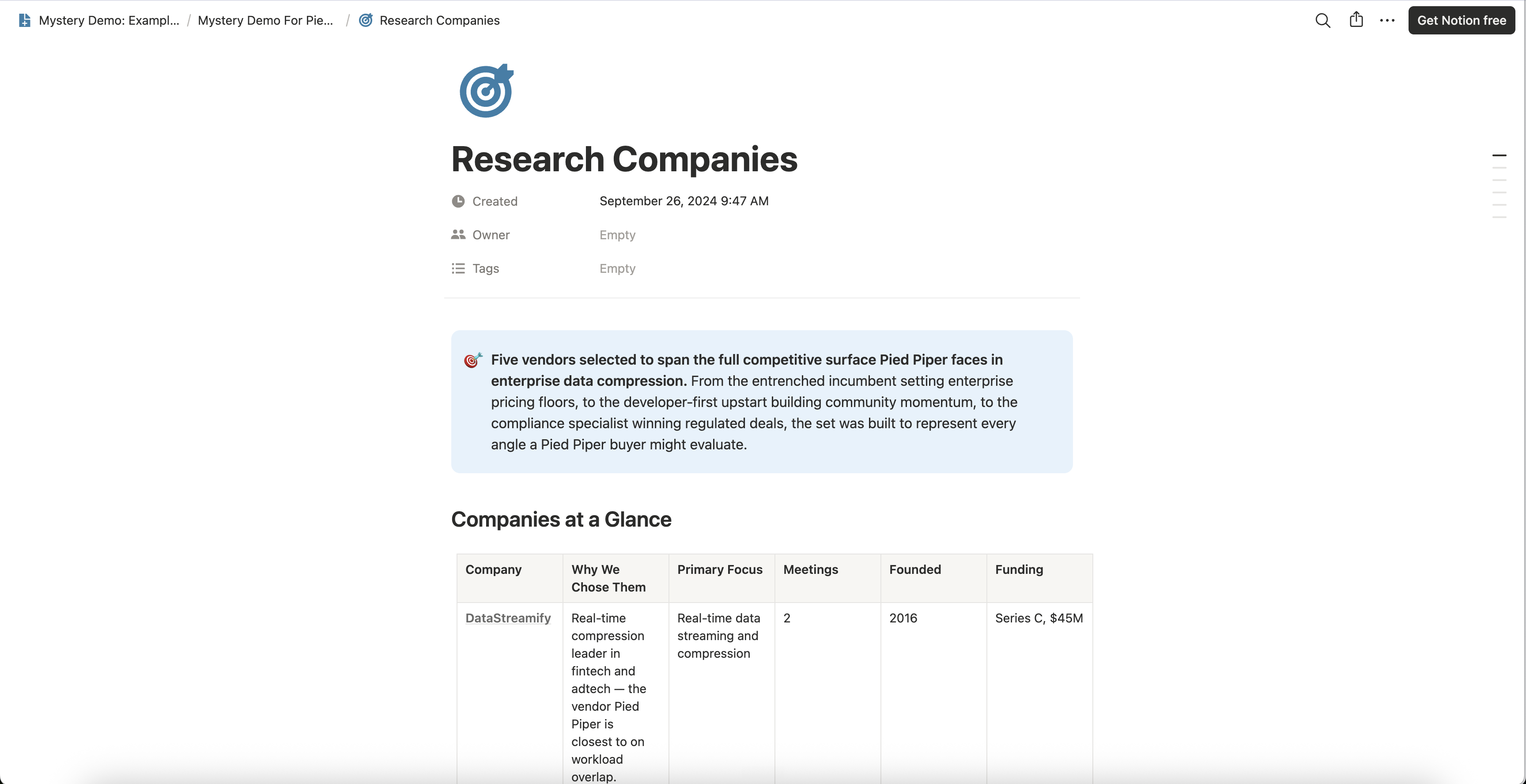
The rivals come from your audit: the ones your confirmed losses name most often. Below is the Research Companies page of our public example board, where the client and every competitor are invented. On a real project, this is where each rival is listed with the reason it was chosen and the meetings it got.
The people asking are operators who have sold B2B software, so they know which question about the rollout tends to pull a rep off the script. Every call comes back recorded, with the emails and documents that followed it. Each rival gets its own page on the board, like this one from the same invented example.
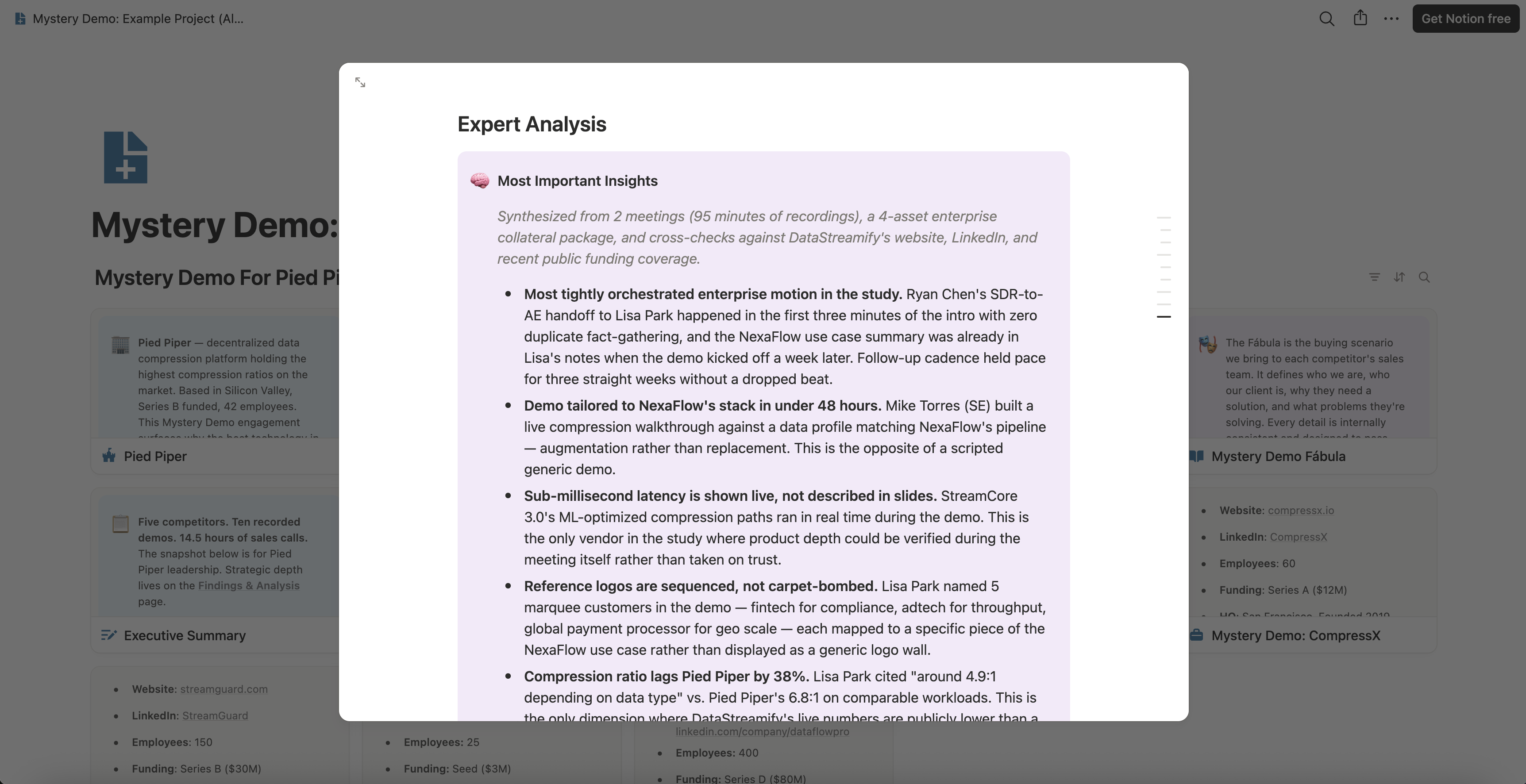
Read across several rivals, those pages become a SaaS competitor product comparison: what each one showed working on the call, what it only described, and what it promised for later.
A run like this is not the pitch that L-0731’s buyer heard. It happens later, with a different buyer, so it never changes that deal’s verdict.
It gives you a sharper question instead. If Rival A’s rep put a fixed go-live date in writing on the second call, ask your next three lost buyers whether the other vendor offered anything like it.
A win-loss template with a field for the rival’s pitch keeps the deal and the rival run apart, and the audit card for L-0731 does the same for one closed-lost code. The deal’s evidence and verdict sit on top. The rival observation sits in its own box below, with its own date and a label that says it is a source of questions.
One competitor costs a flat €499, everything included. If one rival sits behind most of your partly supported verdicts, let’s talk about that rival, and we will go and hear how it sells to a buyer like yours.
Step 5: Fix the Field So the Next Loss Tells the Truth
What you do with each deal depends on its verdict:
Then change the dropdown itself. Add “no decision” and “unknown” as values, plus two fields: whether the winner was confirmed, and what the buyer bought.
Stop there. A RevOps host who once sold at a large CRM vendor recalls keeping three or four fields current on most deals. The same host tells of a mandate, at another company, to fill 35 fields after every call, which ended with the sales team in revolt and senior people fired.
Reopen a lost deal only when current evidence says the decision is still open. Corporate Visions’ 10 percent is a reason to ask your lost buyers where things stand, not a count of deals to chase. A buyer who went quiet may have shelved the decision because getting started felt like too much work, and that is worth asking about directly.
Run the First Twenty Losses This Week
The first audit fits in a week:
Some codes will hold, some will not, and a few will stay unknown. That is the truth about your losses, and it is more useful than the field you started with.
When the second causes keep pointing at the same rival, one question is left that your recordings and interviews cannot answer: how that rival sells to a buyer like yours. You can run every step above yourself, except hearing that pitch as a buyer, because its reps know who you are. Tell us which rival your confirmed losses keep pointing to, and Mystery Demo will hear its side as the buyer and bring back the recording your next interview needs.
.png)


